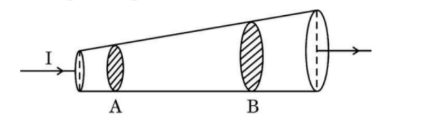
Current I (= 1 A) is passing through a copper rod (n = ) of varying cross-sections as shown in the figure. The areas of cross-section at points A and B along its length are and respectively. Calculate: (I) the ratio of electric fields at points A and B.
(II) the drift velocity of free electrons at point B.
Official Solution
Correct Option: (1)
Let the current pass through the copper rod. The electric field and drift velocity are related to the current by: where: - is the number of free electrons per unit volume, - is the cross-sectional area, - is the charge of an electron, - is the drift velocity. Also, the electric field is related to the drift velocity by: where is the resistivity of the material and is the current density. Now, the drift velocity and electric field are inversely proportional to the area of cross-section, meaning the electric field at point A and point B can be compared as: Substituting the areas: Thus, the ratio of electric fields at points A and B is: Now, to calculate the drift velocity at point B, we can use the equation: Substituting the given values: Thus, the drift velocity at point B is:
02
PYQ 2025
easy
physicsID: cbse-cla
Obtain an expression for the electric field due to a dipole of dipole moment at a point on its equatorial plane and specify its direction. Hence, find the value of electric field:
at the centre of the dipole ( )
at a point , where is the length of the dipole.
Official Solution
Correct Option: (1)
Consider a dipole consisting of two equal and opposite charges and , separated by a distance . The dipole moment is defined as:
The electric field due to a dipole at any point is derived by considering the contribution from both charges. Electric Field on the Equatorial Plane:
On the equatorial plane of the dipole, the angle between the position vector and the dipole moment is , and the distance from the dipole is . 1. The expression for the electric field at a point on the equatorial plane at a distance from the center of the dipole is:
where is the dipole moment, is the distance from the center of the dipole, and is the permittivity of free space. 2. Direction of the Electric Field: The electric field on the equatorial plane is directed perpendicular to the axis of the dipole and lies in the plane containing the dipole charges. Specifically, it points away from the dipole axis. (I) Electric Field at the Centre of the Dipole ( ): At the center of the dipole, the electric field due to each charge is equal in magnitude but opposite in direction. Therefore, the net electric field at the center of the dipole is zero. Thus, the electric field at the center of the dipole is:
(II) Electric Field at a Point : When the distance is much greater than the separation of the charges , the dipole behaves as though it were a point charge. In this case, the electric field behaves as:
For large distances, the dipole field behaves like the field due to a point charge with the same total charge . However, for , the field expression becomes much weaker (as ) compared to that of a single charge. Hence, the electric field at a large distance from the dipole is:
Thus, at points where , the dipole field decreases rapidly with the cube of the distance.
03
PYQ 2025
hard
physicsID: cbse-cla
Two point charges and are placed at points and . Find the net electric field at point .
Official Solution
Correct Option: (1)
Net Electric Field at a Point Due to Two Point Charges
We are given two point charges and need to find the net electric field at a point due to the two charges.
The electric field due to a point charge is given by Coulomb's law:
where:
is the charge,
is the distance from the charge to the point of interest,
is the unit vector pointing from the charge to the point,
is the permittivity of free space .
Electric Field Due to at Point :
First, calculate the distance between and point . Since is at and point is at :
Next, find the unit vector :
Now, using Coulomb's law for :
Electric Field Due to at Point :
Similarly, calculate the distance between and point :
Find the unit vector :
Now, using Coulomb's law for :
Net Electric Field at Point :
The total electric field at point is the vector sum of and :
Thus, the net electric field at point is:
04
PYQ 2025
medium
physicsID: cbse-cla
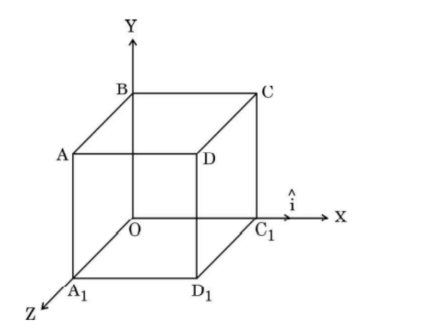
An electric field exists in a region in which a cube of side is kept as shown in the figure. Here and are in metres. Calculate the net flux through the cube.
Official Solution
Correct Option: (1)
We are given an electric field N/C, where is the position along the x-axis. The flux through the cube can be calculated using Gauss's law, which states that the net electric flux through a closed surface is equal to the charge enclosed divided by the permittivity of free space . Mathematically:
where is the vector area element on the surface of the cube. Step 1: Electric Field Expression
The electric field is given as . This means the electric field has a component along the x-axis, and it depends on the x-coordinate. Step 2: Flux Through Each Face
The cube has six faces, and the flux through each face depends on the electric field and the orientation of the face. The area vector for each face is perpendicular to the surface, and the flux through each face is calculated by the dot product . For a face of the cube, the electric flux is given by:
where is the area of the face of the cube. Since the electric field is only along the x-axis, the flux through the faces that are parallel to the yz-plane (i.e., the faces at and ) will contribute to the total flux. Step 3: Calculate the Flux Through the Faces at and
1. Face at : The electric field at is N/C. The area of the face at is , and the area vector is in the negative x-direction. Therefore, the flux through this face is: 2. Face at : The electric field at is N/C. The area vector is in the positive x-direction, so the flux through this face is: Step 4: Total Flux
The total flux through the cube is the sum of the flux through the two faces (at and ):
Thus, the net electric flux through the cube is .