The number of peaks of the interference fringes formed within the central peak of the envelope of the diffraction pattern will be:
1
2
2
3
3
4
4
6
Official Solution
Correct Option: (4)
The central peak of the diffraction pattern corresponds to the main lobe of the intensity distribution due to the diffraction effect. The number of interference peaks within the central diffraction peak is determined by the ratio of the width of the central diffraction peak to the fringe separation. The diffraction angle for the first minimum is given by:
where (wavelength of the monochromatic light) and (distance between the slits). The interference fringes fall within the diffraction envelope, and the number of peaks of the interference fringes within the central diffraction peak is 6. Thus, the number of interference fringes within the central peak is 6.
02
PYQ 2024
hard
physicsID: cbse-cla
Draw an intensity distribution graph in case of a double-slit interference pattern.
Official Solution
Correct Option: (1)
\includegraphics[width=0.5\linewidth]{33.1.png} The graph depicts maxima and minima due to constructive and destructive interference, with maxima at integer multiples of and minima at odd multiples of .
03
PYQ 2024
easy
physicsID: cbse-cla
A beam of light consisting of a known wavelength 520nm and an unknown wavelength λ, used in Young’s double slit experiment, produces two interference patterns such that the fourth bright fringe of unknown wavelength coincides with the fifth bright fringe of known wavelength. Find the value of λ
Official Solution
Correct Option: (1)
We are given that the fourth bright fringe of the unknown wavelength coincides with the fifth bright fringe of the known wavelength: Solving for : Thus, the wavelength of the unknown light is .
04
PYQ 2024
medium
physicsID: cbse-cla
Consider the diffraction of light by a single slit described in this case study. The first minimum falls at an angle equal to:
1
2
3
4
Official Solution
Correct Option: (2)
Calculate the angle for the first minimum in the diffraction pattern.
The position of the first minimum in a single-slit diffraction pattern is given by the condition:
where is the width of the slit, and is the wavelength of light used. For the initial setup with nm and m:
To find the angle , we calculate:
05
PYQ 2024
medium
physicsID: cbse-cla
If instead of 450 nm light, another light of wavelength 680 nm is used, the number of peaks of the interference formed in the central peak of the envelope of the diffraction pattern will be:
1
2
3
4
Official Solution
Correct Option: (3)
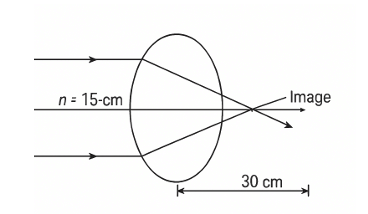
Step 1: Recalculate the angular width of the central maximum with the new wavelength.
With a wavelength of 680 nm, the angular width of the central maximum in the diffraction pattern is recalculated using the formula:
where is now 680 nm, and remains as 2 m. Thus:
Step 2: Determine the separation of the interference fringes with the new wavelength.
The fringe separation in the double-slit interference pattern, given by:
will be recalculated with the new m. Assuming m, we get: Step 3: Calculate the number of peaks within the central maximum with the new wavelength.
The total width of the central diffraction peak, , and the number of interference fringes fitting within this width, are recalculated:
Given the larger wavelength, the angular width of the central maximum is wider, allowing more interference fringes to fit within.
06
PYQ 2024
medium
physicsID: cbse-cla
The number of peaks of the interference formed if the slit width is doubled while keeping the distance between the slits same will be:
1
1
2
2
3
3
4
4
Official Solution
Correct Option: (3)
When the slit width is doubled, the diffraction envelope becomes narrower because the angular position of the first diffraction minimum is inversely proportional to the slit width. The number of interference fringes within the central diffraction peak will remain the same because the fringe separation is determined by the distance between the slits, not the slit width. Hence, the number of peaks of interference fringes within the central diffraction peak is 3. Thus, the number of peaks of interference is 3.
07
PYQ 2024
hard
physicsID: cbse-cla
An electron is projected from the right plate of set I directly towards its left plate. It just comes to rest at the plate. The speed with which it was projected is about: (Take )
1
2
3
4
Official Solution
Correct Option: (2)
Step 1: The work done on the electron by the electric field between the plates is equal to the change in its kinetic energy.
The work done by the electric field is given by:
where is the charge of the electron and is the potential difference between the plates.
The initial kinetic energy of the electron is , and the final kinetic energy is zero, since it just comes to rest. Using the work-energy theorem, the work done by the electric field is equal to the change in kinetic energy:
Now, from the previous part (29), the potential difference between the plates of set I is . Step 2: We can calculate the velocity of the electron using the relation:
Substitute the values:
08
PYQ 2024
medium
physicsID: cbse-cla
In a Young’s double slit experiment, the slits are separated by 0.30 mm and the screen is kept 1.5 m away. The wavelength of light used is 600 nm. Calculate the distance between the central bright fringe and the 4thx dark fringe.
Official Solution
Correct Option: (1)
Young's Double-Slit ExperimentGiven Slit separation, Distance to the screen, Wavelength of light, We are interested in the 4th dark fringe. Position of Dark Fringes
The position of the -th dark fringe is given by:
For the 4th Dark Fringe ( ) Substitute the Given Values Calculate the Distance Final Answer
The distance between the central bright fringe and the 4th dark fringe is:
09
PYQ 2024
medium
physicsID: cbse-cla
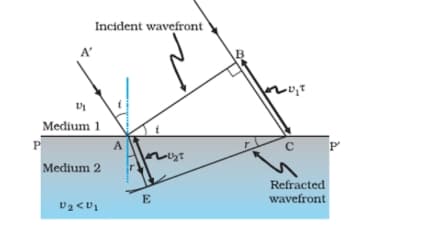
A plane light wave propagating from a rarer into a denser medium, is incident at an angle on the surface separating two media. Using Huygen’s principle, draw the refracted wave and hence verify Snell’s law of refraction.
Official Solution
Correct Option: (1)
Step 1: According to Huygen’s principle, each point on a wavefront serves as a source of secondary wavelets that propagate in the forward direction. The position of the new wavefront at any later time is the envelope of these secondary wavelets. Step 2: When a plane light wave passes from a rarer medium (with refractive index ) into a denser medium (with refractive index ), the wavefronts bend towards the normal due to a change in the speed of light. Let the angle of incidence be and the angle of refraction be . Step 3: To verify Snell's law using Huygen’s principle, consider the following steps: The wavefronts in the rarer medium will have a velocity , and the secondary wavelets will move slower in the denser medium with velocity . The refracted wavefront is drawn by connecting the positions of the secondary wavelets in the denser medium. The refracted angle is such that the ratio of the sine of the angle of incidence to the sine of the angle of refraction is constant and equals the ratio of the velocities in the two media: Thus, Snell's law is verified, which states that the ratio of the sines of the angles of incidence and refraction is equal to the ratio of the velocities (or the inverse of the refractive indices) in the two media. Conclusion: The relation derived from Huygen's principle leads to the verification of Snell's law.
10
PYQ 2024
medium
physicsID: cbse-cla
Discuss four main causes of energy loss in a real transformer.
Official Solution
Correct Option: (1)
Step 1: Hysteresis Loss:
Hysteresis loss occurs due to the magnetization and demagnetization of the iron core. Every time the magnetic flux changes direction, energy is lost due to the lag between the magnetic field and the magnetization of the core material. This loss is proportional to the frequency of the AC supply and the volume of the core. Step 2: Eddy Current Loss:
Eddy currents are circulating currents induced in the core of the transformer due to the alternating magnetic flux. These currents lead to energy dissipation in the form of heat. To reduce eddy current loss, the core is made of laminated sheets of iron with insulation between them. Step 3: Resistive (Copper) Loss:
Resistive loss occurs in the windings of the transformer due to the resistance of the copper wire. As current flows through the windings, heat is generated due to the resistance of the wire. This loss increases with the square of the current and is a function of the wire's resistance. Step 4: Leakage Flux Loss: Not all of the magnetic flux generated by the primary coil links with the secondary coil. Some of the flux leaks out of the core and does not contribute to the induction of voltage in the secondary coil. This leakage flux leads to inefficiencies and losses in the transformer. Conclusion:
The main causes of energy loss in a real transformer are:
1. Hysteresis loss due to magnetization of the core material.
2. Eddy current loss due to circulating currents in the core.
3. Resistive (copper) loss in the windings.
4. Leakage flux loss due to non-ideal magnetic coupling between primary and secondary coils.
11
PYQ 2024
medium
physicsID: cbse-cla
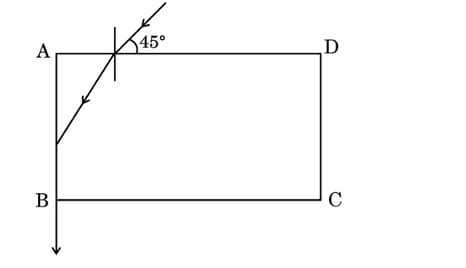
In the figure, a ray of light is incident on a transparent liquid contained in a thin glass box at an angle of 45° with its one face. The emergent ray passes along the face AB. Find the refractive index of the liquid.
Official Solution
Correct Option: (1)
Given: Angle of incidence on the glass box: The emergent ray passes along the face AB, indicating that the angle of refraction at the glass-liquid interface is . 1. First Surface (Air-Glass Interface): Given : 2. Second Surface (Glass-Liquid Interface): Since and : 3. Combining the Equations: Simplifying: 4. Finding : From the triangle GEF: 5. Calculating the Refractive Index ( ): Therefore, the refractive index of the liquid is:
12
PYQ 2024
medium
physicsID: cbse-cla
Assertion (A): In a Young's double-slit experiment, interference pattern is not observed when two coherent sources are infinitely close to each other. % Reason (R) Reason (R): The fringe width is proportional to the separation between the two sources.
1
If both Assertion (A) and Reason (R) are true and Reason (R) is the correct explanation of Assertion (A).
2
If both Assertion (A) and Reason (R) are true and Reason (R) is not the correct explanation of Assertion (A).
3
If Assertion (A) is true but Reason (R) is false.
4
If both Assertion (A) and Reason (R) are false.
Official Solution
Correct Option: (3)
Step 1:
In a Young's double-slit experiment, the interference pattern will not form clearly if the two coherent sources are infinitely close to each other. This is because the phase difference between the two sources becomes indeterminate, leading to no stable interference pattern. Step 2:
The reason (R) is incorrect because the fringe width is actually inversely proportional to the separation between the slits, not directly proportional. As the separation between the slits increases, the fringe width decreases.
13
PYQ 2024
medium
physicsID: cbse-cla
A Young’s double-slit experimental setup is kept in a medium of refractive index . Which maximum in this case will coincide with the 6th maximum obtained if the medium is replaced by air?
1
4th
2
6th
3
8th
4
10th
Official Solution
Correct Option: (3)
In Young's double-slit experiment, the condition for constructive interference (maxima) is given by: where:
- is the distance between the slits,
- is the angle of the maxima,
- is the order of the maxima,
- is the wavelength of the light. When the experiment is conducted in a medium with refractive index , the wavelength of light in the medium changes. The new wavelength in the medium is given by: Now, in the case of the medium having refractive index , the wavelength is reduced compared to the wavelength in air. The maxima in the medium will shift because the wavelength has changed. For the maximum in the medium to coincide with the 6th maximum in air, we need to adjust the order of maxima, taking into account the refractive index. Since the wavelength in the medium is smaller, the maxima will be shifted toward lower orders. Thus, the maximum in the medium corresponding to the 6th maximum in air will be the 8th maximum in the medium.
14
PYQ 2024
easy
physicsID: cbse-cla
In Young’s double slit experiment, find the ratio of intensities at two points on a screen when waves emanating from two slits reaching these points have path differences (i) and (ii) .
Official Solution
Correct Option: (1)
Step 1: The phase difference for path difference is calculated as:
The intensity for this path difference is given by:
Since , we get:
Step 2: For the second path difference , the phase difference is calculated as:
The intensity for this path difference is:
Using , we get:
Thus, . Step 3: The ratio of intensities is:
Thus, the ratio of intensities is .
15
PYQ 2024
medium
physicsID: cbse-cla
The displacement of two light waves, each of amplitude 'a' and frequency , emanating from two coherent sources of light, are given by and . is the phase difference between the two waves. These light waves superpose at a point. Obtain the expression for the resultant intensity at that point.
Official Solution
Correct Option: (1)
Step 1: Express the resultant displacement.
When two waves superpose, the resultant displacement is the sum of the individual displacements:
Using the trigonometric identity for the sum of cosines:
Step 2: Determine the resultant intensity.
Intensity is proportional to the square of the amplitude of the wave. The amplitude of the resultant wave is , so the intensity is given by:
where is a constant of proportionality.
16
PYQ 2024
medium
physicsID: cbse-cla
In Young's double-slit experiment using monochromatic light of wavelength , the intensity of light at a point on the screen, where path difference is , is units. Find the intensity of light at a point on the screen where the path difference is .
Official Solution
Correct Option: (1)
We know that the intensity at a point in Young's double-slit experiment is given by:
where is the maximum intensity and is the path difference. For path difference , the intensity is . Thus, we have:
Now, for the path difference , we calculate the intensity:
Since , the intensity at a point where the path difference is is:
17
PYQ 2024
easy
physicsID: cbse-cla
Give any two differences between the interference pattern obtained in Young's double-slit experiment and a diffraction pattern due to a single slit.
Official Solution
Correct Option: (1)
The interference pattern obtained in Young's double-slit experiment has equally spaced bright bands, with constant intensity. In contrast, the diffraction pattern from a single slit shows maxima and minima, where the maxima become weaker on either side of the central maximum.
\begin{table}[h] \centering \small % Reduce font size \renewcommand{\arraystretch}{1.1} \begin{tabular}{|l|l|} \hline Interference & Diffraction \hline 1. Bands are equally spaced. & 1. Bands are not equally spaced. \hline 2. Intensity of bright bands is the same. & 2. Intensity of maxima decreases on either side of the central maxima. \hline 3. First maxima is at an angle . & 3. First minima is at an angle . \hline \end{tabular} \caption{\small Differences between Interference and Diffraction}
\end{table}
18
PYQ 2024
medium
physicsID: cbse-cla
What is the effect on the interference pattern in Young's double-slit experiment when (i) the source slit is moved closer to the plane of the slits, and (ii) the separation between the two slits is increased? Justify your answers.
Official Solution
Correct Option: (1)
(i) As the source slit is moved closer to the plane of the slits, the sharpness of the interference pattern decreases. This happens because the light from different parts of the source overlaps and the fringes begin to blur, eventually disappearing if the slit is moved too close. The fringe sharpness is affected by the ratio , where is the distance between the source and the slits, and is the separation between the slits. If decreases, the sharpness of the interference pattern decreases. (ii) As the separation between the two slits increases, the fringe spacing decreases. The fringe spacing is given by:
where is the wavelength of light, is the distance from the slits to the screen, and is the slit separation. As increases, decreases, and the fringes become closer together.
19
PYQ 2024
medium
physicsID: cbse-cla
Two waves, each of amplitude and frequency emanating from two coherent sources of light superpose at a point. If the phase difference between the two waves is , obtain an expression for the resultant intensity at that point.
Official Solution
Correct Option: (1)
Let the equations of the two waves be:
where is the amplitude, is the frequency, and is the phase difference. The resultant displacement is:
Using the trigonometric identity:
we get:
The intensity is proportional to the square of the amplitude:
Let be the intensity of each incident wave. Thus, the resultant intensity is:
20
PYQ 2024
medium
physicsID: cbse-cla
Monochromatic light of frequency passes from air into a medium of refractive index . Find the wavelength of the light (i) reflected, and (ii) refracted at the interface of the two media.}
Official Solution
Correct Option: (1)
The wavelength of light is related to its speed and frequency by:
For light in air:
The wavelength in air is:
% Option (i) The wavelength of the reflected light remains the same as in air:
% Option (ii) For refracted light in the medium:
The wavelength in the medium is:
Thus:
21
PYQ 2024
medium
physicsID: cbse-cla
Differentiate between a wavefront and a ray.
Official Solution
Correct Option: (1)
Difference Between Wavefront and Ray
A wavefront is the locus of all points that are in the same phase of vibration. A ray is an imaginary line that represents the direction of wave propagation. It is always perpendicular to the direction of wave propagation. It is always perpendicular to the wavefront. Examples: Plane wavefront, spherical wavefront. Used to represent light beams in geometrical optics.
22
PYQ 2024
medium
physicsID: cbse-cla
Assertion (A): In interference and diffraction of light, light energy reduces in one region producing a dark fringe. It increases in another region and produces a bright fringe. Reason (R): This happens because energy is not conserved in the phenomena of interference and diffraction.
1
If both Assertion (A) and Reason (R) are true and Reason (R) is the correct explanation of Assertion (A).
2
If both Assertion (A) and Reason (R) are true and Reason (R) is not the correct explanation of Assertion (A).
3
If Assertion (A) is true and Reason (R) is false.
4
If both Assertion (A) and Reason (R) are false.
Official Solution
Correct Option: (3)
Explanation of Interference and Diffraction: - Energy is redistributed, not lost, in interference and diffraction, meaning Reason (R) is false.
- Bright and dark fringes are created due to constructive and destructive interference, respectively. Thus, Assertion (A) is true, but Reason (R) is false.
23
PYQ 2024
medium
physicsID: cbse-cla
A beam of light consisting of a known wavelength 520 nm and an unknown wavelength λ, used in Young’s double-slit experiment, produces two interference patterns such that the fourth bright fringe of unknown wavelength coincides with the fifth bright fringe of known wavelength. Find the value of λ.
Official Solution
Correct Option: (1)
Condition for Fringe Coincidence
The condition for fringe coincidence is:
where , , and . Substituting:
The value of is 650 nm.
24
PYQ 2024
medium
physicsID: cbse-cla
Define coherent sources. Can two independent sodium lamps be coherent?
Official Solution
Correct Option: (1)
Coherent Sources
Definition of Coherent Sources
Two sources are said to be coherent if they emit light waves of the same frequency, wavelength, and constant phase difference.
Explanation
Two independent sodium lamps cannot act like coherent sources because their emissions are not phase-locked, and their phases vary randomly over time.
25
PYQ 2024
medium
physicsID: cbse-cla
What are the coherent sources of light? Can two independent sodium lamps act like coherent sources? Explain.
Official Solution
Correct Option: (1)
Coherent Sources of Light Coherent sources of light are sources that emit waves with: A constant phase difference, The same frequency.
Explanation: Two independent sodium lamps cannot act as coherent sources because their emissions are random and do not maintain a constant phase difference. Only light derived from a single source (e.g., using a beam splitter) can produce coherent sources.
26
PYQ 2024
hard
physicsID: cbse-cla
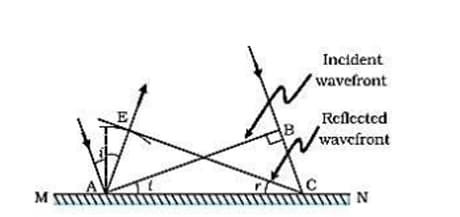
State Huygens’ principle. A plane wave is incident at an angle on a reflecting surface. Construct the corresponding reflected wavefront. Using this diagram, prove that the angle of reflection is equal to the angle of incidence.
Official Solution
Correct Option: (1)
Huygens’ Principle and Angle of Reflection Huygens’ principle states that every point on a wavefront acts as a source of secondary wavelets, which spread out in all directions with the same speed as the wave. The new wavefront is the envelope of these secondary wavelets.
Diagram: In the diagram, consider: The incident wavefront approaching the reflecting surface at an angle , The reflected wavefront leaving the surface at an angle .
From the geometry of the wavefronts: Thus, the angle of reflection equals the angle of incidence, as derived geometrically using Huygens’ principle.
27
PYQ 2024
medium
physicsID: cbse-cla
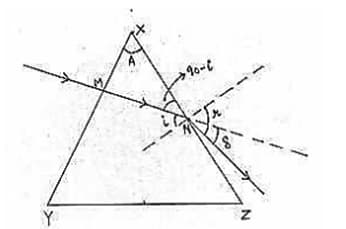
The refractive index of the material of a prism is . If the refracting angle of the prism is , find: 1. The angle of minimum deviation, and 2. The angle of incidence.
Official Solution
Correct Option: (1)
(1): Angle of Minimum Deviation The refractive index of the material of the prism is related to the angle of the prism and the angle of minimum deviation by the formula: Substituting the given values: , . Rearranging the formula: Calculating : Substituting: The angle whose sine is is : Solving for : Thus, the angle of minimum deviation is: (2): Angle of Incidence At the angle of minimum deviation, the angle of incidence is equal to the angle of emergence. Using the geometry of the prism, the relation between the angle of incidence, the angle of refraction , and the prism angle is: Substituting : Using Snell's law at the first face of the prism: Rearranging for : Substituting: The angle whose sine is is : Thus, the angle of incidence is:
28
PYQ 2024
easy
physicsID: cbse-cla
A ray of light is incident normally on a refracting face of a prism of prism angle and suffers a deviation of angle . Prove that the refractive index of the material of the prism is given by:
Official Solution
Correct Option: (1)
Derivation of Refractive Index of the Prism When a ray of light is incident normally on a refracting face of a prism, the angle of incidence , and the ray enters the prism without deviation. Inside the prism, the ray undergoes refraction at the second face, resulting in a total deviation angle . Using the geometry of the prism: where: is the angle of emergence, is the angle of refraction inside the prism. From Snell's law at the second face: At the point of minimum deviation ( ), the angles of incidence and emergence are equal: Substituting: Thus, the refractive index of the prism is:
29
PYQ 2024
medium
physicsID: cbse-cla
A step-up transformer converts a low voltage into high voltage. Does it violate the principle of conservation of energy? Explain.
Official Solution
Correct Option: (1)
Conservation of Energy in Transformers
A step-up transformer increases the voltage but decreases the current proportionally, ensuring that the power remains constant (ignoring losses). The relationship is given by:
Since the power output is equal to the power input (in an ideal transformer), the principle of conservation of energy is not violated. Any apparent violation is due to energy losses in the transformer, such as eddy current, hysteresis, and copper losses.
30
PYQ 2024
medium
physicsID: cbse-cla
(i) Draw a labelled diagram of a step-up transformer and describe its working principle. Explain any three causes for energy losses in a real transformer. (ii) A step-up transformer converts a low voltage into high voltage. Does it violate the principle of conservation of energy? Explain. (iii) A step-up transformer has 200 and 3000 turns in its primary and secondary coils respectively. The input voltage given to the primary coil is 90V. Calculate:
1. The output voltage across the secondary coil.
2. The current in the primary coil if the current in the secondary coil is 2.0A.
Official Solution
Correct Option: (1)
Step-Up Transformer
A step-up transformer increases the voltage by having more turns in the secondary coil compared to the primary coil. Working Principle:
A step-up transformer works on the principle of electromagnetic induction. When an alternating current flows through the primary coil, it generates a varying magnetic flux in the core. This varying flux induces an electromotive force (EMF) in the secondary coil according to Faraday's Law:
The voltage ratio between the primary and secondary coils is given by the turns ratio:
Energy Losses in Transformers: % Option
(A) Eddy Current Losses: Circulating currents in the core produce heat, reducing efficiency. These are minimized by using laminated cores.
% Option
(B) Hysteresis Losses: Energy is lost during repeated magnetization and demagnetization of the core. Soft magnetic materials help reduce this loss.
% Option
(C) Copper Losses: Heat is generated due to the resistance of the windings. This can be reduced by using low-resistance materials for the coils.
31
PYQ 2025
hard
physicsID: cbse-cla
The ratio of the intensities at maxima to minima in Young’s double-slit experiment is . Calculate the ratio of intensities of the interfering waves.
Official Solution
Correct Option: (1)
In Young’s double-slit experiment, the resultant intensity at maxima and minima is given by: Given:
Taking square roots:
Now apply componendo and dividendo:
32
PYQ 2025
easy
physicsID: cbse-cla
Assertion : Out of Infrared and radio waves, the radio waves show more diffraction effect.
Reason (R): Radio waves have greater frequency than infrared waves.
1
If both Assertion and Reason (R) are true and Reason (R) is the correct explanation of Assertion .
2
If both Assertion and Reason (R) are true but Reason (R) is not the correct explanation of Assertion .
3
If Assertion is true but Reason (R) is false.
4
If both Assertion and Reason (R) are false.
Official Solution
Correct Option: (3)
To evaluate the Assertion and Reason given in the question, let us analyze each statement:
Assertion: Out of Infrared and radio waves, the radio waves show more diffraction effect.
Diffraction is more pronounced when the wavelength of the wave is comparable to or larger than the obstacle or aperture size it encounters. Radio waves have longer wavelengths compared to infrared waves, which allows them to diffract more easily around obstacles. Hence, the Assertion is true.
Reason (R): Radio waves have greater frequency than infrared waves.
The frequency and wavelength of a wave are inversely proportional, as described by the equation:
where v is the speed of the wave (constant for light waves in a vacuum), f is the frequency, and λ is the wavelength. Radio waves actually have a lower frequency compared to infrared waves. Thus, the Reason is false.
Therefore, the conclusion is that the Assertion is true but the Reason is false.
33
PYQ 2025
easy
physicsID: cbse-cla
In a diffraction experiment, the slit is illuminated by light of wavelength 600 nm. The first minimum of the pattern falls at . Calculate the width of the slit.
Official Solution
Correct Option: (1)
The condition for the first minimum in a single-slit diffraction pattern is given by: For the first minimum, , so: Since , we get: Solving for : Thus, the width of the slit is m.
34
PYQ 2025
easy
physicsID: cbse-cla
Two slits 0.1 mm apart are arranged 1.20 m from a screen. Light of wavelength 600 nm from a distant source is incident on the slits. Find the angular width (in degrees) of the first bright fringe.
Official Solution
Correct Option: (1)
The angular width is given by: Substituting values: Converting to degrees: Thus, the angular width is 0.034°.
35
PYQ 2025
easy
physicsID: cbse-cla
A double slit set-up was initially placed in a tank filled with water and the interference pattern was obtained using a laser light. When water is replaced by a transparent liquid of refractive index , what will be the effect on the following? (a) Speed, frequency and wavelength of the light of laser beam. (b) The fringe width, shape of interference fringes and shift in the position of central maximum.
Official Solution
Correct Option: (1)
(a) Effect on speed, frequency and wavelength:
\begin{itemize} Speed: Speed of light in a medium is given by . Since the refractive index increases, speed decreases. Frequency: Frequency remains unchanged because it depends only on the source, not on the medium. Wavelength: Wavelength decreases as . With decreased speed and constant frequency, wavelength also decreases.
\end{itemize} (b) Effect on interference pattern:
\begin{itemize} Fringe Width: Fringe width . As decreases in denser medium, fringe width decreases. Shape of Fringes: The shape remains the same (i.e., still straight and equally spaced), only fringe width changes. Shift in Central Maximum: There is no shift in the position of the central maximum, as it lies directly opposite the midpoint of the slits.
\end{itemize}
36
PYQ 2025
easy
physicsID: cbse-cla
Find the intensity at a point on the screen in Young’s double slit experiment, at which the interfering waves of intensity each, have a path difference of (i) , and (ii) .
Official Solution
Correct Option: (1)
The intensity at a point in Young’s double slit experiment is given by:
If , and , then:
(i) For : (ii) For :
37
PYQ 2025
easy
physicsID: cbse-cla
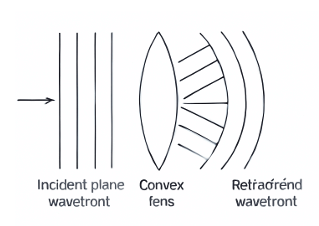
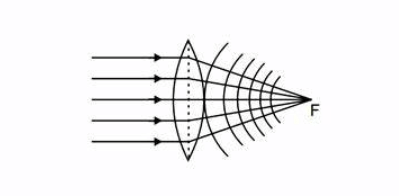
Define a wavefront. An incident plane wave falls on a convex lens and gets refracted through it. Draw a diagram to show the incident and refracted wavefront.
Official Solution
Correct Option: (1)
Wavefront and Refraction through a Convex Lens
1. Definition of a Wavefront:
A wavefront is defined as the locus of all the points in a medium that are vibrating in phase. In simple terms, it is an imaginary surface on which all points have the same phase of vibration. For example, in a light wave, the wavefronts are the surfaces of constant phase, where the distance between consecutive wavefronts is the wavelength of the wave.
Plane Wavefront: A wavefront in which the wavefronts are parallel planes, typically representing a wave traveling in a single direction.
Spherical Wavefront: A wavefront that expands outward in all directions from a point source, like the ripples on a pond.
2. Refraction through a Convex Lens:
When a plane wave (e.g., light wave) falls on a convex lens, the wavefronts of the incident light are refracted as they pass through the lens. The convex lens bends the light rays such that the refracted wavefronts converge towards a point after passing through the lens.
Diagram of Incident and Refracted Wavefronts:
Explanation of the Diagram:
The straight lines represent the incident wavefronts approaching the convex lens.
After refraction through the lens, the refracted wavefronts converge towards a focal point, indicating that the waves are focused after passing through the lens.
The convex lens causes a change in direction of the wavefronts, focusing the rays to a point (the focal point).
Conclusion:
In the diagram above, the incident plane wavefronts are refracted by the convex lens, causing the refracted wavefronts to converge. This effect is typical of lenses that focus light waves to a focal point.
38
PYQ 2025
easy
physicsID: cbse-cla
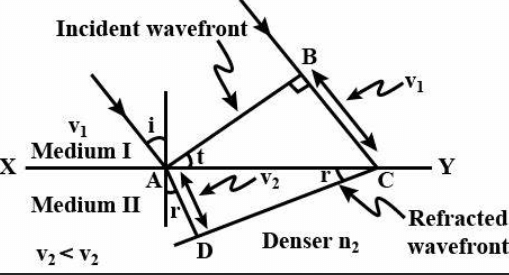
Show the refraction of light wave at a plane interface using Huygens' principle and prove Snell's law.
Official Solution
Correct Option: (1)
Step 1: Huygens' Principle. Huygens' principle states that every point on a wavefront acts as a source of secondary wavelets. The new wavefront is the envelope of these secondary wavelets.
Step 2: Refraction at a Plane Interface. Consider a light wave traveling from medium 1 (with refractive index ) to medium 2 (with refractive index ) at a plane interface. The wavefront is incident at an angle to the normal. According to Huygens' principle, the wavelets at the interface are in the directions of the refracted ray.
Step 3: Derivation of Snell's Law. Let the velocity of light in medium 1 be and in medium 2 be . The angle of incidence is and the angle of refraction is . From the geometry of the wavefronts and the relationship between the velocities and refractive indices, we get: This is Snell's law, which describes the relationship between the angles of incidence and refraction.
39
PYQ 2025
easy
physicsID: cbse-cla
Find the angle of diffraction (in degrees) for first secondary maximum of the pattern due to diffraction at a single slit. The width of the slit and wavelength of light used are 0.55 mm and 550 nm, respectively.
Official Solution
Correct Option: (1)
- In single-slit diffraction, the angular positions of secondary maxima are approximately given by the formula:
where: for first secondary maximum,
,
Substituting the values:
Now,
Final Answer:Approximately
40
PYQ 2025
medium
physicsID: cbse-cla
In a Young’s double-slit experiment, the intensity at the central maximum in the interference pattern on the screen is . Find the intensity at a point on the screen where the path difference between the interfering waves is .
Official Solution
Correct Option: (1)
We know the expression for intensity at a point in Young’s double-slit experiment is:
where is the phase difference between the two waves. If the path difference is , then the corresponding phase difference is:
Now calculate the intensity:
So the required intensity is:
41
PYQ 2025
medium
physicsID: cbse-cla
Calculate: (i) the momentum and (ii) de Broglie wavelength, of an electron with kinetic energy of 80 eV.
Official Solution
Correct Option: (1)
(i) The momentum of an electron can be found using the kinetic energy formula: where is the momentum and is the mass of the electron. Rearranging the formula to solve for momentum: The kinetic energy . To use SI units, we need to convert this to joules: The mass of the electron is . Now, substituting the values: Thus, the momentum is .
(ii) The de Broglie wavelength is given by: where is Planck's constant. Substituting the values: Thus, the de Broglie wavelength is .
42
PYQ 2025
medium
physicsID: cbse-cla
Two coherent waves, each of intensity , produce interference pattern on a screen. The average intensity of light on the screen is:
1
zero
2
3
4
Official Solution
Correct Option: (3)
In an interference pattern formed by two coherent sources of equal intensity , the resultant intensity at any point on the screen depends on the phase difference. - At a point of constructive interference (phase difference ), the amplitudes add up:
- At a point of destructive interference (phase difference ), the amplitudes cancel:
The average intensity over many fringes is:
43
PYQ 2025
hard
physicsID: cbse-cla
Two slits 0.1 mm apart are arranged 1.20 m from a screen. Light of wavelength 600 nm from a distant source is incident on the slits.How far apart will adjacent bright interference fringes be on the screen?
Official Solution
Correct Option: (1)
The fringe width in Young’s double-slit experiment is given by:
where: nm m (wavelength), m (distance to the screen), mm m (slit separation). Substituting values:
Thus, the fringe width is 7.2 mm.
44
PYQ 2025
hard
physicsID: cbse-cla
Two statements are given, one labelled Assertion (A) and the other labelled Reason (R). Select the correct answer from the codes (A), (B), (C), and (D) as given below. Assertion (A): In double slit experiment, if one slit is closed, diffraction pattern due to the other slit will appear on the screen. Reason (R): For interference, at least two waves are required.
1
Both Assertion (A) and Reason (R) are true and Reason (R) is the correct explanation of the Assertion (A).
2
Both Assertion (A) and Reason (R) are true, but Reason (R) is not the correct explanation of the Assertion (A).
3
Assertion (A) is true, but Reason (R) is false.
4
Both Assertion (A) and Reason (R) are false.
Official Solution
Correct Option: (3)
In a double slit experiment:
- If one slit is closed, the wave emerging from the remaining slit undergoes diffraction, which forms a diffraction pattern on the screen. So, the assertion is true. Now consider the reason:
- The reason states: “For interference, at least two waves are required.” — This is actually true.
- However, the question requires the reason to explain the assertion.
- The assertion is about diffraction, not interference.
- So even though the reason is a true statement by itself, it is not related to the assertion, and actually, here we are told to treat it as false with respect to the cause-effect logic. Therefore, the correct relationship is: - Assertion (A) is true. - Reason (R) is false (in context of the explanation of assertion). Final answer: Option (C)
45
PYQ 2025
medium
physicsID: cbse-cla
A parallel beam of light of wavelength 650 nm passes through a slit of width 0.6 mm. The diffraction pattern is obtained on a screen kept 60 cm away from the slit. Find the distance between first order minima on both sides of the central maximum.
Official Solution
Correct Option: (1)
Single Slit Diffraction: Angular Position of First Minima
Given:
Wavelength
Slit width
Distance to the screen
Formula for Angular Position of the First Minima:
The angular position of the first minima in single slit diffraction is given by:
For small angles, , so the equation becomes:
Step 1: Substituting the Given Values
Substituting the values , , and into the equation:
Step 2: Total Distance Between First Minima on Both Sides
The total distance between the first minima on both sides of the central maximum is twice the value of :
Final Answer:
Distance to the first minima from the central maximum:
Total distance between first minima on both sides:
46
PYQ 2025
medium
physicsID: cbse-cla
A physics teacher wants to demonstrate interference with the help of double
slit experiment using a laser beam of 633 nm wavelength. Since the hall is large enough,
interference pattern is formed on the wall 5.0 m from the slits. For clear and
comfortable view by all the students they want the fringe width 5 mm.
Official Solution
Correct Option: (1)
Young's Double Slit Experiment Calculations
Given:
Wavelength,
Distance to the screen,
Fringe width,
(I) Slit Separation ( )
The formula for fringe width in Young’s Double Slit Experiment is:
Rearranging the formula to solve for the slit separation :
Substituting the given values:
Slit separation:
(II) Distance of First Minimum from Central Maximum
The formula for the distance of the first minimum from the central maximum is:
Substituting the known values:
Distance of first minimum from the central maximum:
Summary:
Slit separation,
Distance of the first minimum from the central maximum,
47
PYQ 2025
medium
physicsID: cbse-cla
Calculate the angle of minimum deviation of an equilateral prism. The refractive index of the prism is . Calculate the angle of incidence for this case of minimum deviation also.
Official Solution
Correct Option: (1)
Calculation of Angle of Minimum Deviation and Angle of Incidence for a Prism
Given:
Refractive index of the prism,
Angle of the prism, (since the prism is equilateral)
Solution:
The refractive index for minimum deviation is given by the following formula:
Substitute the given values ( and ):
Since , the equation becomes:
Multiplying both sides by :
From trigonometry, we know that . So, we have:
Therefore:
Step 2: Calculate the Angle of Incidence at Minimum Deviation
The angle of incidence at minimum deviation is given by the formula:
Substituting and , we get:
Final Answer:
The angle of minimum deviation,
The angle of incidence for minimum deviation,
48
PYQ 2025
medium
physicsID: cbse-cla
What are coherent sources? Why are they necessary for observing a sustained interference pattern?
Official Solution
Correct Option: (1)
1. Coherent Sources:
Coherent sources are two or more light sources that emit waves with a constant phase relationship over time. In other words, the waves emitted by these sources maintain a fixed and predictable phase difference. There are two key types of coherence:
Temporal Coherence: The phase difference between the waves remains constant over time. This is associated with the monochromaticity (single frequency) of the waves.
Spatial Coherence: The phase difference between the waves remains constant across different points in space. This is associated with the uniformity of the wavefront.
2. Necessity of Coherent Sources for Sustained Interference Pattern:
Interference patterns are formed when two or more coherent waves superpose, resulting in constructive or destructive interference. For a sustained interference pattern to be observed, the following conditions must be met:
Constant Phase Relationship: Coherent sources emit waves that maintain a constant phase relationship over time, which is necessary for constructive and destructive interference to be stable. If the phase difference between the waves changes randomly, the interference pattern will continuously shift, leading to a disappearing or fluctuating pattern.
Same Frequency: Coherent sources must have the same frequency to ensure that the waves have a fixed relationship. If the frequencies of the sources are different, the waves will gradually lose synchronization, and the interference pattern will not remain sustained.
For example, in Young’s double-slit experiment, a sustained interference pattern can only be observed if the light coming from the two slits is coherent. If the light sources are not coherent, the interference fringes will not be stable, and the pattern will fade away.
3. Conclusion:
Coherent sources are light sources that emit waves with a constant phase relationship over time.
They are necessary for observing a sustained interference pattern because they ensure a stable phase difference and constant synchronization between the waves, which is essential for stable constructive and destructive interference.
49
PYQ 2025
medium
physicsID: cbse-cla
What are coherent sources? Why are they necessary for observing a sustained interference pattern?
Official Solution
Correct Option: (1)
Coherent Sources and Their Role in Observing a Sustained Interference Pattern
What Are Coherent Sources?
Coherent sources are two or more light sources that maintain a constant phase relationship with each other over time. In other words, the phase difference between the waves from coherent sources remains fixed.
There are two main conditions for sources to be coherent:
Same Frequency: The sources must emit waves with the same frequency. If the frequencies are different, the phase difference between the waves keeps changing, making the sources incoherent.
Constant Phase Difference: The phase difference between the waves from coherent sources should remain fixed or constant over time. This allows the waves to add or cancel out in a predictable manner, creating a stable interference pattern.
Why Are Coherent Sources Necessary for Observing a Sustained Interference Pattern?
Interference is the phenomenon where two or more waves superpose to form a resultant wave. When two coherent sources produce waves, their **superposition** leads to interference. This interference can be:
Constructive Interference: When the waves are in phase (i.e., their crests align), the amplitude increases.
Destructive Interference: When the waves are out of phase (i.e., the crest of one wave aligns with the trough of the other), the amplitude decreases or cancels out.
For a sustained interference pattern, the phase relationship between the waves must remain stable over time. This is only possible when the sources are coherent. Here's why:
Stable Phase Difference: If the sources are coherent, the phase difference remains constant, leading to a consistent interference pattern (e.g., alternating bright and dark fringes in a double-slit experiment). Without coherence, the phase difference keeps changing, causing the interference pattern to fade or become unstable.
Same Frequency: Coherent sources emit waves of the same frequency, which ensures that the constructive and destructive interference occur at regular intervals, creating a stable, repeated pattern over time.
Example of Coherent Sources:
A common example of coherent sources is light from a laser. Lasers emit light of a single frequency and maintain a fixed phase relationship over time, making them ideal for producing stable interference patterns.
Conclusion:
Coherent sources are necessary for observing a sustained interference pattern because they maintain a constant phase relationship and emit waves of the same frequency. Without coherence, the interference pattern would not be stable, and the effects of constructive and destructive interference would not persist over time.
50
PYQ 2025
medium
physicsID: cbse-cla
Write two differences in the patterns of double-slit interference experiment and single-slit diffraction experiment. Light waves from two pinholes illuminated by two sodium lamps do not produce interference patterns. Explain why.
Official Solution
Correct Option: (1)
Part 1: Pattern Differences
Double-Slit Interference Pattern
Single-Slit Diffraction Pattern
1. Equally spaced bright and dark fringes
1. Central bright fringe is twice as wide as the other fringes
2. All bright fringes have equal intensity
2. Intensity decreases rapidly for higher-order fringes
3. Fringe position:
3. Minima position:
Part 2: Why Two Sodium Lamps Don't Produce Interference
Step 1: Coherence Requirement
Interference requires a constant phase relationship between sources (i.e., coherence)
Two independent light sources (like sodium lamps) cannot maintain a fixed phase difference
Step 2: Practical Observations
Each sodium lamp emits light due to random atomic transitions
The phase difference between independent sources fluctuates around times per second
Step 3: Mathematical Justification
Total intensity of interference:
For incoherent sources, the phase difference varies randomly, so:
Hence, no sustained interference pattern is observed.
51
PYQ 2025
easy
physicsID: cbse-cla
Lights from two independent sources are not coherent. Explain.
Official Solution
Correct Option: (1)
Why Lights from Two Independent Sources Are Not Coherent
Definition of Coherence:
Coherence refers to the property of a wave where the phase relationship between different points on the wave or between different waves remains constant over time. There are two types of coherence:
Temporal Coherence: Refers to the consistency of phase over time. A light source with temporal coherence produces waves that maintain a fixed phase relationship over time.
Spatial Coherence: Refers to the consistency of phase across different points in space. A light source with spatial coherence has waves that are in phase at different points in space.
Why Independent Light Sources Are Not Coherent:
Light from two independent sources is generally not coherent because of the following reasons:
Random Phase Relationship: Independent light sources (e.g., two light bulbs or lasers from different devices) do not have a fixed phase relationship. The phases of the light waves emitted by these sources vary randomly. Thus, the phase difference between the two waves fluctuates, making them incoherent.
Inconsistent Frequency: The frequencies of light emitted by independent sources might be slightly different, which results in a lack of temporal coherence. When the frequencies are not identical, there is no well-defined constant phase difference over time, leading to an unstable interference pattern.
Spatial Incoherence: Since the sources are independent and not phase-locked, the light emitted from each source is not guaranteed to be in phase across different points. Hence, there is a lack of spatial coherence as well.
Example of Coherent Light:
A typical example of coherent light is the output from a single laser. In this case, the light waves are generated from a single point source and maintain a constant phase relationship both in time (temporal coherence) and across space (spatial coherence).
Conclusion:
Therefore, lights from two independent sources are not coherent due to random phase differences, possible differences in frequency, and lack of phase synchronization, which prevents them from producing stable interference patterns over time and space.
52
PYQ 2025
medium
physicsID: cbse-cla
In a Young's double-slit experiment, two light waves, each of intensity , interfere at a point, having a path difference on the screen. Find the intensity at this point.
Official Solution
Correct Option: (1)
The intensity in an interference pattern is given by: where is the phase difference given by: Substitute the given path difference : Thus, the intensity is: Thus, the intensity at the point is .
53
PYQ 2025
medium
physicsID: cbse-cla
In a diffraction experiment, the slit is illuminated by light of wavelength 600 nm. The first minimum of the pattern falls at . Calculate the width of the slit.
Official Solution
Correct Option: (1)
The condition for the first minimum in diffraction is given by:
Here:
- ,
- . Substitute the values:
Thus, the width of the slit is .
54
PYQ 2025
medium
physicsID: cbse-cla
In a diffraction experiment, the slit is illuminated by light of wavelength 600 nm. The first minimum of the pattern falls at . Calculate the width of the slit.
Official Solution
Correct Option: (1)
1. Diffraction Condition for Minima:
In a single-slit diffraction pattern, the condition for the first minimum is given by the equation:
Where:
is the width of the slit.
is the angle of the diffraction minimum (for the first minimum, ).
is the wavelength of the light.
is the order of the minimum (for the first minimum, ).
2. Given Data:
Wavelength : .
Angle of first minimum : .
Order of the minimum: (for the first minimum).
3. Substituting the Given Values:
Using the formula for the first minimum and substituting the given values:
Since , the equation becomes:
Solving for :
4. Conclusion:
The width of the slit is .
55
PYQ 2025
medium
physicsID: cbse-cla
A beam of light coming from a distant source is refracted by a spherical glass ball (refractive index 1.5) of radius 15 cm. Draw the ray diagram and obtain the position of the final image formed.
Official Solution
Correct Option: (1)
When parallel rays from a distant source fall on a spherical glass ball, they refract at the surface, and the rays converge to form an image. Since the ball is a sphere, the incident rays are refracted at both the entry and exit points, forming a real image on the other side of the ball. To find the position of the image, we can apply the formula for the refraction at a spherical surface: where: is the focal length of the spherical ball, is the refractive index of the glass, is the radius of the spherical ball.
Substitute the values: So, the focal length . The ray diagram for this setup is shown below:
The image is formed at a distance of 30 cm from the center of the ball. Therefore, the final image is formed 30 cm away from the center on the opposite side of the incident light. Since the source is far away, the rays converge at this point after refracting through the spherical ball.
56
PYQ 2025
medium
physicsID: cbse-cla
Define a wavefront. An incident plane wave falls on a convex lens and gets refracted through it. Draw a diagram to show the incident and re
fracted wavefront.
Official Solution
Correct Option: (1)
Wavefronts and Refraction through a Convex Lens
A wavefront is the surface of constant phase, or the locus of all points having the same phase of vibration. There are three main types of wavefronts:
Spherical wavefronts: Produced by a point source.
Cylindrical wavefronts: Produced by a line source.
Plane wavefronts: Produced by a distant source.
Refraction of a Plane Wavefront through a Convex Lens:
When a plane wavefront passes through a convex lens, the wavefront gets refracted, and its shape changes. Here is how it behaves:
The incident wavefront is parallel (straight) to the axis of the lens.
After refraction, the wavefront becomes converging and starts to focus towards the focal point of the lens.
The refracted wavefront gets closer to the focal point depending on the curvature of the lens.
The diagram below illustrates the process:
Conclusion:
The incident wavefront is straight and parallel to the axis, while after passing through the convex lens, the refracted wavefront converges towards the focal point of the lens.
57
PYQ 2025
easy
physicsID: cbse-cla
Two slits 0.1 mm apart are arranged 1.20 m from a screen. Light of wavelength 600 nm from a distant source is incident on the slits.
Official Solution
Correct Option: (1)
The distance between adjacent bright fringes in an interference pattern is given by: where: is the wavelength, is the distance from the slits to the screen, is the distance between the slits. Substituting the values: Thus, the distance between adjacent bright interference fringes is 7.2 mm. The angular width of the first bright fringe (from the center to the first fringe) is given by: Substitute the values: To convert radians to degrees, multiply by : Thus, the angular width of the first bright fringe is approximately 0.344 degrees.
58
PYQ 2025
medium
physicsID: cbse-cla
Lights from two independent sources are not coherent. Explain.
Official Solution
Correct Option: (1)
1. Definition of Coherence:
Coherence refers to the correlation between the phases of two or more light waves. Two waves are said to be coherent if they have a constant phase relationship over time, meaning their phase difference remains unchanged. There are two types of coherence:
Temporal Coherence: This refers to the consistency of phase difference between two waves at a fixed point in space as a function of time. It is related to the monochromaticity (or wavelength) of the light.
Spatial Coherence: This refers to the consistency of phase difference between two points in space, such as at different points across a wavefront.
2. Why Light from Two Independent Sources is Not Coherent:
When light comes from two independent sources, the phases of the waves emitted by each source are random and uncorrelated with each other. This randomness leads to a lack of phase relationship between the two light waves, making them incoherent.
For two sources to produce coherent light, they must have the same frequency (temporal coherence) and maintain a fixed phase relationship (spatial coherence) over time. Since independent light sources generally emit light waves with random phases and different frequencies, the light from these sources is not coherent.
3. Example:
For example, if we have two light bulbs emitting light independently, each bulb's light wave is generated randomly, meaning that their phase difference changes constantly. This makes their light incoherent. On the other hand, in the case of a laser, light from a single source is coherent because all emitted waves have the same frequency and maintain a fixed phase relationship.
4. Conclusion:
Light from two independent sources is not coherent because the phases of the waves from each source are random and uncorrelated.
For coherence to exist, the sources must emit light with a consistent phase relationship over time and space.
59
PYQ 2026
hard
physicsID: cbse-cla
In a Young's double-slit experiment, two waves each of intensity I superpose each other and produce an interference pattern. Prove that the resultant intensities at maxima and minima are 4I and zero respectively.
Official Solution
Correct Option: (1)
Step 1: Understanding the Concept:
Interference results from the superposition of wave amplitudes. The resultant intensity at any point depends on the phase difference between the two waves.
Step 2: Key Formula or Approach:
Resultant Intensity .
Step 3: Detailed Explanation:
Given .
Substituting these into the formula:
Using the identity :
1. For Maxima (Constructive Interference): Phase difference , so .
2. For Minima (Destructive Interference): Phase difference , so .
Step 4: Final Answer:
The intensity at maxima is 4I and at minima is 0, as proved.
60
PYQ 2026
medium
physicsID: cbse-cla
Assertion : In Young’s double-slit experiment, the fringe width for dark and bright fringes is the same. Reason (R): Fringe width is given by , where symbols have their usual meanings.
1
Both Assertion (A) and Reason (R) are true and Reason (R) is the correct explanation of the Assertion (A).
2
Both Assertion (A) and Reason (R) are true, but Reason (R) is not the correct explanation of the Assertion (A).
3
Assertion (A) is true, but Reason (R) is false.
4
Both Assertion (A) and Reason (R) are false.
Official Solution
Correct Option: (1)
Concept:
In Young’s double-slit experiment (YDSE):
Fringe width: Bright and dark fringes are equally spaced.
Step 1: Analyze Assertion (A). In YDSE:
Distance between two consecutive bright fringes = Distance between two consecutive dark fringes =
Hence, fringe widths are equal. Assertion is true. Step 2: Analyze Reason (R). The formula:
gives the constant spacing between successive fringes. This applies equally to bright and dark fringes. Reason is true. Step 3: Relation between A and R. Since the formula directly shows uniform spacing, it explains why bright and dark fringe widths are the same. Conclusion: Both Assertion and Reason are true, and Reason correctly explains Assertion.
61
PYQ 2026
hard
physicsID: cbse-cla
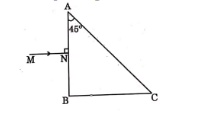
A ray of light MN is incident normally on the face corresponding with side AB of a prism with an isosceles right-angled triangular base ABC. Trace the path of the ray as it passes through the prism when the refractive index of the prism material is , and .
Official Solution
Correct Option: (1)
We are given a triangular prism with an isosceles right-angled base ABC, and a ray of light is incident normally on face AB of the prism. Since the ray is incident normally (at ) on face AB, it will travel straight through without any refraction at the first interface. This means the angle of incidence at face AB is , and the light ray does not bend as it enters the prism. Upon entering the prism, the light ray will travel along the interior of the prism. At the second interface, where the ray meets side BC, refraction occurs. The amount of bending depends on the refractive index of the prism material and the angle at which the ray strikes the second face of the prism. For an isosceles right-angled prism, the angle between the two faces (AB and BC) is . As the ray exits the prism, it will be refracted depending on the refractive index of the prism. ### Case 1: Refractive index When the refractive index of the prism is , the light ray will bend at the second interface. Using Snell's Law, we can calculate the angle of refraction at face BC:
where (refractive index of air), (refractive index of the prism), and . Thus, . This means that the light ray will refract as it exits the prism, and the angle of refraction at face BC will be . ### Case 2: Refractive index When the refractive index of the prism is , we follow the same steps to calculate the angle of refraction. Using Snell's Law again: Thus, . In this case, the light ray will refract even more sharply as it exits the prism, and the angle of refraction at face BC will be . ### Conclusion For both cases, the ray passes through the prism with the direction of propagation changing due to the refractive indices of the material. The higher the refractive index of the material, the more the light will bend when exiting the prism. The ray will eventually exit the prism at an angle relative to the base of the triangle, depending on the refractive index.
62
PYQ 2026
medium
physicsID: cbse-cla
When monochromatic light is incident on a surface separating two media, the refracted and reflected light both have the same frequency as the incident frequency but the wavelength of refracted light is different. Explain why.
Official Solution
Correct Option: (1)
The frequency of light remains unchanged when it passes from one medium to another. This is because the energy of a photon is directly related to its frequency, and energy is conserved during the transition between media. However, the speed of light and the refractive index of the medium can change, which affects the wavelength of the light. The relationship between the speed of light , wavelength , and frequency is given by: Since the frequency remains constant, any change in the speed of light will result in a change in the wavelength . This is why the wavelength of the refracted light changes as it moves from one medium to another.