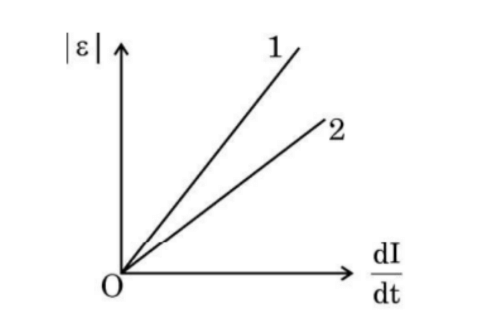
The figure shows the plot of magnitude of induced emf ( ) versus the rate of change of current in two coils ‘1’ and ‘2’. Which coil has a greater value of self-inductance and why?
Official Solution
Correct Option:
(1)
The induced electromotive force (emf) in a coil is related to the rate of change of current through the coil by Faraday's law of induction, which is given by:
where:
- is the induced emf,
- is the self-inductance of the coil,
- is the rate of change of current. From this equation, we see that the induced emf ( ) is directly proportional to the rate of change of current ( ) and the self-inductance of the coil. Therefore, the coil with the steeper slope in the plot will have a greater value of self-inductance. Analyzing the Plot:
- In the plot, coil 1 has a steeper slope than coil 2, which means that for the same rate of change of current ( ), coil 1 produces a larger induced emf.
- According to the relationship , a larger induced emf for the same rate of change of current implies a larger value of self-inductance. Thus, coil 1 has a greater value of self-inductance than coil 2.
About Faraday S Law - CBSE-CLASS-XII
Faraday S Law is a vital chapter for CBSE-CLASS-XII aspirants. Mastering the concepts covered in this chapter is essential for securing a top rank.
By rigorously practicing the previous year questions associated with this chapter, you can identify high-yield topics, understand the examiner's perspective, and boost your confidence during the actual exam.
Frequently Asked Questions
Why focus on Faraday S Law PYQs?
Analyzing PYQs for this specific chapter reveals the most frequently tested concepts and the typical complexity of questions, allowing you to tailor your study plan efficiently.
How to best use this analysis?
Review the topic breakdown to see which sub-topics within Faraday S Law carry the most weight. Then, tackle the questions iteratively to solidify your understanding.