CBSE-CLASS-XII SERIES
Physics

Photoelectric Effect

21 previous year questions.

Volume: 21 Ques
Yield: High

High-Yield Trend

3
2026
16
2025
2
2024

Chapter Questions
21 MCQs

01
PYQ 2024
easy
physics ID: cbse-cla
Explain the existence of threshold frequency of incident radiation for photoelectric emission from a given surface.
02
PYQ 2024
medium
physics ID: cbse-cla
Assertion (A): Electrons are ejected from the surface of zinc when it is irradiated by yellow light.
Reason (R): Energy associated with a photon of yellow light is more than the work function of zinc.
1
If both Assertion (A) and Reason (R) are true and Reason (R) is the correct explanation of Assertion (A).
2
If both Assertion (A) and Reason (R) are true and Reason (R) is not the correct explanation of Assertion (A).
3
If Assertion (A) is true and Reason (R) is false.
4
If both Assertion (A) and Reason (R) are false.
03
PYQ 2025
hard
physics ID: cbse-cla
Assertion (A): The minimum negative potential applied to the anode in a photoelectric experiment at which photoelectric current becomes zero, is called cut-off voltage.
Reason (R): The threshold frequency for a metal is the minimum frequency of incident radiation below which emission of photoelectrons does not take place.
1
Both Assertion (A) and Reason (R) are true and Reason (R) is the correct explanation of the Assertion (A).
2
Both Assertion (A) and Reason (R) are true, but Reason (R) is not the correct explanation of the Assertion (A).
3
Assertion (A) is true, but Reason (R) is false.
4
Both Assertion (A) and Reason (R) are false.
04
PYQ 2025
medium
physics ID: cbse-cla
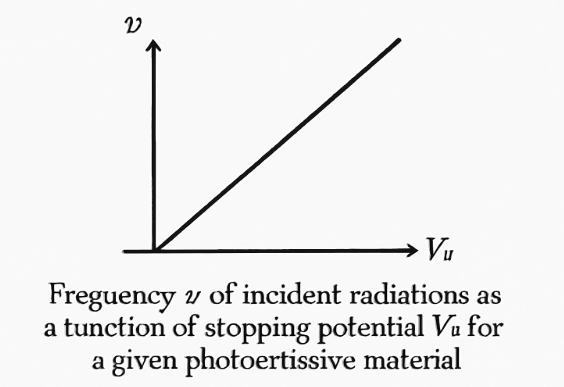
Draw a plot of frequency of incident radiations as a function of stopping potential for a given photoemissive material. What information can be obtained from the value of the intercept on the stopping potential axis?
05
PYQ 2025
medium
physics ID: cbse-cla
(a) Briefly explain Einstein’s photoelectric equation.
(b) Four metals with their work functions are listed below:
K = 2.3 eV, Na = 2.75 eV, Mo = 4.17 eV, Ni = 5.15 eV.
The radiation of wavelength 330 nm from a laser source placed 1 m away, falls on these metals.
Which of these metals will not show photoelectric emission?
What will happen if the laser source is brought closer to a distance of 50 cm?
06
PYQ 2025
medium
physics ID: cbse-cla
(a) Define 'work function' of a metal. How can its value be determined from a graph between stopping potential and frequency of the incident radiation?
(b) The work function of a metal is 2.4 eV. A stopping potential of 0.6 V is required to reduce the photocurrent to zero, in a photoelectric experiment. Calculate the wavelength of light used.
07
PYQ 2025
hard
physics ID: cbse-cla
Two statements are given, one labelled Assertion (A) and the other labelled Reason (R). Select the correct answer from the codes (A), (B), (C), and (D) as given below.
Assertion (A): For monochromatic incident radiation, the emitted photoelectrons from a given metal have speed ranging from zero to a certain maximum value.
Reason (R): Each metal has a definite work function.
1
Both Assertion (A) and Reason (R) are true and Reason (R) is the correct explanation of the Assertion (A).
2
Both Assertion (A) and Reason (R) are true, but Reason (R) is not the correct explanation of the Assertion (A).
3
Assertion (A) is true, but Reason (R) is false.
4
Both Assertion (A) and Reason (R) are false.
08
PYQ 2025
medium
physics ID: cbse-cla
The threshold frequency for a given metal is Hz. If monochromatic radiations of frequency Hz are incident on this metal, find the cut-off potential for the photoelectrons.
Given: - Threshold frequency, Hz
- Frequency of incident radiation, Hz
- Planck's constant,
- Charge of the electron,
09
PYQ 2025
easy
physics ID: cbse-cla
In a photoelectric experiment with a material of work function 2.1 eV, the stopping potential is found to be 2.5 V. The maximum kinetic energy of ejected photoelectrons is:
1
0.4 eV
2
2.1 eV
3
2.5 eV
4
4.6 eV
10
PYQ 2025
easy
physics ID: cbse-cla
Explain the following observations using Einstein’s photoelectric equation:
(a) Photoelectric emission does not occur from a surface when the frequency of the light incident on it is less than a certain minimum value.
(b) It is the frequency, and not the intensity of the incident light which affects the maximum kinetic energy of the photoelectrons.
(c) The cut-off voltage versus frequency of the incident light curve is a straight line with a slope .
11
PYQ 2025
easy
physics ID: cbse-cla
Answer the following giving reasons:
(a) The maximum kinetic energy of the photoelectrons is independent of the intensity of incident radiation.
(b) Photoelectric current increases with the increase in the intensity of the incident radiation.
(c) The stopping potential varies linearly with the frequency of the incident radiation for a given photosensitive surface.
12
PYQ 2025
easy
physics ID: cbse-cla
The work function of a material is 2.21 eV. Which of the following cannot produce photoelectrons from it?
1
Red light
2
Blue light
3
Violet light
4
Green light
13
PYQ 2025
easy
physics ID: cbse-cla

Einstein's Explanation of the Photoelectric Effect:

Einstein explained the photoelectric effect on the basis of Planck’s quantum theory, where light travels in the form of small bundles of energy called photons.
The energy of each photon is , where:

  • ν is the frequency of the incident light
  • h is Planck’s constant

The number of photons in a beam of light determines the intensity of the incident light.When a photon strikes a metal surface, it transfers its total energy to a free electron in the metal.A part of this energy is used to eject the electron from the metal, and this required energy is called the work function.The remaining energy is carried by the ejected electron as its kinetic energy.

14
PYQ 2025
medium
physics ID: cbse-cla
The cut-off voltage versus frequency of the incident light curve is a straight line with a slope of . Explain this observation.
15
PYQ 2025
easy
physics ID: cbse-cla
Answer the following giving reason:
(a) All the photoelectrons do not eject with the same kinetic energy when monochromatic light is incident on a metal surface.
(b) The saturation current in case (a) is different for different intensity.
(c) If one goes on increasing the wavelength of light incident on a metal sur face, keeping its intensity constant, emission of photoelectrons stops at a certain wavelength for this metal.
16
PYQ 2025
medium
physics ID: cbse-cla
In his experiment on photoelectric effect, Robert A. Millikan found the slope of the cut-off voltage versus frequency of incident light plot to be . Calculate the value of Planck’s constant from it.
17
PYQ 2025
easy
physics ID: cbse-cla
Mention any three features of results of experiment on photoelectric effect which cannot be explained using the wave theory of light.
18
PYQ 2025
medium
physics ID: cbse-cla
The stopping potential measured in a photoelectric experiment for a metal surface is plotted against frequency of the incident radiation. Let be the slope of the straight line so obtained. Then the value of the charge of an electron is given by (where is the Planck’s constant):
1
2
3
4
19
PYQ 2026
medium
physics ID: cbse-cla
Light of which of the following colours will have the maximum energy in a photon associated with it?
1
Red light
2
Yellow light
3
Green light
4
Blue light
20
PYQ 2026
medium
physics ID: cbse-cla
Assertion : Photoelectric effect is a spontaneous phenomenon. Reason (R): According to the wave picture of radiation, an electron would take hours/days to absorb sufficient energy to overcome the work function and come out from a metal surface.
1
Both Assertion (A) and Reason (R) are true and Reason (R) is the correct explanation of the Assertion (A).
2
Both Assertion (A) and Reason (R) are true, but Reason (R) is not the correct explanation of the Assertion (A).
3
Assertion (A) is true, but Reason (R) is false.
4
Both Assertion (A) and Reason (R) are false.
21
PYQ 2026
easy
physics ID: cbse-cla
Photoemission of electrons occurs from a metal ( ) when light of frequency is incident on it. Calculate: Energy of a photon in the incident light, The maximum kinetic energy of the emitted electrons, and The stopping potential.