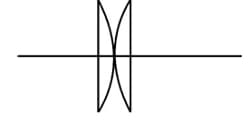
The above two parts are kept in contact with each other as shown in the figure. The power of the combination will be:
Official Solution
Correct Option: (1)
When two lenses are kept in contact, the total power of the combination is the algebraic sum of their individual powers. Since both parts have power , the total power is:
02
PYQ 2024
medium
physicsID: cbse-cla
A ray of light of wavelength 600 nm is incident in water ( ) on the water-air interface at an angle less than the critical angle. The wavelength associated with the refracted ray is:
Official Solution
Correct Option: (1)
When light passes from one medium to another, the wavelength of the light changes. The relationship between the wavelengths in the two media is given by: where is the wavelength in the first medium (water), and is the wavelength in the second medium (air). Given: - nm - (water) - (air) Thus: Thus, the correct answer is:
03
PYQ 2024
easy
physicsID: cbse-cla
A convex lens ( ) has a focal length of 15.0 cm in air. Find its focal length when it is immersed in a liquid of refractive index 1.65. What will be the nature of the lens?
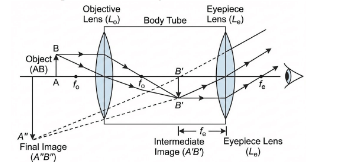
Official Solution
Correct Option: (1)
Let be the focal length of the convex lens in air and be the focal length of the convex lens in liquid.
Let be the refractive index of the lens material, be the refractive index of air, and be the refractive index of the liquid.
Let and be the radii of curvature of the lens surfaces. The lens maker's formula for a lens in air is given by:
$ n_g = 1.52 n_a = 1 n_l = 1.65 f_l = -6.6 f_a f_a = 15 f_l = -6.6 \times 15 = -99 f_l \boxed{-99cm}$
04
PYQ 2024
easy
physicsID: cbse-cla
A plano-convex lens of focal length is made of a material of refractive index . Calculate the radius of the curved surface of the lens.}
Official Solution
Correct Option: (1)
The lens formula is given by: For the given lens with a refractive index , and the relation becomes: Since , the equation simplifies to: Solving for : Thus, the radius of the curved surface is .
05
PYQ 2024
easy
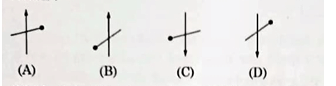
physicsID: cbse-cla
Three beams of red, yellow, and violet colours are passed through a prism, one by one under the same condition. When the prism is in the position of minimum deviation, the angles of refraction from the second surface are , , and respectively. Then,
1
2
3
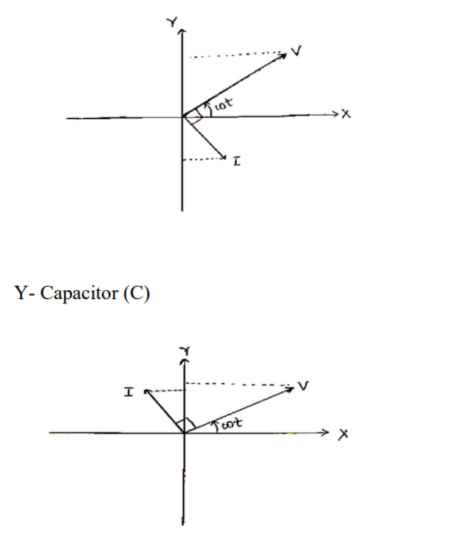
4
Official Solution
Correct Option: (3)
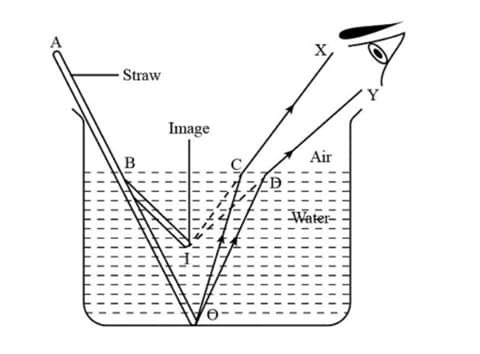
Step 1: When white light passes through a prism, different wavelengths of light experience different amounts of deviation due to their different refractive indices in the prism material. Violet light, having the shortest wavelength, is refracted the most, and red light, with the longest wavelength, is refracted the least. Step 2: The angle of refraction in a prism depends on the refractive index, which in turn depends on the wavelength of light. The refractive index decreases as the wavelength increases. Step 3: Since the violet light has the highest refractive index, it will have the smallest angle of refraction . The red light, with the lowest refractive index, will have the largest angle of refraction . Yellow light lies in between, with an angle of refraction . Step 4: Therefore, the order of angles of refraction is . Conclusion: The correct option is (C) .
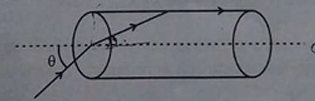
06
PYQ 2024
medium
physicsID: cbse-cla
Two capacitors of capacitances and , are first connected in series and then in parallel across the same battery. The ratio of energies stored in series combination to that in parallel is:
1
2
3
4
Official Solution
Correct Option: (4)
Let the battery voltage be . Energy Stored in a Capacitor:
The energy stored in a capacitor is given by the formula:
where is the capacitance and is the voltage across the capacitor. Energy Stored in Series Combination:
For capacitors connected in series, the equivalent capacitance is given by:
where: , . Substituting the values:
Thus:
The energy stored in the series combination is: Energy Stored in Parallel Combination:
For capacitors connected in parallel, the equivalent capacitance is given by:
Substituting the values:
The energy stored in the parallel combination is: Ratio of Energies:
The ratio of the energy stored in the series combination to that in the parallel combination is:
Thus, the ratio of energies stored in series combination to that in parallel is . % Correct Answer Correct Answer:} (D)
07
PYQ 2024
hard
physicsID: cbse-cla
A telescope has an objective lens of focal length 150 cm and an eyepiece of focal length 5 cm. Calculate its magnifying power in normal adjustment and the distance of the image formed by the objective.
Official Solution
Correct Option: (1)
Step 1: The magnifying power of the telescope in normal adjustment is given by the formula:
where is the focal length of the objective lens and is the focal length of the eyepiece. Step 2: Substituting the given values:
Thus, the magnifying power of the telescope in normal adjustment is 30. Step 3: To find the distance of the image formed by the objective, we use the lens formula:
where is the focal length of the objective lens, is the image distance, and is the object distance. Step 4: In normal adjustment, the object is at infinity, so . Therefore, the lens formula simplifies to:
Thus, the distance of the image formed by the objective is 150 cm.
08
PYQ 2024
medium
physicsID: cbse-cla
An object is placed between the pole and the focus of a concave mirror. Using mirror formula, prove mathematically that it produces a virtual and enlarged image.
Official Solution
Correct Option: (1)
The mirror formula is given by:
where: is the focal length of the mirror, is the image distance, is the object distance. Let the object be placed between the pole and the focus. So, . Now, we rearrange the mirror formula:
Using the new Cartesian sign convention, we get:
Since , the denominator is positive, and will be positive, indicating that the image is virtual. The magnification is given by:
Since , the image is enlarged. Thus, the image is virtual and enlarged.
09
PYQ 2024
medium
physicsID: cbse-cla
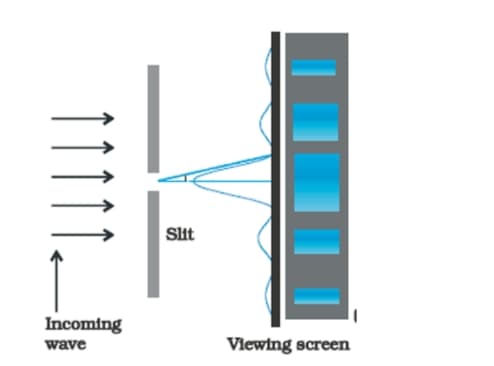
Discuss briefly diffraction of light from a single slit and draw the shape of the diffraction pattern.
Official Solution
Correct Option: (1)
Step 1: Diffraction is the bending of light around the edges of an obstacle or aperture. It occurs when light passes through a narrow slit or around an object and spreads out. Diffraction is most noticeable when the size of the slit is comparable to the wavelength of light. Step 2: When monochromatic light passes through a single slit, it creates a pattern on a screen. The pattern consists of a central bright fringe, with alternating dark and bright fringes on either side. The central maximum is the brightest and widest, with subsequent maxima and minima decreasing in intensity. Step 3: The angular position of the minima in the diffraction pattern is given by the condition: where: - is the width of the slit, - is the angle of diffraction, - is the wavelength of the light, - is the order of the minima. Step 4: The diffraction pattern consists of a central maximum, with minima at , and smaller maxima between the minima. Conclusion: The diffraction pattern for light passing through a single slit has a central bright fringe with progressively weaker bright fringes on either side, separated by dark minima.
10
PYQ 2024
medium
physicsID: cbse-cla
The critical angle for a ray of light passing from glass to water is minimum for
1
red colour
2
blue colour
3
yellow colour
4
violet colour
Official Solution
Correct Option: (4)
Step 1: The critical angle is given by the formula:
where and are the refractive indices of the two media. Step 2: The refractive index of a medium depends on the wavelength of light. Violet light has a shorter wavelength than red light and thus a higher refractive index. As a result, the critical angle for violet light is smaller than for red light. Step 3: Since the critical angle is inversely proportional to the refractive index, the critical angle is minimum for violet light (the shortest wavelength). Conclusion: The critical angle for a ray of light passing from glass to water is minimum for violet colour.
11
PYQ 2024
medium
physicsID: cbse-cla
When a ray of light of wavelength and frequency is refracted into a denser medium,
1
and both increase.
2
increases but is unchanged.
3
decreases but is unchanged.
4
and both decrease.
Official Solution
Correct Option: (3)
Step 1: When light enters a denser medium, its speed decreases due to the higher refractive index . The relationship between the speed of light , wavelength , and frequency is given by:
Since the frequency remains unchanged when light passes from one medium to another, the decrease in speed leads to a decrease in the wavelength . Step 2: The refractive index of the denser medium is greater than 1, and since the speed of light decreases in the denser medium, the wavelength also decreases. Conclusion: The wavelength decreases while the frequency remains unchanged.
12
PYQ 2024
medium
physicsID: cbse-cla
The critical angle for glass is and that for water is . The critical angle for the glass-water surface would be (given , ):
1
less than
2
between and
3
greater than
4
less than
Official Solution
Correct Option: (3)
Given Data Refractive index of glass, Refractive index of water, Critical angle for glass, Critical angle for water, Critical Angle Formula
The critical angle for a boundary between two media is given by:
where is the refractive index of the denser medium (glass) and is the refractive index of the less dense medium (water). Critical Angle for Glass-Water Interface
For the glass-water interface:
Therefore: Comparison with Given Critical Angles
The critical angle for glass ( ) is: The critical angle for water ( ) is: The critical angle for the glass-water interface ( ) is greater than both and . Conclusion
The critical angle for the glass-water interface is greater than the critical angle for water ( ). Final Answer
\begin{center} \boxed{\text{(C) greater than } \theta_2}
\end{center}
13
PYQ 2024
medium
physicsID: cbse-cla
A ray of light is incident normally on a refracting face of a prism of prism angle A and suffers a deviation of angle δ. Prove that the refractive index n of
the material of the prism is given by:n = sin(A+δ)/sin A
Official Solution
Correct Option: (1)
When light is incident normally on a refracting face of the prism, the deviation is related to the prism angle and the refractive index as follows:
At Normal Incidence
The angle of incidence on the first face is , and hence the refraction occurs only at the second face of the prism.
Snell's Law at the Second Face
The angle of refraction at the second face satisfies Snell's Law:
where is the angle of incidence at the second face. Since the total deviation is given by:
and for normal incidence, , we have:
Substituting into Snell's Law
Substituting into Snell's Law:
Refractive Index
Hence, the refractive index of the prism material is:
14
PYQ 2024
hard
physicsID: cbse-cla
The refractive index of the material of a prism is √2. If the refracting angle of the prism is 60◦, find: (1) Angle of minimum deviation: (2) Angle of incidence:
Official Solution
Correct Option: (1)
Angle of Minimum Deviation
Formula for the Refractive Index
The formula for the refractive index of the prism is:
where is the angle of the prism and is the angle of minimum deviation.
Given Values
Given and , we have:
Simplifying the Equation
Since , we can simplify:
Simplifying further:
Therefore, we have:
Solving for , we get:
Conclusion
The angle of minimum deviation is .
For the angle of minimum deviation, the angle of incidence equals the angle of emergence. Using symmetry, the angle of incidence is:
Substituting the Given Values
Substituting and :
Conclusion
The angle of incidence is .
For the angle of minimum deviation, the angle of incidence equals the angle of emergence. Using symmetry, the angle of incidence is:
Substituting the Given Values
Substituting and :
Conclusion
The angle of incidence is .
15
PYQ 2024
medium
physicsID: cbse-cla
The focal lengths of the objective and the eyepiece of a compound microscope are 1 cm and 2 cm respectively. If the tube length of the microscope is 10 cm, the magnification obtained by the microscope for most suitable viewing by relaxed eye is:
1
250
2
200
3
150
4
125 \bigskip
Official Solution
Correct Option: (4)
The magnification of a compound microscope is given by the formula:
where:
- is the least distance of distinct vision (usually taken as 25 cm),
- is the focal length of the objective lens,
- is the tube length of the microscope,
- is the focal length of the eyepiece. Given:
- ,
- ,
- ,
- . Substituting these values into the formula:
Thus, the magnification obtained by the microscope is 125. \bigskip
16
PYQ 2024
medium
physicsID: cbse-cla
A telescope consists of two lenses of focal length 100 cm and 5 cm. Find the magnifying power when the final image is formed at infinity.
Official Solution
Correct Option: (1)
In a telescope, the magnifying power is given by the ratio of the focal lengths of the objective and the eyepiece:
Here, and , so the magnifying power is:
Thus, the magnifying power of the telescope is 20.
17
PYQ 2024
medium
physicsID: cbse-cla
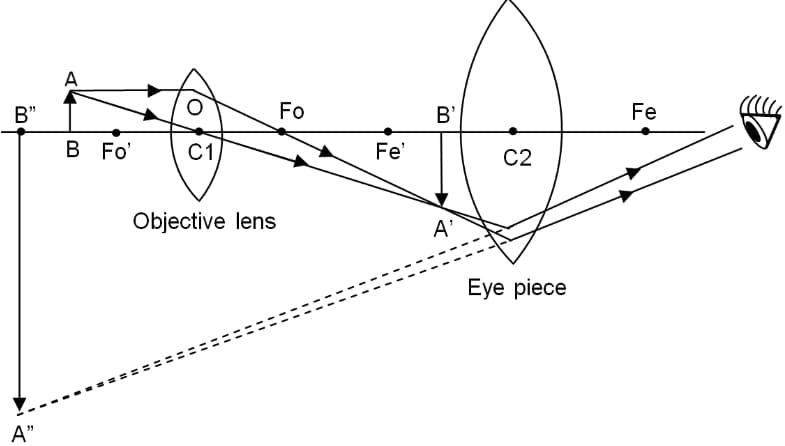
Draw a labelled ray diagram of a compound microscope showing image formation at least distance of distinct vision. Derive an expression for its magnifying power.
Official Solution
Correct Option: (1)
In a compound microscope, the objective lens forms a real, inverted, and diminished image at the focal plane of the eyepiece. The eyepiece acts as a magnifier to form a virtual, erect, and magnified image at the least distance of distinct vision. The magnifying power of the compound microscope is given by the product of the magnifying powers of the objective lens and the eyepiece lens : The magnifying power of the objective lens is given by: where is the image distance and is the object distance for the objective lens. Since the image is formed at the focal length of the objective lens , we have: For the eyepiece, the magnifying power is given by: where is the least distance of distinct vision and is the focal length of the eyepiece. Thus, the total magnifying power is:
18
PYQ 2024
medium
physicsID: cbse-cla
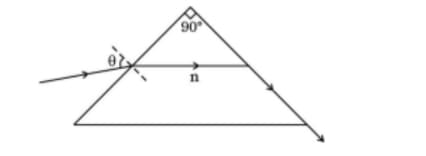
The figure shows the path of a light ray through a triangular prism. In this phenomenon, the angle is given by:
Official Solution
Correct Option: (1)
For the given triangular prism, the angle is related to the refractive index of the material of the prism. Using Snell's law and geometrical principles, the relationship is given by:
\vspace{0.5cm}
19
PYQ 2024
medium
physicsID: cbse-cla
Two media A and B are separated by a plane boundary. The speed of light in medium A and B is and , respectively. The critical angle for a ray of light going from medium A to medium B is:
Official Solution
Correct Option: (1)
Using Snell’s law for the critical angle : Hence, Thus, the critical angle is: Thus, the correct answer is:
20
PYQ 2024
hard
physicsID: cbse-cla
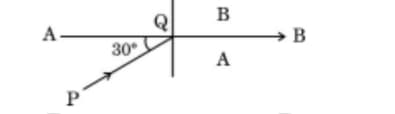
The interface AB between the two media A and B is shown in the figure. In the denser medium A, the incident ray PQ makes an angle of with the horizontal. The refracted ray is parallel to the interface. The refractive index of medium B with respect to medium A is:
Official Solution
Correct Option: (1)
For the given case, using Snell’s law: Here, since the refracted ray is parallel to the interface, , and hence: Thus, the refractive index of medium B is: Since the refractive index of the denser medium (A) is , we have: Thus, the correct answer is:
21
PYQ 2024
medium
physicsID: cbse-cla
When a ray of light propagates from a denser medium to a rarer medium, it bends away from the normal. When the incident angle is increased, the refracted ray deviates more from the normal. For a particular angle of incidence in the denser medium, the refracted ray just grazes the interface of the two surfaces. This angle of incidence is called the critical angle for the pair of media involved.
Official Solution
Correct Option: (1)
The angle of incidence at the critical angle is the angle at which the refracted ray grazes the interface, i.e., it refracts along the boundary. At this point, the angle of refraction is , so by the law of reflection, the angle of reflection must also be . Thus, the correct answer is:
22
PYQ 2024
medium
physicsID: cbse-cla
Assertion (A): The magnifying power of a compound microscope is negative. Reason (R): The final image formed is erect with respect to the object.
1
Both Assertion (A) and Reason (R) are true and Reason (R) is the correct explanation of the Assertion (A).
2
Both Assertion (A) and Reason (R) are true, but Reason (R) is not the correct explanation of the Assertion (A).
3
Assertion (A) is true, but Reason (R) is false.
4
Assertion (A) is false and Reason (R) is also false.
Official Solution
Correct Option: (3)
The assertion is correct because the magnifying power of a compound microscope is considered negative, as the final image is inverted relative to the object. However, the reason is incorrect because the final image formed is not erect but rather inverted with respect to the object. Therefore, the assertion is true, but the reason is false.
23
PYQ 2024
medium
physicsID: cbse-cla
A double-convex lens of power , with each face having the same radius of curvature, is cut into two equal parts perpendicular to its principal axis. The power of one part of the lens will be:
Official Solution
Correct Option: (1)
When a lens is cut into two equal parts perpendicular to its principal axis, the curvature of each part remains the same as the original lens. However, the effective thickness of each part is halved. The power of a lens is inversely proportional to its focal length, and the focal length is proportional to the thickness of the lens. Since the thickness is halved, the focal length of one part will also be halved. This results in the power of one part being twice that of the original lens. Therefore, the power of one part of the lens will be: Thus, the correct answer is:
24
PYQ 2024
medium
physicsID: cbse-cla
An object is placed 30 cm in front of a concave mirror of radius of curvature 40 cm. Find the (i) position of the image formed and (ii) magnification of the image.
Official Solution
Correct Option: (1)
(i) The lens formula is given by: Substituting the given values: Now, solving for : Thus, the value of is . (ii) The magnification ( ) is given by: Substituting the values of and : Thus, the magnification is .
25
PYQ 2024
hard
physicsID: cbse-cla
Assertion (A): Plane and convex mirrors cannot produce real images under any circumstance. Reason (R): A virtual image cannot serve as an object to produce a real image.
1
Both Assertion (A) and Reason (R) are true and Reason (R) is the correct explanation of the Assertion (A).
2
Both Assertion (A) and Reason (R) are true, but Reason (R) is not the correct explanation of the Assertion (A).
3
Assertion (A) is true, but Reason (R) is false.
4
Assertion (A) is false and Reason (R) is also false.
Official Solution
Correct Option: (4)
- The assertion (A) is false because while it is true that a plane mirror cannot produce a real image, a convex mirror can produce virtual images but does not produce real images under any circumstance. Thus, the assertion is incorrect. - The reason (R) is also false. A virtual image formed by one mirror can indeed serve as an object for another mirror, and a real image can be formed by using this object. Thus, the statement that a virtual image cannot serve as an object for producing a real image is also incorrect. Therefore, the correct answer is:
26
PYQ 2024
easy
physicsID: cbse-cla
State Huygens' principle. Plane wave incident at angle i on reflecting surface. Construct reflected wavefront and prove i=r.
Official Solution
Correct Option: (1)
Huygens' Principle and Proof of Law of Reflection
Huygens' Principle
Every point on a wavefront acts as a source of secondary wavelets that spread out in all directions with the speed of the wave. The new wavefront is the surface tangent to these secondary wavelets.
Proof of Law of Reflection
Consider a plane wavefront incident at an angle on a reflecting surface. Let be the incident wavefront, the reflected wavefront, and and the corresponding normals.
From Huygens' principle:
Distance covered by the wave in time is .
Since the wavefronts are symmetric about the normal:
27
PYQ 2024
medium
physicsID: cbse-cla
An object is placed 30 cm in front of a concave mirror (radius of curvature 40 cm). Find: (i) image position (ii) magnification
Official Solution
Correct Option: (1)
(i) 1/v + 1/u = 1/f. u = -30cm, f = -R/2 = -20cm. Solving for v: v = -60cm. (ii) m = -v/u = -(-60)/(-30) = -2.
28
PYQ 2024
medium
physicsID: cbse-cla
An electric lamp is designed to operate at DC and current. If the lamp is operated on , AC source with a coil in series, then find the inductance of the coil.Correct Answer: The inductance of the coil is .
Official Solution
Correct Option: (1)
The lamp is designed for DC operation with the following specifications:
The power consumed by the lamp is:
When the lamp is connected to an AC source of and with a coil in series, the total impedance of the circuit is given by:
The impedance of the circuit is the combination of the resistance of the lamp and the inductive reactance of the coil:
The resistance of the lamp is:
The inductive reactance is given by:
Substituting the values:
The inductive reactance is related to the inductance by:
where is the angular frequency of the AC source. For :
Substituting for :
Simplifying:
Approximating:
29
PYQ 2024
medium
physicsID: cbse-cla
When does an inductor act as a conductor in a circuit? Give reason for it.
Official Solution
Correct Option: (1)
Inductor Acting as a Conductor
An inductor acts as a conductor in a DC circuit when the current is steady (i.e., not changing with time). This happens because:
\begin{itemize} \item The induced emf in the inductor is given by Faraday's Law: \item When the current is steady, , and hence the induced emf is zero.
\end{itemize} With no opposing emf, the inductor behaves as a simple conductor with negligible resistance, allowing the current to flow freely.
30
PYQ 2025
hard
physicsID: cbse-cla
The focal length of a concave mirror in air is . When the mirror is immersed in a liquid of refractive index , its focal length will become:
1
2
3
4
Official Solution
Correct Option: (1)
Question: The focal length of a concave mirror in air is . When the mirror is immersed in a liquid of refractive index , its focal length will become:
1. Key Concept:
The focal length of a concave mirror does not depend on the surrounding medium because the reflection from a mirror depends only on its radius of curvature and not on the refractive index of the medium. However, this is true only for reflection-based optics. In some competitive exams, the question may involve interpreting the apparent change in focal length due to refraction effects surrounding the mirror (such as using the mirror inside a liquid).
In such cases, the formula used is:
where is the refractive index of the surrounding medium with respect to air.
Here, , so:
2. Final Answer:
Option (A) is correct.
31
PYQ 2025
hard
physicsID: cbse-cla
Two statements are given one labelled Assertion (A) and the other labelled Reason (R). Select the correct answer from the codes (A), (B), (C) and (D) as given below. Assertion (A): In a reflecting telescope, the image does not have chromatic aberration. Reason (R): Chromatic aberration occurs only due to refraction of light through an optical medium.
1
Both Assertion (A) and Reason (R) are true and Reason (R) is the correct explanation of the Assertion (A).
2
Both Assertion (A) and Reason (R) are true, but Reason (R) is not the correct explanation of the Assertion (A).
3
Assertion (A) is true, but Reason (R) is false.
4
Both Assertion (A) and Reason (R) are false.
Official Solution
Correct Option: (1)
Assertion (A) is true: In a reflecting telescope, the image is formed using mirrors, and not lenses. Since mirrors reflect all wavelengths of light equally, there is no chromatic aberration. Reason (R) is also true: Chromatic aberration arises when different wavelengths of light are refracted (bent) by different amounts through a lens (optical medium), due to their varying refractive indices. Since reflecting telescopes use reflection (not refraction), they do not suffer from chromatic aberration. Therefore, the reason correctly explains the assertion.
32
PYQ 2025
easy
physicsID: cbse-cla
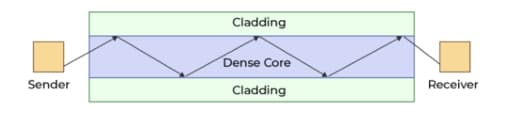
Explain the transmission of optical signal through an optical fiber with a diagram.
Official Solution
Correct Option: (1)
Optical fibers transmit light signals using the principle of total internal reflection. The light signals enter the fiber at an angle greater than the critical angle, which causes the light to be reflected entirely within the fiber. This continuous reflection ensures that the light travels through the fiber even if the fiber is bent.
33
PYQ 2025
medium
physicsID: cbse-cla
Two convex lenses A and B, each of focal length 10.0 cm, are mounted on an optical bench at 50.0 cm and 70.0 cm respectively. An object is mounted at 20.0 cm. Find the nature and position of the final image formed by the combination.
Official Solution
Correct Option: (1)
Step 1: Finding the image formed by the first lens . For lens A, the object distance is (since the object is real) and the focal length is . Using the lens formula: So, the image formed by lens A is at , which is real and inverted.
Step 2: Finding the image formed by the second lens . The image formed by lens A acts as the object for lens B. The object distance for lens B is the distance between the two lenses, i.e., . Using the lens formula for lens B: Thus, the final image is formed at a distance of 12.5 cm from lens B, which is real and inverted.
34
PYQ 2025
hard
physicsID: cbse-cla
Consider the arrangement shown in the figure. A black vertical arrow and a horizontal thick line with a ball are painted on a glass plate. It serves as the object. When the plate is illuminated, its real image is formed on the screen. Which of the following correctly represents the image formed on the screen?
Official Solution
Correct Option: (1)
In this question, the arrangement described suggests that a real image is formed by a lens or optical system where the object consists of a vertical arrow and a horizontal line with a ball. The characteristics of the image formed are: - Since the image is real, it will be inverted. - The image should retain the relative orientation of the object but will be mirrored vertically, as real images formed by a lens are typically inverted. Therefore, the correct answer corresponds to the image formed where the image is inverted and real.
35
PYQ 2025
medium
physicsID: cbse-cla
A point source of light in air is kept at a distance of 12 cm in front of a convex spherical surface of glass of refractive index 1.5 and radius of curvature 30 cm. Find the nature and position of the image formed.
Official Solution
Correct Option: (1)
Use the formula for refraction at a spherical surface:
Where: - (air), (glass) - (object in front of the surface) - (convex surface, positive R) Substitute:
So, the image is formed at a distance of 22.5 cm from the surface on the same side as the object, and is virtual.
36
PYQ 2025
medium
physicsID: cbse-cla
When a parallel beam of light enters water surface obliquely at some angle, what is the effect on the width of the beam?
Official Solution
Correct Option: (1)
When a parallel beam of light enters a water surface obliquely, the beam undergoes refraction due to the change in the speed of light when passing from one medium (air) to another (water). Let's break down the effect of this refraction on the width of the beam:
1. Refraction of Light at the Water Surface:
When light passes from air (where the refractive index is approximately 1) into water (with a refractive index of about 1.33), the change in speed causes the light to bend according to Snell's law. The refractive index ( ) is related to the angle of incidence ( ) and the angle of refraction ( ) as:
where:
is the refractive index of air (1),
is the refractive index of water (1.33),
is the angle of incidence in air, and
is the angle of refraction in water.
2. Effect on the Width of the Beam:
When the light enters the water obliquely, the beam bends, causing the light rays to spread out more (or less) depending on the direction of the incident light. Since the speed of light in water is slower, the light rays are refracted towards the normal, causing the beam to become narrower in the direction of propagation.
As the beam enters the water, the width of the beam decreases due to the bending of the rays towards the normal. This narrowing of the beam occurs because the light slows down in the water, and the rays are closer together after refraction.
The effect is more pronounced when the angle of incidence is large, as the light bends more sharply towards the normal. For a smaller angle of incidence, the change in the width is less noticeable.
3. Conclusion:
When a parallel beam of light enters the water surface obliquely, the width of the beam decreases due to the refraction of light as it slows down and bends towards the normal. The greater the angle of incidence, the more pronounced the narrowing of the beam.
37
PYQ 2025
medium
physicsID: cbse-cla
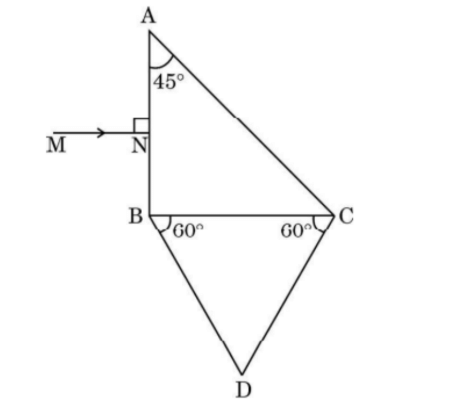
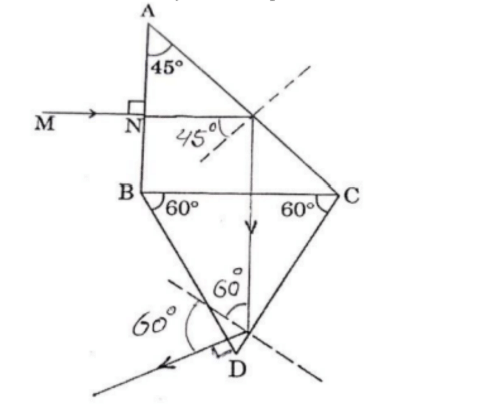
A right-angled isosceles glass prism ABC is kept in contact with an equilateral triangular prism DBC as shown in the figure. Both prisms are made of the same glass of refractive index 1.6. Trace the path of the ray MN incident normally on face AB as it passes through the combination.
Official Solution
Correct Option: (1)
Let us analyze the passage of the ray step-by-step using geometrical optics: - The ray is incident normally on the surface AB, which means there is no refraction at that surface. The ray enters the prism undeviated. - The prism is a right-angled isosceles prism with , , and . The ray inside travels toward surface BC. - At surface BC, the ray strikes at an angle of incidence (measured from the normal, because triangle is isosceles). Let’s calculate the critical angle for glass-air interface: Since , total internal reflection (TIR) occurs at face BC. - The ray reflects from BC toward face AC, which is in contact with the second prism . Since both prisms are made of the same glass, and this surface is not in contact with air, no refraction occurs at BC interface between the two prisms. - Now, consider triangle (an equilateral triangle). At face CD, the ray strikes at (interior angle). Again, let’s check for TIR: - Finally, the ray emerges normally out of face AD because it strikes it perpendicularly after internal reflections. Path of the ray: MN → undeviated into the prism → reflects from BC → reflects from CD → exits normally through AD.
38
PYQ 2025
medium
physicsID: cbse-cla
An object is placed 30 cm from a thin convex lens of focal length 10 cm. The lens forms a sharp image on a screen. If a thin concave lens is placed in contact with the convex lens, the sharp image on the screen is formed when the screen is moved by 45 cm from its initial position. Calculate the focal length of the concave lens.
Official Solution
Correct Option: (1)
Calculation of Focal Length of Concave Lens
Given:
Object distance from convex lens,
Focal length of convex lens,
Shift in image position with concave lens added,
Step 1: Use Lens Formula for Convex Lens
The lens formula is:
Substituting the given values for and :
So, the image distance is:
The initial image distance is (since the image formed is real, we use object-image symmetry).
Step 2: Adding the Concave Lens
After adding the concave lens, the image shifts by behind the original screen. So, the new image distance becomes:
Step 3: Effective Focal Length of the System
Since the lenses are in contact, the effective focal length of the system can be calculated using the lens formula:
Now, use the lens formula again for the system:
Substituting the values and :
Hence, the effective focal length is .
Step 4: Focal Length of the Concave Lens
Now, we can solve for the focal length of the concave lens: Substituting the known values: Solving for : Therefore, the focal length of the concave lens is:
Final Answer:
The focal length of the concave lens is .
39
PYQ 2025
easy
physicsID: cbse-cla
A current element X is connected across an AC source of emf . It is found that the voltage leads the current in phase by radian. If element X was replaced by element Y, the voltage lags behind the current in phase by radian. (I) Identify elements X and Y by drawing phasor diagrams. (II) Obtain the condition of resonance when both elements X and Y are connected in series to the source and obtain expression for resonant frequency. What is the impedance value in this case?
Official Solution
Correct Option: (1)
Phasor Diagrams, Resonance Condition, and Resonant Frequency
(I) Phasor Diagrams
In AC circuits, the relationship between voltage and current can be represented using phasor diagrams:
For Capacitor (X):
In a capacitor, the voltage leads the current by . This is because the current in a capacitor leads the voltage due to the nature of capacitive reactance.
The phasor diagram shows that the phasor for voltage is ahead of the phasor for current.
For Inductor (Y):
In an inductor, the voltage lags behind the current by . This happens because the voltage across an inductor opposes the change in current (inductive reactance).
The phasor diagram shows that the phasor for voltage is behind the phasor for current.
(II) Condition of Resonance and Resonant Frequency
When a capacitor and an inductor are connected in series with a resistor (forming an RLC circuit), resonance occurs under specific conditions. The condition of resonance is when the inductive reactance ( ) equals the capacitive reactance ( ).
Condition for Resonance:
The resonance condition is given by:
Solving for , we get:
Resonant Frequency:
The resonant frequency is given by:
Impedance at Resonance:
At resonance, the net reactance becomes zero because . Therefore, the total impedance in the circuit is purely resistive:
At Resonance:
The impedance is equal to the resistance of the circuit.
The current is maximum and is in phase with the voltage.
Summary:
Resonance in an RLC circuit occurs when the inductive reactance equals the capacitive reactance, leading to maximum current and a purely resistive impedance. The resonant frequency is given by:
40
PYQ 2025
medium
physicsID: cbse-cla
An equiconvex lens is made of glass of refractive index 1.55. If the focal length of the lens is 15.0 cm, calculate the radius of curvature of its surfaces.
Official Solution
Correct Option: (1)
Given: Refractive index
Focal length
Since it is an equiconvex lens: Radius of curvature , Use the lens maker’s formula:
Substitute the values:
Now solve for :
Final Answer:Radius of curvature
41
PYQ 2025
medium
physicsID: cbse-cla
Which of the following statements is incorrect? (A) For a convex mirror, magnification is always negative. (B) For all virtual images formed by a mirror, magnification is positive. (C) For a concave lens, magnification is always positive. (D) For real and inverted images, magnification is always negative.
Official Solution
Correct Option: (1)
We need to evaluate the given statements about magnification for different mirrors and lenses.
1. Understanding the Concepts:
Magnification: The magnification of an image is the ratio of the image's height to the object's height. It is given by the formula , where is the image height and is the object height. A positive magnification means the image is upright, and a negative magnification means the image is inverted.
2. Analyzing the Statements:
Statement (A): For a convex mirror, magnification is always negative. This statement is incorrect. For a convex mirror, the image formed is always virtual, upright, and smaller than the object. The magnification for a convex mirror is always positive, not negative.
Statement (B): For all virtual images formed by a mirror, magnification is positive. This statement is correct. Virtual images formed by mirrors, such as in concave mirrors or convex mirrors, are always upright, resulting in a positive magnification.
Statement (C): For a concave lens, magnification is always positive. This statement is correct. A concave lens always forms a virtual, upright image, which results in a positive magnification.
Statement (D): For real and inverted images, magnification is always negative. This statement is correct. Real and inverted images, which are formed by concave mirrors or convex lenses, always have a negative magnification.
3. Conclusion:
The incorrect statement is Statement (A): "For a convex mirror, magnification is always negative." This is false because the magnification for convex mirrors is always positive.
Final Answer:
The incorrect statement is (A) For a convex mirror, magnification is always negative.
42
PYQ 2025
easy
physicsID: cbse-cla
With the help of a ray diagram, show that a straw appears bent when it is partly dipped in water and explain it.
Official Solution
Correct Option: (1)
When light travels from one medium to another (such as from water to air), the change in speed causes the light rays to bend at the interface. This bending of light makes the straw appear broken or bent at the surface of water. The light rays from the part of the straw submerged in water are refracted at the water-air interface, making the submerged part appear displaced from the rest of the straw.
43
PYQ 2025
easy
physicsID: cbse-cla
A transparent solid cylindrical rod (refractive index ) is kept in air. A ray of light incident on its face travels along the surface of the rod, as shown in the figure. Calculate the angle .
Official Solution
Correct Option: (1)
The light travels along the surface of the cylindrical rod. For this to happen, the angle of incidence must be such that the light is refracted along the surface. Using Snell's law at the interface between the rod and air: Given and , we have: Thus: Therefore, the angle is .
44
PYQ 2025
medium
physicsID: cbse-cla
A beaker is filled with water (refractive index ) up to a height . A coin is placed at its bottom. The depth of the coin, when viewed along the near normal direction, will be:
1
2
3
4
Official Solution
Correct Option: (2)
To determine the apparent depth of a coin placed at the bottom of a beaker filled with water, we use the concept of the refractive index and Snell's law. The apparent depth ( ) is given by the formula:
where is the actual depth of the coin and is the refractive index of the medium (water in this case).
Given:
Actual depth,
Refractive index of water,
Substituting the values, we find:
To solve this, multiply by the reciprocal of :
Therefore, the depth of the coin, when viewed along the near normal direction, is .
45
PYQ 2026
hard
physicsID: cbse-cla
Consider the nuclear reaction . Let , , and be the masses of the three nuclei X, Y, and Z respectively. Then which of the following relations hold true?
1
2
3
4
Official Solution
Correct Option: (4)
In a nuclear reaction, the mass of the system before the reaction must be greater than or equal to the mass of the system after the reaction (mass-energy conservation). The mass of the original nucleus is always greater than the sum of the masses of the products and . This is because some mass is converted to energy during the reaction, which is released as energy (binding energy of the products). Thus, the relation that holds true is:
Final Answer: (D)
46
PYQ 2026
easy
physicsID: cbse-cla
A 500 nm photon is incident normally on a perfectly reflecting surface and is reflected. The value of momentum transferred to the surface is:
1
2
3
4
Official Solution
Correct Option: (3)
We are given a 500 nm photon that is incident normally on a perfectly reflecting surface. The goal is to find the value of momentum transferred to the surface.
Step 1: Calculate the energy of the photon. The energy of the photon is given by the equation:
where:
- (Planck's constant)
- (speed of light)
- (wavelength of the photon) Substituting the values:
Step 2: Calculate the momentum of the photon. The momentum of a photon is given by:
Substituting the value of :
Step 3: Calculate the momentum transferred to the surface. Since the photon is reflected, the momentum transferred to the surface is twice the photon's momentum: Final Answer:
47
PYQ 2026
medium
physicsID: cbse-cla
A point source, in air, is placed at a distance of 6 cm in front of a convex spherical surface (n = 1.5 and radius of curvature = 24 cm). Find the position and nature of the image formed.
Official Solution
Correct Option: (1)
Step 1: Understanding the Concept:
When light travels from one medium to another through a spherical interface, the image formation is governed by the refraction formula for spherical surfaces.
Step 2: Key Formula or Approach:
The refraction formula is:
Step 3: Detailed Explanation:
Given:
- (air)
- (glass/medium)
- cm (object distance, sign convention)
- cm (convex surface) Substituting into the formula:
Step 4: Final Answer:
The image is formed at a distance of approximately 10.29 cm from the pole on the same side as the object. Since is negative, the image is virtual.
48
PYQ 2026
medium
physicsID: cbse-cla
Write any two points of difference between interference pattern due to double-slit and diffraction pattern due to single-slit.
Official Solution
Correct Option: (1)
Concept:
Interference and diffraction are both wave phenomena, but they differ in origin and characteristics. Differences:
Origin:
Interference: Produced by superposition of light from two coherent sources (double slit). Diffraction: Produced by superposition of wavelets from different parts of the same slit (single slit).
Fringe width and intensity:
Interference: Fringes are equally spaced and of nearly equal intensity (except due to envelope effects). Diffraction: Central maximum is widest and brightest; secondary maxima are weaker and not equally spaced.
Other valid differences (any two acceptable):
Interference needs two slits; diffraction can occur with a single slit. In interference, bright and dark fringes are sharp; in diffraction, intensity gradually decreases away from centre.
49
PYQ 2026
medium
physicsID: cbse-cla
A parallel beam of monochromatic light falls normally on a single slit of width and a diffraction pattern is observed on a screen placed at a distance from the slit. Explain: the formation of maxima and minima in the diffraction pattern, and why the maxima go on becoming weaker and weaker with increasing order .
Official Solution
Correct Option: (1)
Concept:
This is Fraunhofer diffraction at a single slit. Every point of the slit acts as a source of secondary wavelets (Huygens’ principle). (I) Formation of maxima and minima:Minima (dark bands): Consider slit of width . If path difference between light from top and bottom of slit is:
then waves cancel pairwise by destructive interference → dark fringes. Thus, condition for minima:
Maxima (bright bands): Between successive minima, waves interfere constructively to give bright regions. The central maximum occurs at where all wavelets are in phase. Secondary maxima occur between minima due to partial constructive interference. (II) Why higher-order maxima become weaker:
As angle increases, path differences across the slit increase. Contributions from different parts of the slit increasingly cancel each other. Only partial constructive interference occurs. Energy spreads over a wider angular region.
Thus, intensity of higher-order maxima decreases. Additional explanation:
Central maximum is widest and brightest. Intensity envelope decreases rapidly away from centre. Energy conservation causes spreading of light.
Conclusion:
Minima occur due to complete destructive interference. Higher-order maxima are weaker because interference becomes less constructive as angle increases.
50
PYQ 2026
medium
physicsID: cbse-cla
Two thin lenses of focal length and are placed in contact with each other coaxially. Prove that the focal length of the combination is given by
Official Solution
Correct Option: (1)
Concept:
For thin lenses in contact:
Image formed by first lens acts as object for second lens Use lens formula:
Step 1: Apply lens formula to first lens. Let object distance = , image formed by first lens = . Step 2: Second lens. Since lenses are in contact, image of first lens becomes object for second lens. So object distance for second lens = . Let final image distance = . Step 3: Add equations (1) and (2).
Cancel :
Step 4: Equivalent focal length. For equivalent single lens:
Comparing:
Step 5: Final expression.
Taking reciprocal:
51
PYQ 2026
medium
physicsID: cbse-cla
The energy of an electron in an orbit in hydrogen atom is -3.4 eV. Its angular momentum in the orbit will be:
1
2
3
4
Official Solution
Correct Option: (3)
Step 1: Understanding the Concept:
Bohr's model states that the energy of an electron in a hydrogen atom is quantized and specifically related to the principal quantum number . Furthermore, the angular momentum of an electron is also quantized and is an integral multiple of .
Step 2: Key Formula or Approach:
1. Energy of orbit: eV
2. Bohr's quantization of angular momentum:
Step 3: Detailed Explanation:
Given the energy eV:
For the second orbit ( ), the angular momentum is:
Step 4: Final Answer:
The angular momentum in the orbit is .
52
PYQ 2026
medium
physicsID: cbse-cla
The real image of an object placed between and from a convex lens can be seen on a screen placed at the image location. If the screen is removed, is the image still there? Explain. Plane and convex mirrors produce virtual images of objects. Can they produce real images under some circumstances? Explain.
Official Solution
Correct Option: (1)
(I) Image formation by convex lens: When an object is placed between and of a convex lens:
A real, inverted image is formed beyond Real image is formed due to actual convergence of light rays
If the screen is removed:
The image still exists at that position in space. A screen is only needed to make the image visible by scattering light to the eye. Without a screen, the image can still be seen by placing the eye at the image location.
Conclusion: Yes, the real image still exists even if the screen is removed, because it is formed by actual intersection of light rays. (II) Real images by plane and convex mirrors:Plane mirror:
Always forms virtual images for real objects. Cannot produce real images under normal circumstances.
Convex mirror:
Also produces virtual images for real objects. However, if the object is virtual (i.e., converging rays fall on the mirror), it can produce a real image.
Example:
If a converging beam (from another optical system) falls on a convex mirror, reflected rays may converge to form a real image.
Conclusion:
Plane mirror cannot form real images. Convex mirror can form real images only when the object is virtual (incident rays are converging).
53
PYQ 2026
medium
physicsID: cbse-cla
With the help of a ray diagram, describe the construction and working of a compound microscope.
Official Solution
Correct Option: (1)
Concept:
A compound microscope is an optical instrument used to observe very small objects by producing highly magnified images using two convex lenses:
Objective lens Eyepiece lens
Construction:
Consists of two coaxial convex lenses mounted at the ends of a tube. Objective:
Short focal length Small aperture Placed close to the object
Eyepiece:
Relatively larger focal length than objective Acts as a magnifying glass Placed near the eye
The distance between lenses is adjustable (tube length).
Ray Diagram (Description):
Object placed just beyond focal point of objective. Objective forms a real, inverted, enlarged intermediate image. This image lies within the focal length of the eyepiece. Eyepiece produces a virtual, magnified final image.
Working: Step 1: Formation of intermediate image.
Object placed slightly beyond the focal length of objective. Objective forms:
Real Inverted Magnified image inside the tube
Step 2: Final image formation.
Intermediate image acts as object for eyepiece. Eyepiece acts as a simple magnifier. Final image is:
Virtual Highly magnified Inverted relative to original object
Magnifying Power (optional formula):
For final image at least distance of distinct vision :
Where:
= tube length = focal length of objective = focal length of eyepiece
Conclusion:
A compound microscope achieves high magnification by:
Objective producing a real magnified intermediate image Eyepiece further magnifying it as a virtual image