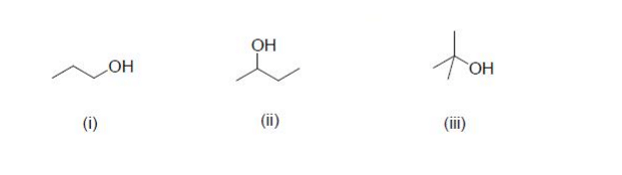
Identify the correct trend of acidic strength for the given alcohols:
1
(i)>(iii)>(ii)
2
(ii)>(i)>(iii)
3
(ii)>(iii)>(i)
4
(iii)>(ii)>(i)
Official Solution
Correct Option:
(2)
Acidic strength in alcohols depends on the stability of the conjugate base (alkoxide ion). The more stable the alkoxide, the stronger the acid. - (ii) is ethanol (primary) – least hindered, most acidic.
- (i) is isopropyl alcohol (secondary) – more hindered, less acidic.
- (iii) is tert-butyl alcohol (tertiary) – most hindered, least acidic. Thus, the correct order is:
02
PYQ 2022
medium
chemistryID: ap-eapce
An aryl carboxylic acid on treatment with sodium hydrogen carbonate liberates a gaseous molecule. Identify the gas molecule liberated.
1
H2
2
CO2
3
CO
4
O2
Official Solution
Correct Option:
(2)
Carboxylic acids react with NaHCO3} to liberate carbon dioxide gas:
Ar–COOH + NaHCO3} → Ar–COONa + H2}O + CO2}↑
Effervescence of CO2} is a test for carboxylic acids.
03
PYQ 2022
medium
chemistryID: ap-eapce
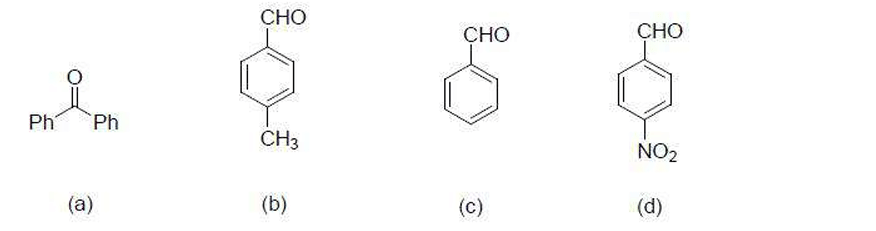
Arrange the following in increasing order of their reactivity for nucleophilic addition reaction:
1
2
3
4
Official Solution
Correct Option:
(1)
The reactivity of carbonyl compounds towards nucleophilic addition depends on the electron withdrawing or donating nature of the substituents.
% Option
(a) Benzophenone has two electron-donating phenyl groups — least reactive.
% Option
(b) p-Methylbenzaldehyde — methyl is slightly donating.
% Option
(c) Benzaldehyde — no additional substituent.
% Option
(d) p-Nitrobenzaldehyde — nitro group is strongly withdrawing, making the carbon more electrophilic.
Thus, reactivity order:
About Aldehydes And Ketones - AP-EAPCET
Aldehydes And Ketones is a vital chapter for AP-EAPCET aspirants. Mastering the concepts covered in this chapter is essential for securing a top rank.
By rigorously practicing the previous year questions associated with this chapter, you can identify high-yield topics, understand the examiner's perspective, and boost your confidence during the actual exam.
Frequently Asked Questions
Why focus on Aldehydes And Ketones PYQs?
Analyzing PYQs for this specific chapter reveals the most frequently tested concepts and the typical complexity of questions, allowing you to tailor your study plan efficiently.
How to best use this analysis?
Review the topic breakdown to see which sub-topics within Aldehydes And Ketones carry the most weight. Then, tackle the questions iteratively to solidify your understanding.