Which of the following aqueous solutions has the highest osmotic pressure?
1
5.85\% NaCl
2
3.42\%
3
6\% Urea
4
18\% Glucose
Official Solution
Correct Option: (1)
The osmotic pressure is given by the formula:
Where:
- is the van 't Hoff factor (the number of particles the solute dissociates into),
- is the molarity,
- is the ideal gas constant,
- is the temperature. For NaCl, it dissociates into two ions, Na and Cl , thus . For , it dissociates into 5 ions, thus . For urea and glucose, both are non-electrolytes and do not dissociate into ions, so . Therefore, even though dissociates into more ions, the concentration and dissociation factor need to be considered in detail. The osmotic pressure is determined by both the concentration and dissociation factor, and the 5.85% NaCl solution gives the highest osmotic pressure among the options.
02
PYQ 2023
medium
chemistryID: ap-eapce
If the osmotic pressure of cane sugar solution is 2.46 atm at 27°C, then what is the concentration (in mol L ) of the solution (R = 0.0821 L atm mol K )
1
0.1
2
0.2
3
0.01
4
0.02
Official Solution
Correct Option: (1)
The formula for osmotic pressure is given by: Where is the osmotic pressure, is the number of moles of solute, is the ideal gas constant, is the temperature, and is the volume of the solution. Rearranging to find concentration: Substitute the known values to find the concentration.
03
PYQ 2024
medium
chemistryID: ap-eapce
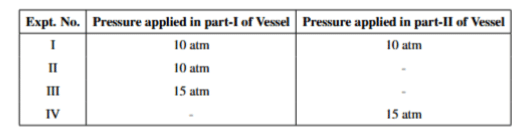
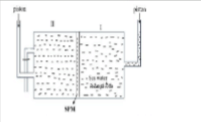
The osmotic pressure of seawater is 1.05 atm. Four experiments were carried out as shown in the table. In which of the following experiments, pure water can be obtained in part-II of the vessel?
1
only
2
only
3
4
only
Official Solution
Correct Option: (1)
The problem requires determining in which experiments pure water can be obtained in part-II of the vessel, given the osmotic pressure of seawater is 1.05 atm. To understand when pure water can be obtained, we need to apply the concept of osmotic pressure. Osmotic pressure ( ) is the pressure required to stop the flow of a solvent into a solution through a semipermeable membrane. The solvent naturally flows from lower to higher solute concentration (from lower to higher osmotic pressure) until equilibrium is reached.
For pure water to be obtained in part-II, the osmotic pressure of the solution in part-II must be less than in part-I, which implies water flows from part-I to part-II. Let's analyze each experiment:
Experiment
Part-I Solution
Part-II Solution
Osmotic Pressure in Part-I (atm)
I
Seawater
Pure water
1.05
II
Distilled water
Seawater
0
III
Seawater
Distilled water
1.05
IV
Salt solution (2 atm)
Distilled water
2.00
1. **Experiment I:** The osmotic pressure is 1.05 atm in part-I (seawater), and 0 atm in part-II (pure water). Since the pressure is higher in part-I, water moves towards part-II, allowing pure water accumulation.
2. **Experiment II:** Here, part-I has 0 atm (distilled water) while part-II has seawater at 1.05 atm. Water will move from part-I to part-II, leading to no accumulation of pure water in part-II.
3. **Experiment III:** Similar to experiment I, part-I contains seawater with a pressure of 1.05 atm, and part-II contains distilled water with 0 atm. Water will flow from part-I to part-II, allowing pure water accumulation.
4. **Experiment IV:** Part-I has a salt solution at 2 atm while part-II has 0 atm. Though the pressure difference would facilitate water to part-II, the osmotic pressure in part-I exceeding that of seawater suggests it doesn't fit the specific case of seawater osmotic pressures matching only.
Based on these analyses, experiments I and III result in pure water accumulation in part-II since water moves from a higher to lower osmotic pressure. Thus, the correct choice is only.