The vapors of 1 g of an element occupy 2.5625 L exerting a pressure of 0.5 atm at 1000 K. What is the molar mass (in ) of the element? (Assume vapors follow ideal gas equation. Given )
1
64
2
16
3
32
4
128
Official Solution
Correct Option: (1)
We use the ideal gas law:
Rewriting in terms of molar mass , using :
Given:
Substitute into the formula:
Divide:
Hence, the molar mass is , matching option (1).
02
PYQ 2023
medium
chemistryID: ap-eapce
At 300 K, 1 g of an ideal gas (A) exerted a pressure of 2 atm in a closed container. When 2 g of another ideal gas (B) was introduced into this container at the same temperature, the pressure changed to 3 atm. The correct relationship between the molar mass of A ( ) and B ( ) is:
1
2
3
4
Official Solution
Correct Option: (4)
From the ideal gas law, we know that the pressure is directly proportional to the number of moles and inversely proportional to the molar mass:
Let the molar mass of gas be and that of gas be . The pressure exerted by gas is 2 atm, and the total pressure after introducing gas is 3 atm. From the ideal gas law:
After solving for the relationship between the molar masses, we get:
Thus, the correct answer is Option 4: .
03
PYQ 2023
medium
chemistryID: ap-eapce
Identify the correct statements from the following: (I) According to Charles' law, at constant pressure, the volume of a gas is directly proportional to its temperature. (II) The rate of diffusion of a certain mass of a gas is inversely proportional to its density, at constant pressure and temperature. (III) The kinetic energy of a gas is directly proportional to T (K).
1
I, II, III
2
3
4
Official Solution
Correct Option: (2)
- Statement I (Charles' law): Correct. According to Charles' law, the volume of a gas is directly proportional to its temperature at constant pressure.
- Statement II (Graham's law): Correct. The rate of diffusion of a gas is inversely proportional to its density, at constant pressure and temperature.
- Statement III: Correct. The kinetic energy of a gas is directly proportional to the absolute temperature (T). Thus, the correct answer is Option 2: I, II, III.
04
PYQ 2023
medium
chemistryID: ap-eapce
A gas obeys Charles' law in the temperature range 0--500 K at a given pressure. Its volume changes to zero at temperature of
1
C
2
C
3
C
4
K
Official Solution
Correct Option: (3)
Charles' law: (at constant pressure). This means as , . Theoretically, if volume becomes zero, the corresponding temperature is absolute zero:
This is the point at which all molecular motion theoretically stops. So, if volume is zero, the temperature must be C.
05
PYQ 2023
medium
chemistryID: ap-eapce
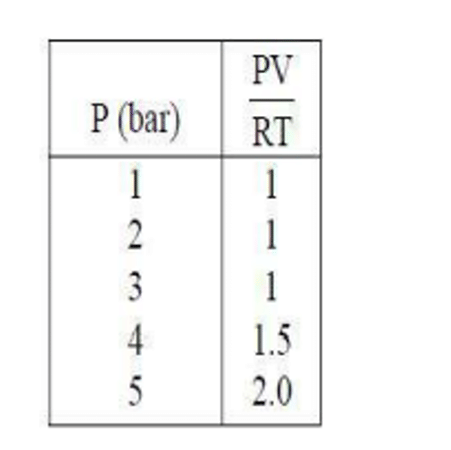
The following data is obtained for one mole of a gas. The gas behaves as an ideal gas in the pressure range (in bar)
1
1 to 3
2
1 to 5
3
4 to 5
4
above 5
Official Solution
Correct Option: (1)
Step 1: Recall the ideal gas law.
For an ideal gas, . Step 2: Analyze the data.
From to , , indicating ideal behavior.
For and , deviates from 1, indicating non-ideal behavior. Step 3: Conclusion.
The gas behaves ideally in the pressure range 1 to 3 bar. Final Answer:
06
PYQ 2023
medium
chemistryID: ap-eapce
At a given temperature, the density of an ideal gas is proportional to (P = pressure of ideal gas)
1
2
3
4
Official Solution
Correct Option: (2)
The ideal gas law is given by:
$ is the pressure, is the volume, is the number of moles, is the ideal gas constant, and is the temperature. We want to find the relationship between the density of the gas and its pressure at a constant temperature .
Density is defined as mass per unit volume:
\) can be expressed in terms of the mass of the gas and its molar mass :
\) into the ideal gas law:
\) , which is the density :
\) , and for a specific ideal gas (which has a constant molar mass ), the terms are constant. Let . Then the equation becomes:
\) $
This shows that the density of an ideal gas at a given temperature is directly proportional to its pressure . Therefore, .
07
PYQ 2024
hard
chemistryID: ap-eapce
Two statements are given below:Statement-I: The ratio of the molar volume of a gas to that of an ideal gas at constant temperature and pressure is called the compressibility factor. Statement-II: The RMS velocity of a gas is directly proportional to the square root of .
1
Both statement-I and statement-II are correct
2
Both statement-I and statement-II are not correct
3
Statement-I is correct but statement-II is not correct
4
Statement-I is not correct but statement-II is correct
Official Solution
Correct Option: (1)
Explanation:
Statement-I: The compressibility factor (Z) is defined as the ratio of the molar volume of a gas to the molar volume of an ideal gas at the same temperature and pressure. Mathematically, it is expressed as:
Z =
where is the molar volume of the real gas and is the molar volume of the ideal gas. This statement is correct as it directly defines the compressibility factor.
Statement-II: The root mean square (RMS) velocity of a gas is given by:
where is the gas constant, is the temperature in Kelvin, and is the molar mass. This formula shows that the RMS velocity is directly proportional to the square root of the absolute temperature . Therefore, this statement is also correct.
In conclusion, both statement-I and statement-II are correct.
08
PYQ 2025
easy
chemistryID: ap-eapce
What volume will 2 moles of an ideal gas occupy at STP (Standard Temperature and Pressure)?
1
11.2 L
2
22.4 L
3
44.8 L
4
33.6 L
Official Solution
Correct Option: (3)
To determine the volume occupied by 2 moles of an ideal gas at STP (Standard Temperature and Pressure), we must use the ideal gas law, specifically noting the molar volume of a gas at STP.
At STP, which is defined as a temperature of 0°C (273.15 K) and a pressure of 1 atmosphere (atm), one mole of an ideal gas occupies a volume of 22.4 liters (L).
Given: Moles of gas = 2 moles Molar volume at STP = 22.4 L/mol
To find the total volume occupied by 2 moles of the gas, multiply the number of moles by the molar volume:
Volume = Number of Moles × Molar Volume
Volume = 2 moles × 22.4 L/mol = 44.8 L
Therefore, 2 moles of an ideal gas at STP occupy a volume of 44.8 liters.
09
PYQ 2025
medium
chemistryID: ap-eapce
Which one of the following gases is the major contributor to global warming?
1
CO
2
CO2
3
CH4
4
N2O
Official Solution
Correct Option: (2)
CO2 is the most significant greenhouse gas due to its high concentration and persistence in the atmosphere. It absorbs infrared radiation and traps heat. While CH4 and N2O are stronger per molecule, their overall concentration is far less than that of CO2.
10
PYQ 2025
medium
chemistryID: ap-eapce
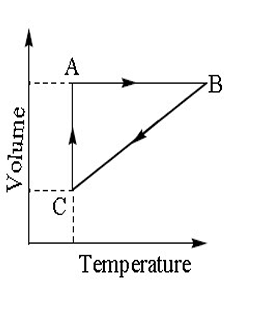
5 moles of a gas is allowed to pass through a series of changes as shown in the graph, in a cyclic process. The processes , , and respectively are:
1
Isothermal, Isochoric, Isobaric
2
Isochoric, Isobaric, Isothermal
3
Isobaric, Isochoric, Isothermal
4
Isothermal, Isobaric, Isochoric
Official Solution
Correct Option: (4)
Step 1: Analyze segment
In this path, the curve is vertical, meaning temperature is constant while volume changes.
Hence, the process is Isothermal. Step 2: Analyze segment
Here, volume increases but temperature remains constant (horizontal line),
which is a characteristic of an Isobaric process. Step 3: Analyze segment
This segment shows a straight line with constant volume, while temperature decreases.
Therefore, the process is Isochoric. Step 4: Conclusion
The sequence of processes is: Isothermal (CA), Isobaric (AB), Isochoric (BC).
11
PYQ 2025
medium
chemistryID: ap-eapce
The mass of a mixture containing NaCl and NaBr is 4.0 g. If Na is 20% of the total mixture, the composition of NaCl in the mixture is
1
48%
2
55%
3
45%
4
52%
Official Solution
Correct Option: (1)
First, calculate the mass of Na in the mixture, which is 20% of 4.0 g, i.e., 0.8 g of Na. Then, use the molar masses of NaCl and NaBr to calculate the fraction of Na that is in NaCl. By setting up the equation for the mass of NaCl, you will find that NaCl constitutes 48% of the mixture.
12
PYQ 2025
medium
chemistryID: ap-eapce
Consider the following
A) 0.0025 B) 500.0 C) 2.0034
Number of significant figures in A, B and C respectively, are
1
5, 4, 4
2
2, 4, 2
3
4, 3, 2
4
2, 4, 5
Official Solution
Correct Option: (4)
Rules for determining significant figures:
1. Non-zero digits are always significant.
2. Zeros between non-zero digits are significant.
3. Leading zeros (zeros to the left of the first non-zero digit) are not significant. They only indicate the position of the decimal point.
4. Trailing zeros in a number with a decimal point are significant.
5. Trailing zeros in a number without a decimal point are ambiguous (e. g. , 500 could have 1, 2, or 3 s. f. ). Scientific notation or an explicit decimal point (like 500. ) removes ambiguity. A) 0. 0025 - The leading zeros (0. 00) are not significant. - The non-zero digits 2 and 5 are significant. - Number of significant figures = 2. B) 500. 0 - The non-zero digit 5 is significant. - The zeros between 5 and the decimal point are significant because of the trailing zero after the decimal point. - The trailing zero after the decimal point (500. 0) is significant. - All digits 5, 0, 0, 0 are significant. - Number of significant figures = 4. C) 2. 0034 - The non-zero digits 2, 3, 4 are significant. - The zeros between 2 and 3 (2. 0034) are significant. - All digits 2, 0, 0, 3, 4 are significant. - Number of significant figures = 5. So, the number of significant figures in A, B, and C are 2, 4, and 5, respectively.
This matches option (4).
13
PYQ 2025
medium
chemistryID: ap-eapce
Which one of the following reactions is not feasible?
1
2
3
4
Official Solution
Correct Option: (4)
Step 1: Understanding Feasibility Feasibility depends on oxidation strength:
- Chlorine is the strongest oxidizing agent, capable of replacing bromine and iodine.
- Bromine is weaker, but can replace iodine.
- Iodine is the weakest and cannot oxidize bromide ions. Step 2: Evaluating the Reactions - (A) : - Feasible (Chlorine displaces bromine).
- (B) : - Feasible (Chlorine displaces iodine).
- (C) : - Feasible (Bromine displaces iodine).
- (D) : - Not feasible (Iodine cannot displace bromine). Conclusion Thus, the correct answer is:
14
PYQ 2025
medium
chemistryID: ap-eapce
Which one of the following reactions is not feasible?
1
2
3
4
Official Solution
Correct Option: (4)
Step 1: Understanding Feasibility Feasibility depends on oxidation strength:
- Chlorine is the strongest oxidizing agent, capable of replacing bromine and iodine.
- Bromine is weaker, but can replace iodine.
- Iodine is the weakest and cannot oxidize bromide ions. Step 2: Evaluating the Reactions - (A) : - Feasible (Chlorine displaces bromine).
- (B) : - Feasible (Chlorine displaces iodine).
- (C) : - Feasible (Bromine displaces iodine).
- (D) : - Not feasible (Iodine cannot displace bromine). Conclusion Thus, the correct answer is:
15
PYQ 2025
medium
chemistryID: ap-eapce
Consider the following
A) 0.0025 B) 500.0 C) 2.0034
Number of significant figures in A, B and C respectively, are
1
5, 4, 4
2
2, 4, 2
3
4, 3, 2
4
2, 4, 5
Official Solution
Correct Option: (4)
Rules for determining significant figures:
1. Non-zero digits are always significant.
2. Zeros between non-zero digits are significant.
3. Leading zeros (zeros to the left of the first non-zero digit) are not significant. They only indicate the position of the decimal point.
4. Trailing zeros in a number with a decimal point are significant.
5. Trailing zeros in a number without a decimal point are ambiguous (e. g. , 500 could have 1, 2, or 3 s. f. ). Scientific notation or an explicit decimal point (like 500. ) removes ambiguity. A) 0. 0025 - The leading zeros (0. 00) are not significant. - The non-zero digits 2 and 5 are significant. - Number of significant figures = 2. B) 500. 0 - The non-zero digit 5 is significant. - The zeros between 5 and the decimal point are significant because of the trailing zero after the decimal point. - The trailing zero after the decimal point (500. 0) is significant. - All digits 5, 0, 0, 0 are significant. - Number of significant figures = 4. C) 2. 0034 - The non-zero digits 2, 3, 4 are significant. - The zeros between 2 and 3 (2. 0034) are significant. - All digits 2, 0, 0, 3, 4 are significant. - Number of significant figures = 5. So, the number of significant figures in A, B, and C are 2, 4, and 5, respectively.
This matches option (4).
16
PYQ 2025
medium
chemistryID: ap-eapce
A sample of gas occupies 4.0 L at 27°C and 1 atm pressure. What will be its volume at 127°C and 1 atm pressure? (Assume ideal gas behavior)
1
5.33 L
2
60 L
3
30 L
4
4.33 L
Official Solution
Correct Option: (1)
Step 1: Use Charles's Law. Charles's law: , where temperature is in Kelvin. Step 2: Convert Celsius to Kelvin.