The correct statements regarding froth floatation method in metallurgy are I. Used for the purification of sulphide ores II. Used for the roasting of sulphide ores III. It is based on the relative densities of gangue and ore particles IV. It is based on the wetting properties of gangue and ore particles in frothing agent and water
1
I & IV only
2
II & III only
3
II & IV only
4
I & III only
Official Solution
Correct Option: (1)
The froth flotation method is a selective separation process used in mineral processing to separate hydrophobic materials from hydrophilic materials. It is widely used for the extraction and purification of sulphide ores. Let's examine each statement: I. **Used for the purification of sulphide ores:** Froth flotation is indeed primarily used for concentrating sulphide ores, such as copper sulphide (CuS), zinc sulphide (ZnS), and lead sulphide (PbS), by separating them from gangue (impurities like silica, clay, etc. ). This statement is correct. II. **Used for the roasting of sulphide ores:** Roasting is a pyrometallurgical process where sulphide ores are heated strongly in the presence of excess air to convert them into metal oxides or sulphates. Froth flotation is a physical separation method based on surface properties and is used before roasting in some cases, not as the roasting process itself. This statement is incorrect. III. **It is based on the relative densities of gangue and ore particles:** While gravity separation methods rely on differences in densities, froth flotation is primarily based on the differences in the wettability (hydrophobicity and hydrophilicity) of the ore and gangue particles. This statement is incorrect. IV. **It is based on the wetting properties of gangue and ore particles in frothing agent and water:** In froth flotation, the ore particles are preferentially wetted by oil (or a suitable collector) and become hydrophobic, attaching to air bubbles. The gangue particles are preferentially wetted by water and remain in the aqueous phase. Frothing agents stabilize the froth, allowing the hydrophobic ore particles to be carried to the surface and separated. This statement is correct. Therefore, the correct statements regarding the froth flotation method are I and IV.
02
PYQ 2023
medium
chemistryID: ap-eapce
The O-H bond length in in gas phase is
1
95.7 pm
2
90.2 pm
3
104.5 pm
4
115.5 pm
Official Solution
Correct Option: (1)
The O-H bond length in water molecules in the gas phase is well known to be approximately 95.7 pm (picometers). Thus, the correct bond length is .
03
PYQ 2023
medium
chemistryID: ap-eapce
Sphalerite is the ore of metal and malachite is the ore of metal . Atomic numbers of and are respectively
1
30, 82
2
82, 30
3
30, 29
4
29, 30
Official Solution
Correct Option: (3)
To solve this, we need to identify the metals associated with the given ores and their atomic numbers: - Sphalerite: Sphalerite is the primary ore of zinc ( ). The atomic number of zinc is 30. Therefore, , and the atomic number of is 30.
- Malachite: Malachite is a common ore of copper ( ). The atomic number of copper is 29. Therefore, , and the atomic number of is 29. Now, let's evaluate the options:
- Option (1): 30, 82 – Incorrect, as 82 corresponds to lead ( ), not copper.
- Option (2): 82, 30 – Incorrect, as 82 is lead ( ), not zinc, and 30 is zinc, not copper.
- Option (3): 30, 29 – Correct, as 30 is zinc ( ) and 29 is copper ( ).
- Option (4): 29, 30 – Incorrect, as 29 is copper (not the metal for sphalerite) and 30 is zinc (not the metal for malachite). So, the atomic numbers of and are 30, 29.
04
PYQ 2023
medium
chemistryID: ap-eapce
The process which involves the treatment of the ore with a suitable reagent so as to make it soluble but not impurities is called
1
Froth floatation
2
Roasting
3
Hydrometallurgy
4
Leaching
Official Solution
Correct Option: (4)
Step 1: Understand the definition of each given metallurgical process. Froth flotation: A separation technique based on the difference in the wettability of mineral and gangue particles. Roasting: Heating an ore in the presence of air to convert it to a metallic oxide or other compound.
Hydrometallurgy: The extraction of metals from their ores using aqueous solutions. Leaching: The process of selectively dissolving a desired mineral from an ore using a suitable reagent, while the impurities remain insoluble. Step 2: Match the description in the question with the correct process.
The question specifically describes the selective dissolution of the ore while leaving impurities undissolved. This is the definition of leaching. Final Answer: The final answer is
05
PYQ 2023
medium
chemistryID: ap-eapce
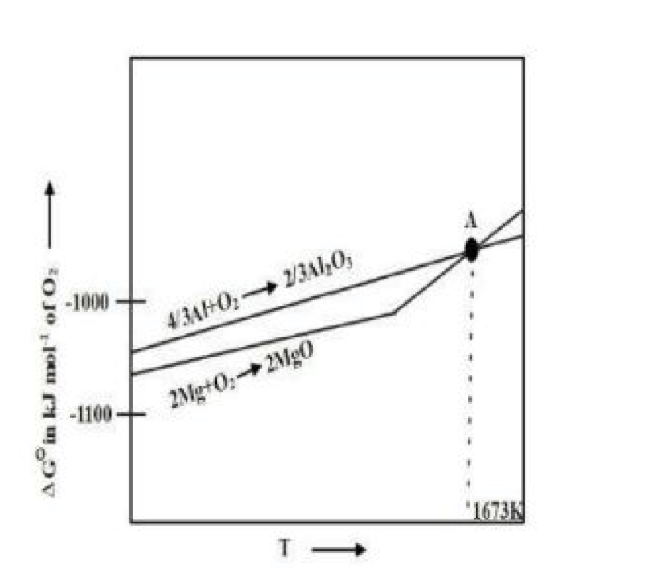
Observe the following Ellingham diagram, and identify the incorrect statement regarding it:
1
At point ‘A’ for the reduction of Al\textsubscript{2}O\textsubscript{3} by Mg,
2
Below 1673K, Mg can reduce Al\textsubscript{2}O\textsubscript{3} to Al
3
Below 1673K, Al can reduce MgO to Mg
4
Above 1673K, Al can reduce MgO to Mg
Official Solution
Correct Option: (3)
Ellingham diagrams represent the temperature dependence of the stability of compounds. A metal can reduce the oxide of another metal if its line lies below the other's in the diagram. Below 1673K, Mg line lies below Al, so Mg can reduce Al\textsubscript{2}O\textsubscript{3}, not the other way around. The statement that Al reduces MgO is incorrect.
06
PYQ 2023
medium
chemistryID: ap-eapce
S-I: Scattering of light by dispersed particles of colloidal system is known as Tyndall effect.
S-II: The diameter of the dispersed particles should not be much smaller than the wavelength of the light used.
1
Both S-I and S-II are correct
2
S-I is correct but S-II is incorrect
3
Both S-I and S-II are incorrect
4
S-I is incorrect but S-II is correct
Official Solution
Correct Option: (1)
The Tyndall effect is an important property of colloidal systems. It is defined as the scattering of visible light by particles in a colloid or in very fine suspensions.
Statement S-I: Correct. When a beam of light passes through a colloid, the light gets scattered by the dispersed particles in the colloidal solution, and this scattered light becomes visible. This is known as the Tyndall effect. Examples: sunlight scattering through mist, smoke in a dark room, etc.
Statement S-II: Also correct. For the Tyndall effect to be observable, the particle size of the dispersed phase should be comparable to the wavelength of visible light (around 400–700 nm). If the particle size is much smaller, no significant scattering occurs, and thus, no Tyndall effect will be seen.
Both conditions are essential and valid.
07
PYQ 2023
medium
chemistryID: ap-eapce
The correct statements about Zeolites are: 1. They are good shape selective catalysts 2. They contain Al-O-Si framework 3. They are not found in nature 4. They are used as catalysts for cracking hydrocarbons in the petrochemical industry.
1
I & II only
2
II & III only
3
I, II & IV only
4
I, II, III & IV
Official Solution
Correct Option: (3)
Statement I: Correct. Zeolites are widely used as shape-selective catalysts due to their porous structure. Statement II: Correct. Zeolites have a three-dimensional Al-O-Si framework with well-defined pores and cavities. Statement III: Incorrect. Zeolites \textit{are} found in nature (e.g., volcanic rocks) and can also be synthesized artificially. Statement IV: Correct. Zeolites (especially ZSM-5) are extensively used in petroleum refining for catalytic cracking of hydrocarbons. Thus, the correct combination is I, II, and IV only, making option (3) correct.
08
PYQ 2023
medium
chemistryID: ap-eapce
Match the following
List I (Method)
List II (Metal refined)
A) Zone refining
I) Sn
B) Liquation
II) In
C) Vapour phase refining
III) Zn
D) Distillation
IV) Zr
V) Al
1
A-IV, B-I, C-III, D-V
2
A-II, B-I, C-IV, D-III
3
A-II, B-V, C-III, D-I
4
A-I, B-III, C-IV, D-II
Official Solution
Correct Option: (2)
Zone refining: This method is used for the purification of metals like indium (In) and gallium where impurities are swept by a molten zone. So, A → II. Liquation: In this method, a low melting metal like tin (Sn) is separated from higher melting impurities. So, B → I. Vapour phase refining: This technique refines metals like zirconium (Zr), using a volatile compound. So, C → IV. Distillation: Metals like zinc (Zn) with low boiling points are purified by distillation. So, D → III. Hence, the correct matching is:
A → II, B → I, C → IV, D → III
09
PYQ 2023
medium
chemistryID: ap-eapce
White metal is an alloy of
1
Li & Mg
2
Li & Pb
3
Pb & Sn
4
Pb & Al
Official Solution
Correct Option: (3)
White metal is a term that can refer to several different alloys depending on the context. However, the most common and historically significant "white metal" alloy is **Babbitt metal**. Babbitt metal is primarily an alloy of **tin (Sn)**, with smaller amounts of other metals like **copper (Cu)** and **antimony (Sb)**. Lead (Pb) can also be a major component in some variations of Babbitt metal, especially cheaper grades. Looking at the options provided: Option (A) Li & Mg: This alloy is known for being lightweight and is used in aerospace applications, but it's not typically referred to as "white metal".
Option (B) Li & Pb: Alloys of lithium and lead are used in some specialized applications, but this is not the standard composition of "white metal".
Option (C) Pb & Sn: An alloy of lead (Pb) and tin (Sn) is a common type of white metal, particularly in the context of solders and some bearing materials (though often with antimony and copper added for strength and hardness in bearings). This fits the description of a common "white metal" alloy.
Option (D) Pb & Al: Alloys of lead and aluminum are used in some bearing applications, but this specific binary alloy is not the primary association with the term "white metal". Given the common usage of "white metal" to refer to lead-tin based alloys (often with other additions), option (C) is the most appropriate answer among the choices. It's worth noting that the term "white metal" can be ambiguous and might sometimes refer to other whitish-silvery alloys. However, in the context of common alloys, lead and tin are strongly associated with this term.
10
PYQ 2024
easy
chemistryID: ap-eapce
The reactions which occur in blast furnace at 500 – 800 K during extraction of iron from haematite are i. ii. iii. iv.
1
2
3
4
Official Solution
Correct Option: (4)
The extraction of iron from haematite in a blast furnace involves multiple reactions, primarily between temperatures of 500 – 800 K. Let's examine the reactions provided:
The correct reactions relevant to the process at the specified temperatures are:
Reaction i: This reaction occurs as iron(III) oxide reacts with carbon monoxide to form iron(II,III) oxide and carbon dioxide, fitting the temperature range.
Reaction iii: Here, iron(II) oxide reacts with carbon monoxide to produce iron and carbon dioxide, a typical reduction step.
Reaction iv: This reaction indicates further reduction of iron oxides with carbon monoxide, also fitting the process conditions.
Hence, the reactions occurring at 500 – 800 K during iron extraction in the blast furnace are accurately depicted by:
11
PYQ 2024
medium
chemistryID: ap-eapce
The flux used in the preparation of wrought iron from cast iron in reverberatory furnace is:
1
SiO
2
CaCO
3
C
4
NaCN
Official Solution
Correct Option: (2)
Step 1: Understanding Flux in Iron Extraction - Flux is a substance used in metallurgy to remove impurities by forming slag. - In wrought iron production, the impurities (SiO ) are removed using CaCO (Limestone) as a flux. Step 2: Reaction Involved Step 3: Explanation - SiO is an impurity, not a flux. - C (carbon) is used as a reducing agent. - NaCN is not used in iron metallurgy. Thus, the correct answer is CaCO .
12
PYQ 2025
medium
chemistryID: ap-eapce
The correct order of electronegativity of group 13 elements is
1
B > Ga > Al > Tl > In
2
B > Al > Tl > Ga > In
3
B > Al > Ga > In > Tl
4
B > Tl > In > Ga > Al
Official Solution
Correct Option: (3)
The electronegativity of group 13 elements decreases as we move down the group. B has the highest electronegativity, followed by Al, Ga, In, and Tl. Thus, the correct order is B > Al > Ga > In > Tl.
13
PYQ 2025
medium
chemistryID: ap-eapce
Which of the following sets are correctly matched?
I) Hg — distillation
II) Cu — poling
III) B — zone refining
IV) Ti — liquation
1
I, III & IV only
2
I, II & III only
3
II, III & IV only
4
I, II, III & IV
Official Solution
Correct Option: (2)
I) Mercury (Hg) is refined by distillation since it is volatile — correct.
II) Copper (Cu) is refined by poling — correct.
III) Boron (B) is purified by zone refining — correct.
IV) Titanium (Ti) is purified by Van Arkel method, not liquation — incorrect.
14
PYQ 2025
medium
chemistryID: ap-eapce
The number of amphoteric oxides from the following is
1
3
2
4
3
6
4
5
Official Solution
Correct Option: (2)
Let's classify the oxides one by one: - : Acidic oxide
- : Amphoteric
- : Amphoteric
- : Amphoteric
- : Neutral oxide
- : Amphoteric
- : Basic
- : Basic Amphoteric oxides:Number of amphoteric oxides = 4
15
PYQ 2025
medium
chemistryID: ap-eapce
Kaolinite, a form of clay is the ore of metal X and malachite is the ore of metal Y. X and Y respectively are:
1
Cu, Zn
2
K, Cu
3
Al, Cu
4
Zn, Al
Official Solution
Correct Option: (3)
Step 1: Identify ores
• Kaolinite is an ore of \textit{aluminum} (Al)
• Malachite is an ore of \textit{copper} (Cu) Step 2: Match with options
Only option (3) correctly pairs Al with kaolinite and Cu with malachite.
16
PYQ 2025
medium
chemistryID: ap-eapce
Match the following: List-I (Process) A. Hall-Heroult process B. Mond process C. Van-Arkel process D. Zone refining process List-II (Metal) I. Ti II. In III. Al IV. Ni
1
A-IV, B-III, C-I, D-II
2
A-II, B-III, C-IV, D-I
3
A-III, B-I, C-IV, D-II
4
A-III, B-IV, C-I, D-II
Official Solution
Correct Option: (4)
Hall-Heroult process: Used for the extraction of aluminum (Al). Mond process: Used for the purification of nickel (Ni). Van-Arkel process: Used for the purification of titanium (Ti) and zirconium (Zr). Zone refining process: Used for the purification of indium (In), silicon (Si), germanium (Ge), and other semiconductors.
17
PYQ 2025
medium
chemistryID: ap-eapce
Consider the following:Statement-I: In the extraction of Al by Hall-Heroult process, pure mixed with lowers its melting point and increases conductivity. Statement-II: Zirconium metal is purified by zone refining method. The correct answer is:
1
Both statement-I and statement-II are correct
2
Both statement-I and statement-II are not correct
3
Statement-I is correct, but statement-II is not correct
4
Statement-I is not correct, but statement-II is correct
Official Solution
Correct Option: (3)
Step 1: Verifying Statement-I In the Hall-Heroult process, aluminum oxide ( ) has a high melting point (~2000 K), making electrolysis inefficient. To reduce this, cryolite ( ) is added: - Lowers the melting point to ~1000 K, making electrolysis easier. - Enhances conductivity, allowing efficient ion migration in the molten electrolyte. Thus, Statement-I is correct. Step 2: Verifying Statement-II The zone refining method is used for purification of semiconductor metals, such as silicon and germanium, not zirconium. Zirconium is purified using the van Arkel method, which involves thermal decomposition of zirconium tetraiodide ( ). Thus, Statement-II is incorrect. Conclusion Thus, the correct answer is:
18
PYQ 2025
medium
chemistryID: ap-eapce
Which of the following is used as froth stabilizer in froth floatation process?
1
xanthate
2
aniline
3
pine oil
4
NaCN
Official Solution
Correct Option: (2)
In the froth flotation process, various reagents are used:
1. Frothers (Foaming agents): These substances enhance the formation of a stable froth. Examples include pine oil, fatty acids, eucalyptus oil. Pine oil is a primary frother.
2. Collectors: These enhance the non-wettability of the mineral particles and help them attach to air bubbles. Examples include xanthates (e. g. , sodium ethyl xanthate) and fatty acids.
3. Froth Stabilizers: These substances stabilize the froth, making it last longer so that the mineral can be skimmed off. Cresols and aniline are common examples of froth stabilizers. They reduce the surface tension of the froth bubbles to prevent them from coalescing too quickly.
4. Depressants/Activators: Depressants prevent certain minerals from floating (e. g. , NaCN for ZnS in presence of PbS). Activators enhance the floatability of a desired mineral (e. g. , CuSO for ZnS). Based on this:
- Xanthate: Collector.
- Aniline: Can act as a froth stabilizer. Cresols are more commonly cited, but aniline fits the role.
- Pine oil: Frother.
- NaCN: Depressant. Therefore, aniline is used as a froth stabilizer.
This matches option (2).
19
PYQ 2025
medium
chemistryID: ap-eapce
Consider the following
Statement-I : is amphoteric in nature.
Statement-II : is more basic than .
The correct answer is
1
Both statement-I and statement-II are correct
2
Both statement-I and statement-II are not correct
3
Statement-I is correct, but statement-II is not correct
4
Statement-I is not correct, but statement-II is correct
Official Solution
Correct Option: (1)
Statement-I: is amphoteric in nature.
Aluminium oxide ( ) can react with both acids and bases.
- Reaction with acid (e. g. , HCl): (acts as a base).
- Reaction with base (e. g. , NaOH): (sodium aluminate) (acts as an acid).
Since it reacts with both acids and bases, is amphoteric. So, Statement-I is correct. Statement-II: is more basic than .
Gallium (Ga) and Thallium (Tl) are both in Group 13. Ga is in Period 4, Tl is in Period 6.
Down a group, metallic character generally increases, and the basicity of oxides tends to increase (while acidity decreases).
- is acidic.
- is amphoteric.
- is amphoteric (though predominantly acidic character is less than Al O , more basic).
- is basic.
- is basic.
As we go down Group 13, the oxides become more basic. Thallium is below Gallium.
Therefore, is more basic than . So, Statement-II is correct.
Both statements are correct.
This matches option (1).
20
PYQ 2025
medium
chemistryID: ap-eapce
Complete hydrolysis of Xenon hexafluoride gives HF along with compound X. The hybridisation in X is
1
2
3
4
Official Solution
Correct Option: (1)
Explanation:
Xenon hexafluoride undergoes complete hydrolysis to form XeO and HF.
The structure of shows Xe bonded to three oxygen atoms and one lone pair, making a total of 4 regions of electron density.
This corresponds to sp hybridisation.
Final Answer:
21
PYQ 2025
medium
chemistryID: ap-eapce
Identify the reaction in which diborane is produced on an industrial scale:
1
Reaction of with in diethyl ether
2
Oxidation of with
3
Reaction of with at 450 K
4
By heating to above 370 K temperature
Official Solution
Correct Option: (3)
Step 1: Industrial Preparation of Diborane Diborane ( ) is typically produced industrially by the reaction of boron trifluoride ( ) with sodium hydride ( ) at high temperatures. This reaction occurs at approximately 450 K, yielding diborane ( ) efficiently. Conclusion Thus, the correct answer is:
22
PYQ 2025
medium
chemistryID: ap-eapce
Which of the following methods is useful for producing semiconductor grade metals of high purity?
1
Liquation
2
Vapour phase refining
3
Electrolytic refining
4
Zone refining
Official Solution
Correct Option: (4)
Zone refining is used to produce semiconductor-grade metals with high purity. The process involves the movement of a molten zone through the metal, which purifies the metal by segregating impurities.
23
PYQ 2025
medium
chemistryID: ap-eapce
Consider the following statements: Statement-I: The order of electronegativity of B, Al, In, Tl is Statement-II: Boric acid is a weak protic acid
1
Both statement-I and statement-II are correct
2
Both statement-I and statement-II are not correct
3
Statement-I is correct, but statement-II is not correct
4
Statement-I is not correct, but statement-II is correct
Official Solution
Correct Option: (2)
Step 1: Electronegativity order Correct order is , so statement-I is incorrect. Step 2: Nature of boric acid Boric acid is a weak monobasic acid, but it acts as a Lewis acid, not protic acid. Hence statement-II is incorrect. Step 3: Conclusion Both statements are incorrect.
24
PYQ 2025
medium
chemistryID: ap-eapce
Consider the following:Statement-I: In the extraction of Al by Hall-Heroult process, pure mixed with lowers its melting point and increases conductivity. Statement-II: Zirconium metal is purified by zone refining method. The correct answer is:
1
Both statement-I and statement-II are correct
2
Both statement-I and statement-II are not correct
3
Statement-I is correct, but statement-II is not correct
4
Statement-I is not correct, but statement-II is correct
Official Solution
Correct Option: (3)
Step 1: Verifying Statement-I In the Hall-Heroult process, aluminum oxide ( ) has a high melting point (~2000 K), making electrolysis inefficient. To reduce this, cryolite ( ) is added: - Lowers the melting point to ~1000 K, making electrolysis easier. - Enhances conductivity, allowing efficient ion migration in the molten electrolyte. Thus, Statement-I is correct. Step 2: Verifying Statement-II The zone refining method is used for purification of semiconductor metals, such as silicon and germanium, not zirconium. Zirconium is purified using the van Arkel method, which involves thermal decomposition of zirconium tetraiodide ( ). Thus, Statement-II is incorrect. Conclusion Thus, the correct answer is:
25
PYQ 2025
medium
chemistryID: ap-eapce
Identify the reaction in which diborane is produced on an industrial scale:
1
Reaction of with in diethyl ether
2
Oxidation of with
3
Reaction of with at 450 K
4
By heating to above 370 K temperature
Official Solution
Correct Option: (3)
Step 1: Industrial Preparation of Diborane Diborane ( ) is typically produced industrially by the reaction of boron trifluoride ( ) with sodium hydride ( ) at high temperatures. This reaction occurs at approximately 450 K, yielding diborane ( ) efficiently. Conclusion Thus, the correct answer is:
26
PYQ 2025
medium
chemistryID: ap-eapce
In the extraction of iron from haematite, the impurity (x) of the ore is removed in the form of 'y'. What are x and y respectively?
1
SiO , CaSiO
2
CaO, CaSiO
3
SiO , FeSiO
4
P O , Ca (PO )
Official Solution
Correct Option: (1)
Step 1: Identify the impurity in haematite. The main impurity in the extraction of iron from haematite (Fe O ) is silica (SiO ). Step 2: Role of limestone (CaCO ). When heated, CaCO decomposes to give CaO, which acts as a basic flux: Step 3: Formation of slag. The CaO reacts with SiO (acidic impurity) to form calcium silicate (CaSiO ), which is the slag: Thus, impurity is SiO and it is removed as .
27
PYQ 2025
medium
chemistryID: ap-eapce
In the structure of diborane, the number of 2-centre-2-electron bonds is X and 3-centre-2-electron bonds is Y. The value of (X + Y) is:
1
5
2
6
3
4
4
8
Official Solution
Correct Option: (2)
Diborane (B H ) contains:
- Four terminal B-H bonds (2c-2e), so X = 4
- Two bridging hydrogen bonds (3c-2e), so Y = 2
Thus, X + Y = 4 + 2 = 6
28
PYQ 2025
medium
chemistryID: ap-eapce
Which of the following is used as froth stabilizer in froth floatation process?
1
xanthate
2
aniline
3
pine oil
4
NaCN
Official Solution
Correct Option: (2)
In the froth flotation process, various reagents are used:
1. Frothers (Foaming agents): These substances enhance the formation of a stable froth. Examples include pine oil, fatty acids, eucalyptus oil. Pine oil is a primary frother.
2. Collectors: These enhance the non-wettability of the mineral particles and help them attach to air bubbles. Examples include xanthates (e. g. , sodium ethyl xanthate) and fatty acids.
3. Froth Stabilizers: These substances stabilize the froth, making it last longer so that the mineral can be skimmed off. Cresols and aniline are common examples of froth stabilizers. They reduce the surface tension of the froth bubbles to prevent them from coalescing too quickly.
4. Depressants/Activators: Depressants prevent certain minerals from floating (e. g. , NaCN for ZnS in presence of PbS). Activators enhance the floatability of a desired mineral (e. g. , CuSO for ZnS). Based on this:
- Xanthate: Collector.
- Aniline: Can act as a froth stabilizer. Cresols are more commonly cited, but aniline fits the role.
- Pine oil: Frother.
- NaCN: Depressant. Therefore, aniline is used as a froth stabilizer.
This matches option (2).
29
PYQ 2025
medium
chemistryID: ap-eapce
Consider the following
Statement-I : is amphoteric in nature.
Statement-II : is more basic than .
The correct answer is
1
Both statement-I and statement-II are correct
2
Both statement-I and statement-II are not correct
3
Statement-I is correct, but statement-II is not correct
4
Statement-I is not correct, but statement-II is correct
Official Solution
Correct Option: (1)
Statement-I: is amphoteric in nature.
Aluminium oxide ( ) can react with both acids and bases.
- Reaction with acid (e. g. , HCl): (acts as a base).
- Reaction with base (e. g. , NaOH): (sodium aluminate) (acts as an acid).
Since it reacts with both acids and bases, is amphoteric. So, Statement-I is correct. Statement-II: is more basic than .
Gallium (Ga) and Thallium (Tl) are both in Group 13. Ga is in Period 4, Tl is in Period 6.
Down a group, metallic character generally increases, and the basicity of oxides tends to increase (while acidity decreases).
- is acidic.
- is amphoteric.
- is amphoteric (though predominantly acidic character is less than Al O , more basic).
- is basic.
- is basic.
As we go down Group 13, the oxides become more basic. Thallium is below Gallium.
Therefore, is more basic than . So, Statement-II is correct.
Both statements are correct.
This matches option (1).
30
PYQ 2025
medium
chemistryID: ap-eapce
In the extraction of which of the following metals, the ore is concentrated by leaching process?
I) Ag
II) Au
III) Zn
IV) Al
1
I& III only
2
II& III only
3
III& IV only
4
I, II& IV only
Official Solution
Correct Option: (4)
Step 1: Understand the Leaching Process.
Leaching is a chemical concentration method used for ores where the ore is soluble in a suitable solvent, but the impurities are not. The metal is then recovered from the solution. This process is particularly effective for precious metals (like gold and silver) and for aluminum. Step 2: Analyze each metal for concentration by leaching. \begin{itemize} \item I) Ag (Silver): Silver ores (like argentite, Ag S) are concentrated by cyanide leaching (MacArthur-Forrest cyanide process). The ore is treated with a dilute solution of sodium or potassium cyanide in the presence of air (oxygen). Silver forms a soluble dicyanoargentate(I) complex. So, silver is concentrated by leaching. \item II) Au (Gold): Gold is also extracted by cyanide leaching. Gold reacts with oxygen and cyanide ions to form a soluble dicyanoaurate(I) complex. So, gold is concentrated by leaching. \item III) Zn (Zinc): Zinc ores (like sphalerite, ZnS) are primarily concentrated by froth flotation, followed by roasting. While there can be hydrometallurgical routes involving leaching for zinc, the primary and most common concentration method is froth flotation for sulfide ores. For oxide ores, sometimes acid leaching is used, but it's not typically the \textit{initial} concentration step for the ore itself in the way cyanide leaching is for Ag/Au or Bayer process for Al. Therefore, it's generally not considered among the metals \textit{primarily} concentrated by leaching in this context. \item IV) Al (Aluminum): Aluminum ore (bauxite, Al O .nH O) is concentrated by the Bayer process, which is a leaching process. Bauxite is digested with a hot concentrated solution of NaOH, which dissolves alumina to form soluble sodium meta-aluminate, while impurities like iron oxides remain insoluble. So, aluminum is concentrated by leaching.
\end{itemize} Step 3: Identify the correct combination.
From the analysis, Ag (I), Au (II), and Al (IV) are metals whose ores are concentrated by leaching. Zinc (III) is generally not. Step 4: Match with the given options.
The combination I, II& IV only matches option (4).
31
PYQ 2025
medium
chemistryID: ap-eapce
Identify the reaction which occurs in blast furnace at temperature of above 900 K.
1
2
3
4
Official Solution
Correct Option: (3)
In a blast furnace, the reduction of iron oxide takes place in stages. At temperatures above 900 K, iron(II) oxide ( ) is reduced by carbon monoxide to iron metal. This corresponds to the third reaction.
32
PYQ 2025
medium
chemistryID: ap-eapce
Copper matte mainly contains
1
Cu S, Fe S
2
Cu S, FeS
3
Cu O, Cu S
4
FeO, FeS
Official Solution
Correct Option: (2)
Copper matte is the product formed during the smelting of copper ores. It mainly contains copper(I) sulfide (Cu S) and iron(II) sulfide (FeS).
33
PYQ 2025
medium
chemistryID: ap-eapce
The ore, concentrated by froth floatation process is:
1
Malachite
2
Sphalerite
3
Bauxite
4
Zincite
Official Solution
Correct Option: (2)
- Froth flotation is used for sulphide ores like sphalerite (ZnS).
- Malachite and bauxite are concentrated by other methods.