The Q-value of a nuclear process is the difference between final and initial kinetic energies.
2
The nuclear mass is always higher than the total mass of its constituents.
3
Nuclides with same number of neutrons in the nucleus are known as isotopes.
4
In nuclear fusion, a heavy nucleus breaks into two smaller fragments.
Official Solution
Correct Option: (1)
The Q-value in nuclear reactions represents the net energy released or absorbed:
Incorrect options:
- (B) Nuclear mass is typically less than total mass of constituents due to binding energy.
- (C) Nuclides with same neutrons are isotones, not isotopes.
- (D) Nuclear fission, not fusion, splits a heavy nucleus.
02
PYQ 2022
medium
chemistryID: ap-eapce
Calculated magnetic moment value for ion in Bohr Magnetons (BM) is:
1
3.87
2
4.90
3
2.84
4
1.73
Official Solution
Correct Option: (2)
Electronic configuration of is:
Number of unpaired electrons Magnetic moment
03
PYQ 2022
medium
chemistryID: ap-eapce
The number of radial nodes and angular nodes in a 4f orbital are respectively:
1
0, 3
2
1, 2
3
2, 1
4
2, 0
Official Solution
Correct Option: (1)
Radial nodes = , Angular nodes =
For 4f:
04
PYQ 2022
medium
chemistryID: ap-eapce
The wavelength of the electron in the first orbit of hydrogen atom is . The kinetic energy of the electron (in J) is: (Given: )
1
2
3
4
Official Solution
Correct Option: (3)
From de-Broglie relation:
Now, kinetic energy:
Substitute:
05
PYQ 2022
medium
chemistryID: ap-eapce
Which quantum number provides information about the shape of an orbital?
1
Spin quantum number
2
Azimuthal quantum number
3
Magnetic quantum number
4
Principal quantum number
Official Solution
Correct Option: (2)
Azimuthal quantum number ( ) describes the shape of the orbital. For example, (spherical, s-orbital), (dumbbell, p-orbital), etc.
06
PYQ 2022
medium
chemistryID: ap-eapce
The energy required (in eV) to excite an electron in a hydrogen atom from the ground state to the third state is:
1
2
3
4
Official Solution
Correct Option: (3)
The energy levels in hydrogen atom are given by:
For ground state : For third state : Energy required:
07
PYQ 2023
medium
chemistryID: ap-eapce
Which of the following contains 10 electrons, 11 protons, and 12 neutrons?
1
2
3
4
Official Solution
Correct Option: (1)
The atom with 11 protons is sodium ( ) with an atomic number 11. The mass number is the sum of protons and neutrons: Thus, the atom is . Since it has 10 electrons, it must be ionized and is . Thus, the correct answer is Option 1.
08
PYQ 2023
medium
chemistryID: ap-eapce
The minimum number of quantum numbers required to specify an orbital in an atom is
1
1
2
4
3
2
4
3
Official Solution
Correct Option: (4)
To specify an orbital in an atom, three quantum numbers are required:
1. Principal quantum number ( ): Specifies the energy level.
2. Azimuthal quantum number ( ): Specifies the shape of the orbital.
3. Magnetic quantum number ( ): Specifies the orientation of the orbital. These three quantum numbers are sufficient to describe an orbital completely. Thus, the minimum number of quantum numbers required to specify an orbital is .
09
PYQ 2023
medium
chemistryID: ap-eapce
The ion with smallest radius among the following is
1
Ca
2
K
3
Ti
4
Sc
Official Solution
Correct Option: (3)
Step 1: Determine the number of protons and electrons in each ion.
\begin{itemize} \item Ca : Protons = 20, Electrons = 18 \item K : Protons = 19, Electrons = 18 \item Ti : Protons = 22, Electrons = 18 \item Sc : Protons = 21, Electrons = 18
\end{itemize} Step 2: Identify that all ions are isoelectronic.
All the given ions have the same number of electrons (18). Step 3: Apply the rule for ionic radius in isoelectronic species.
For isoelectronic ions, the ionic radius decreases with increasing nuclear charge (number of protons). Step 4: Compare the nuclear charges of the ions.
The number of protons (nuclear charge) for each ion is:
\begin{itemize} \item Ca : 20 \item K : 19 \item Ti : 22 \item Sc : 21
\end{itemize} Step 5: Determine the ion with the smallest radius.
The ion with the largest nuclear charge is Ti (22 protons). Therefore, Ti will have the smallest ionic radius due to the strongest attraction between the nucleus and the electrons. Final Answer: The final answer is
10
PYQ 2023
medium
chemistryID: ap-eapce
The atomic mass of H and C is 1 and 12 u respectively. What is the ratio of weight of one atom each of H and C?
1
1 : 1
2
1 : 12
3
1 : 3
4
1 : 6
Official Solution
Correct Option: (2)
The ratio of the weight of one atom of hydrogen and one atom of carbon is simply the ratio of their atomic masses. Since the atomic mass of H is 1 u and the atomic mass of C is 12 u, the ratio is .
11
PYQ 2023
medium
chemistryID: ap-eapce
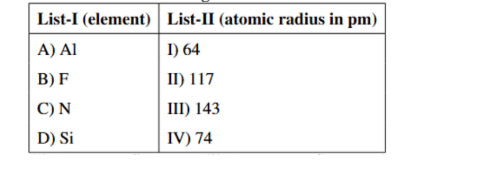
Match List I with List II:
1
A-III, B-I, C-II
2
A-I, B-II, C-III
3
A-IV, B-I, C-II
4
A-II, B-IV, C-II
Official Solution
Correct Option: (1)
- A. Law of conservation of mass is associated with III. A. Lavoisier, who formulated the law that mass is neither created nor destroyed in a chemical reaction.
- B. Law of multiple proportions is associated with I. Dalton, who proposed this law which states that the masses of one element combine with a fixed mass of another element in simple whole number ratios.
- C. Law of definite proportions is associated with II. Joseph Proust, who stated that a given chemical compound always contains the same elements in the same proportions by mass. Thus, the correct answer is Option 1: A - III, B - I, C - II.
12
PYQ 2023
medium
chemistryID: ap-eapce
The energy (in J) released when an excited electron of 5 orbit of hydrogen atom returns to its ground state is
1
2
3
4
Official Solution
Correct Option: (1)
Step 1: Write the formula for energy released during electron transition in hydrogen atom. The energy released when an electron jumps from the orbit to the ground state ( ) is:
For :
The negative sign indicates energy is released. Step 2: Convert energy from eV to Joules. 1 eV J
Final Answer:
13
PYQ 2023
medium
chemistryID: ap-eapce
In which of the following, orbitals are correctly arranged in the increasing order of their energies?
1
4f < 5p < 5d <6s
2
5p < 4f < 6s < 5d
3
5p < 6s < 4f < 5d
4
5p < 5d < 4f < 6s
Official Solution
Correct Option: (3)
Step 1: Understand the Aufbau principle and Hund's rule. The Aufbau principle states that electrons first fill the lowest energy orbitals available. Hund's rule states that within a subshell, electrons will individually occupy each orbital before doubling up in any one orbital. Step 2: Apply the (n+l) rule. The energy of an orbital is determined by the (n+l) rule, where n is the principal quantum number and l is the azimuthal quantum number (l = 0 for s, 1 for p, 2 for d, 3 for f). Step 3: Determine the (n+l) values for each orbital. 5p: n = 5, l = 1, n+l = 6 6s: n = 6, l = 0, n+l = 6 4f: n = 4, l = 3, n+l = 7 5d: n = 5, l = 2, n+l = 7 When orbitals have the same (n+l) value, the orbital with the lower n value has lower energy. Therefore, 5p<6s and 4f<5d. Step 4: Determine the correct order.
5p and 6s have lower (n+l) values than 4f and 5d, so they must come first. Comparing 5p and 6s, 5p has a lower n value, so 5p < 6s. Comparing 4f and 5d, 4f has a lower n value, so 4f< 5d.
Combining these, the correct order is 5p <6s< 4f < 5d. Final Answer:
14
PYQ 2023
medium
chemistryID: ap-eapce
The wave number of a photon is . What is its energy in joules? Given:
1
2
3
4
Official Solution
Correct Option: (1)
The energy of a photon is given by: Substituting the given values: Simplifying: Thus, the energy of the photon is .
15
PYQ 2024
medium
chemistryID: ap-eapce
The difference in radii between fourth and third Bohr orbits of (in m) is:
1
2
3
4
Official Solution
Correct Option: (3)
Step 1: Apply Bohr Radius Formula For a hydrogen-like ion: For ( ): Step 2: Compute the Difference Thus, the correct answer is m.
16
PYQ 2025
medium
chemistryID: ap-eapce
The ratio of wavelengths of first line ( ) and second line ( ) of Balmer series of hydrogen spectrum is
1
9 : 5
2
27 : 20
3
20 : 27
4
5 : 9
Official Solution
Correct Option: (2)
Step 1: Identify the Formula for Wavelength in Hydrogen Spectrum (Rydberg Formula)
For the hydrogen spectrum, the wavelength ( ) of a spectral line is given by the Rydberg formula:
Where:
\begin{itemize} \item is the Rydberg constant. \item is the principal quantum number of the lower energy level. \item is the principal quantum number of the higher energy level, where .
\end{itemize} Step 2: Define Balmer Series Parameters
For the Balmer series, the electron transitions end in the second energy level, meaning . Step 3: Calculate Wavelength for the First Line of Balmer Series
The first line of the Balmer series corresponds to a transition from to .
Let this wavelength be .
Find a common denominator (36):
Step 4: Calculate Wavelength for the Second Line of Balmer Series
The second line of the Balmer series corresponds to a transition from to .
Let this wavelength be .
Find a common denominator (16):
Step 5: Determine the Ratio of Wavelengths
From equation (1), .
From equation (2), . Now, calculate the ratio :
Cancel out :
Simplify the fractions:
The ratio is . Step 6: Analyze Options
\begin{itemize} \item Option (1): 9 : 5. Incorrect. \item Option (2): 27 : 20. Correct, as it matches our calculated ratio. \item Option (3): 20 : 27. Incorrect. \item Option (4): 5 : 9. Incorrect.
\end{itemize}
17
PYQ 2025
medium
chemistryID: ap-eapce
Choose the incorrect statement from the following:
1
For H-atom, the order of energy of orbitals is .
2
The number of radial nodes for a -orbital is zero.
3
The number of angular nodes for a -orbital is 2.
4
The wave character of the electron is not considered in the Bohr model of the H-atom.
Official Solution
Correct Option: (2)
\textbf{Step 1: Analyze Each Statement} Let's evaluate each statement one by one: Statement (1): For H-atom, the order of energy of orbitals is . In hydrogen-like atoms, the energy of orbitals depends only on the principal quantum number ( ). For the same value of , all subshells have the same energy. Therefore, for , the energy levels are: $ n 4f n l 4f n = 4 l = 3 f l = 3 4f 4d l d l = 2 l = 2 $. This statement is correct. Statement (4): The wave character of the electron is not considered in the Bohr model of the H-atom. The Bohr model treats electrons as particles in circular orbits and does not consider their wave nature. This statement is correct. \textbf{Step 2: Identify the Incorrect Statement} From the analysis, Statement (2) is the incorrect statement.
18
PYQ 2025
medium
chemistryID: ap-eapce
Identify the set containing isoelectronic species.
1
, ,
2
, ,
3
, ,
4
, ,
Official Solution
Correct Option: (2)
Step 1: Known Information.
Isoelectronic species are atoms or molecules that have the same number of electrons.
We need to identify the set of species with the same number of electrons. Step 2: Analyze Each Option. 1. Option 1: , , : Nitrogen ( ) has 7 electrons. has electrons. : Oxygen ( ) has 8 electrons. has electrons. Adding one extra electron ( ) gives electrons. : Nitrogen ( ) has 7 electrons. Oxygen ( ) has 8 electrons. has electrons. Removing one electron ( ) gives electrons. Electron Count: (14), (17), (14). Not all species have the same number of electrons. 2. Option 2: , , : As calculated earlier, has 14 electrons. : Carbon ( ) has 6 electrons. Oxygen ( ) has 8 electrons. has electrons. : As calculated earlier, has 14 electrons. Electron Count: (14), (14), (14). All species have the same number of electrons. 3. Option 3: , , : Fluorine ( ) has 9 electrons. has electrons. : As calculated earlier, has 17 electrons. : As calculated earlier, has 14 electrons. Electron Count: (18), (17), (14). Not all species have the same number of electrons. 4. Option 4: , , : As calculated earlier, has 14 electrons. : Oxygen ( ) has 8 electrons. has electrons. Removing one electron ( ) gives electrons. : Carbon ( ) has 6 electrons. has electrons. Electron Count: (14), (15), (12). Not all species have the same number of electrons. Step 3: Correct Answer. The set containing isoelectronic species is:
19
PYQ 2025
easy
chemistryID: ap-eapce
The number of d-electrons in Fe2+ (Z = 26) is not equal to:
Official Solution
Correct Option: (1)
20
PYQ 2025
medium
chemistryID: ap-eapce
The orbital with number of total nodes as 3 and angular nodes as 3 is
1
3d
2
4d
3
4f
4
5p
Official Solution
Correct Option: (1)
Total nodes = , Angular nodes = , Radial nodes = Total - Angular For 3d: - , - Total nodes = , but angular nodes = 2, not 3 → Eliminate Check all: - 3d: total = 2, angular = 2 → No - 4d: , , total = 3, angular = 2 → Not matching - 4f: , , total = 3, angular = 3 Correct answer: **4f**, not 3d % Correction Correction: The actual correct answer should be **(3) 4f**, based on quantum numbers.
21
PYQ 2025
medium
chemistryID: ap-eapce
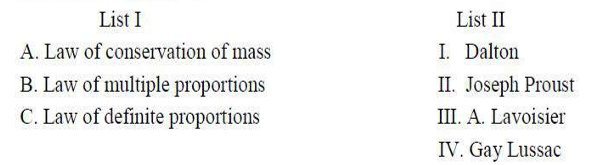
Match the following
1
A-III, B-I, C-IV, D-II
2
A-III, B-IV, C-II, D-I
3
A-I, B-III, C-II, D-IV
4
A-I, B-IV, C-III, D-II
Official Solution
Correct Option: (1)
Step 1: Understand the Trend of Atomic Radius in the Periodic Table
Atomic radius generally follows these trends:
\begin{itemize} \item Decreases across a period from left to right: As you move across a period, the effective nuclear charge increases, pulling the electrons closer to the nucleus, thus decreasing the atomic radius. \item Increases down a group: As you move down a group, new electron shells are added, increasing the distance of the outermost electrons from the nucleus, thus increasing the atomic radius despite an increase in nuclear charge.
\end{itemize} Step 2: Identify the Elements and Their Positions
The given elements are:
\begin{itemize} \item A) Al (Aluminum): Period 3, Group 13. \item B) F (Fluorine): Period 2, Group 17. \item C) N (Nitrogen): Period 2, Group 15. \item D) Si (Silicon): Period 3, Group 14.
\end{itemize} Ordering them by expected atomic radius (smallest to largest): % Option
(A) Fluorine (F) - Period 2, Group 17 (smallest due to highest effective nuclear charge in Period 2 among these and only 2 shells).
% Option
(B) Nitrogen (N) - Period 2, Group 15 (larger than F as it's to the left of F in Period 2).
% Option
(C) Silicon (Si) - Period 3, Group 14 (larger than Period 2 elements due to more shells, but smaller than Al as it's to the right of Al in Period 3).
% Option
(D) Aluminum (Al) - Period 3, Group 13 (largest among these as it's furthest left in Period 3 among these, and has 3 shells). So, the expected order of increasing atomic radii is F< N< Si< Al. Step 3: Match Elements with Given Atomic Radii
The given atomic radii in pm are: I) 64, II) 117, III) 143, IV) 74.
Ordering these radii from smallest to largest: 64 pm, 74 pm, 117 pm, 143 pm. Now, let's match based on our expected order:
\begin{itemize} \item B) F (Fluorine): Expected to be the smallest. Matches with I) 64 pm. \item C) N (Nitrogen): Expected to be the second smallest. Matches with IV) 74 pm. \item D) Si (Silicon): Expected to be the third smallest (or second largest). Matches with II) 117 pm. \item A) Al (Aluminum): Expected to be the largest. Matches with III) 143 pm.
\end{itemize} Therefore, the matches are:
A) Al - III) 143 pm
B) F - I) 64 pm
C) N - IV) 74 pm
D) Si - II) 117 pm Step 4: Compare with Options
Let's check Option (1): A-III, B-I, C-IV, D-II.
This perfectly matches our derived mapping. Step 5: Analyze the Options
\begin{itemize} \item Option (1): A-III, B-I, C-IV, D-II. This is the correct match. \item Option (2): A-III, B-IV, C-II, D-I. Incorrect. \item Option (3): A-I, B-III, C-II, D-IV. Incorrect. \item Option (4): A-I, B-IV, C-III, D-II. Incorrect.
\end{itemize}
22
PYQ 2025
easy
chemistryID: ap-eapce
The total maximum number of electrons possible in 3d, 6d, 5s and 4f orbitals with (magnetic quantum number) value -2 is
1
2
3
4
Official Solution
Correct Option: (1)
Step 1: Understand the magnetic quantum number ( ). The magnetic quantum number ( ) describes the orientation of an orbital in space. For a given azimuthal (or angular momentum) quantum number , the possible values of range from to , including 0. Each unique value corresponds to one specific orbital. Each orbital can hold a maximum of two electrons (according to the Pauli Exclusion Principle), one with spin and one with spin . Step 2: Analyze each given orbital type for the possibility of . 3d orbital: For a d-orbital, the azimuthal quantum number . The possible values for are . Since is a possible value for a d-orbital, the 3d subshell contains an orbital with . This orbital can accommodate a maximum of 2 electrons. 6d orbital: Similar to 3d, for a d-orbital, . The possible values for are . Since is a possible value for a d-orbital, the 6d subshell contains an orbital with . This orbital can accommodate a maximum of 2 electrons. 5s orbital: For an s-orbital, the azimuthal quantum number . The only possible value for is . Therefore, is NOT possible for a 5s orbital. It contributes 0 electrons to the count. 4f orbital: For an f-orbital, the azimuthal quantum number . The possible values for are . Since is a possible value for an f-orbital, the 4f subshell contains an orbital with . This orbital can accommodate a maximum of 2 electrons. Step 3: Calculate the total maximum number of electrons. Sum the maximum number of electrons from each orbital type that satisfies the condition : Total electrons = (electrons in 3d with ) + (electrons in 6d with ) + (electrons in 5s with ) + (electrons in 4f with ) Total electrons = 2 + 2 + 0 + 2 = 6 electrons. The final answer is .
23
PYQ 2025
easy
chemistryID: ap-eapce
In an element with atomic number (Z) 25, the number of electrons with (n + l) value equal to 3 and 4 are x and y respectively. The value of (x + y) is
1
21
2
12
3
14
4
16
Official Solution
Correct Option: (4)
Let’s break this down step by step to calculate the number of electrons with specific (n + l) values and determine why option (4) is the correct answer. Step 1: Understand the electron configuration of the element The atomic number corresponds to manganese (Mn). Its electron configuration is:
Total electrons = 25, which matches the atomic number. Step 2: Calculate the (n + l) values for each subshell
For : , , , 2 electrons.
For : , , , 6 electrons.
For : , , , 2 electrons.
For : , , , 6 electrons.
For : , , , 5 electrons.
For : , , , 2 electrons.
Step 3: Sum the electrons with (n + l) = 3 and (n + l) = 4
For :
: 6 electrons
: 2 electrons
Total = (so ).
For :
: 6 electrons
: 2 electrons
Total = (so ).
Step 4: Confirm the correct answer The value of is 16, which matches option (4). Thus, the correct answer is (4) 16.
24
PYQ 2025
medium
chemistryID: ap-eapce
Which of the following has the highest ionization energy?
1
Lithium
2
Beryllium
3
Fluorine
4
Neon
Official Solution
Correct Option: (4)
To determine which element has the highest ionization energy, we need to consider periodic trends. Ionization energy is the energy required to remove an electron from a gaseous atom. In the periodic table, ionization energy increases across a period from left to right and decreases down a group. This trend is due to the increasing effective nuclear charge across a period, which causes electrons to be more strongly attracted to the nucleus.
Analyzing the given options:
Lithium (Li) is in Group 1, Period 2
Beryllium (Be) is in Group 2, Period 2
Fluorine (F) is in Group 17, Period 2
Neon (Ne) is in Group 18, Period 2
All these elements belong to the same period (Period 2), so we compare them based on their group. As we move from left to right across a period, ionization energy increases due to the effective nuclear charge. Thus, among these elements, Neon (Ne), being the rightmost and a noble gas, will have the highest ionization energy. Noble gases have fully filled outer electron shells which makes them very stable and require more energy to remove an electron.
Therefore, Neon has the highest ionization energy among the given options.
25
PYQ 2025
easy
chemistryID: ap-eapce
Which element has the smallest atomic radius among the following?
1
Li
2
C
3
F
4
Ne
Official Solution
Correct Option: (4)
Atomic radius decreases across a period due to increasing nuclear charge. Among the given elements in Period 2, Neon is the last and has the highest effective nuclear charge, pulling electrons closer and resulting in the smallest radius.
26
PYQ 2025
medium
chemistryID: ap-eapce
The ratio of wavelengths of first line ( ) and second line ( ) of Balmer series of hydrogen spectrum is
1
9 : 5
2
27 : 20
3
20 : 27
4
5 : 9
Official Solution
Correct Option: (2)
Step 1: Identify the Formula for Wavelength in Hydrogen Spectrum (Rydberg Formula)
For the hydrogen spectrum, the wavelength ( ) of a spectral line is given by the Rydberg formula:
Where:
\begin{itemize} \item is the Rydberg constant. \item is the principal quantum number of the lower energy level. \item is the principal quantum number of the higher energy level, where .
\end{itemize} Step 2: Define Balmer Series Parameters
For the Balmer series, the electron transitions end in the second energy level, meaning . Step 3: Calculate Wavelength for the First Line of Balmer Series
The first line of the Balmer series corresponds to a transition from to .
Let this wavelength be .
Find a common denominator (36):
Step 4: Calculate Wavelength for the Second Line of Balmer Series
The second line of the Balmer series corresponds to a transition from to .
Let this wavelength be .
Find a common denominator (16):
Step 5: Determine the Ratio of Wavelengths
From equation (1), .
From equation (2), . Now, calculate the ratio :
Cancel out :
Simplify the fractions:
The ratio is . Step 6: Analyze Options
\begin{itemize} \item Option (1): 9 : 5. Incorrect. \item Option (2): 27 : 20. Correct, as it matches our calculated ratio. \item Option (3): 20 : 27. Incorrect. \item Option (4): 5 : 9. Incorrect.
\end{itemize}
27
PYQ 2025
medium
chemistryID: ap-eapce
In Am (Z = 95), the number of f-electrons with ( ) value equal to 8 is (where , represent principal and azimuthal quantum numbers)
1
7
2
6
3
5
4
4
Official Solution
Correct Option: (2)
Atomic number of Am (Americium) is 95. The electron configuration of Am is [Rn]5f 7s . For Am , three electrons are removed, primarily from the 7s and 5f orbitals, resulting in [Rn]5f .
For f-electrons, . So, to get , (since 5f: , ). Hence, we count all the electrons in 5f orbitals.
Thus, 6 electrons exist in 5f orbital with .