In SN2 reaction, the carbon in the transition state is:
1
Tri coordinated
2
Penta coordinated
3
Tetra coordinated
4
Hexa coordinated
Official Solution
Correct Option: (3)
In an SN2 reaction, the transition state involves the central carbon atom being bonded to five different entities: the nucleophile, the leaving group, and the two substituents that are attached to the carbon. This results in the carbon being tetra coordinated in the transition state, as it is simultaneously interacting with four groups in a partially bonded manner. Thus, the correct answer is (3) Tetra coordinated.
02
PYQ 2023
medium
chemistryID: ap-eapce
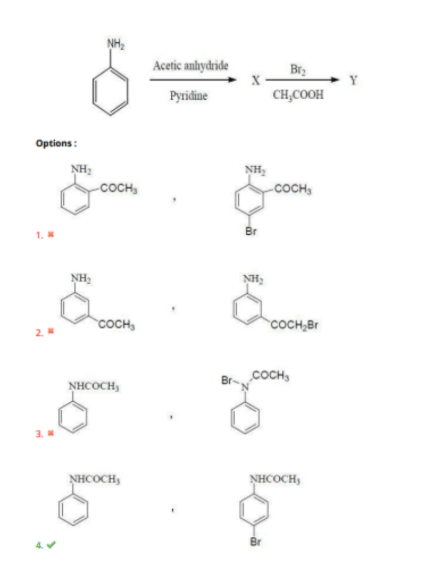
X and Y (major products) in the following reaction sequence are
1
Option A
2
Option B
3
Option C
4
Option D
Official Solution
Correct Option: (4)
The reaction sequence starts with aniline reacting with acetic anhydride in the presence of pyridine. Acetic anhydride is an acetylating agent, and pyridine acts as a base to facilitate the reaction by removing the byproduct. This reaction will acetylate the amino group ( ) of aniline to form an amide ( ), which is acetanilide. The amino group is a strong activating and ortho/para-directing group in electrophilic aromatic substitution. By converting it to an amide, we make it moderately activating and still ortho/para-directing, but less so. This step is done to control the subsequent bromination. Thus, X is acetanilide. The structure of X (acetanilide) is: In the second step, acetanilide reacts with in acetic acid ( ). Bromine is an electrophile, and acetanilide will undergo electrophilic aromatic substitution. The amide group ( ) is an ortho/para-directing group. However, due to steric hindrance at the ortho positions (adjacent to the bulky amide group) and the slightly higher activation of the para position, the major product will be the para-substituted bromoacetanilide. The structure of Y (para-bromoacetanilide) is: Comparing these structures with the options, option (D) correctly shows X as acetanilide and Y as para-bromoacetanilide.
03
PYQ 2025
medium
chemistryID: ap-eapce
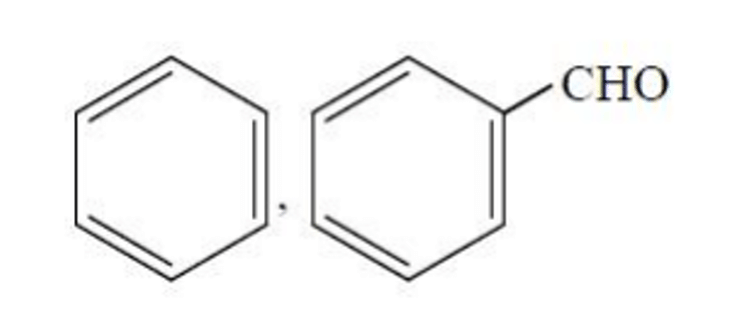
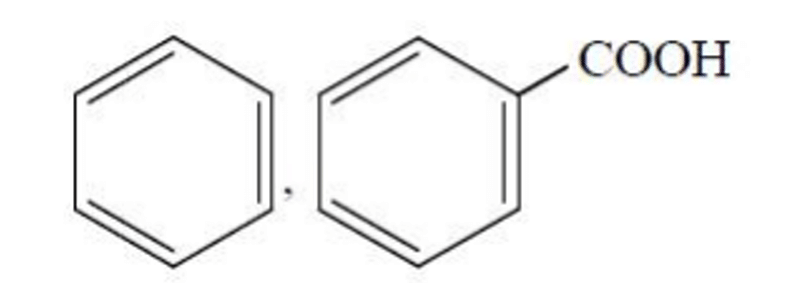
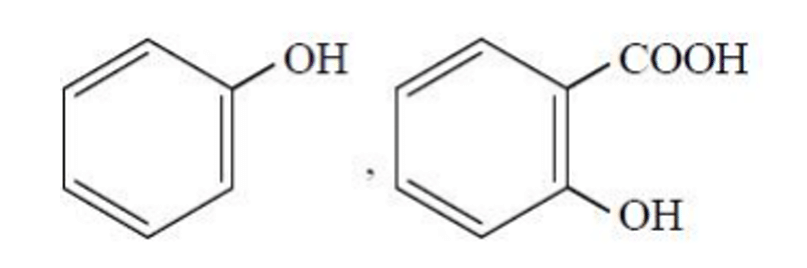
What are X and Y respectively in the following reaction sequence? ( )
% The question implies the first X is an anion, the second X is an organic product. Let's call the organic product P1 to avoid confusion.
% So, C6H5N2+Anion- → P1 → Y
1
Benzene for P1 (X in Q), Benzaldehyde for Y
2
Benzene for P1, Benzoic acid for Y
3
Phenol for P1, Salicylic acid (o-Hydroxybenzoic acid) for Y
4
Phenol for P1, Salicylaldehyde (o-Hydroxybenzaldehyde) for Y
Official Solution
Correct Option: (1)
The starting material is a benzenediazonium salt, . Let's assume X is Cl or HSO typically.
Step 1: Product (referred to as X in options, let's call it P1). Reaction of diazonium salts with ethanol (C H OH) can lead to reduction of the diazonium group to -H (forming benzene) or substitution by -OC H (forming phenetole, an ether). The reduction to benzene is favored, especially if a reducing agent like H PO is also present or if the ethanol acts as the reducing agent (it gets oxidized to ethanal). So, P1 (X in the options) is Benzene ( ). Step 2: P1 ( ) Y This reaction of benzene with carbon monoxide (CO) and hydrogen chloride (HCl) in the presence of anhydrous AlCl (often with CuCl as a co-catalyst) is the Gattermann-Koch reaction. It is used to introduce an aldehyde group (-CHO) onto the benzene ring. (The HCl is formally regenerated or used in forming the electrophile [HCO] ). Product Y is Benzaldehyde ( ). So, X (P1) is Benzene and Y is Benzaldehyde.
This corresponds to the structures shown in option (1). Let's check other possibilities if P1 were Phenol:
If reacts with warm water or dilute acid, it forms phenol ( ). Ethanol can sometimes lead to ether formation too.
If P1 was Phenol: Phenol Y This reaction (Gattermann-Koch) on phenol is not standard for simple formylation. Phenols are highly activated. Formylation of phenol usually occurs via Reimer-Tiemann (CHCl /NaOH) or Gattermann aldehyde synthesis (using HCN/HCl then hydrolysis, not CO/HCl). If Gattermann-Koch were applied to phenol, it would likely give p-hydroxybenzaldehyde or a mixture. Options (3) and (4) suggest P1 is Phenol. Option (3) makes Y Salicylic acid (o-Hydroxybenzoic acid). Option (4) makes Y Salicylaldehyde (o-Hydroxybenzaldehyde). Salicylic acid is COOH, Gattermann-Koch gives CHO. Salicylaldehyde is formylation at ortho. The most standard interpretations are:
- Diazonium salt + Ethanol Benzene (reduction).
- Benzene + CO/HCl/AlCl (Gattermann-Koch) Benzaldehyde.
This makes X=Benzene, Y=Benzaldehyde.
04
PYQ 2025
medium
chemistryID: ap-eapce
The sequence of reagents required to convert aniline to benzoic acid is:
1
2
3
4
Official Solution
Correct Option: (3)
Step 1: Diazotization of Aniline Aniline ( ) reacts with sodium nitrite ( ) and hydrochloric acid ( ) at low temperatures (273 - 278 K), forming benzene diazonium chloride ( ). Step 2: Sandmeyer Reaction - Cyanation Benzene diazonium chloride reacts with copper(I) cyanide ( ) and potassium cyanide ( ), replacing the diazonium group with cyano (-CN) group, forming benzonitrile ( ). Step 3: Hydrolysis to Benzoic Acid Benzonitrile undergoes acidic hydrolysis using (aqueous acid), converting the cyano (-CN) group into a carboxyl (-COOH) group, forming benzoic acid ( ). Conclusion Thus, the correct answer is:
05
PYQ 2025
medium
chemistryID: ap-eapce
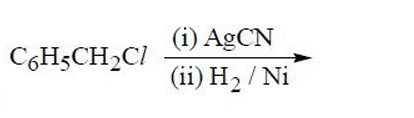
Benzyl amine can be prepared from which of the following reactions?
1
2
3
4
Official Solution
Correct Option: (4)
Benzyl amine can be synthesized via the reaction in option (4), which involves the reduction of the corresponding nitrile to the amine using LiAlH₄.
06
PYQ 2025
easy
chemistryID: ap-eapce
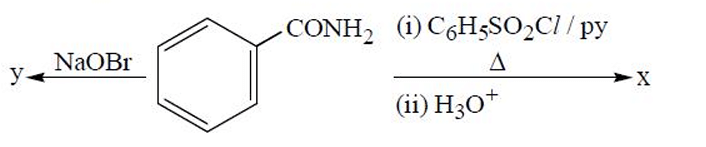
What are x and y in the following set of reactions?
Official Solution
Correct Option: (1)
07
PYQ 2025
medium
chemistryID: ap-eapce
The sequence of reagents required to convert aniline to benzoic acid is:
1
2
3
4
Official Solution
Correct Option: (3)
Step 1: Diazotization of Aniline Aniline ( ) reacts with sodium nitrite ( ) and hydrochloric acid ( ) at low temperatures (273 - 278 K), forming benzene diazonium chloride ( ). Step 2: Sandmeyer Reaction - Cyanation Benzene diazonium chloride reacts with copper(I) cyanide ( ) and potassium cyanide ( ), replacing the diazonium group with cyano (-CN) group, forming benzonitrile ( ). Step 3: Hydrolysis to Benzoic Acid Benzonitrile undergoes acidic hydrolysis using (aqueous acid), converting the cyano (-CN) group into a carboxyl (-COOH) group, forming benzoic acid ( ). Conclusion Thus, the correct answer is:
08
PYQ 2025
medium
chemistryID: ap-eapce
The correct statement regarding the mechanism involved in the above reactions is
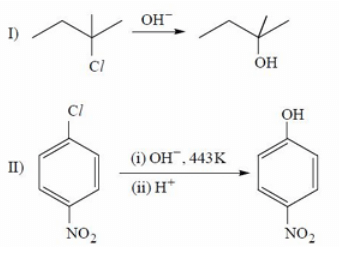
1
In both I, II C--Cl bond is cleaved in slow step of the reaction
2
In both I, II C--Cl bond is cleaved in fast step of the reaction
3
In I C--Cl bond is cleaved in slow step and in II fast step of the reaction
4
In I C--Cl bond is cleaved in fast step and in II slow step of the reaction
Official Solution
Correct Option: (3)
In the SN1 mechanism (reaction I), the C--Cl bond breaks in the slow step, forming a carbocation. In reaction II (aromatic nucleophilic substitution), the presence of strong electron-withdrawing groups facilitates faster bond cleavage.
09
PYQ 2025
medium
chemistryID: ap-eapce
Consider the following statements:
Statement-I: CH NH is more basic than NH , but C H NH is less basic than NH .
Statement-II: The order of basic strength of amines in aqueous phase follows
(C H ) NH > C H NH > C H NH
1
Both statement-I and statement-II are correct
2
Both statement-I and statement-II are not correct
3
Statement-I is correct, but statement-II is not correct
4
Statement-I is not correct, but statement-II is correct
Official Solution
Correct Option: (3)
Statement-I is correct: CH NH is more basic than NH (due to +I effect), while C H NH is less basic due to resonance.
However, in aqueous medium, basicity does not follow the order given in II due to solvation effects; hence Statement-II is incorrect.
10
PYQ 2025
medium
chemistryID: ap-eapce
What are X and Y respectively in the following reaction sequence? ( )
% The question implies the first X is an anion, the second X is an organic product. Let's call the organic product P1 to avoid confusion.
% So, C6H5N2+Anion- → P1 → Y
1
Benzene for P1 (X in Q), Benzaldehyde for Y
2
Benzene for P1, Benzoic acid for Y
3
Phenol for P1, Salicylic acid (o-Hydroxybenzoic acid) for Y
4
Phenol for P1, Salicylaldehyde (o-Hydroxybenzaldehyde) for Y
Official Solution
Correct Option: (1)
The starting material is a benzenediazonium salt, . Let's assume X is Cl or HSO typically.
Step 1: Product (referred to as X in options, let's call it P1). Reaction of diazonium salts with ethanol (C H OH) can lead to reduction of the diazonium group to -H (forming benzene) or substitution by -OC H (forming phenetole, an ether). The reduction to benzene is favored, especially if a reducing agent like H PO is also present or if the ethanol acts as the reducing agent (it gets oxidized to ethanal). So, P1 (X in the options) is Benzene ( ). Step 2: P1 ( ) Y This reaction of benzene with carbon monoxide (CO) and hydrogen chloride (HCl) in the presence of anhydrous AlCl (often with CuCl as a co-catalyst) is the Gattermann-Koch reaction. It is used to introduce an aldehyde group (-CHO) onto the benzene ring. (The HCl is formally regenerated or used in forming the electrophile [HCO] ). Product Y is Benzaldehyde ( ). So, X (P1) is Benzene and Y is Benzaldehyde.
This corresponds to the structures shown in option (1). Let's check other possibilities if P1 were Phenol:
If reacts with warm water or dilute acid, it forms phenol ( ). Ethanol can sometimes lead to ether formation too.
If P1 was Phenol: Phenol Y This reaction (Gattermann-Koch) on phenol is not standard for simple formylation. Phenols are highly activated. Formylation of phenol usually occurs via Reimer-Tiemann (CHCl /NaOH) or Gattermann aldehyde synthesis (using HCN/HCl then hydrolysis, not CO/HCl). If Gattermann-Koch were applied to phenol, it would likely give p-hydroxybenzaldehyde or a mixture. Options (3) and (4) suggest P1 is Phenol. Option (3) makes Y Salicylic acid (o-Hydroxybenzoic acid). Option (4) makes Y Salicylaldehyde (o-Hydroxybenzaldehyde). Salicylic acid is COOH, Gattermann-Koch gives CHO. Salicylaldehyde is formylation at ortho. The most standard interpretations are:
- Diazonium salt + Ethanol Benzene (reduction).
- Benzene + CO/HCl/AlCl (Gattermann-Koch) Benzaldehyde.
This makes X=Benzene, Y=Benzaldehyde.