An element (atomic number 13) forms a complex of the type . What are the covalency and oxidation state of in this complex?
1
5, +2
2
6, +2
3
5, +3
4
6, +3
Official Solution
Correct Option: (4)
The complex is:
There are:
- 5 water ligands (neutral)
- 1 chloride ion (–1) Let oxidation state of be :
Covalency is number of sigma bonds formed by the central metal — here 6 (5 with and 1 with ).
02
PYQ 2022
medium
chemistryID: ap-eapce
Aluminium chloride in acidified aqueous solution gives a complex ion 'X'. The hybridization of central atom in X is
1
sp
2
sp d
3
d sp
4
sp d
Official Solution
Correct Option: (4)
Aluminium chloride (AlCl ) is a Lewis acid. In aqueous solution, it reacts with water.
The Al ion is small and highly charged, leading to strong interactions with water molecules (hydration).
In aqueous solution, aluminium ions typically exist as hydrated ions. The most common hydrated aluminium ion is hexaaquaaluminium(III), [Al(H O) ] .
Water molecules (H O) act as Lewis bases (ligands), donating a pair of electrons to the Al ion to form coordinate covalent bonds.
The complex ion 'X' formed is [Al(H O) ] . In this complex ion:
The central atom is Aluminium (Al).
The ligands are six water molecules (H O).
The coordination number of Al is 6.
The geometry of a 6-coordinate complex is typically octahedral. To determine the hybridization of the central Al atom in [Al(H O) ] :
Electronic configuration of Al (atomic number 13): .
Electronic configuration of Al ion: (or [Ne]).
For bonding with 6 H O ligands in an octahedral geometry, the Al ion needs 6 empty orbitals of suitable energy to accept electron pairs from the ligands.
These orbitals are formed by hybridization.
The available empty orbitals in Al for hybridization (from shell onwards) are , , and orbitals ( for octahedral).
For octahedral geometry (coordination number 6), the hybridization can be either (using outer orbitals) or (using inner orbitals).
Since Al is a third-period element, its shell contains and orbitals. Al has lost its and electrons. For bonding, it uses its empty , three , and two orbitals. These are all from the same principal quantum shell ( ).
The hybridization for an octahedral complex involving and orbitals of the same shell (or outer ) is .
Specifically, Al uses one , three , and two orbitals ( and ) to form six hybrid orbitals. These hybrid orbitals overlap with orbitals from the six H O ligands. Therefore, the hybridization of the central Al atom in [Al(H O) ] is .
The acidified aqueous solution ensures that Al(OH) does not precipitate; the Al remains in solution primarily as the hexaaqua complex.
03
PYQ 2022
medium
chemistryID: ap-eapce
Match the following:List - I \quad (Type of hydride) \quad List - II \quad (Example)A) Electron precise \quad i) SiH B) Saline \quad ii) H OC) Electron deficient \quad iii) MgH D) Electron rich \quad iv) B H
1
A-(ii), B-(iii), C-(i), D-(iv)
2
A-(i), B-(iii), C-(iv), D-(ii)
3
A-(iv), B-(ii), C-(iii), D-(i)
4
A-(ii), B-(i), C-(iv), D-(iii)
Official Solution
Correct Option: (2)
Let's classify each example hydride from List-II according to the types in List-I. Types of Hydrides:
\begin{itemize} \item Electron precise hydrides: These are typically formed by Group 14 elements. The central atom has exactly the number of electrons required to form normal covalent bonds (octet satisfied with no lone pairs or electron deficiency). Example: CH , SiH . \item Saline hydrides (or Ionic hydrides): These are formed by s-block elements (Group 1 and Group 2, except Be and sometimes Mg due to covalent character). They are ionic compounds containing H ions. Example: NaH, CaH , MgH . \item Electron deficient hydrides: These are typically formed by Group 13 elements. The central atom has fewer electrons than required to form normal covalent bonds and achieve an octet. They often form polymeric structures or involve multi-center bonds. Example: B H (diborane). \item Electron rich hydrides: These are typically formed by Group 15, 16, and 17 elements. The central atom has one or more lone pairs of electrons after forming normal covalent bonds. Example: NH , H O, HF.
\end{itemize} Now let's match the examples from List-II:
\begin{itemize} \item i) SiH (Silane): Silicon is in Group 14. SiH has a tetrahedral structure with Si forming four single covalent bonds with H atoms. Silicon completes its octet. This is an electron precise hydride. So, A - Electron precise matches with i) SiH . \item ii) H O (Water): Oxygen is in Group 16. In H O, oxygen forms two single covalent bonds with H atoms and has two lone pairs of electrons. It has more electrons (lone pairs) than needed for bonding. This is an electron rich hydride. So, D - Electron rich matches with ii) H O. \item iii) MgH (Magnesium hydride): Magnesium is in Group 2 (alkaline earth metal). MgH is generally considered an ionic or saline hydride, containing Mg and H ions, although it has some covalent character. Among the given categories, "Saline" is the best fit. So, B - Saline matches with iii) MgH . \item iv) B H (Diborane): Boron is in Group 13. In B H , each boron atom does not have enough electrons to form normal two-center-two-electron bonds with all surrounding atoms. It features banana bonds (three-center-two-electron bonds). This is an electron deficient hydride. So, C - Electron deficient matches with iv) B H .
\end{itemize} Summarizing the matches:
A - (i)
B - (iii)
C - (iv)
D - (ii) This set of matches corresponds to option (b).
04
PYQ 2022
medium
chemistryID: ap-eapce
The hybridization of metals involved in the following complexes, respectively are[Mn(CN) ] , [CoF ]
1
sp d , sp d
2
sp d , d sp
3
d sp , d sp
4
d sp , sp d
Official Solution
Correct Option: (4)
Both complexes have a coordination number of 6, suggesting an octahedral geometry. For octahedral geometry, the hybridization can be (inner orbital complex) or (outer orbital complex). This depends on whether inner ( orbitals or outer orbitals are used for hybridization. Ligand strength plays a key role. 1. [Mn(CN) ] :}
\begin{itemize} \item Central metal ion: Manganese (Mn). \item Oxidation state of Mn: Let it be . CN is a ligand with -1 charge. . So, Mn is in the +3 oxidation state (Mn ). \item Electronic configuration of Mn (Z=25): [Ar] . \item Electronic configuration of Mn : [Ar] (loses two and one electron). \item Ligand: CN (cyanide ion). CN is a strong field ligand. Strong field ligands cause pairing of electrons in the orbitals if possible, leading to low spin complexes and often using inner orbitals for hybridization ( ). \item For Mn ( ) in an octahedral field with strong ligands (CN ): The four electrons will occupy the orbitals. Pairing will occur. orbitals can hold up to 6 electrons. low spin: . Three electrons in separate orbitals, then the fourth pairs up in one of them. Or if pairing energy is less than , then configuration could be two paired and two empty if using for . For hybridization, two orbitals (here, ), one (here, ), and three (here, ) orbitals are used. The orbitals split into (lower energy) and (higher energy) sets in an octahedral field. For Mn ( ) with a strong field ligand (CN ), it will be a low spin complex. The electrons fill first: . For example, . The two orbitals ( ) are empty and available from the set. These can be used for hybridization if they are the correct ones. Actually, for , the specific orbitals used are and (which are the set). In Mn ( ), the electrons are arranged in and orbitals. Low spin : . Here, the two orbitals are empty. So, these two orbitals ( ) can participate in hybridization along with and orbitals. Thus, hybridization for [Mn(CN) ] is (inner orbital complex).
\end{itemize} 2. [CoF ] :}
\begin{itemize} \item Central metal ion: Cobalt (Co). \item Oxidation state of Co: Let it be . F is a ligand with -1 charge. . So, Co is in the +3 oxidation state (Co ). \item Electronic configuration of Co (Z=27): [Ar] . \item Electronic configuration of Co : [Ar] (loses two and one electron). \item Ligand: F (fluoride ion). F is a weak field ligand. Weak field ligands generally do not cause pairing of electrons in the orbitals, leading to high spin complexes and often using outer orbitals for hybridization ( ). \item For Co ( ) in an octahedral field with weak ligands (F ), it will be a high spin complex. The six electrons are distributed as according to Hund's rule (fill with 3, then with 2, then pair in for the 6th electron). (one pairing in ) Total high spin: . Both orbitals ( ) from the set are occupied by single electrons. They are not empty to participate in hybridization. Therefore, the complex uses outer orbitals for hybridization. The hybridization will be , using one , three , and two orbitals. Thus, hybridization for [CoF ] is (outer orbital complex).
\end{itemize} So, the hybridizations are for [Mn(CN) ] and for [CoF ] .
This matches option (d).
05
PYQ 2023
medium
chemistryID: ap-eapce
IUPAC name of [Pt(NH ) Cl(NH CH )]Cl is
1
Amino methane chloro (diamine) platinum (II) chloride
2
Chlorodiammine (methanamine) platinum (II) chloride
3
Diamminechloro (methanamine) platinum (II) chloride
The IUPAC name for the given complex [Pt(NH ) Cl(NH CH )]Cl is Diamminechloro (methanamine) platinum (II) chloride. The ligands are ammine (NH ), chloro (Cl), and methanamine (NH CH ). Platinum is in the +2 oxidation state.
06
PYQ 2023
medium
chemistryID: ap-eapce
The correct increasing order for the wavelengths of absorption in the visible region for the following Co complexes is: (i) [Co(NH ) ] (ii) [Co(H O) ] (iii) [Co(en) ]
1
iii, i, ii
2
i, ii, iii
3
ii, i, iii
4
iii, ii, i
Official Solution
Correct Option: (1)
Wavelength (Crystal field splitting energy)
Order of ligand strength: H O
Thus, : (ii)<(i)<(iii)
So, : (iii)<(i)<(ii) (inverse relation)
07
PYQ 2025
medium
chemistryID: ap-eapce
The co-ordination number of chromium in K[Cr(H O) (C O ) ] is
1
5
2
4
3
6
4
3
Official Solution
Correct Option: (3)
In the complex K[Cr(H O) (C O ) ], chromium is coordinated to two water molecules (H O) and two oxalate ions (C O ). Oxalate is a bidentate ligand, meaning it coordinates through two oxygen atoms. Therefore, each oxalate ion contributes two coordination sites. Water molecules: 2 coordination sites Oxalate ions: 2 ions 2 sites/ion = 4 coordination sites Total coordination number = 2 + 4 = 6.
08
PYQ 2025
medium
chemistryID: ap-eapce
Identify the complex ion with spin only magnetic moment of 4.90 BM.
1
[Co(NH ) ]
2
[Cr(NH ) ]
3
[Mn(CN) ]
4
[MnCl ]
Official Solution
Correct Option: (4)
Step 1: Understand the formula for spin-only magnetic moment. The spin-only magnetic moment ( ) is given by the formula: where 'n' is the number of unpaired electrons and BM stands for Bohr Magneton. We are given . Let's find the number of unpaired electrons (n) corresponding to this magnetic moment.
Squaring both sides:
We can approximate to be 4 since . So, we are looking for a complex ion with 4 unpaired electrons. Step 2: Determine the number of unpaired electrons for each complex ion option. 1. [Co(NH ) ] Oxidation state of Co: Let it be . . Cobalt (Co) has atomic number 27. Electronic configuration: [Ar] 3d 4s . Co electronic configuration: [Ar] 3d . NH (ammonia) is a strong field ligand. In the presence of a strong field ligand, the 3d electrons pair up. . Number of unpaired electrons (n) = 0. . This is not 4.90 BM. 2. [Cr(NH ) ] Oxidation state of Cr: Let it be . . Chromium (Cr) has atomic number 24. Electronic configuration: [Ar] 3d 4s . Cr electronic configuration: [Ar] 3d . NH is a strong field ligand. However, for d configuration, irrespective of strong or weak field ligand, the electrons occupy orbitals singly before pairing. . Number of unpaired electrons (n) = 3. . This is not 4.90 BM. 3. [Mn(CN) ] Oxidation state of Mn: Let it be . . Manganese (Mn) has atomic number 25. Electronic configuration: [Ar] 3d 4s . Mn electronic configuration: [Ar] 3d . CN (cyanide) is a very strong field ligand. In the presence of a strong field ligand, the 3d electrons pair up. . (This configuration is for low spin complex, one electron pairs up in ). Number of unpaired electrons (n) = 2. . This is not 4.90 BM. 4. [MnCl ] Oxidation state of Mn: Let it be . . Manganese (Mn) has atomic number 25. Electronic configuration: [Ar] 3d 4s . Mn electronic configuration: [Ar] 3d . Cl (chloride) is a weak field ligand. In the presence of a weak field ligand, the 3d electrons will follow Hund's rule and occupy orbitals singly as much as possible before pairing. This forms a high spin complex. . Number of unpaired electrons (n) = 4. . This matches 4.90 BM. Step 3: Conclude the complex ion. The complex ion [MnCl ] has 4 unpaired electrons and thus a spin-only magnetic moment of approximately 4.90 BM. The final answer is .
09
PYQ 2025
medium
chemistryID: ap-eapce
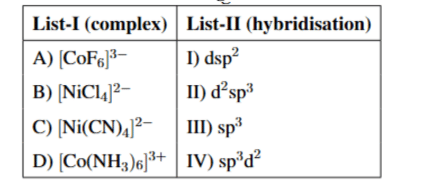
Match the following The correct answer is:
1
A-IV, B-I, C-III, D-II
2
A-II, B-I, C-III, D-IV
3
A-IV, B-III, C-I, D-II
4
A-II, B-III, C-I, D-IV
Official Solution
Correct Option: (3)
To determine the hybridization of the central metal ion in each complex, we need to consider the oxidation state of the metal, its d-electron configuration, and the nature of the ligands (strong field or weak field). A)
\begin{itemize} \item Central metal: Co \item Oxidation state: Let oxidation state of Co be . . So, . \item Electronic configuration of : \item Electronic configuration of : \item Ligand: (Fluoride) is a weak field ligand. \item Since is a weak field ligand, it does not cause pairing of electrons in the 3d orbitals. \item The 6 ligands will occupy 4s, 4p, and 4d orbitals. \item Hybridization: (outer orbital complex) \item This matches with IV) .
\end{itemize} B)
\begin{itemize} \item Central metal: Ni \item Oxidation state: Let oxidation state of Ni be . . So, . \item Electronic configuration of : \item Electronic configuration of : \item Ligand: (Chloride) is a weak field ligand. \item Since is a weak field ligand, it does not cause pairing of electrons. \item For a coordination number of 4, with weak field ligands, tetrahedral geometry and hybridization are common. \item Available orbitals for hybridization: 3d (full), 4s, 4p. \item Hybridization: \item This matches with III) .
\end{itemize} C) }
\begin{itemize} \item Central metal: Ni \item Oxidation state: Let oxidation state of Ni be . . So, . \item Electronic configuration of : \item Electronic configuration of : \item Ligand: (Cyanide) is a strong field ligand. \item Since is a strong field ligand, it causes pairing of electrons in the 3d orbitals. For , the two unpaired electrons will pair up, leaving one 3d orbital vacant. \item Available orbitals for hybridization: one 3d, 4s, two 4p. \item Hybridization: (inner orbital complex, square planar geometry) \item This matches with I) .
\end{itemize} D) }
\begin{itemize} \item Central metal: Co \item Oxidation state: Let oxidation state of Co be . . So, . \item Electronic configuration of : \item Electronic configuration of : \item Ligand: (Ammonia) is a strong field ligand for . \item Since is a strong field ligand, it causes pairing of electrons in the 3d orbitals. For , the electrons will pair up, leaving two 3d orbitals vacant. \item Available orbitals for hybridization: two 3d, 4s, three 4p. \item Hybridization: (inner orbital complex, octahedral geometry) \item This matches with II) .
\end{itemize} Step 6: Form the Correct Match
A - IV
B - III
C - I
D - II Step 7: Analyze Options
\begin{itemize} \item Option (1): A-IV, B-I, C-III, D-II. Incorrect. \item Option (2): A-II, B-I, C-III, D-IV. Incorrect. \item Option (3): A-IV, B-III, C-I, D-II. Correct, as it matches our derived hybridizations. \item Option (4): A-II, B-III, C-I, D-IV. Incorrect.
\end{itemize}
10
PYQ 2025
medium
chemistryID: ap-eapce
Match the following:
List-I (Complex)
List-II (Isomerism)
A) [Co(NH3)5Br]SO4
V) Ionization
B) [Co(en)3]3+
I) Optical
C) [Co(NH3)5(NO2)]2+
II) Linkage
D) [Co(NH3)3Cl3]
III) Geometrical
1
A-V, B-II, C-I, D-III
2
A-II, B-I, C-V, D-III
3
A-V, B-I, C-II, D-III
4
A-III, B-I, C-IV, D-II
Official Solution
Correct Option: (3)
\begin{itemize} \item A) [Co(NH ) Br]SO and [Co(NH ) SO ]Br show ionization isomerism V \item B) [Co(en) ] is optically active due to chiral complex I \item C) [Co(NH ) (NO )] shows linkage isomerism as NO can bind via N or O II \item D) [Co(NH ) Cl ] can have cis and trans forms III
\end{itemize}
11
PYQ 2025
medium
chemistryID: ap-eapce
In which of the following, complex ions are not in correct order with respect to their magnitude of crystal field splitting?
1
[Fe(H O) ] > [FeF ]
2
[Fe(en) ] > [Fe(NCS) ]
3
[Fe(CN) ] > [Fe(H O) ]
4
[Fe(H O) ] > [Fe(NH ) ]
Official Solution
Correct Option: (4)
Step 1: Understand Crystal Field Splitting. Crystal field splitting depends on the ligand field strength. Ligands are arranged in the spectrochemical series. Step 2: Compare the ligands involved. Ammonia (NH ) is a stronger field ligand than water (H O), so it causes more splitting. Step 3: Analyze the given order. The statement “[Fe(H O) ] > [Fe(NH ) ] ” is incorrect because H O is weaker than NH .