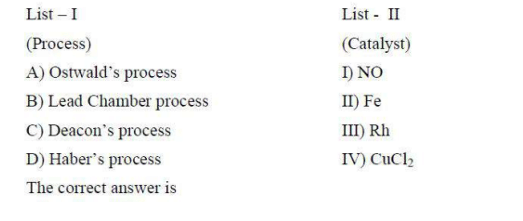
The given question asks us to match industrial processes with their respective catalysts. Below are the detailed explanations for each of the processes and their catalysts: - A) Ostwald's process: - The Ostwald process is a method for producing nitric acid from ammonia. - In this process, Rhodium (Rh) is the catalyst. The process involves the oxidation of ammonia to form nitric oxide (NO), which is further oxidized to form nitrogen dioxide (NO ), which is absorbed in water to produce nitric acid. Rhodium is preferred due to its high catalytic activity and resistance to high temperatures and corrosive conditions. - Matching: A-III - B) Lead Chamber process: - The Lead Chamber process is used in the industrial production of sulfuric acid. - This process involves the oxidation of sulfur dioxide (SO ) in the presence of nitrogen oxides (NO). The catalyst in this process is Nitric Oxide (NO), which facilitates the oxidation of sulfur dioxide. Nitric oxide helps in the formation of nitrogen dioxide (NO ), which reacts with sulfur dioxide to form sulfur trioxide (SO ), a precursor to sulfuric acid. - Matching: B-I - C) Deacon's process: - The Deacon process is used to produce chlorine gas from hydrochloric acid (HCl). - The catalyst used in this process is Copper chloride (CuCl ). In this process, hydrogen chloride (HCl) is oxidized by oxygen in the presence of CuCl at high temperatures to produce chlorine gas (Cl ) and water. - Matching: C-IV D) Haber’s process: The Haber process is a method for synthesizing ammonia from nitrogen and hydrogen gases. The catalyst used in the Haber process is Iron (Fe). The iron catalyst facilitates the combination of nitrogen (N ) and hydrogen (H ) gases at high pressure and temperature to form ammonia (NH ). Matching: D-II Thus, the correct matching of processes to catalysts is A-III, B-I, C-IV, D-II.
02
PYQ 2023
medium
chemistryID: ap-eapce
Consider the reactions I. II. III. The catalysts A, B, C are respectively
1
Ni, ZnO- , Pt
2
Pt, ZnO- , Ni
3
, Ni,
4
Pd, Pt, ZnO-
Official Solution
Correct Option:
(1)
Let's identify the catalysts commonly used for each of the given reactions: I.
This reaction is the **hydrogenation of carbon monoxide to methane**, also known as the **Sabatier reaction**. Nickel (Ni) is a common catalyst used for this reaction, often supported on materials like alumina or silica. II.
This reaction is the **synthesis of methanol from carbon monoxide and hydrogen**. A mixture of zinc oxide (ZnO) and chromium(III) oxide ( ) is a widely used catalyst for this process, especially at high pressures. Copper-based catalysts are also used in modern low-pressure methanol synthesis. However, among the given options, ZnO- is the most fitting catalyst for this reaction under typical conditions implied. III.
This is the **reaction of hydrogen and oxygen to form water**. Platinum (Pt) is a highly effective catalyst for this exothermic reaction, even at room temperature. Other noble metals like palladium (Pd) can also catalyze this reaction. Based on these common catalysts for each reaction:
- Catalyst A (for reaction I) is Nickel (Ni).
- Catalyst B (for reaction II) is Zinc oxide-Chromium(III) oxide (ZnO- ).
- Catalyst C (for reaction III) is Platinum (Pt). Therefore, the catalysts A, B, and C are Ni, ZnO- , and Pt, respectively. This corresponds to option (A).
03
PYQ 2025
medium
chemistryID: ap-eapce
The metal purified by Mond process is X. The number of unpaired electrons in X is
1
5
2
4
3
3
4
2
Official Solution
Correct Option:
(4)
Explanation:
The Mond process is used to purify Nickel (Ni).
Nickel has atomic number 28.
The electronic configuration of Ni is:
In the ground state, the configuration has 2 unpaired electrons.
Final Answer:
2
04
PYQ 2025
medium
chemistryID: ap-eapce
The equation which represents Freundlich adsorption isotherm is (x = amount of gas, m = mass of solid)
1
2
3
4
Official Solution
Correct Option:
(2)
The Freundlich adsorption isotherm gives an empirical relationship between the amount of gas adsorbed by a unit mass of solid adsorbent ( ) and the pressure ( ) of the gas at a particular constant temperature.
The equation is:
where:
- is the mass of the gas adsorbed.
- is the mass of the adsorbent.
- is the equilibrium pressure of the gas.
- and are constants that depend on the nature of the adsorbent and the gas at a particular temperature. is typically greater than 1. To get the logarithmic form, take the logarithm (base 10 or natural logarithm) of both sides:
Using properties of logarithms and :
This equation is of the form , representing a straight line if is plotted against , with slope and y-intercept .
This matches option (2).
05
PYQ 2025
medium
chemistryID: ap-eapce
Which of the following statements regarding adsorption theory of heterogeneous catalysis is not correct?
1
The reactant molecules get adsorbed on the surface of the catalyst
2
The chemical reaction occurs at the surface of the catalyst
3
The product molecules remain permanently bound to the catalyst surface
4
The catalyst remains unchanged in mass and chemical composition at the end of the reaction
Official Solution
Correct Option:
(3)
In heterogeneous catalysis, the catalyst adsorbs the reactant molecules, and the chemical reaction occurs at the surface. After the reaction, the product molecules are desorbed from the catalyst's surface, not permanently bound to it. Thus, the product molecules do not remain permanently bound to the catalyst.
06
PYQ 2025
easy
chemistryID: ap-eapce
Which of the following enzymatic reaction is not correctly matched with enzyme shown against it in brackets?
1
Proteins → Peptides (Pepsin)
2
Starch → Maltose (Zymase)
3
Sucrose → Glucose and fructose (Invertase)
4
Maltose → Glucose (Maltase)
Official Solution
Correct Option:
(2)
The enzyme Zymase breaks down sugars such as glucose and fructose, not starch. Therefore, option (2) is incorrect, as starch is broken down by amylase into maltose, not by zymase.
07
PYQ 2025
medium
chemistryID: ap-eapce
Observe the following reactions
I) Sucrose (aq) + H2O →[x] glucose + fructose
II) Glucose (aq) →[y] ethanol + CO2
What are and respectively? Identify the correct option from the following:
1
Invertase, Zymase
2
Zymase, Diastase
3
Diastase, Zymase
4
Diastase, Invertase
Official Solution
Correct Option:
(1)
Step 1: Analyze the first reaction
The reaction \ch{Sucrose (aq) + H2O →[x] glucose + fructose} involves the hydrolysis of sucrose, a disaccharide, into its monosaccharides, glucose and fructose. This process is catalyzed by the enzyme invertase, which breaks the glycosidic bond in sucrose. Thus, is Invertase. Step 2: Analyze the second reaction
The reaction \ch{Glucose (aq)→[y] ethanol + CO2} represents the fermentation of glucose, where glucose is converted into ethanol and carbon dioxide. This process is catalyzed by the enzyme zymase, typically found in yeast during alcoholic fermentation. Thus, is Zymase. Step 3: Match with options
= Invertase, = Zymase, which corresponds to option (1).
08
PYQ 2025
medium
chemistryID: ap-eapce
Which one of the following acts as an autocatalyst during titration of and oxalic acid in presence of dilute ?
1
2
3
4
Official Solution
Correct Option:
(4)
Step 1: Understanding Autocatalysis in KMnO Titration An autocatalyst is a product of a reaction that enhances its own rate as it forms. In the titration of potassium permanganate ( ) with oxalic acid ( ) in acidic medium, the reaction initially proceeds slowly. However, as the reaction progresses, the formation of Mn ions significantly increases the reaction rate. Step 2: Role of MnSO During the reaction: - The Mn ions (present in MnSO ) act as a catalyst, accelerating the reaction.
- Initially, the reaction is slow, but as Mn ions accumulate, they enhance the rate, exhibiting autocatalytic behavior. Conclusion Thus, the correct answer is:
09
PYQ 2025
medium
chemistryID: ap-eapce
The equation which represents Freundlich adsorption isotherm is (x = amount of gas, m = mass of solid)
1
2
3
4
Official Solution
Correct Option:
(2)
The Freundlich adsorption isotherm gives an empirical relationship between the amount of gas adsorbed by a unit mass of solid adsorbent ( ) and the pressure ( ) of the gas at a particular constant temperature.
The equation is:
where:
- is the mass of the gas adsorbed.
- is the mass of the adsorbent.
- is the equilibrium pressure of the gas.
- and are constants that depend on the nature of the adsorbent and the gas at a particular temperature. is typically greater than 1. To get the logarithmic form, take the logarithm (base 10 or natural logarithm) of both sides:
Using properties of logarithms and :
This equation is of the form , representing a straight line if is plotted against , with slope and y-intercept .
This matches option (2).
10
PYQ 2025
medium
chemistryID: ap-eapce
Match the following:
List-I (reaction)
List-II (catalyst)
A) SO2(g) + Cl2(g) → SO2Cl2(l)
I) Pt / Rh gauge
B) 2SO2(g) + O2(g) → 2SO3(g)
IV) V2O5
C) 4HCl + O2 → 2Cl2 + 2H2O
II) CuCl2
D) 4NH3(g) + 5O2(g) → 4NO(g) + 6H2O(g)
III) Charcoal
1
A-III, B-IV, C-II, D-I
2
A-III, B-II, C-IV, D-I
3
A-IV, B-III, C-I, D-I
4
A-II, B-I, C-III, D-II
Official Solution
Correct Option:
(1)
Each reaction uses a specific catalyst: A - Charcoal, B - V O , C - CuCl , D - Pt / Rh gauge. Matching these correctly gives option (1).
About Catalysis - AP-EAPCET
Catalysis is a vital chapter for AP-EAPCET aspirants. Mastering the concepts covered in this chapter is essential for securing a top rank.
By rigorously practicing the previous year questions associated with this chapter, you can identify high-yield topics, understand the examiner's perspective, and boost your confidence during the actual exam.
Frequently Asked Questions
Why focus on Catalysis PYQs?
Analyzing PYQs for this specific chapter reveals the most frequently tested concepts and the typical complexity of questions, allowing you to tailor your study plan efficiently.
How to best use this analysis?
Review the topic breakdown to see which sub-topics within Catalysis carry the most weight. Then, tackle the questions iteratively to solidify your understanding.