Thermodynamics
70 previous year questions.
High-Yield Trend
Chapter Questions 70 MCQs
Use the data from the table to estimate the enthalpy of formation of CH3CHO.
| Bond Enthalpy | Bond | Enthalpy of Formation |
|---|---|---|
| 400 kJ mol-1 | C–H | C(g) 700 kJ mol-1 |
| 350 kJ mol-1 | C–C | H(g) 200 kJ mol-1 |
| 700 kJ mol-1 | C=O | O(g) 250 kJ mol-1 |
(A) U =H−PV
(B) G =H−TS
(C) U =q+W
Match the Following:
| Process | Option | Expression |
|---|---|---|
| A. Isothermal process | iv | |
| B. Adiabatic process | iii | |
| C. Isobaric process | ii | |
| D. Isochoric process | i |
I. At 0 K, the entropy of pure crystalline materials approaches zero.
II. Entropy for the process decreases.
III. Gibbs energy is a state function.
The isotherms of an ideal gas at along with their slopes (m) (in the brackets) are shown here. If , then the correct order of slopes of these isotherms is: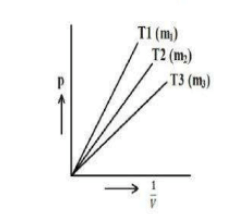
(A) The compressibility factor (Z) for an ideal gas is 1
(B) Uranium isotopes ( and ) are separated by converting them into vapours
(C) Decrease in temperature increases the kinetic energy of gas molecules
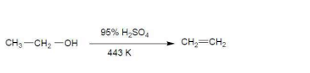
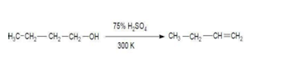
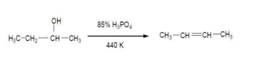
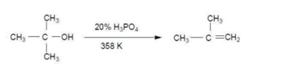
The standard enthalpy of formation of (g), and are -393, -634, -1210 kJ mol respectively. If all the substans are in standard state, the standard enthalpy of decomposition of calcium carbonate to and (in kJ mol ) is
Observe the following reaction: . The standard enthalpy of formation of is:
I) Sublimation of dry ice
II) Freezing of water
III) Crystallisation of the dissolved substance
IV) Burning of rocket fuel
I & II only
II & III only
III & IV only
I & IV only
I) Enthalpy is an intensive property
II) For, H O(l) H O(g) process, increases
III) Entropy is a state function
What is the enthalpy change for the decomposition of 1 mol of NH3(g) into its elements?
Statement-I: Both internal energy (U) and work (w) are state functions.
Statement-II: During the free expansion of an ideal gas into vacuum, the work done is zero.
The correct answer is
[I.]
[II.]
[III.] The oxidation state of P in is
I. For an adiabatic process, .
II. Enthalpy is an intensive property.
III. For the process , the entropy increases.
I) Work is a path function.
II) Enthalpy is an extensive property.
III) Lattice enthalpy of ionic compounds can be obtained from Born–Haber cycle.
About Thermodynamics - AP-EAPCET
Thermodynamics is a vital chapter for AP-EAPCET aspirants. Mastering the concepts covered in this chapter is essential for securing a top rank.
By rigorously practicing the previous year questions associated with this chapter, you can identify high-yield topics, understand the examiner's perspective, and boost your confidence during the actual exam.
Frequently Asked Questions
Why focus on Thermodynamics PYQs?
Analyzing PYQs for this specific chapter reveals the most frequently tested concepts and the typical complexity of questions, allowing you to tailor your study plan efficiently.
How to best use this analysis?
Review the topic breakdown to see which sub-topics within Thermodynamics carry the most weight. Then, tackle the questions iteratively to solidify your understanding.