The set of molecules in which the central atom is not obeying the octet rule is
1
CO , SiH , BeCl
2
H O, Cl O, CO
3
CH , NH , OF
4
SF , PCl , XeF
Official Solution
Correct Option: (4)
SF , PCl , XeF all have expanded octets as central atoms have more than 8 electrons due to involvement of d-orbitals.
02
PYQ 2022
medium
chemistryID: ap-eapce
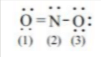
The formal charges of atoms (1), (2) and (3) in the ion are
1
2
3
4
Official Solution
Correct Option: (2)
Formal charge formula: , where is valence electrons, lone pairs, bonding electrons. Calculate for each atom accordingly.
03
PYQ 2022
medium
chemistryID: ap-eapce
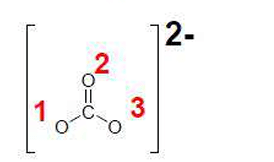
In the Lewis dot structure of carbonate ion ( ), what are the formal charges on oxygen atoms 1, 2, and 3 respectively?
1
2
3
4
Official Solution
Correct Option: (2)
In , the resonance hybrid shows:
- One oxygen atom forms a double bond with carbon → formal charge = 0
- Two oxygen atoms with single bonds and lone pairs → formal charge = –1 Hence:
- O : –1
- O : 0 (double bonded)
- O : –1 Formal charge calculation (FC):
04
PYQ 2022
medium
chemistryID: ap-eapce
Arrange the following species in the decreasing order of their bond orders.NO \quad NO \quad NO (I) \quad (II) \quad (III)
1
(I)>(II)>(III)
2
(II)>(I)>(III)
3
(II)>(III)>(I)
4
(III)>(II)>(I)
Official Solution
Correct Option: (2)
To determine the bond order of these diatomic species, we use Molecular Orbital Theory (MOT).
Bond Order = , where is the number of electrons in bonding molecular orbitals and is the number of electrons in antibonding molecular orbitals. Total number of valence electrons for each species (considering only valence shell for simplicity, or total electrons if using full MO diagram):
N (Atomic number 7): (5 valence e )
O (Atomic number 8): (6 valence e ) 1. NO (I): Total valence electrons = . (Or total electrons = ). MO configuration for species with 14-16 total electrons (like N , O , NO) without mixing affecting order for MOs: . (Using valence electron count of 11). Valence MO filling for 11 electrons: (2e, bonding) (2e, antibonding) (2e, bonding) (4e, bonding) (1e, antibonding) . (Considering MOs from ). . Bond Order (NO) = . 2. NO (II): Total valence electrons = . (Or total electrons = ). This is isoelectronic with N . Valence MO filling for 10 electrons: (2e) (2e) (2e) (4e) The orbitals are empty. . . Bond Order (NO ) = . 3. NO (III): Total valence electrons = . (Or total electrons = ). This is isoelectronic with O . Valence MO filling for 12 electrons: (2e) (2e) (2e) (4e) (2e, antibonding) (one in , one in by Hund's rule) . . Bond Order (NO ) = . Summary of bond orders:
NO (I): 2.5
NO (II): 3.0
NO (III): 2.0 Decreasing order of bond orders:
NO (3.0)>NO (2.5)>NO (2.0)
So, (II)>(I)>(III).
This matches option (b).
05
PYQ 2022
medium
chemistryID: ap-eapce
The velocity of the electron in Bohr’s first orbit is . The deBroglie wavelength associated with it (in nm) is (Given: )
1
2
3
0.73
4
Official Solution
Correct Option: (3)
Using de Broglie relation:
Given:
Substitute:
So, when , the wavelength is 0.73 nm.
06
PYQ 2022
medium
chemistryID: ap-eapce
The general formula of the compound formed when a metal (M) of group - 1 reacts with non metal (x) of group - 16 is
1
MX
2
M X
3
MX
4
M X
Official Solution
Correct Option: (4)
Metal (M) is from Group 1 of the periodic table (alkali metals).
Alkali metals have one valence electron ( ). They tend to lose this electron to form a cation with a +1 charge (M ).
Example: Na Na + e Non-metal (X) is from Group 16 of the periodic table (chalcogens).
Chalcogens have six valence electrons ( ). They need two more electrons to complete their octet ( ). They tend to gain two electrons to form an anion with a -2 charge (X ).
Example: O + 2e O When M and X react to form an ionic compound, the total positive charge must balance the total negative charge to achieve electrical neutrality.
Let the formula of the compound be M X .
The total positive charge is .
The total negative charge is .
For neutrality, , so .
The simplest whole number ratio for and that satisfies this is and .
So, the formula of the compound is M X , which is written as M X. Example: Sodium (Na, Group 1) reacts with Oxygen (O, Group 16) to form Sodium Oxide, Na O.
.
Another example: Potassium (K, Group 1) reacts with Sulfur (S, Group 16) to form Potassium Sulfide, K S.
07
PYQ 2022
medium
chemistryID: ap-eapce
The tetra-atomic molecules/ions with different shapes are:
1
2
3
4
Official Solution
Correct Option: (3)
- : Has a see-saw geometry due to one lone pair on sulfur (AX E type).
- : Has a tetrahedral geometry with no lone pair on nitrogen (AX ). So, they both are tetra-atomic but have different molecular shapes.
08
PYQ 2022
medium
chemistryID: ap-eapce
Calcium carbide reacts with heavy water (D O) to form a compound and Ca(OD) . What is the hybridization of carbon atom(s) in ?
1
2
3
4
Official Solution
Correct Option: (2)
Calcium carbide (CaC ) reacts with water (or D O) to give acetylene (ethyne or C H ) or its deuterated form (C D ): In C D , the carbon atoms are:
- Bonded via a triple bond
- Each bonded to one hydrogen (or deuterium) atom Hybridization of carbon in a triple bond =
09
PYQ 2022
medium
chemistryID: ap-eapce
Bond enthalpy of Ge-Ge bond is 260 kJ mol . The bond enthalpies of Si-Si and Sn-Sn bonds in kJ mol are respectively.
1
240, 270
2
297, 297
3
297, 240
4
200, 348
Official Solution
Correct Option: (3)
Si, Ge, and Sn are all elements of Group 14 (Carbon group) of the periodic table.
The order in the group is: C>Si>Ge>Sn>Pb.
Bond enthalpy (or bond strength) for single bonds between identical atoms (X-X) in this group generally decreases down the group as the atomic size increases and the extent of effective orbital overlap decreases.
So, the expected trend for X-X bond enthalpies (where X = C, Si, Ge, Sn, Pb) is:
C-C>Si-Si>Ge-Ge>Sn-Sn>Pb-Pb. Given:
Bond enthalpy of Ge-Ge = . We need to find the bond enthalpies for Si-Si and Sn-Sn.
Based on the trend:
Bond enthalpy (Si-Si) should be greater than Bond enthalpy (Ge-Ge).
So, BE(Si-Si)> .
Bond enthalpy (Sn-Sn) should be less than Bond enthalpy (Ge-Ge).
So, BE(Sn-Sn)< . Let's examine the options: (Si-Si value, Sn-Sn value)
% Option
(a) (240, 270): BE(Si-Si) = 240 (which is<260, incorrect). BE(Sn-Sn) = 270 (which is>260, incorrect).
% Option
(b) (297, 297): BE(Si-Si) = 297 (which is>260, possible). BE(Sn-Sn) = 297 (which is>260, incorrect).
% Option
(c) (297, 240): BE(Si-Si) = 297 (which is>260, possible). BE(Sn-Sn) = 240 (which is<260, possible). This option fits the expected trend.
% Option
(d) (200, 348): BE(Si-Si) = 200 (which is<260, incorrect). BE(Sn-Sn) = 348 (which is>260, incorrect). Option (c) is the only one that follows the expected trend: Si-Si bond is stronger than Ge-Ge bond, and Ge-Ge bond is stronger than Sn-Sn bond.
BE(Si-Si) =
BE(Ge-Ge) = (given)
BE(Sn-Sn) =
This order is consistent with the trend. Typical literature values for these bond enthalpies are approximately:
C-C: ~347 kJ/mol
Si-Si: ~226 kJ/mol (or values up to ~300 kJ/mol in some sources, e.g., for bulk silicon ~222-226)
Ge-Ge: ~188 kJ/mol (or ~260 kJ/mol as given in problem)
Sn-Sn: ~146 kJ/mol (or higher in some contexts) The values in options can sometimes deviate from precise literature averages due to different sources or specific molecular contexts. However, the relative trend is usually robust.
The question gives Ge-Ge as 260 kJ/mol.
Option (c) gives Si-Si = 297 kJ/mol and Sn-Sn = 240 kJ/mol.
This fits the order: Si-Si (297)>Ge-Ge (260)>Sn-Sn (240).
This is the correct trend.
10
PYQ 2022
medium
chemistryID: ap-eapce
The ratio of radii of second orbit of hydrogen atom to fourth orbit of He ion is
1
1:4
2
2:1
3
1:2
4
2:3
Official Solution
Correct Option: (3)
The radius of the orbit in a hydrogen-like atom is given by:
For hydrogen (Z = 1), radius of second orbit:
For He ion (Z = 2), radius of fourth orbit:
Ratio:
11
PYQ 2022
medium
chemistryID: ap-eapce
Choose the correct option from the following:
1
KF is more covalent than KI
2
SnCl\textsubscript{2} is less covalent than SnCl\textsubscript{4}
3
LiF is more covalent than KF
4
ZnCl\textsubscript{2} is less covalent than NaCl
Official Solution
Correct Option: (3)
According to Fajan’s rule, smaller cation + larger anion → more covalent character.
Li\textsuperscript{+} is smaller than K\textsuperscript{+}, so LiF has more covalent character than KF.
Other statements are incorrect based on oxidation states and ionic sizes.
12
PYQ 2022
medium
chemistryID: ap-eapce
The bond lengths of , , and molecules are , , and pm respectively. The correct order of their bond lengths is:
1
2
3
4
Official Solution
Correct Option: (1)
Bond length inverse of bond order.
Bond order of B\textsubscript{2} = 1, C\textsubscript{2} = 2, N\textsubscript{2} = 3.
So, bond length order: or
13
PYQ 2022
medium
chemistryID: ap-eapce
The set of species having only fractional bond order values is:
1
2
3
4
Official Solution
Correct Option: (2)
Bond order is calculated using:
Where = number of bonding electrons, and = number of antibonding electrons. Let’s check:
- : BO = 2.5
- : BO = 1.5
- : BO = 2.5 All have fractional bond orders. Other options contain:
- : BO = 3 (integer)
- : BO = 2 (integer)
14
PYQ 2022
medium
chemistryID: ap-eapce
The combination of which of the following gives an ionic compound with maximum covalent character?
1
2
3
4
Official Solution
Correct Option: (2)
According to Fajans’ rule, covalent character in ionic bonds increases with:
- High charge on cation
- Small size of cation
- Large size and high charge on anion Among given combinations:
- is small and highly charged
- is a large, doubly charged anion Hence, forms an ionic compound with maximum covalent character.
15
PYQ 2023
medium
chemistryID: ap-eapce
Observe the following species: AlCl , NH , H , Co , OH, Mg , BF , Cl How many Lewis acids are present in the above list?
1
5
2
4
3
2
4
3
Official Solution
Correct Option: (1)
Step 1: Define a Lewis acid.
A Lewis acid is a chemical species that can accept an electron pair. Step 2: Analyze each species in the list.
\begin{itemize} \item AlCl : Aluminum has an incomplete octet and can accept an electron pair. (Lewis acid) \item NH : Nitrogen has a lone pair of electrons and can donate it. (Lewis base) \item H : A proton has an empty 1s orbital and can accept an electron pair. (Lewis acid) \item Co }: The cobalt(III) ion is electron deficient and can accept electron pairs, especially in forming coordination complexes. (Lewis acid) \item OH: The hydroxide ion has lone pairs of electrons and can donate them. (Lewis base) \item Mg }: The magnesium(II) ion is electron deficient and can accept electron pairs, particularly in aqueous solutions forming hydrated ions. (Lewis acid) \item BF : Boron has an incomplete octet and can accept an electron pair. (Lewis acid) \item Cl : The chloride ion has lone pairs of electrons and can donate them. (Lewis base)
\end{itemize} Step 3: Count the number of Lewis acids.
The Lewis acids in the list are AlCl , H , Co , Mg , and BF . There are 5 Lewis acids. Final Answer:
16
PYQ 2023
medium
chemistryID: ap-eapce
The correct order of bond enthalpy of given molecules is
1
O
2
N
3
H
4
H
Official Solution
Correct Option: (4)
The bond enthalpy of a molecule increases as the bond order increases. The correct order of bond enthalpy is H . This is because N has a triple bond, which is stronger, while H has the weakest bond due to its single bond.
17
PYQ 2023
medium
chemistryID: ap-eapce
Which of the following are not in accordance with the property mentioned against them? I. : Oxidising power
II. : Ionic character of metal halide
III. : Bond dissociation enthalpy
IV. : Hydrogen-halogen bond strength
1
I \& III only
2
II \& III only
3
I \& IV only
4
II \& IV only
Official Solution
Correct Option: (2)
Statement I: Oxidising power of halogens decreases down the group. is correct. Statement II: The ionic character depends on the difference in size and electronegativity. MF (metal fluoride) has the highest ionic character due to the large electronegativity difference and small size of F. Hence, the given order MI>MBr>MCl>MF is incorrect. Statement III: Bond dissociation enthalpy should increase down the group. However, fluorine has anomalously low bond dissociation enthalpy due to electron-electron repulsion. The correct trend is: . Hence, the given order is incorrect. Statement IV: Hydrogen-halogen bond strength increases from HI to HF. So is correct. Therefore, statements II and III are not in accordance with the given properties.
18
PYQ 2023
medium
chemistryID: ap-eapce
The correct order of C − O bond length in CO, CO2−3, CO2 is
1
CO
2
CO2−3
3
CO
4
CO2
Official Solution
Correct Option: (1)
The bond length of a molecule depends on the bond order, which is related to the number of bonds between the atoms. For molecules and ions with resonance, the bond length will also depend on how much the resonance delocalizes the electron density over the bond. ### Bond Length in CO:
In CO (carbon monoxide), there is a triple bond between carbon and oxygen. The bond order is 3, indicating a strong bond. The triple bond leads to a short bond length because the bond order is high and the atoms are more strongly held together. ### Bond Length in CO2−3:
In the carbonate ion (CO2−3), the carbon-oxygen bond has a bond order of 1.33 due to resonance between the two C−O bonds. The presence of multiple resonance structures distributes the electron density over the three oxygen atoms, which decreases the bond strength and results in a longer bond compared to CO. ### Bond Length in CO2:
In CO2 (carbon dioxide), the bond order between carbon and each oxygen is 2 because of the double bonds. Therefore, the bond length in CO2 is longer than in CO but shorter than in CO2−3, as a double bond is weaker than a triple bond and stronger than a single bond. Thus, the correct order of bond lengths is:
19
PYQ 2023
medium
chemistryID: ap-eapce
Which of the following is the correct order of increasing number of lone pair of electrons on the ntral atom?
1
2
3
4
Official Solution
Correct Option: (4)
To solve this, we need to determine the number of lone pairs (LP) on the central atom in each molecule. The formula to calculate this is: Step-by-step analysis:
{IF7 (Iodine Heptafluoride)}: Iodine (Group 17) has 7 valence electrons. It forms 7 bonds with fluorine. Lone pairs = .
{IF5 (Iodine Pentafluoride)}: Iodine (Group 17) has 7 valence electrons and forms 5 bonds. Lone pairs = .
{ClF3 (Chlorine Trifluoride)}: Chlorine (Group 17) has 7 valence electrons and forms 3 bonds. Lone pairs = .
{XeF2 (Xenon Difluoride)}: Xenon (Group 18) has 8 valence electrons and forms 2 bonds. Lone pairs = .
Summary of Lone Pairs:
— 0 lone pairs
— 1 lone pair
— 2 lone pairs
— 3 lone pairs
Correct increasing order: This matches option (4).
20
PYQ 2023
medium
chemistryID: ap-eapce
In the extraction of copper from copper glance, blister copper is formed by the evolution of a gas X. The shape of molecule of X is
1
Angular
2
Planar trigonal
3
Tetrahedral
4
Pyramidal
Official Solution
Correct Option: (1)
Step 1: Identify the gas X.
Copper glance is . The gas evolved during the formation of blister copper is . Thus, X is . Step 2: Determine the Lewis structure of .
Sulfur has 6 valence electrons, and each oxygen has 6 valence electrons. Total valence electrons = . The Lewis structure involves resonance and a lone pair on the sulfur atom. Step 3: Apply VSEPR theory to predict the shape.
The central sulfur atom has 2 bond pairs (with two oxygen atoms) and 1 lone pair of electrons. The electron pair geometry is trigonal planar. The molecular geometry, considering only the atoms, is bent or angular. Thus, the shape of the molecule is .
21
PYQ 2023
easy
chemistryID: ap-eapce
SO + H SO X + H O, Y (Hot, Conc) + C Q + R + Z
Z is a neutral oxide. The shapes of molecules of Q and R respectively are
Official Solution
Correct Option: (1)
22
PYQ 2023
medium
chemistryID: ap-eapce
The hybridization and number of lone pair of electrons on central atom of SF respectively are
1
sp d, 1
2
sp d , 2
3
dsp , 0
4
sp , 0
Official Solution
Correct Option: (1)
For SF :
- Sulfur has 6 valence electrons.
- 4 electrons are used in bonding with 4 fluorine atoms.
- 1 lone pair remains.
Steric number = 4 bond pairs + 1 lone pair = 5 ⇒ hybridization = sp d
So, hybridization = sp d and lone pairs = 1
23
PYQ 2023
medium
chemistryID: ap-eapce
One mole and one mole are taken in a 1L flask and heated to 725K. At equilibrium, 40% (by mass) of water reacted with as follows: Its value is:
1
2
3
4
Official Solution
Correct Option: (1)
At equilibrium, the initial number of moles of and are both 1 mole. According to the question, 40% of water reacts with CO, so: Therefore, the moles of products formed are:
The remaining moles of and are:
Thus, at equilibrium, the total volume of the system is 1L. Now, we calculate the concentration of each species:
Now, we can calculate the equilibrium constant using the expression: Substituting the values: Thus, the correct answer is .
24
PYQ 2023
medium
chemistryID: ap-eapce
Match the following molecules with their dipole moments:
List I
List II
I. 0
II. 0.23
III. 1.47
IV. 1.85
1
A--IV, B--I, C--II, D--III
2
A--IV, B--I, C--III, D--II
3
A--IV, B--III, C--I, D--II
4
A--III, B--IV, C--II, D--I
Official Solution
Correct Option: (2)
{H2O} is bent; polar bonds do not cancel → high dipole: D → Match IV
{BF3} is trigonal planar; symmetric → net → Match I
{NH3} is trigonal pyramidal; lone pair adds to polarity → D → Match III
{NF3} also trigonal pyramidal; but bond dipoles oppose lone pair → D → Match II
Which of the following statements are correct? LiF is less soluble in water NaCl is less ionic than CsCl Formation of alkali metal halide is an endothermic reaction
1
i & ii only
2
i, ii & iii
3
ii & iii only
4
iii only
Official Solution
Correct Option: (1)
Option (i) {LiF} is less soluble due to high lattice enthalpy. Option (ii) {NaCl} has more covalent character than {CsCl} per Fajan’s rules. Option (iii) Formation of alkali halides is exothermic, not endothermic.
26
PYQ 2023
medium
chemistryID: ap-eapce
In D-glucose and D-fructose, which OH participates in hemiatal/hemiketal formation?
1
C–5 in both X and Y
2
C–4 in X and C–5 in Y
3
C–5 in X and C–6 in Y
4
C–6 in both X and Y
Official Solution
Correct Option: (1)
D-glucose (X): It has an aldehyde group at C–1. The ring (pyranose form) forms by reaction between the aldehyde at C–1 and the OH at C–5, forming a hemiacetal.
D-fructose (Y): It has a ketone group at C–2. The ring (furanose form) forms by reaction between the ketone at C–2 and the OH at C–5, forming a hemiketal.
Hence, in both cases, the C–5 hydroxyl group participates in ring formation.
27
PYQ 2023
medium
chemistryID: ap-eapce
In OF , the number of bond pairs and lone pairs of electrons are respectively:
1
2, 6
2
2, 8
3
2, 9
4
2, 10
Official Solution
Correct Option: (2)
Molecule: OF
- Central atom = Oxygen (6 valence electrons)
- Fluorine atoms = 2 × 7 = 14 electrons
- Total valence electrons = 6 + 14 = 20 Bond pairs:
- 2 O–F bonds → 2 bond pairs = 4 electrons Lone pairs:
- Remaining = electrons → 8 lone pairs Lone pair distribution:
- 3 lone pairs on each F → 6
- 2 lone pairs on O → 2
→ Total = 8 lone pairs
28
PYQ 2023
medium
chemistryID: ap-eapce
In which of the following, the molecules are arranged in the increasing order of their bond angles?
Bond angle increases with decreasing lone pair-bond pair repulsion and increasing electronegativity and hybridization. P\textsubscript{4} (tetrahedral structure with small angle), S\textsubscript{6} and S\textsubscript{8} (crown-like structures), and O\textsubscript{3} (angular) follow the order of increasing bond angles as given.
29
PYQ 2023
medium
chemistryID: ap-eapce
When burnt in air the metal 'X' forms only oxide, where as metal 'Y' forms oxide and nitride. X, Y respectively are
1
Li, Na
2
Na, Mg
3
Ca, Mg
4
Li, Mg
Official Solution
Correct Option: (1)
Metal 'X' is Lithium (Li), which when burnt in air forms only lithium oxide (Li O) because it does not form a nitride in air. On the other hand, Metal 'Y' is Sodium (Na), which forms both sodium oxide (Na O) and sodium nitride (Na N) when burnt in air.
30
PYQ 2023
medium
chemistryID: ap-eapce
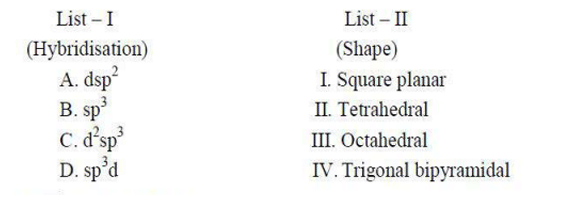
Match the following
1
A - II, B - I, C - III, D - IV
2
A - I, B - II, C - III, D - IV
3
A - III, B - IV, C - II, D - I
4
A - IV, B - III, C - II, D - I
Official Solution
Correct Option: (2)
Step 1: Recall the relationship between hybridization and molecular shape.
The hybridization of the central atom in a molecule determines its electron geometry and, subsequently, its molecular shape (considering lone pairs). Step 2: Match each hybridization with its corresponding shape.
\begin{itemize} \item A. dsp : This hybridization involves one d, one s, and two p orbitals, resulting in a square planar geometry. Matches with I. Square planar. \item B. sp : This hybridization involves one s and three p orbitals, resulting in a tetrahedral geometry. Matches with II. Tetrahedral. \item C. d sp : This hybridization involves two d, one s, and three p orbitals, resulting in an octahedral geometry. Matches with III. Octahedral. \item D. sp d: This hybridization involves one s, three p, and one d orbital, resulting in a trigonal bipyramidal geometry. Matches with IV. Trigonal bipyramidal.
\end{itemize} Step 3: Combine the matches to find the correct option.
The correct matching is A - I, B - II, C - III, D - IV. Final Answer: The final answer is
31
PYQ 2023
medium
chemistryID: ap-eapce
The correct order of bond angles of H S, NH , BF , and SiH is
1
H S
2
NH S
3
H S
4
H S
Official Solution
Correct Option: (1)
- H S: Bent molecule, large lone pair repulsion, smallest bond angle ( )
- NH : Trigonal pyramidal with one lone pair, bond angle
- SiH : Tetrahedral, bond angle
- BF : Trigonal planar, bond angle exactly
Hence, the order: H S
32
PYQ 2023
medium
chemistryID: ap-eapce
Given below are two statements
Assertion (A): Ionic compounds are formed by non-directional bonds
Reasoning (R): They are soluble in nonpolar solvents
The correct answer is
1
Both (A) and (R) are correct and (R) is the correct explanation of (A)
2
Both (A) and (R) are correct and (R) is not the correct explanation of (A)
3
(A) is correct but (R) is not correct
4
(A) is not correct but (R) is correct
Official Solution
Correct Option: (2)
The assertion (A) is correct because ionic compounds are formed by non-directional bonds. However, the reasoning (R) is not the correct explanation for (A) because ionic compounds are not necessarily soluble in nonpolar solvents. Their solubility depends on the solvent's polarity.
33
PYQ 2023
medium
chemistryID: ap-eapce
The hybridization of central atom of ClF , NH , SO are respectively
1
sp , sp , sp
2
sp d, sp , sp
3
sp , sp , sp d
4
sp d, sp , sp
Official Solution
Correct Option: (2)
Step 1: Determine the hybridization of the central atom in ClF . Central atom: Cl Valence electrons in Cl: 7 Number of F atoms attached: 3 Lone pairs on Cl: electrons = 2 lone pairs Total regions of electron density (bonds + lone pairs): Hybridization: sp d
Step 2: Determine the hybridization of the central atom in NH . Central atom: N Valence electrons in N: 5 Number of H atoms attached: 3 Lone pairs on N: electrons = 1 lone pair Total regions of electron density: Hybridization: sp
Step 3: Determine the hybridization of the central atom in SO . Central atom: S Valence electrons in S: 6 Number of O atoms attached: 3 Lone pairs on S: (since each S=O double bond uses 2 electrons from S, but in resonance, all are equivalent) Total regions of electron density: 3 (for the three double bonds) Hybridization: sp Final Answer:
34
PYQ 2023
medium
chemistryID: ap-eapce
Arrange the hydrides NH , HF, H O, HCl in the increasing order of their boiling points
1
HF NH HCl H O
2
H O HF HCl NH
3
NH HCl H O HF
4
HCl NH HF H O
Official Solution
Correct Option: (4)
Step 1: Identify the intermolecular forces present in each hydride.
HCl: Dipole-dipole interactions, London dispersion forces.
NH : Dipole-dipole interactions, London dispersion forces, hydrogen bonding. H O: Dipole-dipole interactions, London dispersion forces, strong hydrogen bonding.
HF: Dipole-dipole interactions, London dispersion forces, very strong hydrogen bonding. Step 2: Compare the strengths of the intermolecular forces.
Hydrogen bonding is significantly stronger than dipole-dipole interactions and London dispersion forces. The strength of hydrogen bonding depends on the electronegativity of the atom bonded to hydrogen and the presence of lone pairs. Fluorine is the most electronegative, followed by oxygen and then nitrogen. Step 3: Predict the boiling points based on the strength of intermolecular forces.
Stronger intermolecular forces lead to higher boiling points. HCl has the weakest intermolecular forces among these, so it will have the lowest boiling point. NH has hydrogen bonding, making its boiling point higher than HCl.
HF has very strong hydrogen bonding, leading to a significantly higher boiling point than HCl and NH .
H O has strong and extensive hydrogen bonding, resulting in the highest boiling point. Step 4: Arrange the hydrides in increasing order of boiling points.
The increasing order of boiling points is: HCl O. Final Answer: The final answer is
35
PYQ 2023
medium
chemistryID: ap-eapce
The P − P bond angle in P4 and S − S bond angle in cyclo S8 molecule are respectively
1
107° , 60°
2
60° , 40°
3
60° , 107°
4
40° , 60°
Official Solution
Correct Option: (3)
P4 molecule:
In the P4 molecule, the phosphorus atoms are arranged in a tetrahedral geometry. The bond angle between the phosphorus atoms is 60°. This angle is smaller than the ideal tetrahedral bond angle of 109.5°, which is due to the lone pairs on the phosphorus atoms. The bond angles are compressed slightly due to the repulsion between the lone pairs of electrons, leading to a bond angle of 60°. S8 molecule:
The sulfur atoms in the S8 molecule form a puckered ring structure. The bond angles between sulfur atoms are 107°, which is close to the ideal tetrahedral angle of 109.5°, but slightly distorted due to the strain in the ring structure. The bonding in S8 involves single bonds with a bond angle that is smaller than the ideal angle due to the cyclic structure. Thus, the correct bond angles are:
36
PYQ 2023
medium
chemistryID: ap-eapce
The number of bond pairs of electrons and total number of lone pairs of electrons in XeOF are respectively
1
6, 10
2
5, 15
3
5, 10
4
6, 15
Official Solution
Correct Option: (4)
In XeOF , the central atom, Xenon (Xe), is surrounded by four fluorine atoms and one oxygen atom. There are 6 bond pairs of electrons, and the total number of lone pairs on Xenon and oxygen is 15. Thus, the correct answer is 6 bond pairs and 15 lone pairs.
37
PYQ 2023
medium
chemistryID: ap-eapce
If the bond order in is , then the bond order in and , respectively are:
1
2
3
4
Official Solution
Correct Option: (3)
Bond order is related to the number of bonding and antibonding electrons in a molecule. For molecules like , , and , the bond order can be calculated using the molecular orbital theory. For , the bond order is , which indicates that the total bonding electrons contribute to the bond strength. The molecular orbital theory states that in and , bond orders are proportional to the bonding electron count relative to the number of electrons in the antibonding orbitals. Thus, if the bond order in is , we find that the bond order in is , and the bond order in is .
38
PYQ 2023
medium
chemistryID: ap-eapce
Among the following the correct statements are I. Germanium exists only in traces
II. PbF4 molecule is tetrahedral in shape
III. GeX2 is more stable than GeX4
1
II, III only
2
III, II only
3
II, I only
4
I, II only
Official Solution
Correct Option: (1)
- Statement I: Germanium does exist in traces, but the question does not make this fact clear enough for this context.
- Statement II: PbF is indeed tetrahedral in shape.
- Statement III: GeX (such as GeCl ) is more stable than GeX due to the lesser electron-electron repulsion in the 2-valent compound compared to the 4-valent one. Thus, the correct statements are II and III.
39
PYQ 2023
medium
chemistryID: ap-eapce
Two statements are given below
Statement (I): C-O bond length in methanol is 136 pm and in phenol 142 pm.
Statement (II): The C-O-H bond angle in methanol and phenol is almost same.
1
Both A and R are correct and R is correct explanation of A.
2
Both A and R are correct but R is not correct explanation of A.
3
A is correct but R is incorrect.
4
A is incorrect but R is correct.
Official Solution
Correct Option: (1)
The bond length of C-O in methanol (136 pm) and phenol (142 pm) differs due to the resonance effect in phenol, which weakens the C-O bond. The C-O-H bond angle is nearly the same in both, as the oxygen atoms in both molecules have similar bonding environments. Hence, both statements are correct and the reason explains the assertion.
40
PYQ 2024
medium
chemistryID: ap-eapce
Observe the following structure: The formal charges on the atoms 1, 2, 3 respectively are:
1
2
3
4
Official Solution
Correct Option: (2)
To determine the formal charges on the atoms in a molecule, we use the formula:
Let's analyze the given options to find the formal charges for the atoms 1, 2, and 3:
Option 1:
Each formal charge must be calculated individually. Typically, atom assignments and connectivity influence the net charge, but this requires visual reference, which cannot be processed here. Let’s verify the correct solution instead.
Option 2:
Validation:
Atom 1: Assumed zero charge implies valence electrons equal the sum of non-bonding electrons and half the bonding electrons.
Atom 2: Identical parameters as atom 1 verify equilibrium for the charge at zero.
Atom 3: To obtain formal charge, assume excess non-bonding electron count beyond typical valence configuration, supported by structure typically hosting lone pair presence.
Thus, the correct solution here is interpreted Option 2 .
41
PYQ 2024
medium
chemistryID: ap-eapce
The correct order of covalent bond character of is:
1
2
3
4
Official Solution
Correct Option: (1)
Step 1: Apply Fajan’s Rule Covalent character increases with:
- Higher cation charge density.
- Larger anion size. Step 2: Arrange Based on Covalent Character
42
PYQ 2025
medium
chemistryID: ap-eapce
A molecule ‘X’ has square pyramidal geometry, as per VSEPR theory. The number of bond pairs and lone pairs of electrons present in the valence shell of central atom of X, respectively, are
1
4, 1
2
5, 1
3
5, 2
4
6, 1
Official Solution
Correct Option: (2)
Step 1: Understand Square Pyramidal Geometry in VSEPR Theory
In VSEPR (Valence Shell Electron Pair Repulsion) theory, the geometry of a molecule is determined by the number of electron domains (bond pairs and lone pairs) around the central atom and their arrangement to minimize repulsion. A square pyramidal geometry arises when the central atom has a specific arrangement of electron domains. Step 2: Determine the Number of Electron Domains for Square Pyramidal Geometry
Square pyramidal geometry is typically observed when the central atom has 6 electron domains (steric number = 6), which are arranged in an octahedral manner. In an octahedral arrangement: There are 6 positions around the central atom, each occupied by an electron domain (either a bond pair or a lone pair). For a square pyramidal shape, 5 of these positions are occupied by bond pairs (attached to surrounding atoms), and 1 position is occupied by a lone pair.
This lone pair distorts the octahedral geometry, removing one vertex and leaving a square base with one atom at the apex, forming a square pyramid. Step 3: Identify Bond Pairs and Lone Pairs In an octahedral arrangement with 6 electron domains, if one domain is a lone pair, the remaining 5 domains must be bond pairs to form the square pyramidal shape. Thus, the central atom has: 5 bond pairs (corresponding to 5 surrounding atoms). 1 lone pair (causing the distortion from octahedral to square pyramidal).
So, the number of bond pairs and lone pairs is 5 and 1, respectively. Step 4: Verify with a Common Example
A common molecule with square pyramidal geometry is : Iodine (I) is the central atom with 7 valence electrons. It forms 5 bonds with fluorine atoms, using 5 of its valence electrons, leaving 2 electrons (1 lone pair). Total electron domains = 5 bond pairs + 1 lone pair = 6, which aligns with an octahedral arrangement. The lone pair occupies one position, and the 5 bond pairs form the square pyramidal shape.
This confirms our understanding: 5 bond pairs and 1 lone pair. Step 5: Analyze Options Option (1): 4, 1. Incorrect, as 4 bond pairs and 1 lone pair (5 electron domains) would lead to a trigonal bipyramidal arrangement, resulting in a seesaw shape, not square pyramidal. Option (2): 5, 1. Correct, as 5 bond pairs and 1 lone pair (6 electron domains) lead to a square pyramidal geometry, as explained. Option (3): 5, 2. Incorrect, as 5 bond pairs and 2 lone pairs (7 electron domains) would lead to a pentagonal bipyramidal arrangement, resulting in a pentagonal pyramidal shape, not square pyramidal. Option (4): 6, 1. Incorrect, as 6 bond pairs and 1 lone pair (7 electron domains) also lead to a pentagonal bipyramidal arrangement, not square pyramidal.
43
PYQ 2025
medium
chemistryID: ap-eapce
How many of the following molecules / ions have a trigonal planar structure?
1
5
2
2
3
4
4
3
Official Solution
Correct Option: (2)
- : Trigonal planar
- : Trigonal pyramidal
- : Trigonal planar
- : T-shaped
- : Pyramidal Only and have trigonal planar geometry.
44
PYQ 2025
medium
chemistryID: ap-eapce
The correct order of increasing bond lengths of C--H, O--H, C--C, and H--H is
1
O--H H--H C--C C--H
2
C--C C--H H--H O--H
3
C--C O--H H--H C--H
4
H--H O--H C--H C--C
Official Solution
Correct Option: (4)
Let’s break this down step by step to determine the correct order of bond lengths and why option (4) is the correct answer. Step 1: Understand the factors affecting bond lengths Bond length depends on:
The size of the atoms involved (larger atoms form longer bonds).
The bond order (higher bond order results in shorter bonds).
Typical bond lengths (in pm):
H--H: 74 pm (in H , single bond).
O--H: 96 pm (in H O, single bond).
C--H: 109 pm (in CH , single bond).
C--C: 154 pm (in C H , single bond).
Step 2: Compare the bond lengths
H--H: Smallest, as both atoms are hydrogen, 74 pm.
O--H: Oxygen is larger than hydrogen, 96 pm.
C--H: Carbon is larger than oxygen, 109 pm.
C--C: Two carbon atoms, single bond, longest at 154 pm.
Order of increasing bond lengths:
Step 3: Confirm the correct answer The order matches option (4). Thus, the correct answer is (4) H--H O--H C--H C--C.
45
PYQ 2025
medium
chemistryID: ap-eapce
The number of molecules having lone pair of electrons on central atom in the following is: BF , SF , SiCl , XeF , NCl , XeF , PCl , HgCl , SnCl
1
6
2
3
3
4
4
5
Official Solution
Correct Option: (4)
Let's examine each molecule: BF : Boron has 3 valence electrons, all bonded to fluorine, leaving no lone pairs on boron. SF : Sulfur has 6 valence electrons. Four are bonded to fluorine, and one lone pair remains on sulfur. SiCl : Silicon has 4 valence electrons, all bonded to chlorine, leaving no lone pairs on silicon. XeF : Xenon has 8 valence electrons. Four are bonded to fluorine, and two lone pairs remain on xenon. NCl : Nitrogen has 5 valence electrons. Three are bonded to chlorine, and one lone pair remains on nitrogen. XeF : Xenon has 8 valence electrons. Six are bonded to fluorine, and one lone pair remains on xenon. PCl : Phosphorus has 5 valence electrons, all bonded to chlorine, leaving no lone pairs on phosphorus. HgCl : Mercury has 2 valence electrons, both bonded to chlorine, leaving no lone pairs on mercury. SnCl : Tin has 4 valence electrons. Two are bonded to chlorine, and one lone pair remains on tin. The molecules with lone pairs on the central atom are SF , XeF , NCl , XeF , and SnCl . Therefore, there are 5 such molecules.
46
PYQ 2025
medium
chemistryID: ap-eapce
Consider the following Assertion (A): Dipole moment of NF is lesser than NH Reason (R): In NF , the orbital dipole due to lone pair of electrons is in the opposite direction to the resultant dipole moment of the three N-F bonds.
The correct answer is:
1
Both (A) and (R) are correct and (R) is the correct explanation of (A)
2
Both (A) and (R) are correct but (R) is not the correct explanation of (A)
3
(A) is correct, but (R) is not correct
4
(A) is not correct, but (R) is correct
Official Solution
Correct Option: (1)
- In NH , the dipole moments of the N–H bonds add up due to the trigonal pyramidal shape, leading to a relatively strong dipole.
- In NF , although F is more electronegative than H, the lone pair on nitrogen contributes a dipole opposite to the resultant N–F bond dipole.
- This opposition reduces the net dipole moment in NF compared to NH .
- Hence, both the assertion and reason are correct, and the reason explains the assertion.
47
PYQ 2025
medium
chemistryID: ap-eapce
The increasing order of covalent character of (I), (II), (III), (IV) is:
1
2
3
4
Official Solution
Correct Option: (3)
Covalent character depends on polarization ability of cation and polarizability of anion. - is larger than , so less polarization → less covalent (II) - smaller than , more polarization → more covalent (I) - with higher charge density → more covalent (III) - with even higher charge density → most covalent (IV) So order of increasing covalent character:
48
PYQ 2025
medium
chemistryID: ap-eapce
Which of the following sets are not correctly matched?
I) O\textsubscript{2}\textsuperscript{+}, O\textsubscript{2}\textsuperscript{–} \hspace{1em} – diamagnetic
II) O\textsubscript{2}\textsuperscript{–}, O\textsubscript{2} \hspace{3.8em} – paramagnetic
III) O\textsubscript{2}\textsuperscript{–}, O\textsubscript{2}\textsuperscript{2–} \hspace{1em} – diamagnetic
IV) O\textsubscript{2}\textsuperscript{+}, O\textsubscript{2}\textsuperscript{2–} \hspace{1em} – paramagnetic
1
II& III
2
I& II
3
III& IV
4
I& III
Official Solution
Correct Option: (3)
- O\textsubscript{2}\textsuperscript{–} (15 electrons) is **paramagnetic**, not diamagnetic. - O\textsubscript{2}\textsuperscript{2–} (16 electrons) is **diamagnetic** - O\textsubscript{2}\textsuperscript{+} (15 electrons) is **paramagnetic** Thus: - III (claims O\textsubscript{2}\textsuperscript{–} is diamagnetic) is incorrect. - IV (claims both are paramagnetic, but O\textsubscript{2}\textsuperscript{2–} is diamagnetic) is also incorrect.
49
PYQ 2025
medium
chemistryID: ap-eapce
A diatomic molecule has a dipole moment of . If the bond distance is , what fraction of an electronic charge exists on each atom? (Actual value of electronic charge = )
1
2
3
4
Official Solution
Correct Option: (3)
\textbf{Step 1: Recall the Formula for Dipole Moment} The dipole moment ( ) of a diatomic molecule is given by:
$ q d q \mu 4 \times 10^{-30} \, \text{Cm} d 1.0 \, \text{\AA} = 1.0 \times 10^{-10} \, \text{m} e q = 4 \times 10^{-20} \, \text{C} e = 1.6 \times 10^{-19} \, \text{C} 0.33 0.50 0.25 0.66 $ Incorrect — does not match the calculated value.
50
PYQ 2025
medium
chemistryID: ap-eapce
The pairs of compounds which have the same molecular geometry are
I) BF\textsubscript{3}, BrF\textsubscript{3}
II) XeF\textsubscript{2}, BeCl\textsubscript{2}
III) BCl\textsubscript{3}, PCl\textsubscript{3}
IV) PCl\textsubscript{3}, NCl\textsubscript{3}
1
I& III only
2
II& III only
3
I& IV only
4
II& IV only
Official Solution
Correct Option: (4)
- **BF\textsubscript{3}**: Trigonal planar
- **BrF\textsubscript{3}**: T-shaped → different geometry - **XeF\textsubscript{2}**: Linear
- **BeCl\textsubscript{2}**: Linear → same geometry ✓ - **BCl\textsubscript{3}**: Trigonal planar
- **PCl\textsubscript{3}**: Trigonal pyramidal → different geometry - **PCl\textsubscript{3}, NCl\textsubscript{3}**: Both are trigonal pyramidal → same geometry ✓
51
PYQ 2025
medium
chemistryID: ap-eapce
Identify the pair of molecules which have the same hybridisation as the hybridisation in Xenon (II) fluoride.
1
,
2
,
3
,
4
,
Official Solution
Correct Option: (3)
Step 1: Known Information.
The molecule in question is Xenon (II) fluoride ( ).
We need to determine the hybridization of and identify another pair of molecules with the same hybridization. Step 2: Determine the Hybridization of .
1. Molecular Formula:
2. Central Atom: Xenon (Xe)
3. Valence Electrons of Xe: Xenon has 8 valence electrons.
4. Bonding Electrons: Each fluorine atom forms a single bond with Xe, contributing 2 electrons per bond. Total bonding electrons = electrons.
5. Lone Pairs: Remaining electrons are lone pairs. Lone pairs = electrons (2 lone pairs).
6. Geometry and Hybridization: has a linear geometry. Linear geometry corresponds to sp hybridization. Thus, the hybridization of is sp. Step 3: Identify Molecules with sp Hybridization. To have sp hybridization, a molecule must:
- Have a linear geometry.
- Have 2 regions of electron density around the central atom (2 sigma bonds). Let's analyze the options: 1. Option 1: , : Xenon has 3 bonding pairs and 2 lone pairs, resulting in trigonal bipyramidal geometry (sp³d hybridization). : Sulfur has 4 bonding pairs and 1 lone pair, resulting in seesaw geometry (sp³d hybridization). Neither molecule has sp hybridization. 2. Option 2: , : Bromine has 5 bonding pairs and 1 lone pair, resulting in square pyramidal geometry (sp³d² hybridization). : Phosphorus has 5 bonding pairs, resulting in trigonal bipyramidal geometry (sp³d hybridization). Neither molecule has sp hybridization. 3. Option 3: , : Chlorine has 3 bonding pairs and 2 lone pairs, resulting in T-shaped geometry (sp³d hybridization). : Sulfur has 4 bonding pairs and 1 lone pair, resulting in seesaw geometry (sp³d hybridization). Neither molecule has sp hybridization. 4. Option 4: , : Phosphorus has 3 bonding pairs and 1 lone pair, resulting in trigonal pyramidal geometry (sp³ hybridization). : Nitrogen has 3 bonding pairs and 1 lone pair, resulting in trigonal pyramidal geometry (sp³ hybridization). Neither molecule has sp hybridization. Step 4: Correct Answer. The correct pair of molecules with sp hybridization is:
52
PYQ 2025
easy
chemistryID: ap-eapce
Which of the following compounds contains both ionic and covalent bonds?
1
NaCl
2
NH3
3
CaCO3
4
CH4
Official Solution
Correct Option: (3)
Solution: To determine which compound contains both ionic and covalent bonds, we need to analyze the bonding in each given compound.
NaCl: Sodium chloride consists of sodium ions (Na+) and chloride ions (Cl-). The bond is purely ionic, as electrons are transferred from sodium to chlorine.
NH3: Ammonia features covalent bonds between nitrogen and hydrogen atoms. All electrons are shared, resulting in covalent bonding only.
CaCO3: Calcium carbonate contains ionic bonds between calcium ions (Ca2+) and carbonate ions (CO32-). Within the carbonate ion, carbon and oxygen atoms are bonded covalently.
CH4: Methane consists of covalent bonds between carbon and hydrogen atoms.
In CaCO3, the presence of ionic bonds between Ca2+ and CO32- and covalent bonds within the CO32- ion indicates that it contains both types of bonds. Therefore, the answer is CaCO3.