How many distinct alkenes obtained from the 3-Bromo-3-methylhexane upon treatment with alc. KOH?
1
2
2
3
3
4
4
5
Official Solution
Correct Option: (3)
Step 1: Identify the -hydrogens and possible alkenes.
Dehydrohalogenation can occur at C2 and C4. Elimination at C2 gives 3-methylhex-2-ene: (can exist as cis and trans isomers). Elimination at C4 gives 3-methylhex-3-ene: (can exist as cis and trans isomers). Step 2: Count the distinct alkenes including stereoisomers.
1. cis-3-methylhex-2-ene
2. trans-3-methylhex-2-ene
3. cis-3-methylhex-3-ene
4. trans-3-methylhex-3-ene There are 4 distinct alkenes. Thus, the number of distinct alkenes is .
02
PYQ 2023
medium
chemistryID: ap-eapce
1-Chloro-4-nitrobenzene, 1-Chloro-2,4-dinitrobenzene and 1-Chloro-2,4,6-trinitrobenzene are transformed to corresponding phenols with the reagents X, Y, Z respectively. What are X, Y, Z?
1
X = H\textsubscript{2}O; Y = NaOH, 365K; Z = NaOH, 445K
2
X = (i) NaOH, 443K (ii) H\textsuperscript{+}; Y = (i) NaOH, 368K (ii) H\textsuperscript{+}; Z = Warm H\textsubscript{2}O
3
X = (i) NaOH, 625K (ii) H\textsuperscript{+}; Y = (i) NaOH, 440K (ii) H\textsuperscript{+}; Z = H\textsubscript{2}O/H\textsuperscript{+}
4
X = NaOH, 625K; Y = H\textsubscript{2}O; Z = NaOH, 440K
Official Solution
Correct Option: (2)
The reactivity of haloarenes towards nucleophilic substitution increases with the number of electron-withdrawing nitro groups. - For 1-chloro-4-nitrobenzene, higher temperature and NaOH/H\textsuperscript{+} are required.
- 1-chloro-2,4-dinitrobenzene reacts at a slightly lower temperature.
- 1-chloro-2,4,6-trinitrobenzene is highly reactive and can be converted to phenol with just warm water.
03
PYQ 2023
medium
chemistryID: ap-eapce
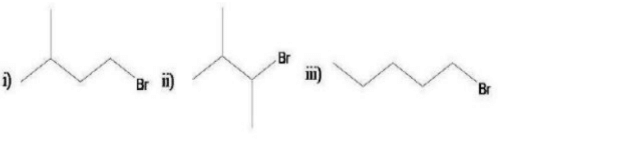
Which is the correct order of the following alkyl halides for an SN2 reaction?
1
ii > i > iii
2
iii > i > ii
3
iii > ii > i
4
ii > iii > i
Official Solution
Correct Option: (2)
S\textsubscript{N}2 reactions are favored in less hindered, primary alkyl halides.
- Compound iii is primary and least hindered.
- Compound i is also primary but slightly more hindered.
- Compound ii is secondary and most hindered.
Hence, the reactivity order is: iii > i > ii.
04
PYQ 2023
medium
chemistryID: ap-eapce
What is the correct boiling point order of the following haloalkanes?
1
i>ii>iii
2
ii>iii>i
3
i
4
iii>ii>i
Official Solution
Correct Option: (2)
- The boiling points of haloalkanes depend on their molecular size and structure.
- 1-Chlorobutane (ii) has the highest boiling point because it is a straight-chain molecule and has more surface area for intermolecular forces.
- 2-Chlorobutane (iii) has a lower boiling point than 1-chlorobutane because it is a branched structure, which results in weaker intermolecular forces.
- 2-chloro-2-methylpropane (i) has the lowest boiling point due to its compact, branched structure, which results in the weakest intermolecular forces. Thus, the correct answer is (2) ii>iii>i.
05
PYQ 2025
medium
chemistryID: ap-eapce
What are X and Y in the following set of reactions?
(dry acetone)
1
NaI / dry acetone; SbF
2
NaI / H O; NaF
3
NaI / H O; SbF
4
NaI / dry acetone; NaF
Official Solution
Correct Option: (1)
Step 1 (Y):
The first transformation is the conversion of to . This indicates the fluorine atom is replaced by a methyl group, suggesting a nucleophilic substitution where F is replaced. Since fluoride is a poor leaving group, a reagent like SbF3 is used to facilitate this by forming a complex.
Step 2 (X):
The next transformation is from bromoalkane to iodoalkane, which is a typical Finkelstein reaction:
This reaction occurs in dry acetone to drive the equilibrium toward product formation because NaBr precipitates out.
Thus:
Y = SbF3
X = NaI / dry acetone
06
PYQ 2025
medium
chemistryID: ap-eapce
The SN reactivity of the following compounds will be in the order: I) C H CH(CH )Br
II) (C H ) CHBr
III) (C H ) C(CH )Br
IV) C H CH Br
1
III< II< I< IV
2
III< I< II< IV
3
II< III< IV< I
4
II< IV< I< III
Official Solution
Correct Option: (1)
SN reactions proceed faster when steric hindrance is minimal, as the nucleophile attacks the electrophilic carbon directly. Letβs evaluate steric hindrance around the carbon attached to Br in each compound: \begin{itemize} \item III: (C H ) C(CH )Br β A tertiary benzylic halide; highly hindered slowest. \item II: (C H ) CHBr β Secondary benzylic halide; still hindered. \item I: C H CH(CH )Br β Secondary benzylic halide; less hindered than II. \item IV: C H CH Br β Primary benzylic halide; least hindered fastest.
\end{itemize} Hence, SN reactivity order: III< II< I< IV.