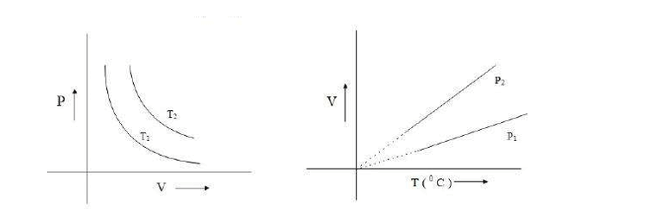
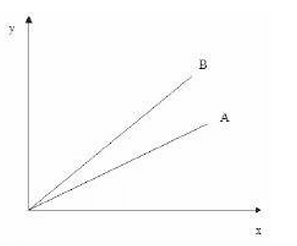
From the following plots, find the correct option regarding
1
;
2
;
3
;
4
;
Official Solution
Correct Option:
(4)
From PV and VT plots, higher temperature corresponds to higher volume at given pressure and vice versa. Analyze graph slopes accordingly.
02
PYQ 2022
medium
chemistryID: ap-eapce
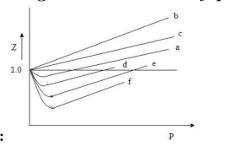
Among the gases a, b, c, d, e, and f, the gases that show only positive deviation from ideal behavior at all pressures in the graph are:
1
b, c only
2
b, c, a only
3
d, e only
4
d, e, f only
Official Solution
Correct Option:
(1)
Positive deviation from ideal behavior means compressibility factor at all pressures. From the graph, curves for b and c lie completely above the line , indicating that they show only positive deviation throughout.
03
PYQ 2022
medium
chemistryID: ap-eapce
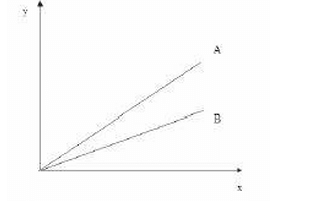
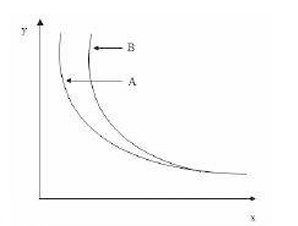
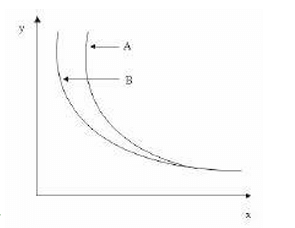
Identify the correct variation of pressure and volume of a real gas (A) and an ideal gas (B) at constant temperature.
( )
1
2
3
4
Official Solution
Correct Option:
(3)
For an ideal gas:
Real gases deviate from ideal behavior due to:
- Intermolecular forces
- Finite volume of molecules Hence:
- Real gas pressure is higher than ideal gas at the same volume, especially at high pressure or low temperature. Thus, real gas curve lies above the ideal gas curve on a vs. graph.
04
PYQ 2022
medium
chemistryID: ap-eapce
The standard molar enthalpy of vaporisation ( ) of A, B and C liquids is 23.3, 41 and 29 kJ mol respectively. The correct order of dipole-dipole attractive forces in these liquids is
1
B>C>A
2
B>A>C
3
A>C>B
4
A>B>C
Official Solution
Correct Option:
(1)
The standard molar enthalpy of vaporization ( ) is the enthalpy change required to vaporize one mole of a liquid at its standard state (usually 1 bar pressure, specified temperature - often the normal boiling point).
A higher enthalpy of vaporization indicates that more energy is required to overcome the intermolecular attractive forces in the liquid state and convert the liquid into a gas.
Therefore, a higher generally implies stronger intermolecular forces. The question asks for the order of dipole-dipole attractive forces. While reflects the *total* strength of all types of intermolecular forces (London dispersion forces, dipole-dipole forces, hydrogen bonding), if we assume that dipole-dipole forces are a significant contributor and other factors are comparable or scale similarly, then a higher would suggest stronger dipole-dipole forces. This is a common simplifying assumption in such comparative questions unless other information (like molecular structure or polarity) is given. Given values:
Liquid A:
Liquid B:
Liquid C: Arranging these values in decreasing order:
(B)> (C)> (A). Since higher implies stronger intermolecular forces, the order of strength of these forces (and by inference, dipole-dipole forces if they are dominant or representative of the total) is:
B>C>A. This matches option (a).
05
PYQ 2022
medium
chemistryID: ap-eapce
The molecule which has more number of lone pair of electrons than the bond pair of electrons in its central atom is
1
XeF
2
ClF
3
XeF
4
SF
Official Solution
Correct Option:
(1)
XeF has 2 bond pairs and 3 lone pairs on the central atom (Xe). Total 5 electron pairs form a trigonal bipyramidal arrangement. Since lone pairs are more than bond pairs on Xe, this satisfies the condition.
06
PYQ 2022
medium
chemistryID: ap-eapce
20 mL of gas A and 10 mL of gas B diffuses through a porous membrane separately in 1 minute. If the vapor density of B is X, what is the vapor density of A?
1
2x
2
4x
3
4
Official Solution
Correct Option:
(3)
According to Graham's Law of Diffusion, the rate of diffusion ( ) of a gas is inversely proportional to the square root of its molar mass ( ) or its vapor density ( ), assuming constant temperature and pressure.
or (since Molar Mass ). Rate of diffusion ( ) can be expressed as Volume diffused ( ) per unit time ( ): .
Given:
For gas A: Volume mL, time minute.
Rate of diffusion of A: .
For gas B: Volume mL, time minute.
Rate of diffusion of B: . Let be the vapor density of gas A and be the vapor density of gas B.
From Graham's Law: . We are given . We need to find .
Substitute the rates of diffusion:
.
.
So, .
Square both sides:
.
.
Now, solve for :
. This matches option (c).
07
PYQ 2023
medium
chemistryID: ap-eapce
The isotopes of hydrogen are H, D and T. What is the approximate ratio of rate of diffusion of H , D , and T ?
1
0.4 : 0.5 : 0.7
2
0.7 : 0.5 : 0.4
3
0.5 : 0.25 : 0.167
4
0.167 : 0.25 : 0.5
Official Solution
Correct Option:
(2)
According to Graham’s law of diffusion:
- Molar mass of H = 2
- Molar mass of D = 4 - Molar mass of T = 6 So:
Rounded to:
08
PYQ 2023
medium
chemistryID: ap-eapce
A gaseous mixture containing H , He, and O exerts a pressure of 1 bar. The weight percentage of H and He is 20 and 16 respectively. What is the ratio of partial pressures of O , He and H ?
1
1 : 2 : 5
2
5 : 2 : 1
3
2 : 1 : 5
4
2.5 : 1 : 1
Official Solution
Correct Option:
(1)
Given:
- Weight % of H = 20%
- Weight % of He = 16%
- So, O = 100 - 20 - 16 = 64% Let’s convert to moles: Total moles = Partial pressure mole fraction: As the question asks for , the correct order is:
09
PYQ 2023
medium
chemistryID: ap-eapce
Elemental sulphur is known to exist as S (in vapor state) at 1000 K. At this temperature, if 1 g of sulphur occupies 2.62 L, its pressure (in atm) is (Assume S vapors follow the ideal gas equation. Given, R = 0.082 L atm mol K )
1
1.0
2
0.5
3
4.0
4
2.0
Official Solution
Correct Option:
(2)
Use the ideal gas equation:
Given: K, L, g, g/mol
mol
atm
10
PYQ 2025
easy
chemistryID: ap-eapce
At T(K), a gaseous mixture contains H and O . The total pressure of the mixture is 2 bar. The weight percentage (w/w) of H is 33.33%. What is the approximate ratio of partial pressure of H and O ?
1
8 : 1
2
4 : 1
3
2 : 1
4
3 : 1
Official Solution
Correct Option:
(1)
Step 1: Assume 100 g of mixture.
Given that H is 33.33% by weight, then:
Step 2: Convert masses to moles. Step 3: Use mole ratio to find partial pressure ratio.
Total moles = Step 4: Calculate the pressure ratio.
11
PYQ 2025
medium
chemistryID: ap-eapce
At 27 °C, rms velocity of SO is x ms and most probable velocity of O at 127 °C is y ms . The value of x : y is
1
3 : 4
2
4 : 3
3
2 : 3
4
3 : 2
Official Solution
Correct Option:
(1)
Step 1: Recall the Formulas for RMS Velocity and Most Probable Velocity
The root mean square (rms) velocity ( ) is given by:
The most probable velocity ( ) is given by:
Where:
= Ideal gas constant
= Absolute temperature in Kelvin
= Molar mass of the gas in kg/mol Step 2: Convert Temperatures to Kelvin and Calculate Molar Masses
For SO :
Temperature
Molar mass of SO ( ): S = 32 g/mol, O = 16 g/mol.
For O :
Temperature
Molar mass of O ( ): O = 16 g/mol.
Step 3: Express x and y using the Velocity Formulas
Given is the rms velocity of SO :
Given is the most probable velocity of O :
Step 4: Calculate the Ratio x : y
Combine the square roots and cancel common terms ( and ):
Simplify the terms inside the square root:
Notice that is half of :
Simplify the fraction:
Therefore, the ratio is . Step 5: Analyze the Options
\begin{itemize} \item Option (1): 3 : 4. This matches our calculated ratio. \item Option (2): 4 : 3. Incorrect. \item Option (3): 2 : 3. Incorrect. \item Option (4): 3 : 2. Incorrect.
\end{itemize}
12
PYQ 2025
medium
chemistryID: ap-eapce
At the same pressure, the volume occupied by of gas "A" at is the same as of at . What is the molar mass (in ) of "A"? (Assume that gas "A" and are ideal gases) ( )
1
2
3
4
Official Solution
Correct Option:
(2)
\textbf{Step 1: Recall the Ideal Gas Law} The ideal gas law is given by:
$ P V n R T n_1 T_1 n_2 T_2 \text{H}_2 m_A = 5.6 \, \text{g} M_A \text{H}_2 \text{H}_2 m_{\text{H}_2} = 1 \, \text{g} \text{H}_2 M_{\text{H}_2} = 2 \, \text{g mol}^{-1} \text{H}_2 \frac{n_1}{T_1} = \frac{n_2}{T_2} M_A 56 28 44 60 $ Incorrect — does not match the calculated value.
13
PYQ 2025
medium
chemistryID: ap-eapce
Consider the following: Statement I: Real gases exhibit ideal behaviour at high pressures and low temperatures. Statement II: At high pressure, all gases have compressibility factor (Z) either as 1 or< 1.
1
Both statement-I and statement-II are correct
2
Both statement-I and statement-II are not correct
3
Statement-I is correct, but statement-II is not correct
4
Statement-I is not correct, but statement-II is correct
Official Solution
Correct Option:
(2)
- Statement I is incorrect: Real gases do **not** behave ideally at high pressure and low temperature — they deviate more significantly. - Statement II is incorrect: At high pressures, the compressibility factor can be greater than 1 (due to repulsive forces), not just ≤1.
About States Of Matter - AP-EAPCET
States Of Matter is a vital chapter for AP-EAPCET aspirants. Mastering the concepts covered in this chapter is essential for securing a top rank.
By rigorously practicing the previous year questions associated with this chapter, you can identify high-yield topics, understand the examiner's perspective, and boost your confidence during the actual exam.
Frequently Asked Questions
Why focus on States Of Matter PYQs?
Analyzing PYQs for this specific chapter reveals the most frequently tested concepts and the typical complexity of questions, allowing you to tailor your study plan efficiently.
How to best use this analysis?
Review the topic breakdown to see which sub-topics within States Of Matter carry the most weight. Then, tackle the questions iteratively to solidify your understanding.