A. Frenkel defects are shown by crystals with vacant lattice sites (4)
B. Schottkey defects are commonly observed in NaCl (2)
C. Vacancy defects are typically found in AgCl (3)
D. Metal deficiency defects are observed in FeO (1)
02
PYQ 2022
medium
chemistryID: ap-eapce
Which of the following solids is not a molecular solid?
1
HCl
2
H2}O
3
CCl4
4
SiO2
Official Solution
Correct Option: (4)
Molecular solids consist of molecules held by van der Waals forces or hydrogen bonds.
SiO2} is a covalent network solid with a 3D structure made of strong covalent bonds, not discrete molecules.
03
PYQ 2022
medium
chemistryID: ap-eapce
The two stable isotopes of carbon present in the naturally occurring carbon are
1
C and C
2
C and C
3
C and C
4
C and C
Official Solution
Correct Option: (2)
Carbon naturally exists as two stable isotopes:
C is a radioactive isotope with a half-life of about 5730 years and is used in radiocarbon dating, not considered stable.
04
PYQ 2022
medium
chemistryID: ap-eapce
The number of network solids and ionic solids in the list given below is respectively H O (ice), AlN, Cu, CaF , diamond, MgO, CCl , ZnS, Ag, NaCl, SiO
1
2
3
4
Official Solution
Correct Option: (2)
Network Solids:Diamond, SiO , AlN 3
Ionic Solids: NaCl, MgO, CaF , ZnS 4
Others: Cu and Ag are metallic, CCl is molecular, H O (ice) is molecular solid.
05
PYQ 2022
medium
chemistryID: ap-eapce
The anions (A) of molecule form an fcc lattice. Cations (C) are positioned at the body center and half of the edge centers. The formula of the molecule is:
1
CA
2
3
4
Official Solution
Correct Option: (4)
- Anions (A) form FCC lattice → Total A per unit cell:
- Cations (C) occupy: - 1 body center → 1 atom - 12 edges, with half occupied → atoms (each edge contributes if only half edges occupied) So, in one unit cell:
- A = 4
- C = 4 But the formula asks for smallest whole number ratio. Multiplying by 2:
06
PYQ 2022
medium
chemistryID: ap-eapce
The percentage of abundance of three elements X, Y and Z in the earth’s crust are about 27.7, 8.3 and 46.0 by mass respectively. X, Y and Z are
1
O, Si, Al
2
Al, Si, O
3
Si, Al, O
4
Al, O, Si
Official Solution
Correct Option: (1)
According to geological data of earth’s crust composition:
\begin{itemize} \item Oxygen is the most abundant element (~46%) \item Silicon comes next (~27.7%) \item Aluminium follows (~8.3%)
\end{itemize} Therefore, based on the given mass percentages, the correct order of elements is:
So X, Y, Z = O, Si, Al.
07
PYQ 2022
medium
chemistryID: ap-eapce
The density of Na is 0.613 g cm . If the edge length of unit cell of Na is 5\AA, the effective number of atoms of Na per unit cell is (Atomic weight of Na = 23 u)}
1
8
2
1
3
2
4
4
Official Solution
Correct Option: (3)
The density ( ) of a crystal is related to its unit cell parameters by the formula:
where:
= effective number of atoms per unit cell
= atomic weight (or molar mass in g/mol)
= Avogadro's number ( mol )
= edge length of the unit cell We need to find . Rearranging the formula:
. Given values:
Density .
Edge length (since ).
Atomic weight of Na, , which means molar mass is .
Avogadro's number . First, calculate :
. Now, substitute all values into the formula for :
.
The units g, cm , mol , cm , g/mol will cancel out, leaving dimensionless, as expected.
.
.
. Calculate the numerator:
.
So, .
Since must be an integer (representing the number of atoms per unit cell for common crystal structures like BCC, FCC, simple cubic), the value rounds to .
A value of corresponds to a body-centered cubic (BCC) structure for an element. Sodium (Na) crystallizes in a BCC structure at room temperature. This matches option (c).
08
PYQ 2022
medium
chemistryID: ap-eapce
Ag crystallizes in fcc lattice. What is the total number of tetrahedral voids present in 540 g of Ag metal? (N = Avagadro number, Ag atomic weight = 108 g mol )
1
10 N
2
20 N
3
40 N
4
60 N
Official Solution
Correct Option: (1)
Silver (Ag) crystallizes in a face-centered cubic (fcc) lattice.
In an fcc lattice structure:
The effective number of atoms per unit cell ( ) is 4.
The number of octahedral voids per unit cell is equal to , so there are 4 octahedral voids.
The number of tetrahedral voids per unit cell is equal to , so there are tetrahedral voids. First, calculate the number of moles of Ag in 540 g.
Atomic weight of Ag = .
Number of moles ( ) = .
. Next, calculate the total number of Ag atoms in 5 moles.
Total number of atoms = Number of moles Avogadro's number ( ).
Total Ag atoms = . In an fcc lattice, there are atoms per unit cell.
The number of tetrahedral voids is per unit cell.
This means for every 4 atoms, there are 8 tetrahedral voids.
So, the ratio of tetrahedral voids to atoms is .
Therefore, the total number of tetrahedral voids is twice the total number of atoms. Total number of tetrahedral voids = .
Total number of tetrahedral voids = .
Total number of tetrahedral voids = . This matches option (a).
09
PYQ 2022
medium
chemistryID: ap-eapce
Elements A and B have FCC and BCC structures respectively with unit cell edge length .
The number of atoms in 210 g of A = number of atoms in 594 g of B.
If density of A is , what is the density of B?
1
2
3
4
Official Solution
Correct Option: (1)
Let molar mass of A = , B = From data:
- A is FCC: 4 atoms/unit cell
- B is BCC: 2 atoms/unit cell
-
- Densities: Given:
- Number of atoms in 210 g of A = in 594 g of B
So:
Now, use density formula:
Use it in:
10
PYQ 2022
medium
chemistryID: ap-eapce
If molten NaCl contains SrCl as impurity, crystallization can generate
1
Anionic vacancies
2
Cationic vacancies
3
Metal excess defects
4
Metal deficiency defects
Official Solution
Correct Option: (2)
Sr substitutes two Na ions, but occupies only one lattice site, creating one Na vacancy to maintain charge neutrality.
Thus, cationic vacancy is created.
11
PYQ 2023
medium
chemistryID: ap-eapce
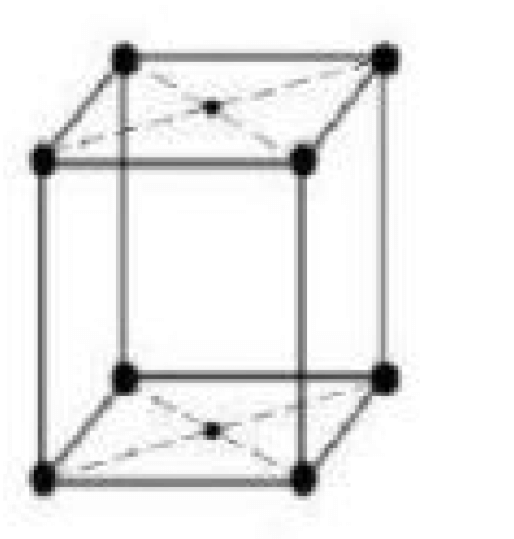
The given unit cell belongs to the type:
1
Primitive unit cell
2
Body centred unit cell
3
Face centred unit cell
4
End centred unit cell
Official Solution
Correct Option: (4)
The diagram shows atoms at all corners and one atom at the center of each pair of opposite faces. This corresponds to an end-centred unit cell. Such unit cells are characteristic of orthorhombic systems.
12
PYQ 2023
medium
chemistryID: ap-eapce
Out of seven crystal systems, how many have face-centred unit cells?
1
1
2
2
3
3
4
4
Official Solution
Correct Option: (2)
There are seven crystal systems, which can be further divided into 14 Bravais lattices based on the arrangement of lattice points in the unit cell. The seven crystal systems and the types of unit cells they exhibit are: 1. **Cubic:** Primitive (simple cubic), Face-centred cubic (FCC), Body-centred cubic (BCC) - 3 types 2. **Tetragonal:** Primitive, Body-centred - 2 types 3. **Orthorhombic:** Primitive, Face-centred, Body-centred, End-centred - 4 types 4. **Rhombohedral (Trigonal):** Primitive - 1 type 5. **Hexagonal:** Primitive - 1 type 6. **Monoclinic:** Primitive, End-centred - 2 types 7. **Triclinic:** Primitive - 1 type We are interested in the crystal systems that have face-centred unit cells. From the list above, we can see that face-centred unit cells occur in the following crystal systems: - **Cubic:** Face-centred cubic (FCC) is one of the Bravais lattices within the cubic crystal system.
- **Orthorhombic:** Face-centred orthorhombic is one of the Bravais lattices within the orthorhombic crystal system. Therefore, there are two crystal systems (Cubic and Orthorhombic) that have face-centred unit cells.
13
PYQ 2023
medium
chemistryID: ap-eapce
In a crystal structure, ions occupy all the tetrahedral voids and ions make BCC unit cell. What is the formula of the compound?
1
2
3
4
Official Solution
Correct Option: (1)
In an AxBy crystal structure, A+y ions occupy all the tetrahedral voids, and B-x ions form a body-centered cubic (BCC) unit cell. To determine the formula of the compound, we need to analyze the occupation of the ions within the structure:
Step 1: BCC unit cell structure with B-x ions
In a BCC lattice, there are 2 atoms per unit cell. So, we have 2 B atoms for the crystal structure.
Step 2: Tetrahedral voids in BCC structure
The BCC lattice contains 8 tetrahedral voids per unit cell. Given that A+y ions occupy all these voids, we have 8 A atoms within the unit cell.
Step 3: Determining the empirical formula
The structure consists of 8 A atoms and 2 B atoms. Simplifying this ratio gives:
A8B2= A4B1.
Correct formula: A4B2.
Therefore, the correct option for the given crystal structure is A4B2.
14
PYQ 2023
medium
chemistryID: ap-eapce
Which of the following arrangement of magnetic moment is correct for ferrimagnetic substance?
1
2
3
4
Official Solution
Correct Option: (4)
Ferrimagnetic substances have magnetic moments aligned in opposite directions (antiparallel), but the magnitudes are unequal, resulting in net magnetism. This is unlike antiferromagnetic substances, where equal and opposite spins cancel out.
15
PYQ 2023
medium
chemistryID: ap-eapce
CsCl crystallizes in a BCC structure. The radii of cation and anion are 165 pm and 182 pm respectively. What is the edge length of the unit cell?
1
400 pm
2
410 pm
3
420 pm
4
430 pm
Official Solution
Correct Option: (3)
For BCC structure, the body diagonal =
pm
pm
pm (this gives diagonal, now back-calculate )
pm
16
PYQ 2023
medium
chemistryID: ap-eapce
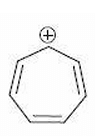
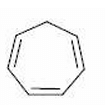
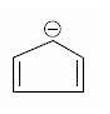
Which of the following molecules is not aromatic?
1
2
3
4
Official Solution
Correct Option: (1)
Aromaticity is determined by Hückel's rule (4n + 2 -electrons in a cyclic, planar, conjugated system):
Only option (a) lacks aromaticity. Thus, the correct answer is .
17
PYQ 2023
medium
chemistryID: ap-eapce
In crystal structure, A atoms occupied all octahedral as well as all tetrahedral voids and B atoms are at FCC centres. What is the formula of compound ?
1
2
3
4
Official Solution
Correct Option: (1)
In the crystal structure, A atoms occupy both the octahedral and tetrahedral voids, while B atoms are located at the face-centred cubic (FCC) lattice positions. In an FCC structure, each unit cell contains 4 atoms of type B. To satisfy the stoichiometry of the given crystal, the number of A atoms needs to be thrice the number of B atoms, leading to the formula . Thus, the correct formula for the compound is , which is option (1).
18
PYQ 2023
medium
chemistryID: ap-eapce
Which one of the following is correct?
1
Thallium is more electropositive than aluminium
2
Boron has high electrical conductivity
3
An aqueous solution of ortho boric acid is generally used as a mild antiseptic
4
Boron-11 ) isotope has high ability to absorb neutrons
Official Solution
Correct Option: (3)
Option (3) is correct. Ortho boric acid ( ) is a weak monobasic acid and is widely used as a mild antiseptic for eyes and skin due to its antibacterial properties.
Thallium is less electropositive than aluminium, so (1) is incorrect.
Boron is a metalloid and a poor conductor of electricity, so (2) is incorrect.
Boron-11 isotope has neutron absorbing ability but not the highest — is preferred in nuclear applications. Hence, (4) is incorrect.
19
PYQ 2023
medium
chemistryID: ap-eapce
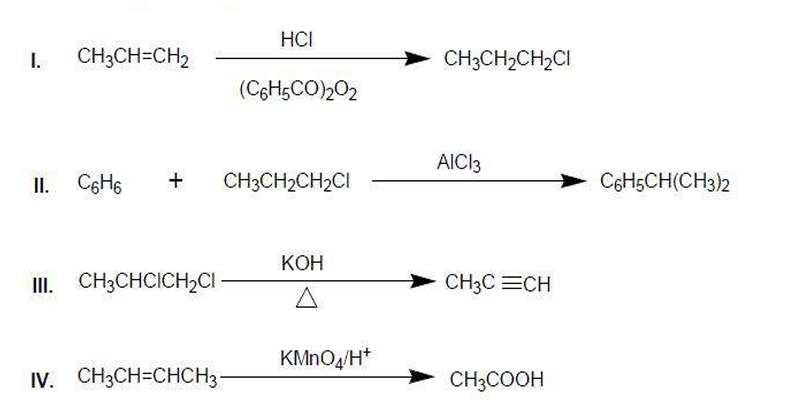
Which of the following reactions are not feasible?
1
I & IV only
2
II & III only
3
II & IV only
4
I & III only
Official Solution
Correct Option: (4)
Reactions I and III are not feasible due to their mechanism or reagent incompatibility.
I: Alkene formation by reaction with HCl is incorrect without rearrangement or suitable mechanism.
III: Terminal alkyne formation from this substrate using KOH is mechanistically impossible.
II and IV are feasible with the given reagents (Friedel-Crafts and oxidation respectively).
20
PYQ 2024
medium
chemistryID: ap-eapce
Identify the incorrect set from the following:
1
SiO₂, covalent solid, insulator, high melting point
2
MgO, covalent solid, insulator, high melting point
3
H₂O (ice), molecular solid, insulator, low melting point
4
Ag(s), metallic solid, conductor, high melting point
Official Solution
Correct Option: (2)
Step 1: Understanding the Classifications
- SiO₂ is correctly classified as a covalent solid. - MgO is incorrectly classified as a covalent solid (it is an ionic solid).
- H₂O (ice) is correctly classified as a molecular solid.
- Ag is correctly classified as a metallic solid. Thus, MgO's classification is incorrect.
21
PYQ 2025
medium
chemistryID: ap-eapce
The crystal system of a compound with cell dimensions , , ; and is
1
cubic
2
rhombohedral
3
orthorhombic
4
hexagonal
Official Solution
Correct Option: (4)
Step 1: Understand Crystal Systems and Their Parameters
Crystal systems are classified based on the lengths of the unit cell edges and the angles between them . There are seven basic crystal systems, each with unique axial lengths and interfacial angles.
Step 2: List the Given Cell Dimensions and Angles
Edge lengths:
Interfacial angles:
Step 3: Compare Given Parameters with Characteristics of Different Crystal Systems
Cubic: , Does not match — here, , and .
Rhombohedral (Trigonal): , Does not match — here, edge lengths are unequal.
Orthorhombic: , Does not match — angles do not all equal 90° and .
Hexagonal: , This matches perfectly with the given unit cell dimensions and angles.
Step 4: Conclude the Crystal System
The given parameters clearly correspond to the hexagonal crystal system.
Step 5: Analyze Options
Option (1): Cubic — Incorrect
Option (2): Rhombohedral — Incorrect
Option (3): Orthorhombic — Incorrect
Option (4): Hexagonal — Correct
✅ Final Answer: Hexagonal
22
PYQ 2025
medium
chemistryID: ap-eapce
An element occurs in the body-centred cubic structure with an edge length of 288 pm. The density of the element is 7.2 g cm . The number of atoms present in 208 g of the element is nearly
1
2
3
4
Official Solution
Correct Option: (1)
For a body-centred cubic (BCC) structure, the number of atoms per unit cell is . The relationship between density ( ), molar mass ( ), Avogadro's number ( ), edge length ( ), and is: $ \frac{208 \, \text{g}}{52 \, \text{g/mol}} = 4 \, \text{mol} 4 \, \text{mol} \times 6.022 \times 10^{23} \, \text{atoms/mol} = 24.088 \times 10^{23} \, \text{atoms} \approx 24.2 \times 10^{23}$
23
PYQ 2025
medium
chemistryID: ap-eapce
An element crystallizes in bcc lattice. The atomic radius of the element is 2.598 \AA{. What is the edge length (in \AA{}) of the unit cell?}
1
4
2
8
3
6
4
5
Official Solution
Correct Option: (3)
Step 1: Use the BCC relation between atomic radius and edge length.
In a body-centered cubic (bcc) structure:
Step 2: Substitute the given atomic radius.
Given: \AA{}
Step 3: Final Answer
Edge length = 6 \AA
24
PYQ 2025
medium
chemistryID: ap-eapce
A metal crystallizes in simple cubic lattice. The radius of the metal atom is . What is the volume of the unit cell in ?
1
2
3
4
Official Solution
Correct Option: (3)
In simple cubic lattice: Given radius , so Volume of unit cell:
25
PYQ 2025
medium
chemistryID: ap-eapce
Gold crystallizes in fcc lattice. The edge length of the unit cell is 4 Å. The closest distance between gold atoms is 'x' Å and density of gold is 'y' g/cm . What are x and y respectively?
1
, 41.04
2
, 20.52
3
, 10.25
4
, 5.15
Official Solution
Correct Option: (2)
Step 1: Closest distance in fcc lattice In face-centered cubic (fcc), atoms touch along the face diagonal: For gold with 4 Å edge length, closest distance is: Step 2: Calculate density Using: Where (fcc atoms per unit cell), , , . Calculating gives approximately 20.52 g/cm . Step 3: Conclusion The closest distance and density are Å and 20.52 g/cm .
26
PYQ 2025
medium
chemistryID: ap-eapce
If AgCl is doped with mole percent of CdCl , the number of cation vacancies (in mol ) is
1
2
3
4
Official Solution
Correct Option: (3)
Step 1: Understand the doping process and defect formation.
AgCl is an ionic compound where Ag ions occupy cation sites. CdCl is doped into AgCl. When a Cd ion (from CdCl ) replaces an Ag ion in the AgCl lattice, the charge balance needs to be maintained.
An Ag ion has a +1 charge. A Cd ion has a +2 charge.
When one Cd ion substitutes for one Ag ion, there is an excess of +1 positive charge at that site. To maintain electrical neutrality in the crystal, an additional positive charge equivalent to +1 must be removed. This is achieved by the creation of a cation vacancy, meaning another Ag ion leaves its lattice site.
Therefore, for every one Cd ion incorporated into the AgCl lattice, one Ag cation vacancy is created. Step 2: Calculate the mole fraction of CdCl doping.
The doping concentration is given as mole percent.
"Mole percent" means out of 100 moles.
So, mole percent of CdCl means that there are moles of CdCl for every 100 moles of AgCl (or total solution/mixture).
To express this as a mole fraction per mole of AgCl:
Mole fraction of CdCl = mol of CdCl per mole of AgCl. Step 3: Calculate the moles of cation vacancies per mole of AgCl.
As established in Step 1, for every mole of CdCl doped, one mole of cation vacancies is created.
Therefore, if there are moles of CdCl doped per mole of AgCl, then there will be moles of cation vacancies per mole of AgCl. Step 4: Convert moles of vacancies to the number of vacancies.
To find the actual number of cation vacancies, multiply the moles of vacancies by Avogadro's number ( ).
Number of cation vacancies = (Moles of vacancies) Avogadro's number
Number of cation vacancies =
Number of cation vacancies = This value matches option (3). The final answer is .
27
PYQ 2025
medium
chemistryID: ap-eapce
A metal crystallizes in simple cubic lattice. The volume of one unit cell is . What is the radius of the metal atom in pm?
1
100
2
200
3
300
4
400
Official Solution
Correct Option: (2)
For a simple cubic lattice, the relationship between the unit cell volume and the atomic radius is:
Given that the volume is , solving for gives us a radius of 200 pm.
28
PYQ 2025
medium
chemistryID: ap-eapce
An element (atomic weight = 250 u) crystallises in a simple cubic lattice. If the density of the unit cell is , what is the radius (in ) of the atom of the element? ( )
1
4.04
2
2.93
3
1.93
4
3.04
Official Solution
Correct Option: (3)
For a simple cubic (SC) lattice:
Number of atoms per unit cell .
Relationship between edge length of the unit cell and atomic radius : .
Density of the unit cell is given by:
where is the atomic weight (in g/mol), is Avogadro's number, and is the edge length.
Given:
Atomic weight g/mol (since 250 u per atom implies 250 g per mole).
Density .
Avogadro's number . (Given as N in question)
.
Substitute these values into the density formula to find :
Let's use for a quicker estimate:
.
. No, .
: . So it's between 1 and 2, closer to 2.
, . So . More precisely, .
Let's use .
Using :
.
.
.
So .
Convert cm to Angstroms ( ): .
So . For a simple cubic lattice, .
So, radius .
This does not match any option closely. Let me recheck calculation or formula usage.
Options are 1. 93, 2. 93, 3. 04, 4. 04. My is around their . Maybe the I found is actually .
Is the atomic weight definition different? No, 250u is 250 g/mol.
Let's check my value again.
. This is correct.
.
, , , .
So is slightly less than 1. 8. About 1. 7935.
.
Then . Let's check if one of the options for gives the density.
Option (3): .
Then .
.
. . .
.
.
Density
.
This is very close to 7. 2 g/cm . So is likely the correct answer.
My calculation of was correct, but the value of might have been interpreted as the final radius by mistake, or there's a factor of 2 error. Let's retrace calculation for :
.
My prior calculation of was . This is .
Then . What if for simple cubic? No, for simple cubic, atoms touch along the edge, so .
What if the problem uses instead of ?
.
.
.
Still around . The options are: 1. 93, 2. 93, 3. 04, 4. 04. These values seem to be rather than , or my density formula is off by a factor.
Density . This is .
Mass of one atom g.
Mass of unit cell (Z=1 for SC) g.
Volume of unit cell .
So for Z=1. This is correct. Let's check the calculation using which implies .
If is radius (in ), then cm.
.
(if r is in cm)
If is in , then .
Substitute values: .
Now, .
. So is close to 2, slightly less.
.
.
Let's calculate : . .
.
This is very close to .
So, .
This matches option (3). My initial placement of in the main density formula denominator was correct, but I solved for first, then . Direct formula for is better. My error was in .
Original: . If , then .
So . This formula is for in cm.
.
.
Since ,
.
This is consistent.
29
PYQ 2025
medium
chemistryID: ap-eapce
The composition of a sample of wustite is . Percentage of iron in the form of ion is nearly:
1
2
3
4
Official Solution
Correct Option: (2)
Step 1: Understanding Wustite Composition Wustite ( ) is a non-stoichiometric compound, meaning it contains both and . The given formula shows iron deficiency, indicating the presence of . Step 2: Determining Iron Oxidation States Let be the fraction of . Charge balance equation: Step 3: Percentage Calculation Percentage of : Conclusion Thus, the correct answer is:
30
PYQ 2025
medium
chemistryID: ap-eapce
An element (atomic weight = 250 u) crystallises in a simple cubic lattice. If the density of the unit cell is , what is the radius (in ) of the atom of the element? ( )
1
4.04
2
2.93
3
1.93
4
3.04
Official Solution
Correct Option: (3)
For a simple cubic (SC) lattice:
Number of atoms per unit cell .
Relationship between edge length of the unit cell and atomic radius : .
Density of the unit cell is given by:
where is the atomic weight (in g/mol), is Avogadro's number, and is the edge length.
Given:
Atomic weight g/mol (since 250 u per atom implies 250 g per mole).
Density .
Avogadro's number . (Given as N in question)
.
Substitute these values into the density formula to find :
Let's use for a quicker estimate:
.
. No, .
: . So it's between 1 and 2, closer to 2.
, . So . More precisely, .
Let's use .
Using :
.
.
.
So .
Convert cm to Angstroms ( ): .
So . For a simple cubic lattice, .
So, radius .
This does not match any option closely. Let me recheck calculation or formula usage.
Options are 1. 93, 2. 93, 3. 04, 4. 04. My is around their . Maybe the I found is actually .
Is the atomic weight definition different? No, 250u is 250 g/mol.
Let's check my value again.
. This is correct.
.
, , , .
So is slightly less than 1. 8. About 1. 7935.
.
Then . Let's check if one of the options for gives the density.
Option (3): .
Then .
.
. . .
.
.
Density
.
This is very close to 7. 2 g/cm . So is likely the correct answer.
My calculation of was correct, but the value of might have been interpreted as the final radius by mistake, or there's a factor of 2 error. Let's retrace calculation for :
.
My prior calculation of was . This is .
Then . What if for simple cubic? No, for simple cubic, atoms touch along the edge, so .
What if the problem uses instead of ?
.
.
.
Still around . The options are: 1. 93, 2. 93, 3. 04, 4. 04. These values seem to be rather than , or my density formula is off by a factor.
Density . This is .
Mass of one atom g.
Mass of unit cell (Z=1 for SC) g.
Volume of unit cell .
So for Z=1. This is correct. Let's check the calculation using which implies .
If is radius (in ), then cm.
.
(if r is in cm)
If is in , then .
Substitute values: .
Now, .
. So is close to 2, slightly less.
.
.
Let's calculate : . .
.
This is very close to .
So, .
This matches option (3). My initial placement of in the main density formula denominator was correct, but I solved for first, then . Direct formula for is better. My error was in .
Original: . If , then .
So . This formula is for in cm.
.
.
Since ,
.
This is consistent.
31
PYQ 2025
medium
chemistryID: ap-eapce
A compound consists of atoms A and B. The atoms of B form hcp lattice. The atoms of A occupy rd of octahedral voids and rd of tetrahedral voids. What is the molecular formula of the compound?
1
2
3
4
Official Solution
Correct Option: (4)
- Number of atoms of B in hcp lattice per unit cell = 6.
- Number of octahedral voids per atom = 1.
- Number of tetrahedral voids per atom = 2.