Poly dispersity index of a polymer is 1.25. If , what is its ?
1
850
2
900
3
950
4
1000
Official Solution
Correct Option:
(4)
We use the relation: Given:
02
PYQ 2023
medium
chemistryID: ap-eapce
Zinc acetate – antimony trioxide catalyst is used in the preparation of which polymer?
1
High density polythene
2
Teflon
3
Terylene
4
PVC
Official Solution
Correct Option:
(3)
The question asks about the polymer that is synthesized using zinc acetate and antimony trioxide as a catalyst. These two compounds are commonly used in the polymerization process of Terylene, also known as Polyethylene terephthalate (PET). Here’s how the polymerization process works: Terylene (PET) is a synthetic polyester formed by the condensation polymerization of terephthalic acid (PTA) and ethylene glycol (EG).
The reaction is initiated and catalyzed by the use of zinc acetate ( ) and antimony trioxide ( ) as catalysts. The role of the catalyst is to help the polymerization process by reducing the activation energy required for the reaction, allowing the esterification between ethylene glycol and terephthalic acid to proceed efficiently. Terylene is used in making synthetic fibers (such as polyester clothing) and plastic bottles (PET bottles). Therefore, the correct answer is Terylene (Option 3).
03
PYQ 2025
medium
chemistryID: ap-eapce
What are and in the following reaction? $ $
1
- thermosetting polymer
2
- thermoplastic polymer
3
- condensation polymer
4
- Network polymer
Official Solution
Correct Option:
(2)
Step 1: Analyze the Reaction. The given reaction is: $ or ) to form a polymer. The reactant suggests that it is ethylene chloride, which can undergo polymerization under specific conditions. Step 2: Identify the Polymerization Process. Ethylene chloride ( ) can undergo polymerization to form polyethylene (PE). However, the presence of chlorine ( ) indicates that this might be a more complex reaction involving substitution or addition reactions before polymerization. Step 3: Determine and . To identify and , we need to consider the reagents and products: 1. Reagent : The reagent is typically a catalyst or initiator for the polymerization reaction. Common initiators for polymerization include metallic compounds like sodium (Na) in liquid ammonia ( ), which can act as a reducing agent or catalyst. 2. Product : The product is the polymer formed from the monomer . Ethylene chloride ( ) can undergo polymerization to form polyethylene (PE). Step 4: Match with Options. The options provided are: (1) - thermosetting polymer (2) - thermoplastic polymer (3) - condensation polymer (4) - Network polymer Option 1: - thermosetting polymer Thermosetting polymers are cross-linked polymers that do not melt upon heating. This does not match the context of the reaction. Option 2: - thermoplastic polymer Thermoplastic polymers are linear or branched polymers that can be melted and reshaped. This matches the context of the reaction, as ethylene chloride polymerizes to form a thermoplastic polymer like polyethylene. Option 3: - condensation polymer Condensation polymers are formed by a condensation reaction, which involves the elimination of small molecules (e.g., water). This does not match the context of the reaction. Option 4: - Network polymer Network polymers are highly cross-linked structures, similar to thermosetting polymers. This does not match the context of the reaction. Step 5: Correct Answer. The correct option is: \) $
04
PYQ 2025
medium
chemistryID: ap-eapce
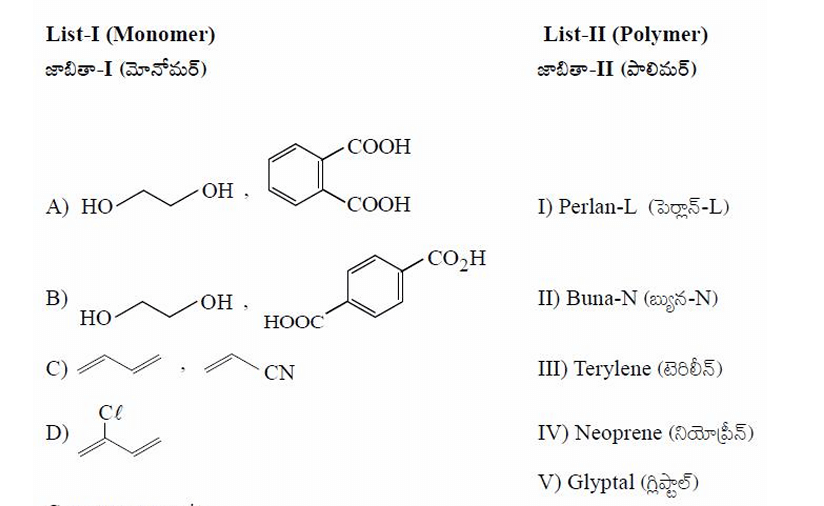
Match the following
1
A-V, B-I, C-II, D-IV
2
A-V, B-III, C-II, D-IV
3
A-III, B-V, C-IV, D-II
4
A-I, B-III, C-IV, D-II
Official Solution
Correct Option:
(2)
Step 1: Analyze each monomer combination and identify the corresponding polymer. \begin{itemize} \item A) Monomers: HO-(CH ) -OH (Ethylene glycol) and Benzene-1,2-dicarboxylic acid (Phthalic acid). Ethylene glycol and phthalic acid (or phthalic anhydride) polymerize to form Glyptal. Glyptal is a type of polyester. Therefore, A matches V (Glyptal). \item B) Monomers: HO-(CH ) -OH (Butane-1,4-diol) and HOOC-Benzene-COOH (Terephthalic acid). Butane-1,4-diol and terephthalic acid polymerize to form poly(butylene terephthalate), which is a type of polyester. Terylene (also known as Dacron or PET) is formed from ethylene glycol and terephthalic acid. Given the options and common polymer types, this combination is related to polyester formation. Therefore, B matches III (Terylene). \item C) Monomers: CH =CH-CH=CH (1,3-Butadiene) and CH =CH-CN (Acrylonitrile). 1,3-Butadiene and acrylonitrile copolymerize to form Buna-N (Nitrile rubber), which is a synthetic rubber. Therefore, C matches II (Buna-N). \item D) Monomer: Cl C=CH-CH=CH (Chloroprene). Chloroprene (specifically 2-chloro-1,3-butadiene) polymerizes to form Neoprene, a synthetic rubber. The structure provided in D is 2-chlorobuta-1,3-diene, which is chloroprene. Therefore, D matches IV (Neoprene).
\end{itemize} Step 2: Combine the matches.
A - V (Glyptal)
B - III (Terylene)
C - II (Buna-N)
D - IV (Neoprene) Step 3: Compare with the given options.
Let's check the options based on our derived matches:
% Option
(1) A-V, B-I, C-II, D-IV (Incorrect, B is not I)
% Option
(2) A-V, B-III, C-II, D-IV (Matches our findings)
% Option
(3) A-III, B-V, C-IV, D-II (Incorrect, A is not III)
% Option
(4) A-I, B-III, C-IV, D-II (Incorrect, A is not I) The correct option is (2).
05
PYQ 2025
medium
chemistryID: ap-eapce
Consider the following
Statement-I: Natural rubber becomes soft at low temperature and brittle at high temperature.
Statement-II: Natural rubber has weak van der Waals forces between its polymer chains.
1
Both statement-I and statement-II are correct
2
Both statement-I and statement-II are not correct
3
Statement-I is correct, but statement-II is not correct
4
Statement-I is not correct, but statement-II is correct
Official Solution
Correct Option:
(4)
Natural rubber becomes brittle at low temperature and soft at high temperature due to weak intermolecular forces (van der Waals) between polymer chains. Hence, statement-I is incorrect and II is correct.
About Polymer Chemistry - AP-EAPCET
Polymer Chemistry is a vital chapter for AP-EAPCET aspirants. Mastering the concepts covered in this chapter is essential for securing a top rank.
By rigorously practicing the previous year questions associated with this chapter, you can identify high-yield topics, understand the examiner's perspective, and boost your confidence during the actual exam.
Frequently Asked Questions
Why focus on Polymer Chemistry PYQs?
Analyzing PYQs for this specific chapter reveals the most frequently tested concepts and the typical complexity of questions, allowing you to tailor your study plan efficiently.
How to best use this analysis?
Review the topic breakdown to see which sub-topics within Polymer Chemistry carry the most weight. Then, tackle the questions iteratively to solidify your understanding.