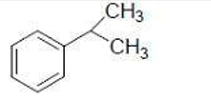
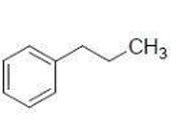
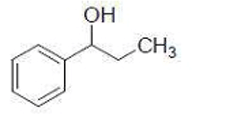
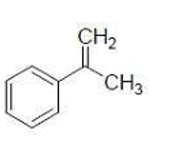
This is a two-step reaction: 1. Friedel-Crafts acylation:
Phenylpropanone (aromatic ketone) is formed. 2. Clemmensen reduction:
The carbonyl group is reduced to -CH -, giving n-propylbenzene. Hence, the final product is:
02
PYQ 2022
medium
chemistryID: ap-eapce
Identify the major product formed from the following reaction?
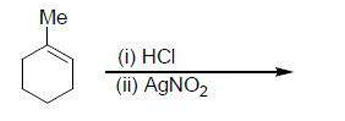
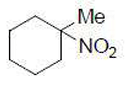
1
2
3
4
Official Solution
Correct Option: (4)
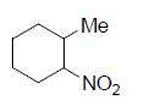
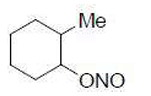
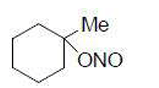
The starting compound is toluene ( ). First, nitrates the ring. The methyl group is ortho-para directing, so the major product is para-nitrotoluene ( , at para). Then, introduces a nitroso group ( ). The methyl group directs the second substitution to the ortho position (relative to ), giving a product with and (ortho to ). Option 4, with (likely , nitroso), ortho to , matches this. Thus, the correct answer is option 4.
03
PYQ 2023
medium
chemistryID: ap-eapce
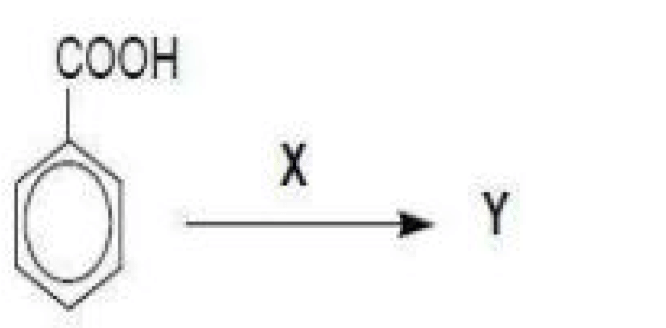
In the reaction, if X is the reagent and Y is the product, which of the following is not feasible?
1
X = Conc. HNO3 + Conc. H2SO4; Y = 3-Nitrobenzoic acid
2
X = Br2/Fe; Y = 3-Bromobenzoic acid
3
X = NaOH, CaO; Y = Benzene
4
X = CH3Cl / AlCl3; Y = 3-Methylbenzoic acid
Official Solution
Correct Option: (3)
Benzoic acid cannot be converted to benzene by heating with NaOH and CaO (this reaction, decarboxylation, removes the –COOH group but doesn’t convert it directly to benzene). The rest of the reactions are feasible:
- Nitration at meta position (–COOH is meta directing)
- Bromination at meta position
- Friedel–Crafts alkylation is not feasible directly on benzoic acid due to deactivation, but methylation via specific steps may be possible.
04
PYQ 2024
medium
chemistryID: ap-eapce
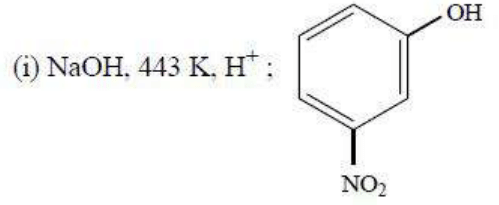
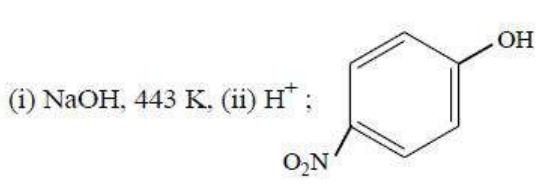
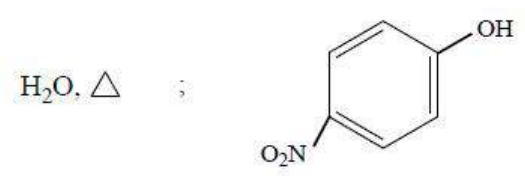
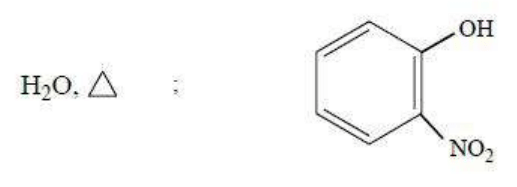
What are Y and Z respectively in the following reaction sequence?
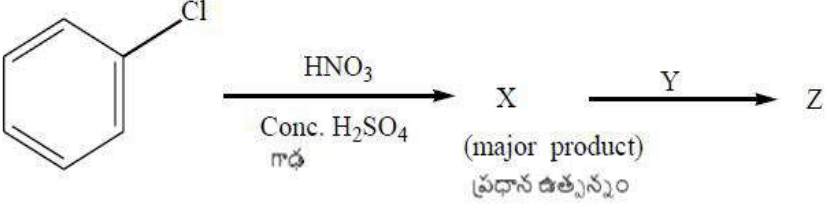
1
2
3
4
Official Solution
Correct Option: (2)
Step 1: Nitration of Chlorobenzene - Reaction: Chlorobenzene undergoes nitration with HNO /H SO . - The major product is p-nitrochlorobenzene due to the electron-withdrawing effect of chlorine. Step 2: Conversion to Phenol - Reaction: The chlorine in p-nitrochlorobenzene is replaced by OH under fused NaOH at high temperature (443K). - The resulting compound is p-nitrophenol. Step 3: Confirming the Correct Option - The correct Y is p-nitrochlorobenzene. - The correct Z is p-nitrophenol. Thus, the correct answer is the option with p-nitrophenol. \bigskip
05
PYQ 2025
medium
chemistryID: ap-eapce
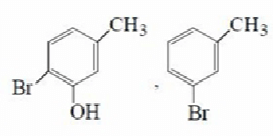
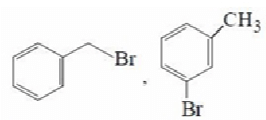
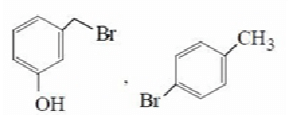
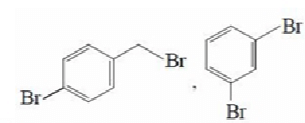
What are X and Y respectively, in the following set of reactions?
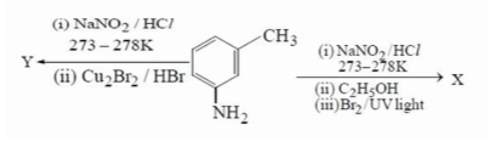
1
2
3
4
Official Solution
Correct Option: (2)
- Starting with p-toluidine (4-methyl aniline), the reaction with NaNO /HCl at 273–278 K forms the diazonium salt.
- Reaction of the diazonium salt with Cu Br /HBr substitutes the diazonium group with bromine, forming benzyl bromide (X).
- The second sequence involves converting the diazonium salt to phenol via reaction with ethanol, and then bromination in presence of UV light leads to substitution at the para position, forming p-bromotoluene (Y).
06
PYQ 2025
medium
chemistryID: ap-eapce
Which of the following sets of reagents convert aniline to chlorobenzene?
1
NaNO / HCl, 273 – 278 K; Cu Cl / HCl
2
NaNO / HCl, 293 – 298 K; Cu Cl / HCl
3
NaNO / HCl, 273 – 278 K; SOCl
4
NaNO / HCl, 273 – 278 K; Cl
Official Solution
Correct Option: (1)
Aniline is diazotized using NaNO and HCl at low temperatures (273–278 K) to form a diazonium salt, which then reacts with Cu Cl (Sandmeyer reaction) to form chlorobenzene.