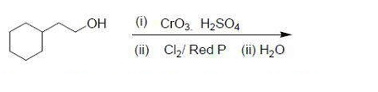
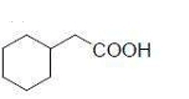
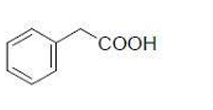
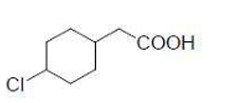
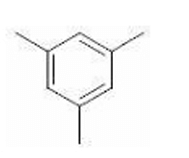
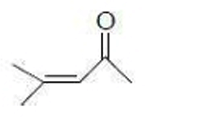
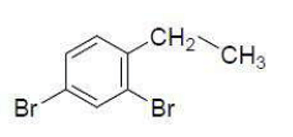
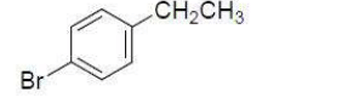
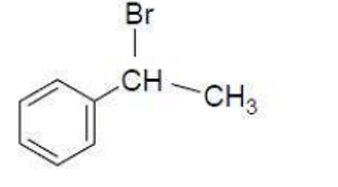
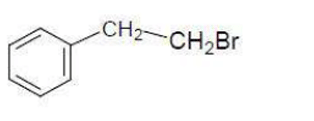
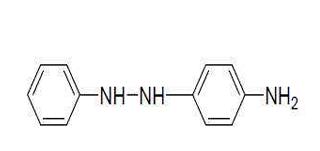
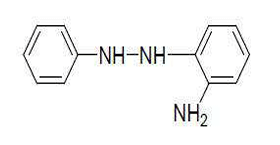
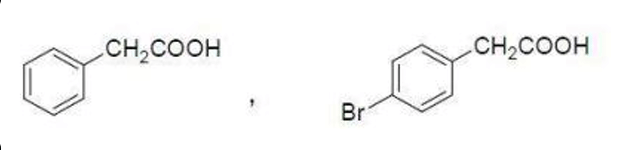
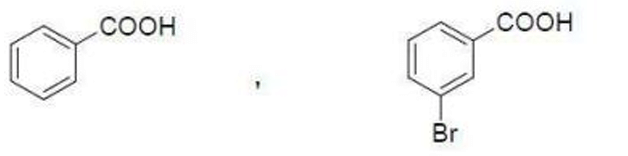
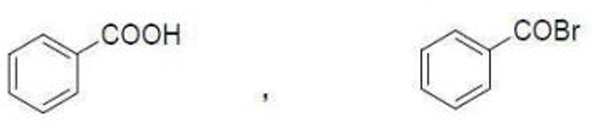
Identify the major product from the following reaction sequence: Reactant: 1-phenylpropanol
1
2
3
4
Official Solution
Correct Option: (4)
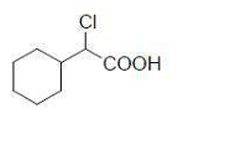
Step-by-step transformation: 1. Oxidation (CrO /H SO ) converts the primary alcohol to a carboxylic acid: 2. Chlorination using Cl /red P results in substitution at the α-carbon (adjacent to -COOH), forming: Hence, the major product is: α-chloro propionic acid derivative with a correct carbon skeleton as per the original straight chain.
02
PYQ 2022
medium
chemistryID: ap-eapce
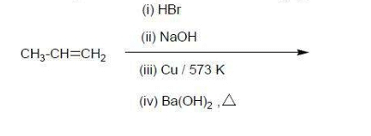
Identify the major product formed from the following reaction sequence:
1
2
3
4
Official Solution
Correct Option: (4)
Step-by-step: 1. CH -CH=CH + HBr → CH -CHBr-CH (Markovnikov addition)
2. Dehydrohalogenation with NaOH: CH -CHBr-CH → CH -C≡CH\ (propyne)
3. Red hot Cu (573 K): CH -C≡CH → CH -CHO (Acetaldehyde)
4. Ba(OH) , heat (aldol condensation): 2 CH -CHO → CH -CO-CH + H O Final product is propanone (acetone).
03
PYQ 2023
medium
chemistryID: ap-eapce
Identify X and Y in the following reaction
1
2
3
4
Official Solution
Correct Option: (1)
To identify X and Y in the given reaction, we need to understand the chemical transformations taking place:
The reaction is:
Step 1: Convert ethene to ethyl iodide . This conversion suggests that ethene is first converted into ethyl bromide using , a process that involves adding HBr across the double bond of ethene via a hydrohalogenation reaction.
Step 2: Convert ethyl bromide to ethyl iodide . This transformation can be achieved using NaI in a dry acetone solvent ( ), which is known as the Finkelstein reaction. In this reaction, the bromine in ethyl bromide is replaced by iodine, producing ethyl iodide.
Conclusion: Therefore, X is and Y is .
04
PYQ 2023
medium
chemistryID: ap-eapce
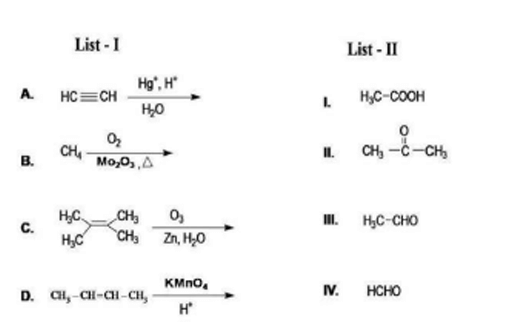
Match the following
1
A-III, B-II, C-I, D-IV
2
A- III, B- IV, C- II, D- I
3
A - IV, B - III, C - II, D - I
4
A - II, B - I, C - III, D - IV
Official Solution
Correct Option: (2)
- For , the reaction with forms a carboxylic acid, which corresponds to option III, .
- For , reacts with in the presence of , yielding , which corresponds to option IV.
- For , reacts with in the presence of , and water, forming formic acid , matching with option II.
- For , in the presence of and forms acetic acid, matching with option I. Thus, the correct match is option 2.
05
PYQ 2023
medium
chemistryID: ap-eapce
The major product of the following reaction is
1
2
3
4
Official Solution
Correct Option: (3)
In this reaction, the alkyl group will undergo radical substitution in the presence of UV light, and the major product will be a substitution of the hydrogen atom with a bromine atom. The resulting product is the alkyl bromide. Thus, the correct answer is .
06
PYQ 2023
medium
chemistryID: ap-eapce
Which of the following reactions is not correct?
1
2
3
4
Official Solution
Correct Option: (2)
The reactions represent common organic reactions: In option (1), the reaction of alkyl halides (CH Br) with zinc leads to the formation of alkene by reduction (dehalogenation), which is correct. In option (2), the reaction of an alkyne with sodium in liquid ammonia is a reduction that leads to trans-alkene formation, which is correct. In option (3), the reaction of an alkyne with water, mercuric ions (Hg ), and acid leads to the formation of an aldehyde, which is correct. In option (4), the reaction of an alkyl halide (Ph-CH Br) with sodium in dry ether leads to a coupling reaction forming biphenyl, which is correct. Thus, option (2) is the correct answer as it involves an incorrect reaction pathway.
07
PYQ 2023
medium
chemistryID: ap-eapce
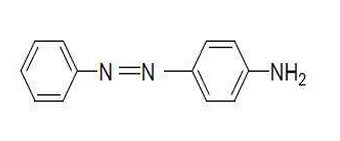
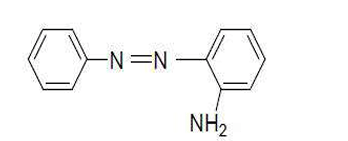
The type of reaction 'X' and product 'Y' of the following are respectively:
1
Electrophilic Substitution and
2
Electrophilic Substitution and
3
Nucleophilic Substitution and
4
Nucleophilic Substitution and
Official Solution
Correct Option: (1)
This is an example of electrophilic substitution involving a diazonium salt reacting with aniline ( ) to form an azo compound.
The diazonium group ( ) acts as an electrophile.
The electron-rich aniline ring undergoes coupling at the para position.
The result is an azo dye with the structure .
This is a classic example of azo coupling, a key method in dye chemistry.
08
PYQ 2023
medium
chemistryID: ap-eapce
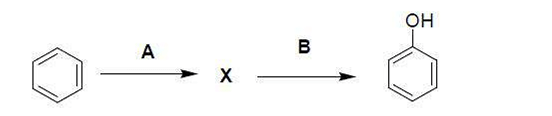
In the following reaction sequence, A and B respectively are
1
2
3
4
Official Solution
Correct Option: (1)
- The reaction involves an alkyl halide (chloropropane) with AlCl , followed by treatment with oxygen and water, which is a typical setup for a Friedel-Crafts alkylation followed by oxidation to form a phenol derivative. - Option (1) correctly represents the reagents needed to achieve the conversion. Thus, the correct answer is (1).
09
PYQ 2023
medium
chemistryID: ap-eapce
Which of the following reagents will convert isobutyraldehyde to the corresponding acid?
1
HNO I
2
NH NH /OH⁻ II
3
2[Ag(NH ) ]⁺ III
4
NaOH IV
Official Solution
Correct Option: (1)
In the given options, HNO (Nitric acid) and 2[Ag(NH ) ]⁺ are reagents that can oxidize isobutyraldehyde into its corresponding carboxylic acid. The third option is also a known reagent for this transformation.
10
PYQ 2023
medium
chemistryID: ap-eapce
What are 'X' and 'Y' respectively in the following reaction sequence?
1
2
3
4
Official Solution
Correct Option: (3)
In the first step, KMnO /KOH acts as an oxidizing agent, converting styrene into a carboxylated product (X). The second step involves a reaction with H O that replaces the halogen (Y) and forms a carboxylic acid.
11
PYQ 2025
medium
chemistryID: ap-eapce
What are X and Y respectively, in the following set of reactions ?
1
2
3
4
Official Solution
Correct Option: (4)
Step 1: Determine Product X from the first reaction.
The first reaction is the oxidation of ethane (CH₃CH₃) with oxygen (O₂) in the presence of manganese acetate ((CH₃COO)₂Mn) and heat ( ). This is a controlled catalytic oxidation.
Under these conditions, alkanes can be selectively oxidized to carboxylic acids. For ethane, the controlled oxidation leads to the formation of acetic acid.
Thus, X = CH₃COOH. Step 2: Determine Product Y from the second reaction.
The second reaction involves the oxidation of propene (CH₃CH=CH₂) with hot, acidic potassium permanganate (KMnO₄/H⁺). Acidic KMnO₄ is a strong oxidizing agent that causes oxidative cleavage of carbon-carbon double bonds.
When an alkene is subjected to hot, acidic KMnO₄:
\begin{itemize} \item A carbon atom of the double bond that carries at least one hydrogen atom is oxidized to a carboxylic acid. \item A terminal group is completely oxidized to carbon dioxide ( ) and water ( ).
\end{itemize}
For propene (CH₃CH=CH₂):
\begin{itemize} \item The group (terminal carbon of the double bond) will be oxidized to and . \item The group (the other carbon of the double bond with a hydrogen) will be oxidized to a carboxylic acid. The product from this fragment is .
\end{itemize}
In organic chemistry problems asking for the major organic product of such cleavages, the organic acid (or ketone) formed is usually the expected answer, rather than .
Thus, Y = CH₃COOH. Step 3: Match the products with the given options.
Based on our analysis:
X = CH₃COOH
Y = CH₃COOH Comparing this with the given options:
% Option
(1)
% Option
(2)
% Option
(3)
% Option
(4) Option (4) matches our derived products.