AP-EAPCET SERIES
Chemistry

Solutions

32 previous year questions.

Volume: 32 Ques
Yield: High

High-Yield Trend

13
2025
2
2024
7
2023
10
2022

Chapter Questions
32 MCQs

01
PYQ 2022
medium
chemistry ID: ap-eapce
At T (K), x g of a non-volatile solid (molar mass 78 g mol ) when added to 0.5 kg water, lowered its freezing point by 1.0°C. What is x (in g)? (K of water at T(K) = 1.86 K kg mol )
1
10.48
2
20.96
3
41.92
4
5.24
02
PYQ 2022
medium
chemistry ID: ap-eapce
Assertion (A): MgSO4 is readily soluble in water.
Reason (R): The greater hydration enthalpy of Mg2+ ions overcomes its lattice enthalpy.
1
A and R both are correct and R is the correct explanation of A.
2
A and R both are correct but R is not the correct explanation of A.
3
A is correct but R is not correct
4
A is incorrect but R is correct
03
PYQ 2022
medium
chemistry ID: ap-eapce

Which of the following are extensive properties?

1

A, B, C and E

2

A, B, and D

3

A, B, and D

4

A, B, E only

04
PYQ 2022
medium
chemistry ID: ap-eapce
For which of the following liquid mixtures and ?}
1
ethyl chloride, ethyl bromide
2
ethanol, acetone
3
phenol, aniline
4
chloroform, acetone
05
PYQ 2022
medium
chemistry ID: ap-eapce
Which of the following compounds do not have sp carbon atom(s)?
I. Acetone\quad II. Acetic acid\quad III. Buta-1,3-diene\quad IV. Propyne\quad V. Naphthalene
1
I only
2
II, III only
3
IV, V only
4
III, V only
06
PYQ 2022
medium
chemistry ID: ap-eapce
3.1 g of a compound, 'X' (molar mass = 62 g mol ) is dissolved in 19.5 g of other compound, Y (molar mass = 78 g mol ). The ratio of mole fractions of X and Y in the solution is
1
1:5
2
5:1
3
4:1
4
1:4
07
PYQ 2022
medium
chemistry ID: ap-eapce
A solution containing 6.0 g of urea is isotonic with a solution containing 10 g of a non-electrolytic solute X. The molar mass of X (in g mol\textsuperscript{-1}) is
1
50.0
2
100
3
75.0
4
68.0
08
PYQ 2022
medium
chemistry ID: ap-eapce
The pair of elements that form both oxides and nitrides, when burnt in air are
1
Na, Mg
2
Na, Be
3
Mg, Ca
4
Be, Mn
09
PYQ 2022
medium
chemistry ID: ap-eapce
Which of the following form an ideal solution?
1
Chloroethane and bromoethane
2
I \& II only
3
II \& III only
4
II, III \& IV only
10
PYQ 2022
medium
chemistry ID: ap-eapce
50 g of a substance is dissolved in 1 kg of water at . When the temperature is lowered to , the density increases from to . What is the percentage change in molarity of the solution?
1
10
2
4.5
3
5
4
7.3
11
PYQ 2023
medium
chemistry ID: ap-eapce
1.06 g of Na CO (molar mass = 106 g mol ) is dissolved in 500 g water. What is its molality?
1
0.2 m
2
0.02 m
3
2 m
4
0.04 m
12
PYQ 2023
medium
chemistry ID: ap-eapce

Match the following:

PropertyExpression
A. πI. Kb · m
B. ΔTfII. Kf · m
C. ΔTbIII. CST
D. (P0 - P) / P0IV. (n1 / (n1 + n2))
1
A – III, B – II, C – I, D – IV
2
A – IV, B – II, C – I, D – III
3
A – II, B – I, C – IV, D – I
4
A – I, B – III, C – II, D – IV
13
PYQ 2023
medium
chemistry ID: ap-eapce
The number of moles of OH ions present in 100 mL of 0.2 M Al(OH) solution is (assume 100% dissociation)
1

2

3

4

14
PYQ 2023
medium
chemistry ID: ap-eapce
34.2% (W/V) sucrose solution is isotonic with 18% (W/V) of unknown solution X. Formula of X is
1

2

3

4

15
PYQ 2023
medium
chemistry ID: ap-eapce
Which of the following in not correct?
1
n-hexane + n-heptane - Ideal solution
2
C H OH + H O - Positive deviation from Raoult's Law
3

4

16
PYQ 2023
medium
chemistry ID: ap-eapce
An example of a network solid is:
1

2

3

4

17
PYQ 2023
medium
chemistry ID: ap-eapce
Which of the following does not belong to an ideal solution?
1
2
3
Obeys Raoult's law over the entire range of concentration
4
Does not obey Raoult's law
18
PYQ 2024
easy
chemistry ID: ap-eapce

Aqueous CuSO4 solution was electrolysed by passing 2 amp of current for 10 min. What is the weight (in g) of copper deposited at cathode? (Cu = 63 u; F = 96500 C mol-1)

1
0.195
2
0.39
3
0.78
4
1.57
19
PYQ 2024
medium
chemistry ID: ap-eapce

Evaluate the correctness of the given statements.
I. Negative deviation occurs when A-B interactions are stronger than A-A and B-B.
II. Reverse osmosis requires applied pressure greater than osmotic pressure.

1
Both Statement-I and Statement-II are correct
2
Both Statement-I and Statement-II are incorrect
3
Statement-I is correct but Statement-II is not correct
4
Statement-I is not correct but Statement-II is correct
20
PYQ 2025
medium
chemistry ID: ap-eapce
A liquid mixture of aniline and 'x' forms a non-ideal solution with negative deviation from Raoult's law. What is 'x'?
1
Benzene
2
Acetone
3
Phenol
4
Toluene
21
PYQ 2025
easy
chemistry ID: ap-eapce
Calculate the molality of a solution prepared by dissolving 10 g of NaCl ( ) in 500 g of water:
1
0.171 mol/kg
2
0.342 mol/kg
3
0.017 mol/kg
4
0.34 mol/kg
22
PYQ 2025
easy
chemistry ID: ap-eapce

Calculate the boiling point of a solution containing 18 g of glucose (C H O ) in 100 g of water. (K₋b = 0.52°C·kg/mol, Molar mass of glucose = 180 g/mol)

1
100.52°C
2
100.26°C
3
100.13°C
4
101.00°C
23
PYQ 2025
medium
chemistry ID: ap-eapce
In an aqueous glucose solution, the mole fraction of water is 40 times the mole fraction of glucose. What is the weight percentage (w/w) of glucose in the solution?
1

2

3

4
24
PYQ 2025
hard
chemistry ID: ap-eapce

What is the molarity of a solution prepared by dissolving 5.85 g of NaCl in 500 mL of water?
(Molar mass of NaCl = 58.5 g/mol)

1
0.1 M
2
0.2 M
3
1.0 M
4
2.0 M
25
PYQ 2025
medium
chemistry ID: ap-eapce
Benzoic acid molecules undergo dimerisation in benzene. 2.44 g of benzoic acid when dissolved in 30 g of benzene caused depression in freezing point of 2 K. What is the percentage of association of it ? (Given ; molar mass of benzoic acid )
1

20

2

70

3

60

4

90

26
PYQ 2025
medium
chemistry ID: ap-eapce
What are the mole fractions of glucose and water respectively, in 20% (w/w) aqueous glucose solution? ( ; ; )
1
0.0244, 0.9756
2
0.04, 0.96
3
0.0636, 0.9364
4
0.0124, 0.9876
27
PYQ 2025
medium
chemistry ID: ap-eapce
The osmotic pressure of 0.01 molar solution of an electrolyte is found to be 0.65 bar at 27°C. The van’t Hoff factor of the electrolyte is (R = 0.083 bar L K mol )
1
2.610
2
1.610
3
2.305
4
1.805
28
PYQ 2025
medium
chemistry ID: ap-eapce

At 298 K, liquid A (solute) forms an ideal solution with liquid B (solvent). The following graph is obtained for this solution.
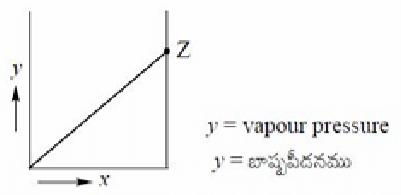
Identify the correct statements about this graph:
I) x-axis represents the mole fraction of A
II) Point Z represents the vapour pressure of pure solvent
III) x-axis represents the mole fraction of B
 

1
I only
2
II only
3
II, III only
4
I, II, III
29
PYQ 2025
medium
chemistry ID: ap-eapce
The mole fractions of glucose and water in aqueous glucose solution are 0.0244 and 0.9756 respectively. What is the weight percentage (w/w) of glucose in this solution?
1
40
2
25
3
20
4
10
30
PYQ 2025
medium
chemistry ID: ap-eapce
At T(K), the vapour pressure of an aqueous solution of a non-volatile solute,
whose mole fraction is 0.02 is found to be 34.65 mm Hg.
What is the vapour pressure (in mm Hg) of pure water at the same temperature?
1
35.70
2
35.36
3
35.00
4
34.30
31
PYQ 2025
medium
chemistry ID: ap-eapce
Consider the following:
Assertion (A): Nitric acid - water mixture is a maximum boiling azeotrope.
Reason (R): Nitric acid - water mixture shows positive deviation from Raoult’s law.
1
Both (A) and (R) are correct and (R) is the correct explanation of (A)
2
Both (A) and (R) are correct but (R) is not the correct explanation of (A)
3
(A) is correct, but (R) is not correct
4
(A) is not correct, but (R) is correct
32
PYQ 2025
medium
chemistry ID: ap-eapce
Two acids A and B are titrated separately. 25 mL of 0.5 M Na CO solution requires 10 mL of A and 40 mL of B for complete neutralisation. The volume (in L) of A and B required to produce 1 L of 1 N acid solution respectively are
1
0.2, 0.8
2
0.8, 0.2
3
0.3, 0.7
4
0.7, 0.3

About Solutions - AP-EAPCET

Solutions is a vital chapter for AP-EAPCET aspirants. Mastering the concepts covered in this chapter is essential for securing a top rank.

By rigorously practicing the previous year questions associated with this chapter, you can identify high-yield topics, understand the examiner's perspective, and boost your confidence during the actual exam.

Frequently Asked Questions

Why focus on Solutions PYQs?

Analyzing PYQs for this specific chapter reveals the most frequently tested concepts and the typical complexity of questions, allowing you to tailor your study plan efficiently.

How to best use this analysis?

Review the topic breakdown to see which sub-topics within Solutions carry the most weight. Then, tackle the questions iteratively to solidify your understanding.

