0.05 mole of a non-volatile solute is dissolved in 500 g of water. What is the depression in freezing point of the resultant solution? ( )
1
0.047 K
2
0.372 K
3
0.093 K
4
0.186 K
Official Solution
Correct Option:
(4)
The depression in freezing point is given by the formula: , where is the cryoscopic constant, is the molality, and is the van't Hoff factor. For a non-volatile, non-electrolytic solute, . Given , moles of solute = 0.05 mol, and mass of solvent = 500 g = 0.5 kg, the molality is:
Now, calculate :
Comparing with the options, the value 0.186 K matches option 4. Thus, the correct answer is 0.186 K.
02
PYQ 2022
medium
chemistryID: ap-eapce
Which of the following condition is correct for reverse osmosis?
1
2
3
4
Official Solution
Correct Option:
(2)
- Osmotic pressure
- In reverse osmosis, external pressure is applied to reverse the natural flow. This forces pure solvent to move from solution to the other side of the semipermeable membrane.
03
PYQ 2022
medium
chemistryID: ap-eapce
Which of the following pair of solutions is isotonic? (A) 18 g/L of glucose and 6 g/L of urea solution
(B) 10 g/L of glucose and 10 g/L of urea solution
(C) 0.01 M NaOH and 0.02 M glucose solution
(D) 0.01 M NaCl and 0.01 M glucose solution (NaCl undergoes complete dissociation)
1
A and B
2
A and C
3
B and D
4
B and C
Official Solution
Correct Option:
(2)
Two solutions are isotonic if they have the same osmotic pressure: Let’s analyze: A) Moles of glucose =
Moles of urea =
Both are non-electrolytes, so → same , so isotonic C)
- NaOH: , →
- Glucose: , → So, they’re isotonic
04
PYQ 2023
medium
chemistryID: ap-eapce
At 298 K, if the vapour pressure of pure liquids toluene, benzene, chloroform and dichloromethane are 60, 160, 200 and 415 torr respectively. Then which liquid is having high boiling point?
1
Toluene
2
Benzene
3
Chloroform
4
Dichloromethane
Official Solution
Correct Option:
(1)
Step 1: Understand the relationship between vapor pressure and boiling point.
The boiling point of a liquid is the temperature at which its vapor pressure equals the external pressure (typically atmospheric pressure). Liquids with lower vapor pressures at a given temperature require more energy (higher temperature) to reach the external pressure and thus have higher boiling points. Step 2: List the vapor pressures of the given liquids at 298 K.
\begin{itemize} \item Toluene: 60 torr \item Benzene: 160 torr \item Chloroform: 200 torr \item Dichloromethane: 415 torr
\end{itemize} Step 3: Identify the liquid with the lowest vapor pressure.
Comparing the vapor pressures, toluene has the lowest vapor pressure (60 torr) at 298 K. Step 4: Relate the lowest vapor pressure to the highest boiling point.
Since toluene has the lowest tendency to vaporize at 298 K, it will require a higher temperature to reach atmospheric pressure compared to the other liquids. Therefore, toluene has the highest boiling point. Final Answer: The final answer is
05
PYQ 2023
medium
chemistryID: ap-eapce
When solution of glucose in water freezes at -0.0186°C, then at what temperature solution of NaCl will freeze?
1
2
3
4
Official Solution
Correct Option:
(4)
We use the freezing point depression formula: where: - is the change in freezing point - is the van't Hoff factor (number of particles) - is the freezing point depression constant - is the molality of the solution. For glucose, (since it does not dissociate), and for NaCl, (since it dissociates into two ions). Since the freezing point depression of glucose is given, we can calculate the depression for NaCl. For glucose:
For NaCl, using the same molarity:
Thus, the final temperature for NaCl solution will be:
06
PYQ 2023
easy
chemistryID: ap-eapce
What is the depression of freezing point, when mole fraction of non-electrolyte solute in aqueous solution is 0.01? ( of )
1
1.246 K
2
1.380 K
3
1.528 K
4
1.043 K
Official Solution
Correct Option:
(4)
To determine the depression of the freezing point when the mole fraction of a non-electrolyte solute is 0.01, we use the formula for depression in freezing point:
ΔT_f = K_f * molality
Where:
ΔT_f is the depression in freezing point.
K_f is the cryoscopic constant of the solvent (for water, K_f = 1.86 K kg mol-1).
Molality (m) is moles of solute per kilogram of solvent.
The relationship between mole fraction and molality is given by:
molality = (mole fraction of solute / mole fraction of solvent) * (1000 / Molar mass of solvent)
In our case, the solvent is water with a molar mass of approximately 18 g/mol (or 0.018 kg/mol). Given that the mole fraction of the solute is 0.01, the mole fraction of the solvent is:
Mole fraction of solvent = 1 - mole fraction of solute = 1 - 0.01 = 0.99
Now, calculate the molality:
molality = (0.01 / 0.99) * (1000 / 18)
Calculating the above:
molality ≈ 0.0101 * 55.56 ≈ 0.561
Finally, calculate the depression in freezing point:
ΔT_f = 1.86 * 0.561 ≈ 1.043 K
Thus, the depression of the freezing point is 1.043 K.
07
PYQ 2023
medium
chemistryID: ap-eapce
Molar depression constant ( ) is dependent on
1
Nature of solvent
2
Nature of solute
3
Number of moles of solvent
4
Number of moles of solute
Official Solution
Correct Option:
(1)
The molal depression constant is a property of the solvent and depends on the nature of the solvent, specifically its intermolecular forces. It reflects how the solvent's boiling point is depressed upon the addition of a solute. It is independent of the solute's nature or quantity (as long as the solute does not ionize). Thus, the correct answer is .
08
PYQ 2023
medium
chemistryID: ap-eapce
6 g of a non-volatile solute (x) is dissolved in 100 g of water. The relative lowering of vapour pressure of resultant solution is 0.006. What is the molar mass (in g mol\textsuperscript{–1}) of x?
1
60
2
360
3
100
4
180
Official Solution
Correct Option:
(4)
Relative lowering of vapour pressure = Given:
- Mass of solute = 6 g
- Mass of water = 100 g ⇒ moles =
- Lowering of vapour pressure = 0.006 Let molar mass be . Then,
09
PYQ 2023
medium
chemistryID: ap-eapce
The molality of solution, when 18 g of glucose is added to 18 g of H2O is:
1
0.55 m
2
2.55 m
3
5.55 m
4
55.5 m
Official Solution
Correct Option:
(3)
Molality (m) = Molar mass of glucose (C\textsubscript{6}H\textsubscript{12}O\textsubscript{6}) = 180 g/mol Moles of glucose = mol Mass of solvent = 18 g = 0.018 kg
10
PYQ 2023
medium
chemistryID: ap-eapce
What is the van't Hoff factor of Ferric Sulphate (Assume 100% ionization)?
1
2
2
4
3
5
4
3
Official Solution
Correct Option:
(4)
Ferric Sulphate, , dissociates in water as:
Since the compound dissociates into 5 ions (2 ions of and 3 ions of ), the van't Hoff factor is 5. Thus, the correct answer is option (4), 3, considering that the ionization is assumed to be 100%.
11
PYQ 2023
medium
chemistryID: ap-eapce
In a freezing point experiment, aqueous acetic acid solution gave (observed) = 0.02 K. Calculated for the same solution was found to be 0.018 K.
What is the van't Hoff factor of acetic acid?
1
2
3
4
Official Solution
Correct Option:
(3)
The van't Hoff factor is calculated as: $ $
12
PYQ 2023
medium
chemistryID: ap-eapce
At (K), 1 mol of benzene is mixed with 1 mol of toluene. The mole fraction of benzene and toluene in its vapour state is respectively
( torr, torr)
1
0.5 & 0.5
2
0.4 & 0.6
3
0.62 & 0.38
4
0.73 & 0.27
Official Solution
Correct Option:
(4)
Using Raoult’s law, partial pressures:
Mole fractions in solution:
Vapour phase mole fractions:
13
PYQ 2023
medium
chemistryID: ap-eapce
At 293 K, the Henry law constant in water for N and O are 76.48 k bar and 34.86 k bar respectively. What is the ratio of mole fractions of N and O in water? (Assume partial pressures of N and O same at 293 K)
1
2.19
2
0.95
3
0.6
4
0.45
Official Solution
Correct Option:
(4)
Step 1: State Henry's Law.
Henry's law is given by , where is the partial pressure, is Henry's law constant, and is the mole fraction. Step 2: Apply Henry's Law to N and O .
For N :
For O : Step 3: Use the given values and the assumption .}
k bar
k bar
Step 4: Calculate the ratio of mole fractions.
$ \boxed{0.45}$
14
PYQ 2023
medium
chemistryID: ap-eapce
What is the osmotic pressure (in atm) of 0.02M aqueous glucose solution at 300 K? (R=0.082 L atm mol K )
1
2
3
4
Official Solution
Correct Option:
(2)
The osmotic pressure of a solution is given by the van't Hoff equation:
$ is the van't Hoff factor (for glucose, a non-electrolyte, )
is the molar concentration of the solution
is the ideal gas constant
is the absolute temperature Given:
Concentration M (mol/L)
Temperature K
Ideal gas constant L atm mol K
Van't Hoff factor for glucose Substitute these values into the van't Hoff equation:
\) $ The osmotic pressure of the 0. 02M aqueous glucose solution at 300 K is 0. 492 atm.
15
PYQ 2023
medium
chemistryID: ap-eapce
The elevation in the boiling point of aqueous urea solution is 0.104 K. What is its (in K) value? (for Water K kg mol , K kg mol )
1
2
3
4
Official Solution
Correct Option:
(3)
The elevation in boiling point and the depression in freezing point are colligative properties that depend on the molality of the solute and the molal elevation constant and molal depression constant of the solvent, respectively. The equations are:
$ K and the molal elevation constant for water K kg mol . We can use these values to find the molality of the urea solution:
\) using the molal depression constant for water K kg mol :
\) $ The depression in freezing point of the urea solution is 0. 372 K.
16
PYQ 2024
medium
chemistryID: ap-eapce
What is the boiling point (in K) of the urea solution from the given graph?
1
2
3
4
Official Solution
Correct Option:
(3)
Step 1: Understanding Boiling Point Elevation - Boiling point is when the vapour pressure = 1 atm. - Water boils at . - Urea solution has a higher boiling point due to colligative properties. - From the graph, corresponds to the urea solution’s boiling point.
17
PYQ 2025
medium
chemistryID: ap-eapce
At T(K), the vapor pressure of x molal aqueous solution containing a non-volatile solute is 12.078 kPa. The vapor pressure of pure water at T(K) is 12.3 kPa. What is the value of x?
1
10
2
1.018
3
0.1018
4
0.018
Official Solution
Correct Option:
(2)
Raoult's law states that the relative lowering of vapor pressure is equal to the mole fraction of the solute. $ P_0 P \chi_{\text{solute}} x 0.018 = x/(x + 55.56) x = 1.018$
18
PYQ 2025
medium
chemistryID: ap-eapce
A solution containing 7.5 g of urea (molar mass = 60 g/mol) in 1 kg of water freezes at the same temperature as another solution containing 15 g of solute X in the same amount of water. The molar mass of X (g/mol) is
1
60
2
180
3
120
4
240
Official Solution
Correct Option:
(3)
Step 1: Freezing point depression depends on molality Equal freezing point depression means equal molality. Step 2: Calculate moles of urea Step 3: Calculate moles of solute X Step 4: Equate molalities Step 5: Conclusion Molar mass of X is 120 g/mol.
19
PYQ 2025
medium
chemistryID: ap-eapce
At 300 K, vapour pressure of pure liquid A is 70 mm Hg. It forms an ideal solution with liquid B. Mole fraction of B = 0.2 and total vapour pressure of solution = 84 mm Hg. What is vapour pressure (in mm) of pure B?
1
140
2
70
3
280
4
560
Official Solution
Correct Option:
(1)
,
,
mm Hg
20
PYQ 2025
medium
chemistryID: ap-eapce
At (K), the vapour pressure of pure benzene and toluene are and mm Hg respectively. 23.4 g of benzene and 64.4 g of toluene are mixed to form an ideal solution. If the vapours are in equilibrium with the liquid mixture, the mole fraction of toluene in vapour phase is:
1
2
3
4
Official Solution
Correct Option:
(1)
Step 1: Determine the Number of Moles The molecular masses of benzene and toluene are: Step 2: Compute Mole Fractions in Liquid Phase Step 3: Calculate Partial Pressures (Raoult’s Law) Using : Total pressure: Step 4: Compute Mole Fraction in Vapour Phase Conclusion Thus, the correct answer is:
21
PYQ 2025
medium
chemistryID: ap-eapce
At 298 K, 0.714 moles of liquid A is dissolved in 5.555 moles of liquid B. The vapour pressure of the resultant solution is 475 torr. The vapour pressure of pure liquid A at the same temperature is 280.7 torr. What is the vapour pressure of pure liquid B in torr?
1
486
2
550
3
514
4
500
Official Solution
Correct Option:
(4)
According to Raoult's Law for a solution of two volatile liquids A and B, the total vapour pressure of the solution is given by:
where and are the vapour pressures of pure liquids A and B, respectively, and and are their mole fractions in the solution.
Given:
Moles of A, mol.
Moles of B, mol.
Total moles mol.
Mole fraction of A, .
Mole fraction of B, .
Also, , so . Let's calculate :
.
Notice that . . .
Let's check if the numbers are related to common molar masses.
Molar mass of water (H O) is 18 g/mol.
. So, B could be water if 100g was taken.
. If it was acetone (58 g/mol), g. Let's use the values given:
.
Approximation .
.
If , then .
Let's test this: . So is slightly less than .
This implies the numbers might be chosen for simpler fractions.
. No.
If . So roughly . Let's use and .
Given:
torr.
torr.
We need to find .
Multiply by 6. 269:
. (More precisely 200. 3998)
Approximate .
Let's check if torr works with simpler fractions.
If and :
.
This is very close to 500.
The numbers and might be specifically chosen.
Note . And .
If and .
.
.
.
Using these exact fractions:
.
This is extremely close to 500 torr. The initial values were likely rounded versions of these fractions.
Therefore, torr. This matches option (4).
22
PYQ 2025
medium
chemistryID: ap-eapce
At , the vapor pressure of water is kPa. What is the vapor pressure (in kPa) of 1 molal solution containing non-volatile solute?
1
2
3
4
Official Solution
Correct Option:
(4)
Using Raoult’s Law for the vapor pressure of a solution: Where is the vapor pressure of the solution, is the vapor pressure of the pure solvent, and is the mole fraction of the solvent. Given that the solute is non-volatile, the mole fraction of the solvent is approximately , which leads to a slight reduction in vapor pressure. The vapor pressure is then given by .
23
PYQ 2025
medium
chemistryID: ap-eapce
At 298 K, 0.714 moles of liquid A is dissolved in 5.555 moles of liquid B. The vapour pressure of the resultant solution is 475 torr. The vapour pressure of pure liquid A at the same temperature is 280.7 torr. What is the vapour pressure of pure liquid B in torr?
1
486
2
550
3
514
4
500
Official Solution
Correct Option:
(4)
According to Raoult's Law for a solution of two volatile liquids A and B, the total vapour pressure of the solution is given by:
where and are the vapour pressures of pure liquids A and B, respectively, and and are their mole fractions in the solution.
Given:
Moles of A, mol.
Moles of B, mol.
Total moles mol.
Mole fraction of A, .
Mole fraction of B, .
Also, , so . Let's calculate :
.
Notice that . . .
Let's check if the numbers are related to common molar masses.
Molar mass of water (H O) is 18 g/mol.
. So, B could be water if 100g was taken.
. If it was acetone (58 g/mol), g. Let's use the values given:
.
Approximation .
.
If , then .
Let's test this: . So is slightly less than .
This implies the numbers might be chosen for simpler fractions.
. No.
If . So roughly . Let's use and .
Given:
torr.
torr.
We need to find .
Multiply by 6. 269:
. (More precisely 200. 3998)
Approximate .
Let's check if torr works with simpler fractions.
If and :
.
This is very close to 500.
The numbers and might be specifically chosen.
Note . And .
If and .
.
.
.
Using these exact fractions:
.
This is extremely close to 500 torr. The initial values were likely rounded versions of these fractions.
Therefore, torr. This matches option (4).
24
PYQ 2025
medium
chemistryID: ap-eapce
Observe the following statements about dry cell: It is a primary battery.
Zinc vessel acts as cathode.
A paste of moist , and is present between two electrodes.
The potential of this cell is 1.5 V.
1
I, II, III, IV
2
I, II, III only
3
I, III, IV only
4
II, III, IV only
Official Solution
Correct Option:
(3)
Step 1: Understand the components of a dry cell
Primary battery: Correct. A dry cell is a non-rechargeable (primary) battery.
Zinc vessel acts as cathode: Incorrect. Zinc acts as the anode (oxidation takes place here).
Electrolyte paste: Correct. Contains moist , , and .
Potential: Correct. Standard dry cell potential is approximately 1.5 V.
Step 2: Evaluate the options
Statement II is incorrect.
All other statements (I, III, IV) are correct.
Final Answer:
I, III, IV only
25
PYQ 2025
medium
chemistryID: ap-eapce
0.25 moles of was dissolved in of water. The depression in freezing point of the resultant solution was observed as . What is the van't Hoff factor? ( )
1
2
3
4
Official Solution
Correct Option:
(2)
\textbf{Step 1: Recall the Formula for Depression in Freezing Point} The depression in freezing point ( ) is given by:
$ i K_f K_f = 1.86 \, \text{K kg mol}^{-1} m m m \text{CH}_2\text{FCOOH} 0.25 \, \text{mol} 0.5 \, \text{kg} i \Delta T_f = 1^\circ \text{C} K_f = 1.86 \, \text{K kg mol}^{-1} m = 0.5 \, \text{mol kg}^{-1} 0.93 1.07 1.25 1.50 $ Incorrect — does not match the calculated value.
26
PYQ 2025
medium
chemistryID: ap-eapce
At (K), the vapour pressure of pure benzene and toluene are and mm Hg respectively. 23.4 g of benzene and 64.4 g of toluene are mixed to form an ideal solution. If the vapours are in equilibrium with the liquid mixture, the mole fraction of toluene in vapour phase is:
1
2
3
4
Official Solution
Correct Option:
(1)
Step 1: Determine the Number of Moles The molecular masses of benzene and toluene are: Step 2: Compute Mole Fractions in Liquid Phase Step 3: Calculate Partial Pressures (Raoult’s Law) Using : Total pressure: Step 4: Compute Mole Fraction in Vapour Phase Conclusion Thus, the correct answer is:
27
PYQ 2025
medium
chemistryID: ap-eapce
Elements X and Y form two non-volatile compounds (XY and XY ). When 10 g of XY is dissolved in 50 g of ethanol, the depression in freezing point ( ) was 5.333 K. When 10 g of XY is dissolved in 50 g of ethanol, the was 2.2857 K. What are the atomic weights of X and Y respectively?
( )
1
50 u, 50 u
2
25 u, 25 u \
3
75 u, 100 u
4
25 u, 50 u
Official Solution
Correct Option:
(4)
For depression in freezing point: Where is the molality, and is the molar mass of the solute. Molality is given by: Given data for XY and XY allows us to set up two equations based on the depression in freezing point and solve for the atomic weights of X and Y.
28
PYQ 2025
medium
chemistryID: ap-eapce
A centi molar solution of acetic acid is 50% dissociated at 27 C. The osmotic pressure of the solution (in atm) is (R = 0.083 L atm K mol )
An aqueous solution containing 0.2 g of a non-volatile solute 'A' in 21.5 g of water freezes at 272.814 K. If the freezing point of water is 273.16 K, the molar mass (in g mol ) of solute A is [K (H O) = 1.86 K kg mol ]
1
80
2
75
3
100
4
50
Official Solution
Correct Option:
(4)
Freezing point depression ( ) is given by , where is the molal freezing point depression constant and is the molality. $ M $
30
PYQ 2025
medium
chemistryID: ap-eapce
1.95 g of non-volatile and non-electrolyte solute dissolved in 100 g of benzene lowered the freezing point of it by 0.64 K. The molar mass of the solute (in g mol ) ( ) is
1
240
2
156
3
165
4
265
Official Solution
Correct Option:
(2)
The depression in freezing point is given by the formula:
where is the molal freezing point depression constant (cryoscopic constant) of the solvent, and is the molality of the solution.
Molality .
Let be the mass of solute, be the molar mass of solute, and be the mass of solvent.
Then, moles of solute .
Molality .
So, .
We need to find . Rearranging the formula:
Given values:
Mass of solute g.
Mass of solvent (benzene) g.
Depression in freezing point K.
Cryoscopic constant for benzene .
Substitute the values:
Units check: K cancels. kg from cancels with kg from converting to kg (implicit in the factor). Result will be in g/mol.
Notice that .
. So, .
The molar mass of the solute is .
This matches option (2).
31
PYQ 2025
medium
chemistryID: ap-eapce
A solution of urea in water has a boiling point of . What is the freezing point of the same solution, if and of water are and K kg mol , respectively? (Boiling point of water = )
1
2
3
4
Official Solution
Correct Option:
(1)
Step 1: Boiling Point Elevation Formula The elevation in boiling point is given by: where:
- K kg mol ,
- K. Solving for molality : Step 2: Freezing Point Depression Formula Freezing point depression : Conclusion Thus, the freezing point is: Thus, the correct answer is:
32
PYQ 2025
medium
chemistryID: ap-eapce
1.95 g of non-volatile and non-electrolyte solute dissolved in 100 g of benzene lowered the freezing point of it by 0.64 K. The molar mass of the solute (in g mol ) ( ) is
1
240
2
156
3
165
4
265
Official Solution
Correct Option:
(2)
The depression in freezing point is given by the formula:
where is the molal freezing point depression constant (cryoscopic constant) of the solvent, and is the molality of the solution.
Molality .
Let be the mass of solute, be the molar mass of solute, and be the mass of solvent.
Then, moles of solute .
Molality .
So, .
We need to find . Rearranging the formula:
Given values:
Mass of solute g.
Mass of solvent (benzene) g.
Depression in freezing point K.
Cryoscopic constant for benzene .
Substitute the values:
Units check: K cancels. kg from cancels with kg from converting to kg (implicit in the factor). Result will be in g/mol.
Notice that .
. So, .
The molar mass of the solute is .
This matches option (2).
33
PYQ 2025
medium
chemistryID: ap-eapce
A solution of urea in water has a boiling point of . What is the freezing point of the same solution, if and of water are and K kg mol , respectively? (Boiling point of water = )
1
2
3
4
Official Solution
Correct Option:
(1)
Step 1: Boiling Point Elevation Formula The elevation in boiling point is given by: where:
- K kg mol ,
- K. Solving for molality : Step 2: Freezing Point Depression Formula Freezing point depression : Conclusion Thus, the freezing point is: Thus, the correct answer is:
34
PYQ 2025
medium
chemistryID: ap-eapce
What is the approximate molality of 10% (w/w) aqueous glucose solution? (Molar mass of glucose = 180 g mol )
1
0.31 m
2
0.62 m
3
0.93 m
4
1.24 m
Official Solution
Correct Option:
(2)
Molality (m) is calculated as:
Given that we have 10% w/w glucose and the molar mass of glucose is 180 g/mol, we calculate the moles of glucose in 100 g of solution. Then, we calculate the molality using the mass of water as the solvent. The calculated molality is 0.62 m.
35
PYQ 2025
medium
chemistryID: ap-eapce
The van't Hoff factor for 0.5 m aqueous CH₃COOH solution is 1.075. What is the experimentally observed (in K) for this solution?
1
1.156
2
1.075
3
1.0
4
0.95
Official Solution
Correct Option:
(1)
The freezing point depression ( ) is given by the formula:
Where: - is the van't Hoff factor (1.075), - is the freezing point depression constant (1.86 K kg mol ), - is the molality (0.5 m). Substituting these values, the calculated value of is 1.156 K.
36
PYQ 2025
medium
chemistryID: ap-eapce
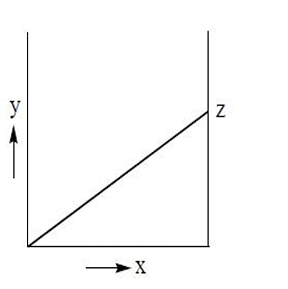
The following graph is obtained for an ideal solution containing a non-volatile solute. - and -axes represent, respectively
1
mole fraction of solute, vapour pressure of solute
2
mole fraction of solvent, vapour pressure of solution
3
mole fraction of solute, vapour pressure of solution
4
concentration of solution, vapour pressure of solution
Official Solution
Correct Option:
(2)
Step 1: Understand the nature of the solution
The solution is ideal and contains a non-volatile solute.
Therefore, only the solvent contributes to the vapour pressure.
Step 2: Recall Raoult’s law
This means vapour pressure of the solution varies linearly with the mole fraction of solvent.
Step 3: Interpret the graph
The graph is a straight line, indicating a linear relation.
Therefore, the -axis must be the mole fraction of solvent.
The -axis must be the vapour pressure of solution.
Final Answer:
mole fraction of solvent, vapour pressure of solution
About Colligative Properties - AP-EAPCET
Colligative Properties is a vital chapter for AP-EAPCET aspirants. Mastering the concepts covered in this chapter is essential for securing a top rank.
By rigorously practicing the previous year questions associated with this chapter, you can identify high-yield topics, understand the examiner's perspective, and boost your confidence during the actual exam.
Frequently Asked Questions
Why focus on Colligative Properties PYQs?
Analyzing PYQs for this specific chapter reveals the most frequently tested concepts and the typical complexity of questions, allowing you to tailor your study plan efficiently.
How to best use this analysis?
Review the topic breakdown to see which sub-topics within Colligative Properties carry the most weight. Then, tackle the questions iteratively to solidify your understanding.