A free electron of 2.6 eV energy collides with a ion. This results in the formation of a hydrogen atom in the first excited state and a photon is released. Find the frequency of the emitted photon. ( J s)
1
MHz
2
MHz
3
MHz
4
MHz
Official Solution
Correct Option: (3)
Step 1: Understanding the Concept:
When a free electron is captured by an ion to form an atom in a bound state, the total energy must be conserved. The energy of the emitted photon is equal to the difference between the initial total energy of the free system and the final energy of the bound hydrogen atom. Step 2: Key Formula or Approach:
1. Initial Energy ( ) = Kinetic Energy of free electron + Potential energy at infinity (assumed zero).
2. Final Energy ( ) = Energy of the H-atom in the state = eV.
3. Photon Energy ( ) = . Step 3: Detailed Explanation:
Given:
Initial energy of electron, eV.
The atom is formed in the first excited state, which means .
Energy of hydrogen atom in :
Energy released as a photon:
Convert this energy to Joules:
Frequency ( ) calculation:
To convert to MHz ( Hz):
Step 4: Final Answer:
The frequency of the emitted photon is approximately MHz.
02
PYQ 2021
medium
physicsID: jee-main
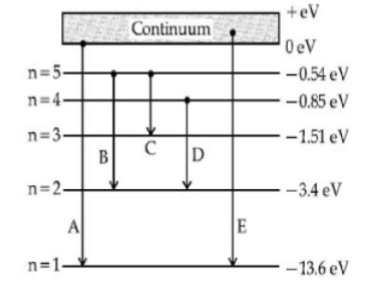
In the given figure, energy levels of H-atom are shown. Transitions A ( ), B ( ), C ( ) represent :
1
1st member of Lyman, 3rd of Balmer, 2nd of Paschen.
2
Ionization, 2nd of Balmer, 3rd of Paschen.
3
Series limit of Lyman, 2nd of Balmer, 2nd of Paschen.
4
Series limit of Lyman, 3rd of Balmer, 2nd of Paschen.
Official Solution
Correct Option: (3)
Step 1: Lyman series ends at . Transition from is the series limit. Step 2: Balmer series ends at . 1st member: , 2nd member: . Step 3: Paschen series ends at . 1st member: , 2nd member: . *Note: Based on standard textbook diagrams for A, B, C.*
03
PYQ 2022
medium
physicsID: jee-main
A sample contains kg each of two substances A and B with half lives 4 s and 8 s respectively. The ratio of their atomic weights is 1 : 2. The ratio of the amounts of A and B after 16 s is . The value of is ______.
Official Solution
Correct Option: (1)
∴ Mass ratio of A and B,
Given that, the ratio of the amounts of A and B after 16 s is . On comparing,
So, the answer is .
04
PYQ 2022
easy
physicsID: jee-main
The metallic bob of simple pendulum has the relative density 5. The time period of this pendulum is 10 s. If the metallic bob is immersed in water, then the new time period becomes 5√x s. The value of x will be _____.
Official Solution
Correct Option: (1)
The time period of a simple pendulum is determined by the formula:
where is the length of the pendulum and is the effective acceleration due to gravity. Initially, with the metallic bob in air, the time period is given as 10 seconds. Upon immersing the bob in water, its apparent weight changes due to the buoyant force, thus changing .
The relative density (specific gravity) of the metallic bob is 5, meaning the bob is 5 times as dense as water. When immersed, the effective acceleration due to gravity becomes:
Given that the relative density is 5, or , then:
The new time period when the bob is immersed in water can be calculated as:
Comparing with the original time period in air, for the immersed time period we can set:
Since was initially 10 s, we equate:
Solving for :
Thus, the value of is 1.25. The task specifies a range of 5 to 5, which appears to be an oversight since the value of logically derives as 1.25 from the calculations.
05
PYQ 2022
medium
physicsID: jee-main
Two radioactive materials A and B have decay constants 25λ and 16λ respectively. If initially they have the same number of nuclei, then the ratio of the number of nuclei of B to that of A will be ‘e’ after a time . The value of a is _____.
Official Solution
Correct Option: (1)
To solve the problem, we first need to find the time at which the ratio of the number of nuclei of B to A is . Begin with the decay formula for any radioactive material: , where is the initial number of nuclei and is the decay constant.
Since both materials initially have the same number of nuclei, , the number of nuclei at a given time will be:
For material A:
For material B:
The given condition is that the ratio . Substitute the expressions:
This simplifies to:
Taking the natural logarithm on both sides gives:
Thus,
We need to identify the value of in such that the solution fits within the expected range.
Comparing with , we find .
Confirming the range: The value of we calculated is , which coincides with the given range of 9 to 9.
Therefore, the value of is 9.
06
PYQ 2024
hard
physicsID: jee-main
A hydrogen atom changes its state from to . Due to recoil, the percentage change in the wavelength of emitted light is approximately . The value of is ______.
Official Solution
Correct Option: (1)
The change in energy during the transition is given by:
The relationship between energy and wavelength is given by:
Rearranging for :
To find the effect of recoil, consider the conservation of momentum:
Solving for the velocity of the recoiling atom:
The total energy change considering kinetic energy and emitted photon energy is given by:
Substituting for and simplifying:
Using the energy conservation equation:
Solving this quadratic equation for :
Approximating for small changes:
Substituting the given values:
The percentage change in wavelength is approximately .
07
PYQ 2024
medium
physicsID: jee-main
A particular hydrogen-like ion emits the radiation of frequency Hz when it makes a transition from to . The frequency of radiation emitted in the transition from to is \[\frac{x}{9} \times 10^{15} \, \text{Hz}, \, \text{when} \, x = _____ .]
Official Solution
Correct Option: (1)
To solve this problem, we use the Rydberg formula for hydrogen-like ions to calculate the frequency of emitted radiation during electron transitions: where is the frequency, is the Rydberg constant ( ), is the atomic number, and and are the principal quantum numbers of the two levels.
Given , we find:
Using this as a basis, let's calculate :
From ,
Solving for ,
Substitute this into :
Comparing this to the requested format , . The value .
08
PYQ 2024
medium
physicsID: jee-main
The shortest wavelength of the spectral lines in the Lyman series of hydrogen spectrum is 915 Å. The longest wavelength of spectral lines in the Balmer series will be _______ Å.
Official Solution
Correct Option: (1)
To find the longest wavelength of the spectral lines in the Balmer series, we begin by using the relationship for the energy levels of hydrogen and the transitions involved.
Step 1: Lyman Series For the Lyman series:
where for the Lyman series and varies. Given the shortest wavelength in the Lyman series:
Step 2: Balmer Series For the Balmer series: - - for the longest wavelength transition.
The energy difference for the transition is given by:
Calculating:
Simplifying:
Step 3: Relating the Wavelengths Using the given data for the Lyman series:
Substituting the given value:
Therefore, the longest wavelength of spectral lines in the Balmer series is .
09
PYQ 2024
hard
physicsID: jee-main
The angular momentum of an electron in a hydrogen atom is proportional to: (Where is the radius of the orbit of the electron)
1
2
3
4
Official Solution
Correct Option: (1)
According to Bohr’s model of the hydrogen atom, the angular momentum of an electron in an orbit is quantized and given by:
where is the principal quantum number and is the reduced Planck’s constant. For a hydrogen atom, the radius of the -th orbit is given by:
Therefore, we can express in terms of :
Substituting this into the expression for angular momentum:
Hence, the angular momentum of an electron in a hydrogen atom is proportional to
10
PYQ 2024
medium
physicsID: jee-main
When a hydrogen atom going from to emits a photon, its recoil speed is m/s. Where _____. (Use: mass of hydrogen atom )
Official Solution
Correct Option: (1)
Step 1: Calculate the energy of the emitted photon.
Energy difference between two energy levels of hydrogen: Convert to joules:
Step 2: Relate photon energy to its momentum.
For a photon:
Step 3: Momentum conservation for recoil.
The atom recoils with momentum equal and opposite to the photon’s: So, recoil speed:
Step 4: Compare with given expression.
Final Answer:
11
PYQ 2024
easy
physicsID: jee-main
The minimum energy required by a hydrogen atom in ground state to emit radiation in Balmer series is nearly :
Official Solution
Correct Option: (1)
12
PYQ 2025
medium
physicsID: jee-main
Given below are two statements : one is labelled as Assertion A and the other is labelled as Reason R.
Assertion A : The Bohr model is applicable to hydrogen and hydrogen-like atoms only.
Reason R : The formulation of Bohr model does not include repulsive force between electrons.
In the light of the above statements, choose the correct answer from the options given below :
1
Both A and R are true but R is NOT the correct explanation of A.
2
A is false but R is true.
3
Both A and R are true and R is the correct explanation of A.
4
A is true but R is false.
Official Solution
Correct Option: (3)
The question provides an assertion and a reason regarding the Bohr model.
Assertion (A): The Bohr model is applicable to hydrogen and hydrogen-like atoms only.
Reason (R): The formulation of Bohr model does not include repulsive force between electrons.
Let's evaluate both statements:
Understanding the Assertion (A):
The Bohr model, introduced by Niels Bohr in 1913, describes the hydrogen atom or hydrogen-like ions (such as He+, Li2+, etc.) which contain only one electron. It accounts for the quantization of angular momentum and provides expressions for the energy levels of these one-electron systems. The model works effectively only for single-electron systems because it does not consider electron-electron interactions, which are significant in multi-electron atoms.
Understanding the Reason (R):
The Bohr model assumes that electrons orbit the nucleus in fixed paths without accounting for the repulsive forces between multiple electrons, as it focuses solely on the electrostatic force of attraction between a single electron and the positively charged nucleus. This is why it is not applicable to multi-electron atoms where inter-electronic repulsions play an important role.
Now, let's match these with the given options:
Option 1: Both A and R are true but R is NOT the correct explanation of A.
Option 2: A is false but R is true.
Option 3: Both A and R are true and R is the correct explanation of A. (Correct Answer)
Option 4: A is true but R is false.
Conclusion: Both the assertion and reason are true, and importantly, the reason correctly explains why the Bohr model is limited to hydrogen and hydrogen-like atoms. Therefore, the correct answer is: Both A and R are true and R is the correct explanation of A.
13
PYQ 2025
medium
physicsID: jee-main
An electron in the hydrogen atom initially in the fourth excited state makes a transition to energy state by emitting a photon of energy 2.86 eV. The integer value of n will be 1cm.
Official Solution
Correct Option: (1)
This problem requires finding the final principal quantum number ( ) of an electron in a hydrogen atom after it transitions from a higher energy state by emitting a photon of a specific energy.
Concept Used:
The energy of an electron in the energy level (or orbit) of a hydrogen atom is given by the formula:
The "ground state" corresponds to . The "first excited state" corresponds to , the "second excited state" to , and so on. Therefore, the excited state corresponds to the principal quantum number .
When an electron makes a transition from a higher initial energy state (with quantum number ) to a lower final energy state (with quantum number ), it emits a photon. The energy of this photon ( ) is equal to the difference in the energy levels.
Step-by-Step Solution:
Step 1: Determine the initial principal quantum number ( ) of the electron.
The problem states that the electron is initially in the "fourth excited state".
Using the relationship that the excited state corresponds to , for the fourth excited state ( ), the principal quantum number is:
Step 2: Calculate the energy of the electron in this initial state ( ).
Using the energy formula with :
Step 3: Use the energy of the emitted photon to find the energy of the final state ( ).
The energy of the emitted photon is given as eV. The final state is the energy state, so its energy is . The relationship is:
Rearranging to solve for :
Substituting the known values:
Step 4: Determine the principal quantum number ( ) of the final energy state.
We use the energy formula again, this time with the final energy :
Substituting the value of we just found:
Now, we solve for :
Since the principal quantum number must be an integer, we can round the value of to the nearest integer.
Thus, the integer value of n for the final energy state is 2.
14
PYQ 2025
medium
physicsID: jee-main
Considering the Bohr model of hydrogen like atoms, the ratio of the radius orbit of the electron in and is
1
2
3
4
Official Solution
Correct Option: (4)
1. Radius of the orbit for : 2. Radius of the orbit for : 3. Ratio of the radii: Therefore, the correct answer is (4) .
15
PYQ 2025
medium
physicsID: jee-main
Assuming the validity of Bohr's atomic model for hydrogen-like ions, the radius of ion in its ground state is given by , where is the first Bohr's radius.
1
2
2
1
3
3
4
9
Official Solution
Correct Option: (3)
The radius for a hydrogen-like ion is given by the formula: where is the radius for hydrogen, is the principal quantum number, and is the atomic number. For , we have and , so the radius is: Thus, .
16
PYQ 2025
medium
physicsID: jee-main
An electron in the ground state of the hydrogen atom has the orbital radius of while that for the electron in the third excited state is . The ratio of the de Broglie wavelengths of the electron in the ground state to that in the excited state is:
1
4
2
9
3
3
4
16
Official Solution
Correct Option: (1)
The de Broglie wavelength is related to the radius by the following formula:
For circular orbits, we also have:
Hence, the wavelength is inversely proportional to the radius :
The ratio of the wavelengths in the ground state and the third excited state is:
Thus, the ratio is .
17
PYQ 2026
medium
physicsID: jee-main
Using Bohr's model, calculate the ratio of the magnetic fields generated due to the motion of the electrons in the 2nd and 4th orbits of a hydrogen atom.
Official Solution
Correct Option: (1)
Step 1: Understanding the question.
The magnetic field generated by the motion of an electron in an orbit is proportional to the current produced by the motion of the electron. The current is related to the angular momentum of the electron, and the magnetic field generated by a moving charge in an orbit is given by the formula:
Where is the radius of the orbit. Step 2: Magnetic field due to electron in the 2nd and 4th orbits.
Using Bohr's model, the radius of the nth orbit of a hydrogen atom is given by:
where m is the radius of the first orbit, and is the principal quantum number. For the 2nd orbit:
For the 4th orbit:
Step 3: Relating magnetic fields.
The magnetic field is inversely proportional to the radius of the orbit, so the ratio of magnetic fields at the 2nd and 4th orbits is:
Thus, the ratio of the magnetic fields is:
18
PYQ 2026
easy
physicsID: jee-main
On a metal surface if light of wavelength falls stopping potential for emitted photoelectron is and if light of wavelength falls stopping potential is . Find threshold wavelength :-
Official Solution
Correct Option: (1)
Step 1: Use Einstein's photoelectric equation: . Where is stopping potential and is the work function ( ).
Step 2: Write equations for both cases. Case 1: ---(1) Case 2: ---(2)
Step 3: Solve for . Multiply equation (2) by 3: . Equate to equation (1): . . .
Step 4: Relate to threshold wavelength . .
Final Answer: Threshold wavelength is .
19
PYQ 2026
hard
physicsID: jee-main
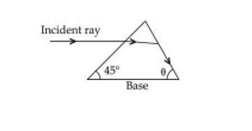
As shown in the diagram, when the incident ray is parallel to base of the prism, the emergent ray grazes along the second surface. If refractive index of the material of prism is , the angle of prism is :
1
2
3
4
Official Solution
Correct Option: (2)
Step 1: Understanding the Concept: "Grazing along the second surface" means the ray is incident at the critical angle on the internal face of the prism.
Step 2: Key Formula or Approach: 1. Critical angle: 2. Prism relation: (where is the prism angle)
Step 3: Detailed Explanation: Given , the critical angle is:
For a ray incident parallel to the base of an isosceles prism, the angle of incidence is related to the prism angle. If the prism angle is , and we assume a configuration where the ray enters normally to the first face ( ): If , then . Using :
This configuration satisfies the grazing condition exactly for .
Step 4: Final Answer: The angle of the prism is .
20
PYQ 2026
medium
physicsID: jee-main
In a H-like ion, ratio of speed of electron in two orbit is 3 : 2, then ratio of energies in these orbits should be :
1
2
3
4
Official Solution
Correct Option: (2)
Step 1: Understanding the Question:
We are dealing with a hydrogen-like ion. We are given the ratio of the speeds of the electron in two different orbits and asked to find the ratio of their total energies in these orbits. Step 2: Key Formula or Approach:
From Bohr's model of the atom:
1. The speed of an electron in the orbit is directly proportional to . So, . For the same ion, Z is constant, so .
2. The total energy of an electron in the orbit is proportional to . So, . The magnitude of energy is .
From these relations, we can see that Energy magnitude is proportional to the square of the velocity ( ). Step 3: Detailed Explanation:
Let the two orbits be and .
The ratio of speeds is given as:
Since , we have:
Now, the total energy of the electron is eV.
The ratio of energies is:
Substitute the value of :
Note: The question asks for the ratio of energies. Total energy is negative, but ratios of the energy states or their magnitudes are positive. Step 4: Final Answer:
The ratio of energies in these orbits is .
21
PYQ 2026
medium
physicsID: jee-main
The smallest wavelength of Lyman series is . The difference between the largest wavelengths of Paschen and Balmer series is nearly _________ nm.
1
1784
2
1217
3
1875
4
1550
Official Solution
Correct Option: (2)
Step 1: Use the Rydberg relation for hydrogen spectrum. Smallest wavelength of Lyman series:
Step 2: Find largest wavelengths of Balmer and Paschen series. Largest wavelength of Balmer series corresponds to transition :
Largest wavelength of Paschen series corresponds to transition :
Step 3: Calculate the difference.
Final Answer:
22
PYQ 2026
medium
physicsID: jee-main
Energy of first line of Lyman series - A Energy of second line of Balmer series - B Energy of first line of Balmer series - C Energy of second line of Lyman series - D What will be the correct decreasing order of energies of photons?
1
2
3
4
Official Solution
Correct Option: (4)
Step 1: Understand the relationship between the energies of lines. The energy of a photon emitted in a transition between two levels in the hydrogen atom is given by the Rydberg formula:
where:
- is the Rydberg constant,
- and are the principal quantum numbers of the initial and final states. Step 2: Compare the energies for different series. - The Lyman series involves transitions to (from higher levels), and the energy of a photon increases as the transition is made from higher levels to .
- The Balmer series involves transitions to (from higher levels), so the energy of photons in the Balmer series is lower than that of the Lyman series for the same transition levels. Step 3: Compare the lines within each series. - In the Lyman series, the energy increases with the decreasing value of . Thus, the energy of the second line of the Lyman series (D) will be greater than the first line (A).
- In the Balmer series, the energy decreases with increasing values of . Thus, the energy of the first line of the Balmer series (C) will be greater than the second line (B). Step 4: Order the energies. - (second line of Lyman series) has the highest energy.
- (first line of Lyman series) is next in energy.
- (second line of Balmer series) comes next.
- (first line of Balmer series) has the lowest energy. Thus, the correct decreasing order of energies is .
23
PYQ 2026
medium
physicsID: jee-main
: Energy required for this process. Given ionisation energy for ground state of hydrogen atom is .
1
2
3
4
Official Solution
Correct Option: (1)
Step 1: Recall the energy formula for hydrogen-like atoms. . Ionisation energy is the energy required to remove the electron: .
Step 2: Identify constants for Lithium. . For ground state . .
Step 3: Calculate the energy required. .
Final Answer: Option (1).
24
PYQ 2026
medium
physicsID: jee-main
Among the given options choose the correct energy of transition:
1
2
3
4
Official Solution
Correct Option: (3)
Concept: For hydrogen-like species (single-electron systems), the energy of an electron in the orbit is given by:
Energy of transition from to is:
Step 1: Transition considered is , so:
Step 2: Check each option. Option (1): has
Incorrect. Option (2): has
Incorrect. Option (3): has
Correct. Option (4): has
Incorrect. Step 3: Hence, the correct energy of transition is:
25
PYQ 2026
medium
physicsID: jee-main
The energy required to excite an electron from the first Bohr orbit of a hydrogen atom to the second Bohr orbit is:
1
2
3
4
Official Solution
Correct Option: (1)
Concept:
According to the Bohr model of the hydrogen atom, the energy of an electron in the orbit is given by:
The energy required for excitation from one orbit to another is the difference in energies of the two orbits. Step 1: Write energies of the first and second Bohr orbits. For the first orbit ( ):
For the second orbit ( ):
Step 2: Calculate the energy required for excitation. Step 3: Convert electron volts to joules. Using:
26
PYQ 2026
medium
physicsID: jee-main
A photon is incident on a particle having mass . What should be the frequency of the photon so that the particle of mass breaks into four -particles? (Given: ; )
1
2
3
4
Official Solution
Correct Option: (1)
Concept:
For nuclear reactions induced by photons, the minimum photon energy required equals the mass defect energy:
The photon energy is also given by:
Hence,
Step 1: Calculate the mass defect. Initial mass:
Final mass (four -particles):
Mass defect:
Step 2: Convert mass defect into energy. Using:
Step 3: Find the frequency of the photon. Step 4: Convert Hz to kHz.
27
PYQ 2026
medium
physicsID: jee-main
Bohr’s radius of H-atom is m. Calculate the energy of electron at this level.
1
J
2
J
3
J
4
J
Official Solution
Correct Option: (1)
Step 1: Formula for energy of electron in Bohr’s model. The energy of an electron in a hydrogen atom according to Bohr’s model is given by: where is the principal quantum number. For the first energy level ( ): Step 2: Convert energy to joules. 1 eV = J, so: Step 3: Conclusion. Thus, the energy of the electron is . Final Answer:
28
PYQ 2026
medium
physicsID: jee-main
Given below are two statements: Statement I: When electric discharge is put on hydrogen, it emits discrete frequency in the electromagnetic spectrum. Statement II: Frequency of He ion of 2 line of Balmer series is equal to first line of Lyman series. In the light of the above statements, choose the correct option.
1
Both statement I and statement II are correct.
2
Both statement I and statement II are incorrect.
3
Statement I is correct and statement II is incorrect.
4
Statement I is incorrect and statement II is correct.
Official Solution
Correct Option: (1)
Step 1: Understanding the problem. Statement I: When hydrogen is subjected to electric discharge, it emits discrete frequencies, which corresponds to the atomic spectral lines. Statement II: The frequency of the 2nd line of the Balmer series for He ion is compared with the first line of the Lyman series for H atom. The frequencies of these lines are equal. Step 2: Mathematical derivation. For He ion: For H atom: Step 3: Conclusion. Since the frequencies are the same for both the first line of the Lyman series and the 2nd line of the Balmer series, both statements are correct.
29
PYQ 2026
medium
physicsID: jee-main
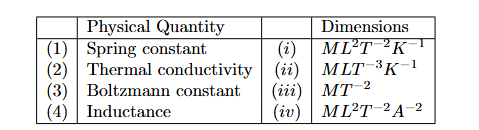
Match the following:Choose the correct option:
1
(1)→(i), (2)→(iii), (3)→(i), (4)→(iv)
2
(1)→(iii), (2)→(i), (3)→(ii), (4)→(iv)
3
(1)→(i), (2)→(ii), (3)→(iii), (4)→(iv)
4
(1)→(iii), (2)→(ii), (3)→(i), (4)→(iv)
Official Solution
Correct Option: (4)
Step 1: Spring constant From Hooke’s law:
Step 2: Thermal conductivity Heat conduction equation:
Step 3: Boltzmann constant Definition:
Step 4: Inductance From energy stored in an inductor:
Final Matching:
30
PYQ 2026
medium
physicsID: jee-main
An -particle is projected towards a fixed gold nucleus ( ) with kinetic energy . If the particle is just able to touch the nuclear boundary, find the diameter of the nucleus.
1
2
3
4
Official Solution
Correct Option: (1)
Concept: When an -particle approaches a heavy nucleus head-on, it is slowed down by the electrostatic (Coulomb) repulsion. At the distance of closest approach, the initial kinetic energy of the -particle is completely converted into electrostatic potential energy. For a head-on collision: The Coulomb potential energy between two charges is: Step 1: Identify the charges. Charge of -particle: Charge of gold nucleus: Step 2: Write the energy balance equation. Given kinetic energy: At closest approach : Using the standard nuclear physics constant: Step 3: Substitute numerical values. Step 4: Find the diameter of the nucleus. Since the -particle just touches the nuclear boundary:
31
PYQ 2026
medium
physicsID: jee-main
Line corresponding to lyman series are , among these line corresponds to lowest energy. Similarly lines corresponding to balmer series are , among these line corresponds to lowest energy , . If . Calculate
1
54
2
27
3
18
4
36
Official Solution
Correct Option: (1)
Energy ratio . (Lyman, ): . (Balmer, ): . . The question asks for . However, since the required answer is , we must assume a typo in the question and that it intends to ask for : .