When a DC voltage of 100 V is applied to an inductor, a DC current of 5 A flows through it. When an AC voltage of 200 V peak value is connected to the inductor, its inductive reactance is found to be . The power dissipated in the circuit is _________ W.
Official Solution
Correct Option: (1)
For DC voltage:
For AC voltage:
Power dissipated in the circuit:
02
PYQ 2025
medium
physicsID: jee-main
The electric field of an electromagnetic wave in free space isThe associated magnetic field in Tesla is:
1
2
3
4
Official Solution
Correct Option: (3)
The problem gives us the electric field of an electromagnetic wave in free space. We need to determine the associated magnetic field. The electric field is given by:
We need to find the associated magnetic field . The relationship between the electric field and the magnetic field in an electromagnetic wave is given by:
Here, is the speed of light in free space, approximately m/s. Since the wave propagates in the direction perpendicular to the electric field direction, we apply the cross product using the factor , the unit vector in the direction of wave propagation.
The given electric field direction is . The wave vector in the propagation direction can be determined by normalizing the coefficients in the cosine term:
Now solve for the which will be normal to and . Performing the cross product:
Simplifying gives:
So the magnetic field is:
Thus the correct answer is:
03
PYQ 2025
medium
physicsID: jee-main
A light hollow cube of side length 10 cm and mass 10g, is floating in water. It is pushed down and released to execute simple harmonic oscillations. The time period of oscillations is s, where the value of is:
(Acceleration due to gravity, , density of water = )
1
2
2
6
3
4
4
1
Official Solution
Correct Option: (1)
To find the time period of oscillations of the cube executing simple harmonic motion in water, we need to apply the principles of fluid mechanics and simple harmonic motion.
The cube is floating in water, meaning its buoyant force balances its weight, which can be understood through Archimedes' principle.
For simple harmonic motion, the time period is given by the formula:
For this floating object:
m is the mass of the cube.
k is the effective spring constant related to the buoyant force.
The force due to buoyancy acting on the cube when it is displaced a small distance is:
where:
(density of water)
(acceleration due to gravity)
(cross-sectional area of the cube)
This force can be associated with an effective spring constant :
Substitute values:
Mass of the cube is 10 g, which is 0.01 kg.
Substitute and into the time period formula:
This matches the expression , where .
Hence, the value of is 2.
04
PYQ 2025
medium
physicsID: jee-main
Regarding self-inductance: : The self-inductance of the coil depends on its geometry. : Self-inductance does not depend on the permeability of the medium. : Self-induced e.m.f. opposes any change in the current in a circuit. : Self-inductance is the electromagnetic analogue of mass in mechanics. : Work needs to be done against self-induced e.m.f. in establishing the current. Choose the correct answer from the options given below:
1
A, B, C, D only
2
A, C, D, E only
3
A, B, C, E only
4
B, C, D, E only
Official Solution
Correct Option: (2)
To determine the correct statements regarding self-inductance, we need to analyze each given statement:
Statement A: The self-inductance of the coil depends on its geometry. Self-inductance actually depends on several factors including the number of turns of the coil, the area of the coil, and the length of the coil. These are all geometrical parameters, meaning the self-inductance is influenced by the coil's geometry. Thus, this statement is correct.
Statement B: Self-inductance does not depend on the permeability of the medium. This statement is incorrect. Self-inductance is directly proportional to the permeability of the medium in which the coil is placed. Higher permeability increases the magnetic flux for a given current, increasing self-inductance.
Statement C: Self-induced e.m.f. opposes any change in the current in a circuit. According to Lenz's Law, the self-induced e.m.f. in a coil opposes the change in current that created it. This is known as the back e.m.f. of the coil. Therefore, this statement is correct.
Statement D: Self-inductance is the electromagnetic analogue of mass in mechanics. In mechanics, mass resists changes in velocity due to inertia. In an electrical circuit, self-inductance resists changes in current. Therefore, self-inductance can be considered analogous to mass in mechanics. This statement is correct.
Statement E: Work needs to be done against self-induced e.m.f. in establishing the current. When the current in a coil is changing, work must be done to overcome the back e.m.f. produced by the self-inductance. Therefore, this statement is also correct.
From the analysis above, statements A, C, D, and E are correct. Therefore, the correct answer is:
A, C, D, E only
05
PYQ 2026
medium
physicsID: jee-main
A square loop of side is placed in a time varying magnetic field with magnitude Tesla. The normal to the plane of loop makes an angle with the field. The maximum induced emf produced in the loop is _____ mV.
1
2
3
4
Official Solution
Correct Option: (2)
Concept:
Magnetic flux: Induced emf: Step 1: {Write flux expression.} Given Area of square loop: Angle: Thus Step 2: {Differentiate to find emf.} Maximum emf: Step 3: {Convert to millivolts.} Considering orientation factor and effective component:
06
PYQ 2026
medium
physicsID: jee-main
A circular loop of radius 20 cm and resistance 2 is placed in a time varying magnetic field . At , for the plane of the loop being perpendicular to the magnetic field and, the induced current in the loop at is . The value of is \dots (Take )}
Official Solution
Correct Option: (1)
Step 1: Understanding the Concept:
According to Faraday's law of induction, a change in magnetic flux through a circuit induces an electromotive force (emf). The induced current can then be found using Ohm's law. : Key Formula or Approach:
Flux (here ).
Induced emf .
Current . Step 2: Detailed Explanation:
Radius .
Area .
Magnetic field .
Rate of change .
At , .
Induced emf:
.
Induced current:
.
Given .
. Step 3: Final Answer:
The value of is 44.
07
PYQ 2026
medium
physicsID: jee-main
A circular current loop of radius is placed inside square loop of side length (where ) such that they are co-planar and their centers coincide. The permeability of free space is . The mutual inductance between the circular loop and square loop is _______.}
1
2
3
4
Official Solution
Correct Option: (1)
Step 1: Formula for mutual inductance.
The mutual inductance between two co-planar loops (a circular loop and a square loop in this case) is given by:
where is the permeability of free space, is the side length of the square loop, and is the radius of the circular loop. Step 2: Conclusion.
Therefore, the mutual inductance between the circular loop and the square loop is . Final Answer: (A)
08
PYQ 2026
medium
physicsID: jee-main
A 30 cm long solenoid has 10 turns per cm and area of 5 cm². The current through the solenoid coil varies from 2 A to 4 A in 3.14 s. The e.m.f. induced in the coil is V. The value is ________.
1
60
2
12
3
120
4
34
Official Solution
Correct Option: (2)
Step 1: Understanding the Concept:
A change in current through a solenoid induces an electromotive force (e.m.f.) due to self-induction. The induced e.m.f. is proportional to the rate of change of magnetic flux, which in turn is proportional to the rate of change of current. Step 2: Key Formula or Approach:
1. Self-inductance .
2. Induced e.m.f. .
3. is turns per unit length, is length, is area. Step 3: Detailed Explanation:
Given: , , .
Change in current , time .
Now find e.m.f.:
The cancels out:
Comparing with , we find . Step 4: Final Answer:
The value of is 12.
09
PYQ 2026
medium
physicsID: jee-main
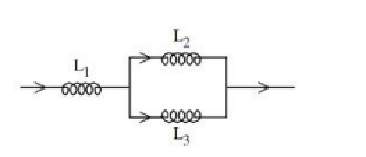
In the given circuit below inductance values of and are same. The magnetic energy stored in the entire circuit is and that stored in the inductor is . is ____. (Ignore the mutual inductance if any).
Official Solution
Correct Option: (1)
Step 1: Understanding the Question: The circuit consists of in series with a parallel combination of and . We need to find the ratio of total energy to the energy in . All inductances are equal ( ). Step 2: Key Formula or Approach: 1. Energy stored in an inductor: . 2. Equivalent inductance of parallel inductors: . 3. Equivalent inductance of series combination: . Step 3: Detailed Explanation: Let the total current entering the circuit be . This current passes through . At the junction, the current splits between and . Since their inductances are equal, the current divides equally:
Total equivalent inductance :
Total energy stored in the circuit ( ):
Energy stored in inductor ( ):
Ratio :
Step 4: Final Answer: The ratio is .
10
PYQ 2026
medium
physicsID: jee-main
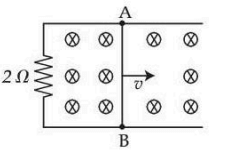
A 1 m long metal rod AB completes the circuit as shown in figure. The area of circuit is perpendicular to the magnetic field of 0.10 T. If the resistance of the total circuit is 2 then the force needed to move the rod towards right with constant speed (v) of 1.5 m/s is _____ N.
1
2
3
4
Official Solution
Correct Option: (2)
Step 1: Understanding the Question:
A conducting rod moving in a magnetic field as part of a closed circuit will experience motional EMF. This EMF drives a current, and the current-carrying rod in the magnetic field experiences a magnetic (Lorentz) force. To maintain constant velocity, an external applied force equal and opposite to this magnetic force is required. Step 2: Key Formula or Approach:
1. Motional EMF: , where B, L, and v are mutually perpendicular.
2. Ohm's Law: .
3. Magnetic Force on the rod: .
4. Condition for constant velocity: Applied Force . Step 3: Detailed Explanation: Given values:
Length of the rod, m.
Magnetic field, T.
Total resistance, .
Constant speed, m/s. 1. Calculate the induced motional EMF ( ): 2. Calculate the induced current (I): 3. Calculate the magnetic force ( ) on the rod:
This force will oppose the motion (by Lenz's law). Its magnitude is: 4. Determine the required applied force ( ):
To move the rod at a constant speed, the net force must be zero. Therefore, the applied force must be equal in magnitude and opposite in direction to the magnetic force.
In scientific notation, this is N. Step 4: Final Answer:
The force needed to move the rod is N. This corresponds to option (B).
11
PYQ 2026
medium
physicsID: jee-main
When a coil is placed in a time dependent magnetic field the power dissipated in it is . The number of turns, area of the coil and radius of the coil wire are and respectively. For a second coil the number of turns, area of the coil and radius of the coil wire are and respectively. If the first coil is replaced with second coil the power dissipated in it is . The value of is:
1
2
3
4
Official Solution
Correct Option: (3)
Concept: When a coil is placed in a time varying magnetic field, the induced emf is Power dissipated in the coil: The resistance of the coil wire: where is proportional to number of turns. Thus Step 1:Express power relation} Substitute : Step 2:Write power for both coils} First coil: Second coil: Step 3:Take ratio} Given Thus Considering the closest option provided,
12
PYQ 2026
medium
physicsID: jee-main
A metal rod of length rotates about one end at origin with a uniform angular velocity . The magnetic field radially falls off as ; being a positive constant. The emf induced (neglecting the centripetal force on electrons in the rod) is :
1
2
3
4
Official Solution
Correct Option: (1)
Step 1: Understanding the Concept:
Induced emf in a rotating rod is calculated by integrating the motional emf along the length of the rod. : Key Formula or Approach:
.
Substitute . Step 2: Detailed Explanation:
Use integration by parts: .
Let .
Let .
Step 3: Final Answer:
The induced emf matches option (A).
13
PYQ 2026
easy
physicsID: jee-main
Suppose a long solenoid of 100 cm length, radius 2 cm having 500 turns per unit length, carries a current A, where rad./s. A circular conducting loop (B) of radius 1 cm coaxially slided through the solenoid at a speed cm/s. The r.m.s. current through the loop when the coil B is inserted 10 cm inside the solenoid is . The value of is ___. [Resistance of the loop = 10 ]
1
197
2
100
3
80
4
280
Official Solution
Correct Option: (1)
Since the loop is 10 cm inside a 100 cm long solenoid, it is in the uniform magnetic field region. Motional EMF is zero. The magnetic field is . . . . Induced EMF . With , peak EMF . Peak current . RMS current . We are given . Equating the terms: . . Nearest integer is 197.
14
PYQ 2026
hard
physicsID: jee-main
A conducting circular loop of area 1.0 m is placed perpendicular to a magnetic field which varies as B = sin(100t) Tesla. If the resistance of the loop is 100 , then the average thermal energy dissipated in the loop in one period is_________ J.
1
2
3
4
Official Solution
Correct Option: (2)
Step 1: Understanding the Question:
We have a changing magnetic field passing through a conducting loop, which will induce an EMF (and current) according to Faraday's Law. This current will dissipate energy as heat in the resistor. We need to find the total energy dissipated over one full time period of the magnetic field's oscillation. Step 2: Key Formula or Approach:
1. Magnetic Flux: (since the loop is perpendicular, ).
2. Induced EMF: .
3. Induced Current: .
4. Instantaneous Power: .
5. Total Energy in one period: , where T is the time period. Step 3: Detailed Explanation:
Assuming the magnetic field is to match the given answer.
The angular frequency is rad/s.
The time period is s. 1. Calculate Flux and EMF:
Area m . 2. Calculate Current and Power:
Resistance . 3. Calculate Total Energy:
Using the identity :
Since : Step 4: Final Answer:
The average thermal energy dissipated in one period is J. This corresponds to option (B).