Train A is moving along two parallel rail tracks towards north with speed 72 km/h and train B is moving towards south with speed 108 km/h.Velocity of train B with respect to A and velocity of ground with respect to B are (in m/s) :
1
–30 and 50
2
–50 and –30
3
–50 and 30
4
50 and –30
Official Solution
Correct Option:
(3)
To solve the problem of finding the velocity of train B with respect to train A and the velocity of the ground with respect to train B, let's break it down step-by-step:
Convert the speeds from km/h to m/s:
Speed of train A, . To convert km/h to m/s, use the conversion factor :
.
Speed of train B, :
.
Calculate the velocity of train B with respect to train A:
The formula for velocity of one object with respect to another is .
Since train B is moving in the opposite direction to train A, the relative velocity is:
However, since they are moving in opposite directions, the velocity of B with respect to A is actually in the opposite direction:
.
Calculate the velocity of the ground with respect to train B:
The ground is stationary, so its velocity relative to anything is 0 m/s. However, from train B's perspective, the ground seems to be moving in the opposite direction of B.
The velocity of the ground with respect to train B is:
.
Therefore, the velocity of train B with respect to train A is , and the velocity of the ground with respect to train B is .
Correct Answer: –50 and 30
02
PYQ 2026
hard
physicsID: jee-main
Two cars A and B are moving in the same direction along a straight line with speeds 100 km/h and 80 km/h, respectively such that car A is moving ahead of car B. A person in car B throws a stone with a speed so that it hits the car A with a speed of 5 m/s. The value of is ______ km/h.
1
18
2
28
3
38
4
48
Official Solution
Correct Option:
(3)
Step 1: Understanding the Concept:
This problem operates on the principle of relative velocity. The stone is thrown from the reference frame of car B, so its absolute velocity depends on both throw speed and car B's speed. We then compute the stone's velocity relative to car A to match the impact speed.
Step 2: Key Formula or Approach:
Absolute velocity of stone:
Relative velocity of stone with respect to A:
Convert 5 m/s to km/h by multiplying by .
Step 3: Detailed Explanation:
Let the direction of motion of the cars be the positive x-direction.
Velocity of car A, km/h.
Velocity of car B, km/h. The stone is thrown forward from B with speed relative to B.
Velocity of the stone relative to the ground is . The stone hits car A. The impact speed is the relative speed of the stone with respect to car A.
Velocity of stone relative to A is . The impact speed is given as 5 m/s. Convert this to km/h:
. The magnitude of the relative impact velocity is 18 km/h.
This gives two possibilities:
km/h.
km/h. Since car A is ahead of car B and moving faster, a stone thrown with km/h relative to B would have a ground speed of 82 km/h. It would never catch up to car A (which is at 100 km/h). Thus, the stone must be thrown fast enough to exceed A's speed.
Therefore, must be 38 km/h.
Step 4: Final Answer:
The value of is 38.
03
PYQ 2026
medium
physicsID: jee-main
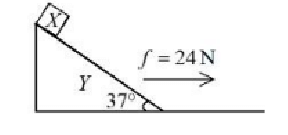
A wedge with mass of 10 kg and all frictionless surfaces and the inclined surface making with horizontal. A block with mass 2 kg is placed at the highest point of the wedge as shown in figure is at rest. At wedge ( ) is pulled toward right with constant force ( ) of 24 N. Taking the block at rest at , the time taken by it to slide down 8.8 m on the slope, while is on the move, is ________s. (take and )
1
2
2
4
3
4
Official Solution
Correct Option:
(1)
Step 1: Understanding the Question: A block is on a wedge . The wedge is pulled to the right by a force . We need to find the relative acceleration of the block down the incline to calculate the time taken to travel a given distance. Step 2: Key Formula or Approach: 1. Find horizontal acceleration of the wedge system: . 2. Use pseudo-force logic: Relative acceleration (since pseudo-force acts opposite to wedge acceleration). 3. Kinematics: . Step 3: Detailed Explanation: First, calculate the acceleration of the wedge system. Since all surfaces are frictionless and the wedge is pulled with N:
Now, consider the motion of block relative to the wedge. The forces acting on the block along the incline in the wedge's frame are: - Component of gravity: (down the incline) - Component of pseudo-force: (up the incline, because is to the right) Net relative acceleration . Given and .
Using the kinematic equation for distance m:
Step 4: Final Answer: The time taken is 2 s.
About Relative Motion - JEE-MAIN
Relative Motion is a vital chapter for JEE-MAIN aspirants. Mastering the concepts covered in this chapter is essential for securing a top rank.
By rigorously practicing the previous year questions associated with this chapter, you can identify high-yield topics, understand the examiner's perspective, and boost your confidence during the actual exam.
Frequently Asked Questions
Why focus on Relative Motion PYQs?
Analyzing PYQs for this specific chapter reveals the most frequently tested concepts and the typical complexity of questions, allowing you to tailor your study plan efficiently.
How to best use this analysis?
Review the topic breakdown to see which sub-topics within Relative Motion carry the most weight. Then, tackle the questions iteratively to solidify your understanding.