A massless spring gets elongated by amount under a tension of 5 N. Its elongation is under the tension of 7 N. For the elongation of , the tension in the spring will be:
1
15 N
2
20 N
3
11 N
4
39 N
Official Solution
Correct Option:
(3)
To find the tension in the spring for the given elongation of , let's use Hooke's Law, which states that the tension or force applied to a spring is directly proportional to its elongation, i.e., , where is the spring constant.
Under a tension of 5 N, the elongation is . Therefore, from Hooke's Law, we have:
Under a tension of 7 N, the elongation is . Therefore:
We need to find the tension for an elongation of . First, let's express this elongation in terms of the known values:
Substitute the expressions for and from the above equations:
Now substitute these back into the formula for :
Therefore, the tension in the spring for the elongation of is 11 N. The correct answer is 11 N.
02
PYQ 2025
medium
physicsID: jee-main
A block of mass 2 kg is attached to one end of a massless spring whose other end is fixed at a wall. The spring-mass system moves on a frictionless horizontal table. The spring's natural length is 2 m and spring constant is 200 N/m. The block is pushed such that the length of the spring becomes 1 m and then released. At distance m ( ) from the wall, the speed of the block will be:
1
2
3
4
Official Solution
Correct Option:
(3)
To solve this problem, we need to use the conservation of mechanical energy principle as the force involved is conservative and there is no energy loss due to friction.
The mechanical energy in a spring-mass system is the sum of kinetic energy (due to motion) and potential energy (stored in the spring).
The initial configuration of the system is when the spring is compressed to 1 m, and the block is released from rest.
Initially, the spring is compressed from its natural length (2 m) to 1 m. So, the initial compression .
The potential energy stored in the spring when compressed by is given by: .
Initially, the block is at rest, so its kinetic energy .
When the block is at a distance from the wall, the spring is stretched by (since 2 m is the natural length).
At this point, the potential energy of the spring is: .
Let the speed of the block at this point be . Then, its kinetic energy is: .
Using conservation of mechanical energy: .
Substituting the known values:
Simplifying for :
Thus, the speed is:
Therefore, the speed of the block at a distance from the wall is , which matches the correct option.
03
PYQ 2026
medium
physicsID: jee-main
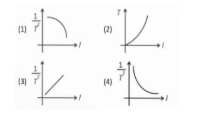
Choose the correct graph between time period and length of pendulum .
1
A
2
B
3
C
4
D
Official Solution
Correct Option:
(4)
Step 1: Recall the formula for the time period of a pendulum. The time period of a simple pendulum is given by: where is the length of the pendulum and is the acceleration due to gravity. Step 2: Analyze the relation. From the equation, we can see that the time period is proportional to . Therefore, , which implies . Final Answer:
About Hooke S Law And Springs - JEE-MAIN
Hooke S Law And Springs is a vital chapter for JEE-MAIN aspirants. Mastering the concepts covered in this chapter is essential for securing a top rank.
By rigorously practicing the previous year questions associated with this chapter, you can identify high-yield topics, understand the examiner's perspective, and boost your confidence during the actual exam.
Frequently Asked Questions
Why focus on Hooke S Law And Springs PYQs?
Analyzing PYQs for this specific chapter reveals the most frequently tested concepts and the typical complexity of questions, allowing you to tailor your study plan efficiently.
How to best use this analysis?
Review the topic breakdown to see which sub-topics within Hooke S Law And Springs carry the most weight. Then, tackle the questions iteratively to solidify your understanding.