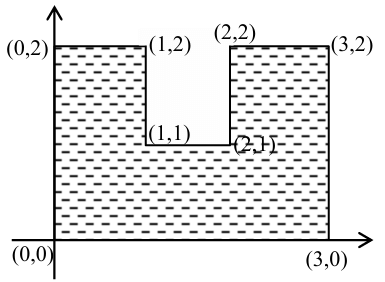
A uniform thin metal plate of mass with dimensions is shown. The ratio of and coordinates of the center of mass of the plate is . The value of is ______.
Official Solution
Correct Option:
(1)
To find the value of , we need to calculate the coordinates of the center of mass for the given plate shape. The shape is composed of a rectangle with a cut-out, which can be analyzed as a combination of simple geometrical figures, allowing us to use subtraction to find the center of mass.
Step-by-Step Solution:
Identify Shapes: The plate consists of a large rectangle (3 × 2) with a smaller rectangular cut-out (1 × 1).
Calculate Total Area of the Plate: Large Rectangle Area: Cut-out Area: Total Area:
Calculate Center of Mass for Each Shape: Large Rectangle: Center: Area: 6 Cut-out: Center: Area: 1
Apply the Center of Mass Formula: For combined objects, center of mass is:
Using the areas as weights, calculate:
Determine the Ratio:
Here, , so .
The calculated value of is 15, which falls within the given range of 15,15.
02
PYQ 2024
easy
physicsID: jee-main
In a system, two particles of masses and are placed at a certain distance from each other. The particle of mass is moved towards the center of mass of the system through a distance . In order to keep the center of mass of the system at the original position, the particle of mass should move towards the center of mass by the distance ______ .
Official Solution
Correct Option:
(1)
1. Define Movement of Center of Mass: To maintain the center of mass position, the total movement of the center of mass ( ) must be zero. 2. Apply Center of Mass Condition: Let the movement of be cm towards the center of mass. Then: where (movement of ) and (movement of ). 3. Set to Zero: Simplifying,
Answer:
03
PYQ 2024
medium
physicsID: jee-main
The identical spheres each of mass 2M are placed at the corners of a right angled triangle with mutually perpendicular sides equal to 4 m each. Taking point of intersection of these two sides as origin, the magnitude of position vector of the centre of mass of the system is , where the value of x is ___________
Official Solution
Correct Option:
(1)
Given three identical spheres of mass placed at the corners of a right-angled triangle. The sides of the triangle are 4 m each. Let the point of intersection of the two sides be the origin . The position vectors of the masses are:
,
,
,
The position vector of the center of mass is given by:
Substituting the values:
Magnitude of :
Thus, .
04
PYQ 2025
medium
physicsID: jee-main
Consider a circular disc of radius 20 cm with center located at the origin. A circular hole of radius 5 cm is cut from this disc in such a way that the edge of the hole touches the edge of the disc. The distance of the center of mass of the residual or remaining disc from the origin will be:
1
2.0 cm
2
0.5 cm
3
1.5 cm
4
1.0 cm
Official Solution
Correct Option:
(4)
To solve this problem, we need to calculate the center of mass of the remaining part of the circular disc after a smaller circular hole has been cut out.
Initially, we have a circular disc with radius cm and its center located at the origin .
A hole with radius cm is cut from this disc in such a way that the edge of the hole touches the edge of the disc.
The distance from the center of the hole to the center of the original disc is .
We apply the concept of center of mass for composite bodies:
= area of the original disc =
= area of the hole =
The center of mass of the original disc ( ) is at the origin (0, 0).
The center of mass of the hole ( ) is at as it touches the edge of the main disc.
Now, calculating the X-coordinate of the center of mass of the remaining region:
The center of mass is 1 cm towards the negative x-direction (since we took the left side as negative direction from the center to the origin).
Thus, the distance of the center of mass from the origin is 1.0 cm, which matches option:
1.0 cm
05
PYQ 2025
medium
physicsID: jee-main
A rod of length is bent at a right angle, keeping one side length as . The position of the centre of mass of the system (Consider cm):
1
2
3
4
Official Solution
Correct Option:
(4)
The rod is bent at a right angle into two segments of lengths and . Assume the corner (joint) is at the origin. Let the segment lie along the x-axis and the segment along the y-axis.
The center of mass of the part is at
The center of mass of the part is at
Using the formula for center of mass:
Substitute cm:
06
PYQ 2025
medium
physicsID: jee-main
The amount of work done to break a big water drop of radius into 27 small drops of equal radius is 10 J. The work done required to break the same big drop into 64 small drops of equal radius will be:
1
15 J
2
10 J
3
20 J
4
5 J
Official Solution
Correct Option:
(1)
To find the work done in breaking a big water drop into smaller drops, we need to understand the concept of surface tension and surface energy. The work done is essentially the increase in surface energy when the drop is broken into smaller drops.
Given that initially, we have a large drop of radius and we need to break it into smaller drops, the formula for the surface energy is:
where is the change in surface area.
For a sphere, the surface area is given by .
**Step 1: Calculate the initial surface area of the large drop**
The surface area of the large drop is .
**Step 2: Calculate the surface area of the small drops**
If the large drop is divided into small drops, each of radius , then:\) is the total surface area of all small drops.
The volume of the big drop is equal to the total volume of all small drops:
From this, we get:
**Case 1: 27 Small Drops**
For the first scenario where :
New total surface area:
Change in surface area:
Using the given work done for 27 drops:
(where T is surface tension)
**Case 2: 64 Small Drops**
For the second scenario where :
New total surface area:
Change in surface area:
Using the above relation:
Thus, the work done to break the big drop into 64 smaller drops is 15 J, which corresponds to the correct option: 15 J.
07
PYQ 2026
medium
physicsID: jee-main
Two identical bodies and of equal masses have initial velocities and respectively. The body has acceleration while the acceleration of body is zero. The centre of mass of the two bodies moves in ______ path.
1
circular
2
parabolic
3
straight line
4
elliptical
Official Solution
Correct Option:
(2)
Concept:
The acceleration of the centre of mass is given by Similarly, velocity of centre of mass: Step 1: {Find velocity of centre of mass.} Since masses are equal: Step 2: {Find acceleration of centre of mass.} Step 3: {Analyze the motion.} Initial velocity: Acceleration: Thus both components vary linearly with time but acceleration is constant. Hence trajectory satisfies a quadratic relation between and , which represents a parabola.
08
PYQ 2026
medium
physicsID: jee-main
Two blocks of masses 2 kg and 1 kg respectively are tied to the ends of a string which passes over a light frictionless pulley as shown in the figure below. The masses are held at rest at the same horizontal level and then released. The distance traversed by the centre of mass in 2 s is _______ m.
1
3.33
2
3.12
3
2.22
4
1.42
Official Solution
Correct Option:
(2)
Step 1: Apply Newton's second law.
Given masses: , . The net force on the system is due to the difference in weights:
where . Step 2: Calculate the acceleration.
Using , where , we find the acceleration of the system:
Substituting the values:
Step 3: Calculate the distance traversed.
Using the equation for distance in uniformly accelerated motion, , and substituting and , we get:
Final Answer: 3.12
09
PYQ 2026
medium
physicsID: jee-main
Given below are two statements: Statement I: For a mechanical system of many particles, total kinetic energy is the sum of kinetic energies of all the particles. Statement II: The total kinetic energy can be the sum of kinetic energy of the center of mass with respect to the origin and the kinetic energy of all the particles with respect to the center of mass as reference. In the light of the above statements, choose the correct answer from the options given below:
1
Both Statement I and Statement II are true
2
Both Statement I and Statement II are false
3
Statement I is false but Statement II is true
4
Statement I is true but Statement II is false
Official Solution
Correct Option:
(1)
Step 1: Analyze Statement I. For a system consisting of many particles, the total kinetic energy of the system is defined as the sum of the individual kinetic energies of all the particles. Mathematically,
Hence, Statement I is true.
Step 2: Analyze Statement II. The kinetic energy of a system of particles can be split into two parts:
where is the total mass, is the velocity of the center of mass with respect to the origin, and is the velocity of the -th particle with respect to the center of mass. This is a standard result in mechanics. Hence, Statement II is also true.
Step 3: Final conclusion. Both Statement I and Statement II are true.
Final Answer:
About Center Of Mass - JEE-MAIN
Center Of Mass is a vital chapter for JEE-MAIN aspirants. Mastering the concepts covered in this chapter is essential for securing a top rank.
By rigorously practicing the previous year questions associated with this chapter, you can identify high-yield topics, understand the examiner's perspective, and boost your confidence during the actual exam.
Frequently Asked Questions
Why focus on Center Of Mass PYQs?
Analyzing PYQs for this specific chapter reveals the most frequently tested concepts and the typical complexity of questions, allowing you to tailor your study plan efficiently.
How to best use this analysis?
Review the topic breakdown to see which sub-topics within Center Of Mass carry the most weight. Then, tackle the questions iteratively to solidify your understanding.