The image of an illuminated square is obtained on a screen with the help of a converging lens. The distance of the square from the lens is . The area of the image is times that of the square. The focal length of the lens is :
1
2
3
4
Official Solution
Correct Option: (4)
If side of object square and side of image square From question, or i.e., magnification From formula or,
02
PYQ 2022
medium
physicsID: jee-main
Two identical metallic spheres A and B when placed at certain distance in air repel each other with a force of F. Another identical uncharged sphere C is first placed in contact with A and then in contact with B and finally placed at midpoint between spheres A and B. The force experienced by sphere C will be
1
2
3
F
4
2F
Official Solution
Correct Option: (2)
To solve the problem, we need to understand the impact of the interactions and the redistribution of charges among the spheres.
Initially, let's assume that the charge on spheres and is each. Since they repel each other with force , we know that: , where is Coulomb's constant, and is the distance between the spheres.
Sphere is initially uncharged.
When sphere is brought into contact with sphere , the charge is shared between them. Since both spheres are identical, the charge will redistribute equally: for both and .
Next, sphere is brought into contact with sphere . Again, the charge is shared equally between and . So, the charge on each sphere becomes: and .
Now, sphere is placed at the midpoint between spheres and .
The net force on sphere due to spheres and must be considered. The force between sphere and is: . The force between sphere and is the same due to symmetry: .
Adding these forces gives: .
Thus, the force experienced by sphere is . Therefore, the correct answer is .
03
PYQ 2022
hard
physicsID: jee-main
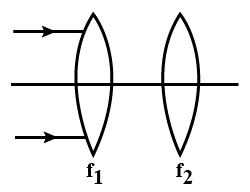
Two identical thin biconvex lenses of focal length 15 cm and refractive index 1.5 are in contact with each other. The space between the lenses is filled with a liquid of refractive index 1.25. The focal length of the combination is ___ cm.
Official Solution
Correct Option: (1)
=( )( ) here |R1|=|R2|=R ⇒ =(1.5-1)(- )= ⇒ = or R=15 cm for the concave lens made up of liquid ⇒ =(1.25-1)(- )=- cm now for an equivalent lens, = + = - = = or fe = 10 cm
04
PYQ 2022
hard
physicsID: jee-main
A convex lens has power P. It is cut into two halves along its principal axis. Further one piece (out of the two halves) is cut into two halves perpendicular to the principal axis . Choose the incorrect option for the reported pieces.
1
Power of
2
Power of
3
Power of
4
Power of
Official Solution
Correct Option: (1)
As We know that,
Hence, Correct option is (A) : Power of
05
PYQ 2022
easy
physicsID: jee-main
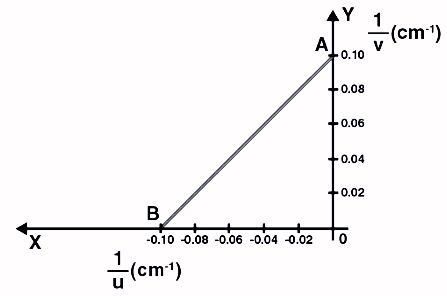
The graph between and for a thin convex lens in order to determine its focal length is plotted as shown in the figure. The refractive index of lens is 1.5, and its both the surfaces have the same radius of curvature R. The value of R will be______cm. (where u = object distance, v = image distance)
Official Solution
Correct Option: (1)
Focus
So, the answer is
06
PYQ 2023
easy
physicsID: jee-main
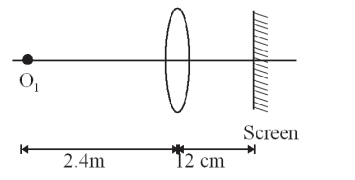
For an object placed at a distance from a lens, a sharp focused image is observed on a screen placed at a distance from the lens A glass plate of refractive index and thickness is introduced between lens and screen such that the glass plate plane faces parallel to the screen By what distance should the object be shifted so that a sharp focused image is observed again on the screen?
1
0.8 m
2
3.2 m
3
1.2 m
4
5.6 m
Official Solution
Correct Option: (2)
Applying lens formula 0.121+2.41=f1⇒f1=24210
Upon putting the glass slab, shift of image is Δx=t(1−μ1)=31cm
Now v=12−31=335cm
Again apply lens formula 0.121+u1=f1=24210
Solving u=−5.6m
Thus shift of object is 5.6−2.4=3.2m
07
PYQ 2023
easy
physicsID: jee-main
Two objects and are placed at and from the pole in front of a concave mirros having radius of curvature . The distance between images formed by the mirror is:
1
2
3
4
Official Solution
Correct Option: (2)
Step 1: Determine the Focal Length
The focal length ( ) of a concave mirror is half of its radius of curvature ( ):
The focal length is negative for a concave mirror.
Step 2: Use the Mirror Formula for Object A
The mirror formula relates the object distance ( ), image distance ( ), and focal length ( ):
For object A, (negative because the object is in front of the mirror).
Step 3: Use the Mirror Formula for Object B
For object B, :
Step 4: Calculate the Distance Between the Images
The image of A is formed at (positive, so it’s a real image formed in front of the mirror). The image of B is formed at (negative, so it’s a virtual image formed behind the mirror). The distance ( ) between the images is:
Conclusion:
The distance between the images is 160 cm (Option 2).
08
PYQ 2023
medium
physicsID: jee-main
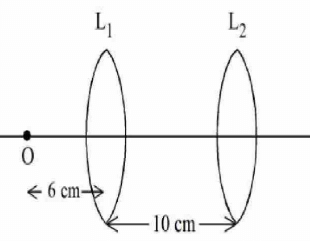
A point object, 'O' is placed in front of two thin symmetrical coaxial convex lenses L1 and L2 with focal length 24 cm and 9 cm respectively. The distance between two lenses is 10 cm and the object is placed 6 cm away from lens L1 as shown in the figure. The distance between the object and the image formed by the system of two lenses is _____ cm.
Official Solution
Correct Option: (1)
From 1st lens 1/v + 1/6 = 1/24 1/v = 1/24 - 1/6 = -1/8 v = -8 cm
From 2nd lens 1/v + 1/18 = 1/9 1/v = 1/9 - 1/18 = 1/18 v = 18 cm
So distance between object and its image: 6 + 10 + 18 = 34 cm
09
PYQ 2023
medium
physicsID: jee-main
Two convex lenses of focal length 20 cm each are placed coaxially with a separation of 60 cm between them. The image of the distant object formed by the combination is at cm from the first lens.
Official Solution
Correct Option: (1)
Solution: Given:
Focal length of each lens,
Separation between the lenses,
The object is at a considerable distance (assumed to be at infinity).
Objective: Find the distance of the final image from the first lens.
Approach:Step 1: Image Formation by the First Lens For the first lens ( ), the object is at infinity. Using the lens formula: where:
is the object distance (infinity),
is the image distance,
is the focal length.
Plugging in the values: So, the first lens forms an image at 20 cm from itself.
Step 2: Object for the Second Lens The image formed by the first lens acts as the object for the second lens. The separation between the lenses is 60 cm, and the first image is 20 cm from the first lens. Therefore, the distance of this image (object for the second lens) from the second lens is: Since the image is on the same side as the incoming light for the second lens, we consider as negative in the lens formula (real image for the first lens acts as a virtual object for the second lens).
Step 3: Image Formation by the Second Lens Using the lens formula for the second lens ( ): Plugging in the values: Solving for : The positive sign indicates that the final image is formed on the opposite side of the second lens from where the light is coming.
Step 4: Distance of the Final Image from the First Lens The final image is 40 cm from the second lens. Since the lenses are 60 cm apart, the distance from the first lens is:
Conclusion: The image of the distant object formed by the combination of the two convex lenses is located at \boxed{100 \, \text{cm}} from the first lens.
10
PYQ 2024
medium
physicsID: jee-main
Radius of curvature of equiconvex lens is 20 cm. Material of lens is having refractive index of 1.5. Find image distance from lens if an object is placed 10 cm away from the lens.
1
20 cm
2
10 cm
3
40 cm
4
5 cm
Official Solution
Correct Option: (1)
The Correct Option is (A) : 20 cm
11
PYQ 2024
easy
physicsID: jee-main
A biconvex lens of refractive index 1.5 has a focal length of 20 cm in air. Its focal length when immersed in a liquid of refractive index 1.6 will be:
Official Solution
Correct Option: (1)
12
PYQ 2026
medium
physicsID: jee-main
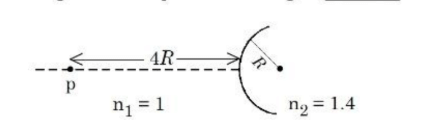
A spherical interface lens of radius separates two media of refractive indices and respectively as shown in the figure below. A point source is placed at a distance of in front of spherical interface. The magnitude of the magnification of point source image is ————.
1
1.66
2
2.33
3
2.66
4
1.33
Official Solution
Correct Option: (1)
To find the magnification, we first need to determine the image position using the formula for refraction at a single spherical surface: $ n_1 = 1 n_2 = 1.4 u = -4R R = +R v |m| \approx 1.66$.