A monochromatic light is incident on a metallic plate having work function . An electron, emitted normally to the plate from a point A with maximum kinetic energy, enters a constant magnetic field, perpendicular to the initial velocity of the electron. The electron passes through a curve and hits back the plate at a point B. The distance between A and B is:
1
2
3
4
Official Solution
Correct Option: (3)
The maximum kinetic energy of the electron is given by:
where is the momentum of the electron, and the relation for momentum is:
Since the motion is in a magnetic field, the radius of the circular path is:
Thus, the distance between A and B becomes:
02
PYQ 2025
hard
physicsID: jee-main
Let be the magnitude of magnetic field at the center of a circular coil of radius carrying current . Let be the magnitude of magnetic field at an axial distance from the center. For , is:
1
4 : 5
2
16 : 25
3
64 : 125
4
25 : 16
Official Solution
Correct Option: (3)
The magnetic field at the center of a circular coil is given by:
The magnetic field at an axial distance from the center is given by:
Substituting , we get:
03
PYQ 2025
medium
physicsID: jee-main
Given below are two statements. One is labelled as Assertion (A) and the other is labelled as Reason (R). Assertion (A): A magnetic monopole does not exist. Reason (R): Magnetic lines are continuous and form closed loops. In the light of the above statements, choose the correct answer from the options below:
1
(A) is false but (R) is true
2
(A) is true but (R) is false
3
Both (A) and (R) are true but (R) is NOT the correct explanation of (A)
4
Both (A) and (R) are true and (R) is the correct explanation of (A)
Official Solution
Correct Option: (3)
- Assertion (A): A magnetic monopole does not exist. This is true, as there is no experimental evidence to support the existence of isolated magnetic poles. Magnetic fields always have both a north and south pole, and the concept of a magnetic monopole remains theoretical. - Reason (R): Magnetic lines are continuous and form closed loops. This is also true. The lines of a magnetic field are continuous, and they always form closed loops, either within the magnet or extending to infinity. However, the reason provided in (R) does not directly explain the assertion in (A), as the existence of magnetic lines being continuous does not imply the absence of magnetic monopoles. Thus, both (A) and (R) are true, but (R) does not explain (A). Therefore, the correct answer is (3).
04
PYQ 2025
easy
physicsID: jee-main
The figure shows a circular portion of radius removed from a disc of mass and radius . The moment of inertia about an axis passing through the centre of mass of the disc and perpendicular to the plane is:
1
2
3
4
Official Solution
Correct Option: (1)
We are given a disc of mass and radius with a circular portion of radius removed. The task is to find the moment of inertia of the remaining portion about an axis passing through its center of mass and perpendicular to the plane of the disc. 1. Moment of inertia of the whole disc: The moment of inertia of a solid disc about an axis through its center and perpendicular to its plane is: 2. Moment of inertia of the removed circular portion: The mass of the removed circular portion is proportional to its area, so its mass is: (since the area of the removed portion is of the total area of the disc). The moment of inertia of a circular portion of radius about the same axis is: 3. Moment of inertia of the remaining portion: The moment of inertia of the remaining portion is the moment of inertia of the whole disc minus the moment of inertia of the removed portion: Thus, the correct answer is .
05
PYQ 2025
medium
physicsID: jee-main
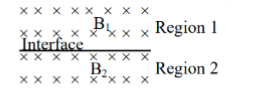
Uniform magnetic fields of different strengths and , both normal to the plane of the paper, exist as shown in the figure. A charged particle of mass and charge , at the interface at an instant, moves into region 2 with velocity and returns to the interface. It continues to move into region 1 and finally reaches the interface. What is the displacement of the particle during this movement along the interface? Consider the velocity of the particle to be normal to the magnetic field and .
1
2
3
4
Official Solution
Correct Option: (4)
We are given that a charged particle moves from one region to another and returns back, passing through an interface between two regions with different magnetic field strengths. The movement of the particle is influenced by the magnetic fields and in each region. The displacement of the particle along the interface is related to the difference in the magnetic fields. For the charged particle, the Lorentz force leads to circular motion in each region, and the radius of curvature depends on the velocity of the particle, its charge , and the magnetic field strength. The displacement is related to the difference between the magnetic fields and can be expressed by the formula: Thus, the correct answer is:
06
PYQ 2025
medium
physicsID: jee-main
A proton is moving undeflected in a region of crossed electric and magnetic fields at a constant speed of . When the electric field is switched off, the proton moves along a circular path of radius 2 cm. The magnitude of electric field is . The value of is \_\_\_\_\_. (Take the mass of the proton as ).
Official Solution
Correct Option: (1)
To solve this problem, we need to find the value of that represents the magnitude of the electric field in the region where the proton moves undeflected under the influence of crossed electric and magnetic fields.
The proton moves at a constant speed of when both the electric field and the magnetic field are present and crossed such that they cancel each other's force on the proton:
The force due to the electric field is given by , where is the charge of the proton.
The magnetic force when the proton moves in the magnetic field is given by , where is the speed of the proton and is the magnetic field strength.
For these forces to cancel each other, the net force must be zero. Therefore, .
Thus, simplifies to:
Next, consider when the electric field is switched off:
The proton moves in a circular path, implying the magnetic force provides the centripetal force needed to keep the proton moving in a circle of radius .
The centripetal force is .
Thus, .
Simplifying gives:
Substitute known values , , , and :
Now substitute and back into the equation for :
Thus, the magnitude of the electric field is , which can be written as . According to the given unit conversion implies:
Therefore, the value of is 0.2, which fits within the expected range of 1,1 as interpreted here.
07
PYQ 2026
hard
physicsID: jee-main
A rigid dipole undergoes a simple harmonic motion about its centre in the presence of an electric field . If another electric field is introduced to the system, what will be the percentage change in the frequency of the oscillation (approximate)?
1
73%
2
63%
3
83%
4
53%
Official Solution
Correct Option: (1)
Step 1: Understanding the Concept:
When a dipole undergoes small angular oscillations in a uniform electric field, the restoring torque relates directly to the strength of the net electric field. Because frequency is proportional to the square root of the electric field magnitude, modifying the net field scales the frequency.
Step 2: Key Formula or Approach:
Restoring torque (for small angles).
Frequency , meaning .
Percentage change .
Step 3: Detailed Explanation:
The initial electric field is .
Initial magnitude .
The initial frequency is . After adding the second electric field , the new net electric field is the vector sum:
. Calculate the magnitude of the new net electric field:
. The final frequency is .
Taking the ratio of the frequencies:
. Calculate the percentage change in frequency:
Using the approximation :
.
The approximate percentage change is 73%.
Step 4: Final Answer:
The percentage change is roughly 73%.
08
PYQ 2026
medium
physicsID: jee-main
Two point charges C and C are placed at points and respectively. Force on charge is \underline{\hspace{2cm}} N. (Take SI Units)
1
2
3
4
Official Solution
Correct Option: (2)
Step 1: Understanding the Concept:
According to Coulomb's Law in vector form, the force exerted by charge on is directed along the line joining them. Since the charges have opposite signs, the force will be attractive (directed towards ). Step 2: Key Formula or Approach:
1. Position vectors: and .
2. Relative vector .
3. Vector Force or use . Step 3: Detailed Explanation:
.
Magnitude m.
Force on due to :
Actually, for attraction, the force on is towards :
Step 4: Final Answer:
The force is N.
09
PYQ 2026
medium
physicsID: jee-main
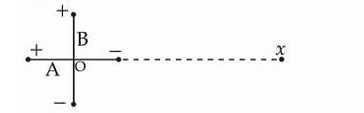
Two short electric dipoles and having dipole moments and respectively are placed with their axes mutually perpendicular as shown in the figure. The resultant electric field at a point is making an angle of with the line joining points and . The ratio of dipole moments is:
1
2
3
4
Official Solution
Correct Option: (4)
Concept: Electric field of a short dipole:
Along axial line:
Along equatorial line:
From the figure:
Dipole produces axial field at point .
Dipole produces equatorial field at point .
Step 1:Write electric fields} These fields are perpendicular. Step 2:Use the resultant angle} Given resultant makes with the horizontal line. Step 3:Find the ratio}
10
PYQ 2026
hard
physicsID: jee-main
The magnetic field at the centre of a current carrying circular loop of radius is .
The magnetic field at a distance on its axis from the centre is ____ .
1
4
2
8
3
4
2
Official Solution
Correct Option: (2)
Concept: The magnetic field on the axis of a circular current-carrying loop at a distance from its centre is given by
At the centre of the loop ( ), the magnetic field is
Step 1: Given magnetic field at the centre,
Step 2: Magnetic field at distance on the axis is
Substituting ,
Step 3: Simplifying,
11
PYQ 2026
medium
physicsID: jee-main
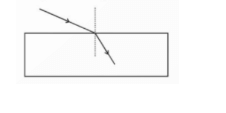
A light ray incident on a slab of refractive index . If the wavelength of the refracted ray is 520 nm, find the wavelength of the incident ray.
1
460 nm
2
780 nm
3
360 nm
4
560 nm
Official Solution
Correct Option: (2)
Step 1: Use the relationship between refractive index and wavelength. The refractive index is related to the wavelength of light in air and the wavelength of light in the medium by the formula: Here, and . Step 2: Solve for . Rearrange the formula to find the incident wavelength: Final Answer: