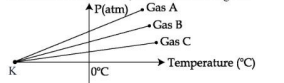
For three low density gases pressure versus temperature graphs are plotted while keeping them at constant volume, as shown in the figure.The temperature corresponding to the point ' ' is :
1
2
3
4
Official Solution
Correct Option: (4)
Step 1: Apply the Ideal Gas Law for an Isochoric Process
For an isochoric process (constant volume), the ideal gas law can be written as: where is the pressure, is the absolute temperature, is the number of moles, is the ideal gas constant, and is the volume. Since is constant, we can write: Converting Celsius temperature ( ) to Kelvin ( ), we have . Substituting:
Step 2: Find the Temperature at Point K
Point K represents the point where the pressure is zero. So: Since is not zero, we must have: Solving:
Conclusion: The temperature corresponding to point K is (Option 4).
04
PYQ 2023
medium
physicsID: jee-main
An ideal gas undergoes a thermodynamic process following the relation PT2 = constant. Assuming symbols have their usual meaning then volume expansion coefficient of the gas is equal to
1
2
3
4
Official Solution
Correct Option: (2)
Given:
For a constant , we have:
So, the volume expansion coefficient is:
05
PYQ 2025
easy
physicsID: jee-main
The expression given below shows the variation of velocity with time :The dimension of is:
Official Solution
Correct Option: (1)
06
PYQ 2025
hard
physicsID: jee-main
Young's double slit interference apparatus is immersed in a liquid of refractive index 1.44. It has slit separation of 1.5 mm. The slits are illuminated by a parallel beam of light whose wavelength in air is 690 nm. The fringe-width on a screen placed behind the plane of slits at a distance of 0.72 m, will be:
1
2
3
4
Official Solution
Correct Option: (1)
The fringe width in a Young's double slit experiment is given by:
where:
- is the wavelength of light in the medium,
- is the distance between the screen and the slits,
- is the separation between the slits. The wavelength in the liquid is:
where is the refractive index of the liquid. Substituting the values:
Now, the fringe width is:
Final Answer: .
07
PYQ 2025
medium
physicsID: jee-main
A Carnot engine (E) is working between two temperatures 473K and 273K. In a new system two engines - engine works between 473K to 373K and engine works between 373K to 273K. If , and are the efficiencies of the engines , and , respectively, then:
1
2
3
4
Official Solution
Correct Option: (3)
Let's denote the temperatures as follows:
K (highest temperature)
K (intermediate temperature)
K (lowest temperature)
The Carnot engine (E) operates between and , so its efficiency is:
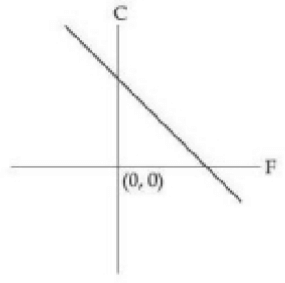
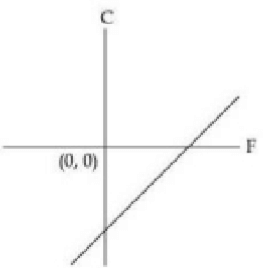
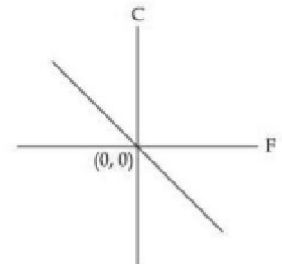
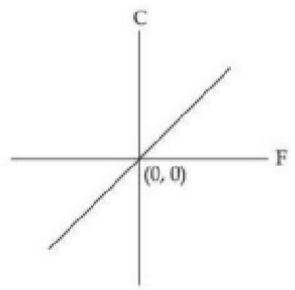
Which of the following figure represents the relation between Celsius and Fahrenheit temperatures?
1
2
3
4
Official Solution
Correct Option: (1)
The relation between Celsius and Fahrenheit temperatures is given by the linear equation: This is a straight line with a slope of and a y-intercept of 32, meaning that when the Celsius temperature is 0°C, the Fahrenheit temperature is 32°F. Thus, the relationship between Celsius and Fahrenheit is a straight line with a positive slope that does not pass through the origin but intersects the Fahrenheit axis at 32°F. In the provided options, the correct figure is one where the line passes through the origin and has a positive slope, matching the relationship of the Celsius to Fahrenheit scale (but offset by the starting point). Final Answer: Option (1).
09
PYQ 2025
medium
physicsID: jee-main
Given below are two statements: one is labelled as Assertion A and the other is labelled as Reason R. Assertion A: In a central force field, the work done is independent of the path chosen. Reason R: Every force encountered in mechanics does not have an associated potential energy. In the light of the above statements, choose the most appropriate answer from the options given below.
1
A is true but R is false
2
Both A and R are true and R is the correct explanation of A
3
Both A and R are true but R is NOT the correct explanation of A
4
A is false but R is true
Official Solution
Correct Option: (3)
Statement A is true because in a central force field (like gravitational or electrostatic), forces are conservative and hence work done is path independent. Statement R is true in the sense that not all forces (like friction) have potential energy; however, it does not correctly explain why A is true since the path independence is due to the conservative nature of central forces, not the lack of potential energy in all forces.
10
PYQ 2025
medium
physicsID: jee-main
Consider a long straight wire of a circular cross-section (radius ) carrying a steady current . The current is uniformly distributed across this cross-section. The distances from the centre of the wire's cross-section at which the magnetic field (inside the wire, outside the wire) is half of the maximum possible magnetic field, anywhere due to the wire, will be:
1
2
3
4
Official Solution
Correct Option: (3)
The magnetic field inside a current-carrying wire increases linearly with the distance from the center. The maximum magnetic field occurs at the surface, and the magnetic field is half of this maximum value at the point where the distance is inside the wire and at outside the wire. Thus, the correct answer is .
11
PYQ 2025
medium
physicsID: jee-main
A Carnot engine (E) is working between two temperatures 473K and 273K. In a new system two engines - engine works between 473K to 373K and engine works between 373K to 273K. If , and are the efficiencies of the engines , and , respectively, then:
1
2
3
4
Official Solution
Correct Option: (3)
Step 1: Calculate the efficiencies of each engine. The efficiency of a Carnot engine is given by:
For :
For :
Step 2: Calculate the overall efficiency of two engines working in series. The overall efficiency when two Carnot engines operate in series is the product of their individual efficiencies, not the sum:
This can be simplified and calculated for the exact values. Step 3: Verify the relationship.
Which indicates the multiplicative relationship is correct as per the properties of series Carnot engines.
12
PYQ 2025
medium
physicsID: jee-main
Young's double slit interference apparatus is immersed in a liquid of refractive index 1.44. It has slit separation of 1.5 mm. The slits are illuminated by a parallel beam of light whose wavelength in air is 690 nm. The fringe-width on a screen placed behind the plane of slits at a distance of 0.72 m, will be:
1
2
3
4
Official Solution
Correct Option: (1)
The fringe width in a Young's double slit experiment is given by:
where:
- is the wavelength of light in the medium,
- is the distance between the screen and the slits,
- is the separation between the slits. The wavelength in the liquid is:
where is the refractive index of the liquid. Substituting the values:
Now, the fringe width is:
Final Answer: .
13
PYQ 2025
medium
physicsID: jee-main
Which of the following figure represents the relation between Celsius and Fahrenheit temperatures?
1
2
3
4
Official Solution
Correct Option: (1)
The relation between Celsius and Fahrenheit temperatures is given by the linear equation:
This is a straight line with a slope of and a y-intercept of 32, meaning that when the Celsius temperature is 0°C, the Fahrenheit temperature is 32°F. Thus, the relationship between Celsius and Fahrenheit is a straight line with a positive slope that does not pass through the origin but intersects the Fahrenheit axis at 32°F. In the provided options, the correct figure is one where the line passes through the origin and has a positive slope, matching the relationship of the Celsius to Fahrenheit scale (but offset by the starting point). Final Answer: Option (1).
14
PYQ 2025
medium
physicsID: jee-main
Given below are two statements: one is labelled as Assertion A and the other is labelled as Reason R. Assertion A: In a central force field, the work done is independent of the path chosen. Reason R: Every force encountered in mechanics does not have an associated potential energy. In the light of the above statements, choose the most appropriate answer from the options given below.
1
A is true but R is false
2
Both A and R are true and R is the correct explanation of A
3
Both A and R are true but R is NOT the correct explanation of A
4
A is false but R is true
Official Solution
Correct Option: (3)
Assertion A: In a central force field, the work done is independent of the path chosen. This statement is true. Central forces are conservative forces, and the work done by a conservative force depends only on the initial and final positions, not on the path taken.
Reason R: Every force encountered in mechanics does not have an associated potential energy. This statement is also true. Non-conservative forces like friction and air resistance do not have associated potential energies because the work done by these forces depends on the path taken.
Analysis of the Relationship Between A and R:
The independence of work done on the path depends on the fact that the force is conservative.
All conservative forces possess an associated potential energy function.
Since Reason R states that not every force has an associated potential energy, while Assertion A refers specifically to conservative (central) forces which do have potential energy,
Reason R is not a correct explanation of Assertion A — it makes a general statement about forces, not specifically about central or conservative forces.
Therefore, both A and R are true, but R is NOT the correct explanation of A.