Dual Nature Of Radiation And Matter
26 previous year questions.
High-Yield Trend
Chapter Questions 26 MCQs
Three objects A, B and C are kept in a straight line on a frictionless horizontal surface. The masses of A, B and C are m, 2m and 2m respectively. A moves towards B with a speed of 9 m/s and makes an elastic collision with it. Thereafter B makes a completely inelastic collision with C. All motions occur along same straight line. The final speed of C is : 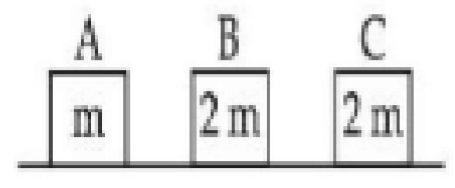
Statement I: Davisson-Germer experiment establishes the wave nature of electrons.
Statement II: If electrons have wave nature, they can interfere and show diffraction.
In the light of the above statements choose the correct answer from the option given below :
Proton and electron have equal kinetic energy, the ratio of de-Broglie wavelength of proton and electron is . Find x. (Mass of proton 1849 times mass of electron)
Find the ratio of de-Broglie wavelength of a proton and a 𝝰 - particle, when accelerated through a potential difference of 2V and 4V respectively.
A. The stopping potential depends only on the work function of the metal
B. The saturation current increases as the intensity of incident light increases
C. The maximum kinetic energy of a photo electron depends on the intensity of the incident light
D. Photoelectric effect can be explained using wave theory of light
Choose the correct answer from the options given below:
(A) reflection
(B) diffraction
(C) photoelectric effect
(D) interference
(E) polarization
Choose the most appropriate answer from the options given below :
Assertion (A): Number of photons increases with increase in frequency of light.
Reason (R): Maximum kinetic energy of emitted electrons increases with the frequency of incident radiation.
In the light of the above statements, choose the most appropriate answer from the options given below:
About Dual Nature Of Radiation And Matter - JEE-MAIN
Dual Nature Of Radiation And Matter is a vital chapter for JEE-MAIN aspirants. Mastering the concepts covered in this chapter is essential for securing a top rank.
By rigorously practicing the previous year questions associated with this chapter, you can identify high-yield topics, understand the examiner's perspective, and boost your confidence during the actual exam.
Frequently Asked Questions
Why focus on Dual Nature Of Radiation And Matter PYQs?
Analyzing PYQs for this specific chapter reveals the most frequently tested concepts and the typical complexity of questions, allowing you to tailor your study plan efficiently.
How to best use this analysis?
Review the topic breakdown to see which sub-topics within Dual Nature Of Radiation And Matter carry the most weight. Then, tackle the questions iteratively to solidify your understanding.