Photoelectric Effect
43 previous year questions.
High-Yield Trend
Chapter Questions 43 MCQs
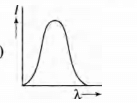
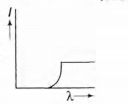
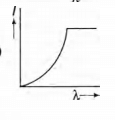
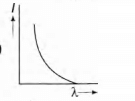
E = 200[sin(6 \times 1015)t + sin(9 \times 1015)t] Vm–1
Given : h = 4.14 \times 10–15 eVs
If this light falls on a metal surface having a work function of 2.50 eV, the maximum kinetic energy of the photoelectrons will be
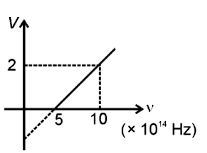
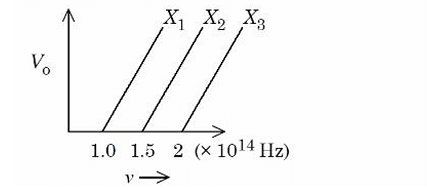
Based on given graph between stopping potential and frequency of irradiation, work function of metal is equal to
1 eV
3 eV
2 eV
4 eV
Statement I: Stopping potential in photoelectric effect does not depend on the power of the light source
Statement II: For a given metal, the maximum kinetic energy of the photoelectron depends on the wavelength of the incident light.
In the light of above statements, choose the most appropriate answer from the options given below
A. The photocurrent is proportional to the intensity of the incident radiation.
B. Maximum Kinetic energy with which photoelectrons are emitted depends on the intensity of incident light.
C. Max. K.E with which photoelectrons are emitted depends on the frequency of incident light.
D. The emission of photoelectrons require a minimum threshold intensity of incident radiation.
E. Max. K.E of the photoelectrons is independent of the frequency of the incident light.
Choose the correct answer from the options given below:
Statement I : Out of microwaves, infrared rays and ultraviolet rays, ultraviolet rays are the most effective for the emission of electrons from a metallic surface.
Statement II : Above the threshold frequency, the maximum kinetic energy of photoelectrons is inversely proportional to the frequency of the incident light.
In the light of above statements, choose the correct answer from the options given below :
A. 75 W infra-red lamp
B. 10 W infra-red lamp
C. 75 W ultra-violet lamp
D. 10 W ultra-violet lamp
Choose the correct answer from the options given below:
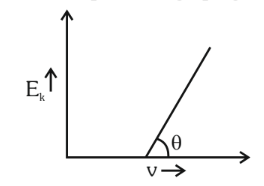
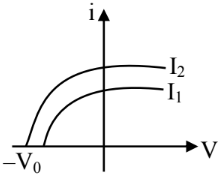
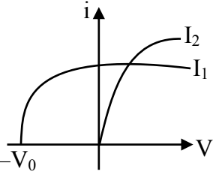
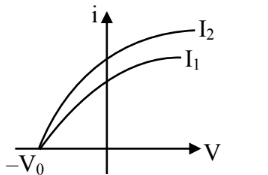
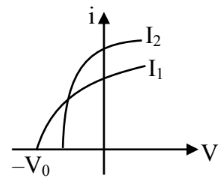
1.9 × 10¹⁵ Hz
1.6×10¹⁵ Hz
2 x 10¹⁶ Hz
1.2×10¹⁵ Hz
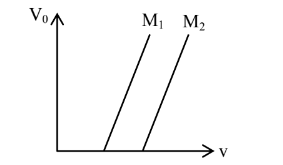
Statement-I: Figure shows the variation of stopping potential with frequency (v) for the two photosensitive materials M1 and M2. The slope gives value of , where h is Planck's constant, e is the charge of electron.
Statement-II: M2 will emit photoelectrons of greater kinetic energy for the incident radiation having same frequency. In the light of the above statements
Choose the most appropriate answer from the options given below.
Given below are two statements: one is labelled as Assertion (A) and the other one is labelled as Reason (R).
Assertion (A): Emission of electrons in the photoelectric effect can be suppressed by applying a sufficiently negative electron potential to the photoemissive substance.
Reason (R): A negative electric potential, which stops the emission of electrons from the surface of a photoemissive substance, varies linearly with the frequency of incident radiation.
In light of the above statements, choose the most appropriate answer from the options given below:
About Photoelectric Effect - JEE-MAIN
Photoelectric Effect is a vital chapter for JEE-MAIN aspirants. Mastering the concepts covered in this chapter is essential for securing a top rank.
By rigorously practicing the previous year questions associated with this chapter, you can identify high-yield topics, understand the examiner's perspective, and boost your confidence during the actual exam.
Frequently Asked Questions
Why focus on Photoelectric Effect PYQs?
Analyzing PYQs for this specific chapter reveals the most frequently tested concepts and the typical complexity of questions, allowing you to tailor your study plan efficiently.
How to best use this analysis?
Review the topic breakdown to see which sub-topics within Photoelectric Effect carry the most weight. Then, tackle the questions iteratively to solidify your understanding.