A body of mass moving with a uniform speed in the plane along the line . The angular momentum of the particle about the origin will be ______ .
Official Solution
Correct Option:
(1)
Given: Particle of mass moves along the line with speed .
1) Position and velocity. Any point on the line: Direction of motion is along the line; slope direction vector . Unit direction . Given speed , the velocity is
2) Angular momentum. Thus
02
PYQ 2025
medium
physicsID: jee-main
The position vectors of two 1 kg particles, (A) and (B), are given by
and
where is time, and and are constants. At and velocities and are orthogonal to each other. At , the magnitude of angular momentum of particle (A) with respect to the position of particle (B) is . The value of is ______.}
Official Solution
Correct Option:
(1)
Given:
At and and are orthogonal to each other.
The magnitude of angular momentum of particle (A) with respect to the position of particle (B) at is .
The velocity of the particles can be obtained by taking the time derivatives of their position vectors:
For particle A:
\p>Substituting the values of at :
For particle B:
Substituting the values of at :
Since the velocities are orthogonal to each other, we can compute their dot product to confirm the condition:
Now, the angular momentum of particle A with respect to particle B is given by:
where and .
Substituting the given values at :
\p>Now calculate the cross product of and :
\p>After calculating the cross product, the magnitude of angular momentum is found to be 90.
Answer:
The value of is 90.
03
PYQ 2025
medium
physicsID: jee-main
Two planets, A and B are orbiting a common star in circular orbits of radii and , respectively, with . The planet B is times more massive than planet A. The ratio of angular momentum ( ) of planet B to that of planet A ( ) is closest to integer:
Official Solution
Correct Option:
(1)
The angular momentum of a planet in orbit is given by:
Where is the mass, is the velocity, and is the radius of the orbit. The velocity of a planet in orbit can be expressed as:
For planet A:
For planet B:
Given that and , the ratio of angular momentum is:
Thus, the correct answer is , .
04
PYQ 2025
medium
physicsID: jee-main
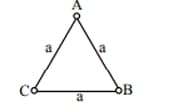
Three equal masses are kept at vertices (A, B, C) of an equilateral triangle of side in free space. At , they are given an initial velocity .Here, are unit vectors along the edges of the triangle. If the three masses interact gravitationally, then the magnitude of the net angular momentum of the system at the point of collision is:
1
2
3
4
Official Solution
Correct Option:
(3)
Step 1: Since the system is an equilateral triangle, the net angular momentum is calculated with respect to the center of mass. First, find the center of mass of the system. For an equilateral triangle, the distance from each vertex to the center of mass is , where is the side length.
Step 2: The angular momentum of each mass is given by:
Where is the velocity of each mass. The net angular momentum is the sum of the angular momentum of each mass. Thus, the magnitude of the net angular momentum of the system at the point of collision is , so the correct answer is option (3).
About The Angular Momentum - JEE-MAIN
The Angular Momentum is a vital chapter for JEE-MAIN aspirants. Mastering the concepts covered in this chapter is essential for securing a top rank.
By rigorously practicing the previous year questions associated with this chapter, you can identify high-yield topics, understand the examiner's perspective, and boost your confidence during the actual exam.
Frequently Asked Questions
Why focus on The Angular Momentum PYQs?
Analyzing PYQs for this specific chapter reveals the most frequently tested concepts and the typical complexity of questions, allowing you to tailor your study plan efficiently.
How to best use this analysis?
Review the topic breakdown to see which sub-topics within The Angular Momentum carry the most weight. Then, tackle the questions iteratively to solidify your understanding.