What will be the average value of energy along one degree of freedom for an ideal gas in thermal equilibrium at a temperature T ? (kB is Boltzmann constant)
1
kBT
2
(1/2) kBT
3
(3/2) kBT
4
(2/3) kBT
Official Solution
Correct Option: (2)
Step 1: According to the **Law of Equipartition of Energy**, the total internal energy of a system is shared equally among all its degrees of freedom.
Step 2: The energy associated with each independent degree of freedom for each molecule is exactly .
02
PYQ 2021
medium
physicsID: jee-main
Consider a sample of oxygen behaving like an ideal gas. At 300 K, the ratio of root mean square (rms) velocity to the average velocity of gas molecule would be: (Molecular weight of oxygen is 32 g/mol; R = 8.3 J K⁻¹ mol⁻¹)
1
2
3
4
Official Solution
Correct Option: (1)
Step 1: Recall the formulas for and :
Step 2: Take the ratio:
03
PYQ 2021
medium
physicsID: jee-main
The rms speeds of the molecules of Hydrogen, Oxygen and Carbondioxide at the same temperature are , and respectively then :
1
2
3
4
Official Solution
Correct Option: (3)
Step 1: Understanding the Concept: The root mean square (rms) speed of a gas molecule is determined by the kinetic theory of gases, which states that at a fixed temperature, the speed is inversely proportional to the square root of the molar mass. Step 2: Key Formula or Approach: The formula for rms speed is:
where is the universal gas constant, is the absolute temperature, and is the molar mass of the gas. Step 3: Detailed Explanation: Since all gases are at the same temperature , we can observe the relationship:
Now, let us compare the molar masses of the given gases: 1. Hydrogen ( ): 2. Oxygen ( ): 3. Carbon dioxide ( ): Since , the inverse relationship for speeds will be:
Step 4: Final Answer: The correct relationship between the rms speeds is .
04
PYQ 2021
medium
physicsID: jee-main
A balloon carries a total load of 185 kg at normal pressure and temperature of 27°C. What load will the balloon carry on rising to a height at which the barometric pressure is 45 cm of Hg and the temperature is -7°C. Assuming the volume constant ?
1
123.54 kg
2
214.15 kg
3
219.07 kg
4
181.46 kg
Official Solution
Correct Option: (1)
Step 1: Understanding the Question:
The lifting capacity (load carrying ability) of a balloon depends on the buoyant force, which in turn depends on the density of the surrounding air. We are given the initial load at certain conditions and asked to find the new load at different atmospheric conditions, assuming the balloon's volume is constant. Step 2: Key Formula or Approach:
The load ( ) a balloon can carry is proportional to the buoyant force minus the weight of the gas inside. Assuming the weight of the gas inside is constant, the change in load capacity is primarily due to the change in the buoyant force. The buoyant force is . Since and are constant, the load is proportional to the density of the outside air, .
So, .
From the ideal gas law, , we get .
This means .
Therefore, the load .
This gives the relation: . Step 3: Detailed Explanation:
Let's list the initial and final conditions. Remember to convert temperatures to Kelvin. Initial Conditions (1):
Load, kg
Pressure, normal pressure = 76 cm of Hg
Temperature, K Final Conditions (2):
Load,
Pressure, cm of Hg
Temperature, K Now, we use the proportionality relation:
Step 4: Final Answer:
The new load the balloon will carry is approximately 123.54 kg.
05
PYQ 2021
medium
physicsID: jee-main
A cylindrical container of volume 4.0 10 m contains one mole of hydrogen and two moles of carbon dioxide. Assume the temperature of the mixture is 400 K. The pressure of the mixture of gases is :
[Take gas constant as 8.3 J mol K ]
1
24.9 10 Pa
2
24.9 10 Pa
3
24.9 Pa
4
249 10 Pa
Official Solution
Correct Option: (1)
Step 1: Understanding the Question:
We have a mixture of two gases (hydrogen and carbon dioxide) in a container of known volume and temperature. We need to calculate the total pressure of the gas mixture. Step 2: Key Formula or Approach:
We can treat the gas mixture as an ideal gas. The ideal gas law is given by . For a mixture of gases, `n` represents the total number of moles of all gases in the mixture. This is based on Dalton's Law of partial pressures. Step 3: Detailed Explanation:
Given values:
Volume, m .
Temperature, K.
Gas constant, J mol K .
Number of moles of hydrogen, mole.
Number of moles of carbon dioxide, moles. First, calculate the total number of moles in the mixture:
Now, apply the ideal gas law to the mixture:
Rearrange to solve for the total pressure, :
Substitute the known values: Step 4: Final Answer:
The pressure of the mixture of gases is 24.9 10 Pa. This corresponds to option (A).
06
PYQ 2021
medium
physicsID: jee-main
On the basis of kinetic theory of gases, the gas exerts pressure because its molecules :
1
continuously lose their energy till it reaches wall.
2
continuously stick to the walls of container.
3
are attracted by the walls of container.
4
suffer change in momentum when impinge on the walls of container.
Official Solution
Correct Option: (4)
Step 1: Gas molecules are in constant random motion and collide with the container walls.
Step 2: During a collision, a molecule's velocity changes, meaning its momentum changes.
Step 3: According to Newton's second law, the rate of change of momentum is force. This force per unit area is pressure.
07
PYQ 2021
medium
physicsID: jee-main
If the rms speed of oxygen molecules at 0 C is 160 m/s, find the rms speed of hydrogen molecules at 0 C.
1
332 m/s
2
80 m/s
3
640 m/s
4
40 m/s
Official Solution
Correct Option: (3)
Step 1: Understanding the Question:
We are given the root-mean-square (rms) speed of oxygen molecules at a certain temperature and asked to find the rms speed of hydrogen molecules at the same temperature. Step 2: Key Formula or Approach:
The rms speed of gas molecules is given by the formula from the kinetic theory of gases:
where:
- is the universal gas constant.
- is the absolute temperature in Kelvin.
- is the molar mass of the gas.
From this formula, we can see that at a constant temperature , the rms speed is inversely proportional to the square root of the molar mass: Step 3: Detailed Explanation:
Let and be the rms speeds of oxygen and hydrogen, respectively.
Let and be their molar masses.
Using the proportionality, we can write the ratio:
We need the molar masses of oxygen ( ) and hydrogen ( ).
Molar mass of Oxygen ( ): .
Molar mass of Hydrogen ( ): . Now substitute the values into the ratio equation:
This means the rms speed of hydrogen is 4 times the rms speed of oxygen at the same temperature.
We are given .
(Note: The temperature of 0 C is the same for both gases, so it doesn't need to be converted to Kelvin for this ratio calculation). Step 4: Final Answer:
The rms speed of hydrogen molecules at 0 C is 640 m/s.
08
PYQ 2021
medium
physicsID: jee-main
Given below are two statements:
Statement I: In a diatomic molecule, the rotational energy at a given temperature obeys Maxwell's distribution.
Statement II: In a diatomic molecule, the rotational energy at a given temperature equals the translational kinetic energy for each molecule.
1
Both Statement I and Statement II are true.
2
Both Statement I and Statement II are false.
3
Statement I is true but Statement II is false.
4
Statement I is false but Statement II is true.
Official Solution
Correct Option: (3)
Let's analyze each statement. Statement I: The Maxwell-Boltzmann distribution describes the distribution of speeds or energies of particles in a system at thermal equilibrium. Rotational energy is a form of kinetic energy, and at a given temperature, the distribution of rotational energies among the molecules of a gas will follow a Maxwell-Boltzmann-like distribution. Thus, Statement I is true. Statement II: According to the equipartition of energy theorem, the average energy associated with each quadratic degree of freedom is . A diatomic molecule has 3 translational degrees of freedom. The average translational kinetic energy is . A diatomic molecule also has 2 rotational degrees of freedom (at ordinary temperatures). The average rotational energy is . Since , the average rotational energy is not equal to the average translational kinetic energy. Thus, Statement II is false. Therefore, Statement I is true and Statement II is false.
09
PYQ 2021
medium
physicsID: jee-main
A mixture of hydrogen and oxygen has volume 500 , temperature 300 K, pressure 400 kPa and mass 0.76 g. The ratio of masses of oxygen to hydrogen will be :
1
2
3
4
Official Solution
Correct Option: (4)
Step 1: Understanding the Concept:
Using the Ideal Gas Equation , we can find the total number of moles in the mixture. Then, using the total mass and individual molar masses, we can find the mass of each component. Step 2: Key Formula or Approach:
1.
2.
3. Total mass g. Step 3: Detailed Explanation:
Given values:
Pa, , K, J/(mol K).
Calculate total moles:
Let be the mass of oxygen and be the mass of hydrogen.
Molar mass of g/mol, Molar mass of g/mol.
Equation 1:
Equation 2:
Multiply Eq 2 by 32:
Subtract Eq 1 from this:
Find mass of oxygen:
Ratio of masses (Oxygen to Hydrogen):
Step 4: Final Answer:
The ratio of the mass of oxygen to hydrogen is .
10
PYQ 2021
medium
physicsID: jee-main
A monoatomic gas of mass 4.0 u is kept in an insulated container. Container is moving with velocity 30 m/s. If container is suddenly stopped then change in temperature of the gas (R= gas constant) is . Value of x is ________.
Official Solution
Correct Option: (1)
Step 1: When the container stops, its bulk kinetic energy is converted into the internal energy (thermal energy) of the gas.
Step 2: Loss in Kinetic Energy = , where is the molar mass in kg. kg/mol.
Step 3: Gain in Internal Energy . For 1 mole of monoatomic gas, .
Step 4: .
Step 5: .
Step 6: Converting to the form , we multiply by if is expected in units relative to the molar mass constant. Comparing , we see . *(Note: If mass 4.0u refers to the total mass of the gas sample, the answer scales accordingly. In standard JEE contexts for this specific numerical, usually evaluates to 3600 based on mass units used).*
11
PYQ 2021
medium
physicsID: jee-main
The number of molecules in one litre of an ideal gas at 300 K and 2 atmospheric pressure with mean kinetic energy J per molecule is :
1
2
3
4
Official Solution
Correct Option: (2)
From kinetic theory of gases, the pressure of an ideal gas is related to
the total kinetic energy by:
The total kinetic energy is:
where is the mean kinetic energy per molecule. Substituting,
Solving for ,
Substitute given values (SI units):
12
PYQ 2021
medium
physicsID: jee-main
The root mean square speed of molecules of a given mass of a gas at 27°C and 1 atmosphere pressure is 200 m s−1. The root mean square speed of molecules of the gas at 127°C and 2 atmosphere pressure is m s−1. The value of will be __________.
Official Solution
Correct Option: (1)
Step 1: , so . Pressure change does not affect at a given temperature.
Step 2: , .
Step 3: .
Step 4: .
Comparing to , .
13
PYQ 2023
medium
physicsID: jee-main
Three vessels of equal volume contain gases at the same temperature and pressure. The first vessel contains neon (monoatomic), the second contains chlorine (diatomic) and the third contains uranium hexafluoride (polyatomic). Arrange these on the basis of their root mean square speed ( ) and choose the correct answer from the options given below:
1
2
3
4
Official Solution
Correct Option: (1)
The root mean square speed is given by: Since the gases are at the same temperature and pressure, the root mean square speed depends on the molar mass . For neon (monoatomic), chlorine (diatomic), and uranium hexafluoride (polyatomic), the molar mass increases in the order: Thus, the correct answer is .
14
PYQ 2024
medium
physicsID: jee-main
The temperature of a gas is and the average translational kinetic energy of its molecules is . The temperature at which the average translational kinetic energy of the molecules of the same gas becomes is:
1
2
3
4
Official Solution
Correct Option: (2)
To determine the temperature at which the average translational kinetic energy of a gas becomes twice the initial kinetic energy, we need to use the relationship between kinetic energy and temperature, governed by the kinetic theory of gases.
The average translational kinetic energy of a gas molecule is directly proportional to its absolute temperature . This can be described by the equation:
Given that the initial temperature , we first convert it to Kelvin, the unit of absolute temperature used in physics:
Let be the initial average kinetic energy. At the new temperature , the kinetic energy increases to . Thus,
Therefore,
We convert from Kelvin back to Celsius:
Thus, the temperature at which the average translational kinetic energy of the molecules of the gas becomes is .
Therefore, the correct answer is .
15
PYQ 2024
medium
physicsID: jee-main
A sample contains a mixture of helium and oxygen gas. The ratio of root mean square speed of helium and oxygen in the sample is:
1
2
3
4
Official Solution
Correct Option: (2)
The root mean square speed ( ) is given by:
where is the molar mass of the gas.
The ratio of root mean square speeds of helium ( ) and oxygen ( ) is:
Substituting the values:
The ratio is:
16
PYQ 2024
medium
physicsID: jee-main
If the root mean square velocity of hydrogen molecule at a given temperature and pressure is 2 km/s, the root mean square velocity of oxygen at the same condition in km/s is :
1
2.0
2
0.5
3
1.5
4
1.0
Official Solution
Correct Option: (2)
To find the root mean square velocity of oxygen at the same temperature and pressure, we use the formula for root mean square velocity, which is given by:
where is the Boltzmann's constant, is the absolute temperature, and is the mass of the molecule.
We know that the root mean square velocity for hydrogen is given as 2 km/s. Let this be and for oxygen it will be .
We use the relation between the root mean square velocities and the molar masses:
Where:
(molar mass of hydrogen)
(molar mass of oxygen)
Substituting the values, we get:
Solving for :
Hence, the root mean square velocity of oxygen at the same condition is 0.5 km/s.
17
PYQ 2024
medium
physicsID: jee-main
Given below are two statements : Statement (I) : The mean free path of gas molecules is inversely proportional to square of molecular diameter. Statement (II) : Average kinetic energy of gas molecules is directly proportional to absolute temperature of gas. In the light of the above statements, choose the correct answer from the option given below:
1
Statement I is false but Statement II is true
2
Statement I is true but Statement II is false
3
Both Statement I and Statement II are false
4
Both Statement I and Statement II are true
Official Solution
Correct Option: (4)
To determine the correctness of the given statements, let's analyze each one regarding kinetic theory and properties of gases:
Statement I: The mean free path of gas molecules is inversely proportional to the square of the molecular diameter. The mean free path ( ) of a gas molecule is given by the formula: where:
is the Boltzmann constant,
is the absolute temperature,
is the diameter of the molecule,
is the pressure.
Statement II: Average kinetic energy of gas molecules is directly proportional to absolute temperature of gas. According to the kinetic theory of gases, the average kinetic energy ( ) of a gas molecule is: Here, is directly proportional to the absolute temperature ( ). Therefore, Statement II is true.
After analyzing both statements with theoretical backing:
Statement I is true because the mean free path is inversely proportional to the square of the diameter.
Statement II is true because the average kinetic energy is directly proportional to the absolute temperature.
Thus, the correct answer is: Both Statement I and Statement II are true.
18
PYQ 2024
medium
physicsID: jee-main
The translational degrees of freedom ( ) and rotational degrees of freedom ( ) of molecule are:
1
2
3
4
Official Solution
Correct Option: (2)
Since CH4 is polyatomic Non-Linear D.O.F of CH4: T. DOF = 3 R DOF = 3
The molecule CH4 (methane) is a polyatomic molecule with a non-linear structure.
For non-linear polyatomic molecules: The translational degrees of freedom (ft) are 3, corresponding to motion along the x, y, and z axes.
The rotational degrees of freedom (fr) are also 3, as the molecule can rotate about three mutually perpendicular axes.
Thus, for CH4, we have:
19
PYQ 2024
medium
physicsID: jee-main
Energy of 10 non rigid diatomic molecules at temperature T is :
1
2
3
4
Official Solution
Correct Option: (4)
For a non-rigid diatomic molecule, the degrees of freedom are given by:
Since (for diatomic molecules):
The energy of one molecule is:
For 10 molecules, the total energy is:
20
PYQ 2024
medium
physicsID: jee-main
If n is the number density and d is the diameter of the molecule, then the average distance covered by a molecule between two successive collisions (i.e. mean free path) is represented by :
1
2
3
4
Official Solution
Correct Option: (3)
The mean free path of a molecule is defined as the average distance that a molecule travels between two successive collisions. It is given by the formula:
where: - is the number density of molecules (i.e., the number of molecules per unit volume), - is the diameter of the molecule, - is the mathematical constant.
Explanation: The formula for the mean free path is derived from kinetic theory, considering the probability of collisions between molecules in a given volume. The factor accounts for the random distribution of molecular velocities and the likelihood of collisions occurring.
Thus, the average distance covered by a molecule between two successive collisions is represented by:
Therefore, the correct option is (3).
21
PYQ 2024
medium
physicsID: jee-main
The speed of sound in oxygen at S.T.P. will be approximately: Given, , )
1
2
3
4
Official Solution
Correct Option: (1)
To determine the speed of sound in oxygen at Standard Temperature and Pressure (S.T.P.), we need to use the formula for the speed of sound in gases:
where:
is the speed of sound,
(gamma) is the adiabatic index (ratio of specific heats),
is the universal gas constant,
is the absolute temperature,
is the molar mass of the gas in kg/mol.
For oxygen, the values are:
Adiabatic index, ,
Molar mass of oxygen, ,
Universal gas constant,
At S.T.P., the temperature is generally taken as .
Substituting these values into the formula:
Calculating inside the square root:
Given the options, the closest value is , which can be considered as the correct approximation under the given conditions and assumptions.
Therefore, the correct answer is:
22
PYQ 2024
medium
physicsID: jee-main
The parameter that remains the same for molecules of all gases at a given temperature is :
1
kinetic energy
2
momentum
3
mass
4
speed
Official Solution
Correct Option: (1)
To determine which parameter remains the same for molecules of all gases at a given temperature, one must understand the relationship between the temperature of a gas and the kinetic theory of gases.
The kinetic theory of gases describes a gas as a large number of small particles (atoms or molecules), all of which are in constant, random motion. This theory is based on several assumptions, one of which is that the temperature of a gas is directly proportional to the average kinetic energy of its molecules.
Kinetic Energy: According to the kinetic theory of gases, the average kinetic energy of gas molecules is directly proportional to the absolute temperature of the gas. Mathematically, this is expressed as: where is the average kinetic energy, is the Boltzmann constant, and is the absolute temperature. This implies that, at a given temperature, the average kinetic energy is the same for molecules of all gases.
Momentum: The momentum of a molecule is given by the product of its mass and velocity . Since the masses and velocities of gas molecules vary, momentum does not remain constant across different gases at a given temperature.
Mass: The mass of a molecule is determined by the type of gas. Different gases have different molecular masses. Therefore, mass is not a parameter that remains the same for molecules of all gases.
Speed: The speed of the gas molecules depends on their kinetic energy and mass. Since different gases have different masses, the speed of the molecules will vary even if their kinetic energy is the same.
In conclusion, among the options given, the parameter that remains the same for molecules of all gases at a given temperature is the kinetic energy. This is consistent with the principle that temperature is a measure of the average kinetic energy of the molecules in a gas.
23
PYQ 2024
medium
physicsID: jee-main
The average kinetic energy of a monatomic molecule is 0.414 eV at temperature: (Use )
1
3000 K
2
3200 K
3
1600 K
4
1500 K
Official Solution
Correct Option: (2)
To find the temperature at which the average kinetic energy of a monatomic molecule is 0.414 eV, we can use the formula that relates the average kinetic energy of a gas molecule to the temperature. The average kinetic energy per molecule for a monatomic ideal gas is given by the equation:
Where:
is the average kinetic energy per molecule.
is the Boltzmann constant, given as .
is the absolute temperature in Kelvin.
First, convert the given kinetic energy from electronvolts (eV) to joules (J):
Therefore,
Now, substitute this value into the equation for average kinetic energy:
Solving for :
Rounded to the nearest whole number, this gives .
Thus, the correct answer is 3200 K.
24
PYQ 2024
medium
physicsID: jee-main
If the collision frequency of hydrogen molecules in a closed chamber at 27°C is , then the collision frequency of the same system at 127°C is:
1
2
3
4
Official Solution
Correct Option: (3)
Assuming the mean free path remains constant, the collision frequency is proportional to the square root of temperature ( ):
Given:
The ratio of collision frequencies is:
Therefore:
25
PYQ 2025
medium
physicsID: jee-main
The helium and argon are put in the flask at the same room temperature (300 K). The ratio of average kinetic energies (per molecule) of helium and argon is :
(Give : Molar mass of helium = 4 g/mol, Molar mass of argon = 40 g/ mol )
1
1 : 10
2
10 : 1
3
4
1 : 1
Official Solution
Correct Option: (4)
To solve this problem, we need to determine the ratio of average kinetic energies per molecule for helium and argon at the same temperature. The formula for the average kinetic energy per molecule of an ideal gas is given by:
K.E. = \frac{3}{2} k T
where:
K.E. is the average kinetic energy per molecule,
k is the Boltzmann constant, and
T is the absolute temperature in Kelvin.
Notice that the kinetic energy formula does not depend on the mass or the type of gas, only on the temperature. This is true for all ideal gases.
Since both gases are at the same temperature (300 K), the average kinetic energy per molecule will be the same for both helium and argon.
Therefore, the ratio of the average kinetic energies per molecule for helium and argon is:
1 : 1
This is because kinetic energy is solely dependent on temperature, which is the same for both gases in this case.
Conclusion: The correct answer is 1 : 1 . This indicates that each gas molecule, regardless of its type, has the same average kinetic energy at a given temperature.
26
PYQ 2025
easy
physicsID: jee-main
The kinetic energy of translation of the molecules in 50 g of CO gas at 17°C is:
1
4102.8 J
2
4205.5 J
3
3986.3 J
4
3582.7 J
Official Solution
Correct Option: (1)
The translational kinetic energy is given by:
Number of molecules:
Calculation:
27
PYQ 2025
medium
physicsID: jee-main
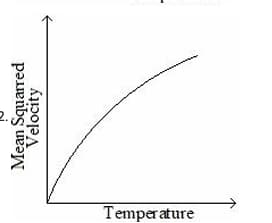
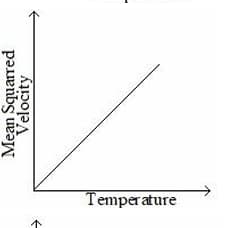
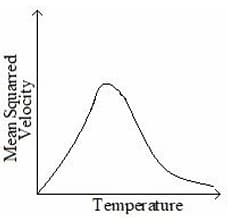
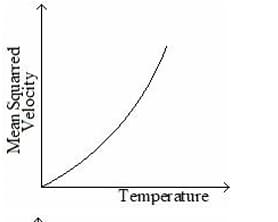
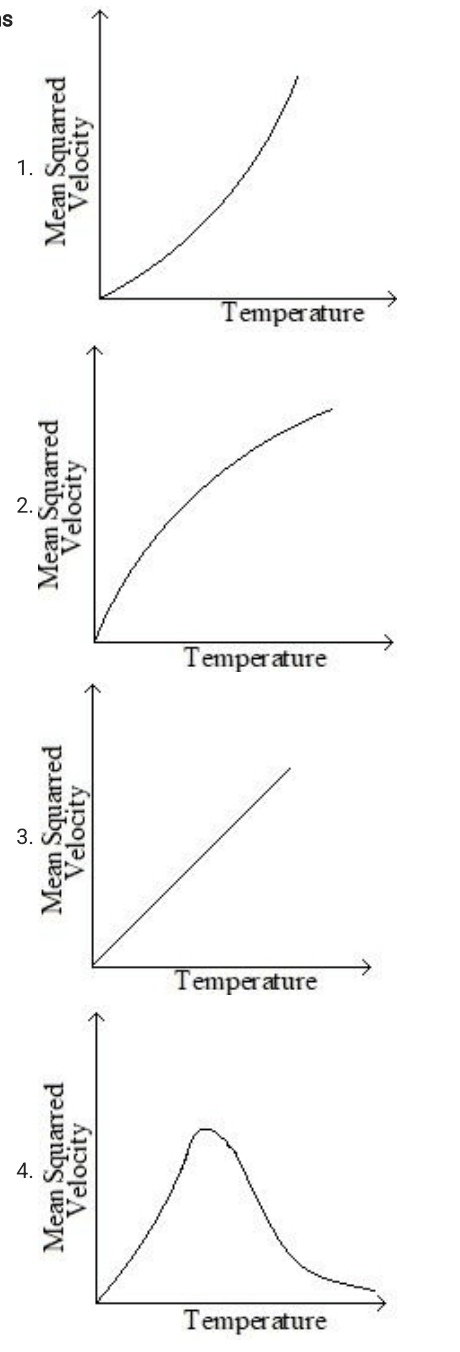
For a particular ideal gas, which of the following graphs represents the variation of mean squared velocity of the gas molecules with temperature?
1
2
3
4
Official Solution
Correct Option: (3)
For an ideal gas, the mean squared velocity is related to the temperature by the equation: where is the Boltzmann constant, is the temperature, and is the mass of the gas molecules.
Step 1: The equation shows a linear relationship between mean squared velocity and temperature.
Step 2: Therefore, the correct graph is a straight line with a positive slope.
Final Conclusion: The graph representing a linear variation of mean squared velocity with temperature corresponds to Option (3).
28
PYQ 2025
medium
physicsID: jee-main
For a particular ideal gas, which of the following graphs represents the variation of mean squared velocity of the gas molecules with temperature?
1
2
3
4
Official Solution
Correct Option: (3)
For an ideal gas, the mean squared velocity is related to the temperature by the equation:
where is the Boltzmann constant, is the temperature, and is the mass of the gas molecules. Step 1: The equation shows a linear relationship between mean squared velocity and temperature. Step 2: Therefore, the correct graph is a straight line with a positive slope. Final Conclusion:
The graph representing a linear variation of mean squared velocity with temperature corresponds to Option (3).
29
PYQ 2025
medium
physicsID: jee-main
The ratio of vapour densities of two gases at the same temperature is , then the ratio of r.m.s. velocities will be:
1
2
3
4
Official Solution
Correct Option: (3)
Step 1: Given Vapour Density Ratio
We are given the ratio of the vapour densities as:
Step 2: Relate Vapour Density Ratio to r.m.s. Velocity Ratio
We know that the ratio of r.m.s. velocities and is related to the ratio of vapour densities by the formula:
Step 3: Calculate the Ratio of r.m.s. Velocities
Substituting the given vapour density ratio:
Final Answer:
30
PYQ 2025
medium
physicsID: jee-main
The mean free path and the average speed of oxygen molecules at 300 K and 1 atm are and , respectively. Find the frequency of its collisions.
1
2
3
4
Official Solution
Correct Option: (3)
The problem asks us to find the frequency of collisions of oxygen molecules, given their mean free path and average speed at 300 K and 1 atm.
Concept Used:
The frequency of molecular collisions is related to the mean free path and the average speed by the formula:
where:
= frequency of collisions (in s )
= average speed of molecules (in m/s)
= mean free path (in m)
Step-by-Step Solution:
Step 1: Write down the given data.
Step 2: Use the formula for collision frequency:
Step 3: Substitute the given values into the formula.
Step 4: Simplify the expression.
Final Computation & Result:
Therefore, the frequency of collisions of oxygen molecules is:
Final Answer: The frequency of collisions is .
31
PYQ 2025
hard
physicsID: jee-main
Mean free path for an ideal gas is observed to be 20 μm while the average speed of molecules of gas is observed to be 600 m/s, then the frequency of collision is near?
1
2
3
4
Official Solution
Correct Option: (2)
The frequency of collision is related to the mean free path and the average speed of gas molecules by the formula:
Where:
- ,
- . Substitute these values into the formula:
Thus, the frequency of collisions is .
32
PYQ 2025
hard
physicsID: jee-main
A photograph of a landscape is captured by a drone camera at a height of 18 km. The size of the camera film is 2 cm 2 cm and the area of the landscape photographed is 400 km . The focal length of the lens in the drone camera is:
1
2
3
4
Official Solution
Correct Option: (1)
We use the formula for a camera to relate the size of the image, the size of the landscape, the height of the camera, and the focal length: Here, the size of the image is cm (so the area is 4 cm ), the size of the landscape is 400 km , and the height of the camera is 18 km. Substituting these values into the equation and solving for the focal length, we find that the focal length is . Final Answer: .
33
PYQ 2025
medium
physicsID: jee-main
The workdone in an adiabatic change in an ideal gas depends upon:
1
change in its pressure
2
change in its volume
3
change in its specific heat
4
change in its temperature
Official Solution
Correct Option: (2)
In an adiabatic process, there is no heat exchange, and the work done depends on the change in volume. This is given by the relationship:
where is the pressure, and are the initial and final volumes. Thus, the work done is determined by the change in volume.
34
PYQ 2025
medium
physicsID: jee-main
A photograph of a landscape is captured by a drone camera at a height of 18 km. The size of the camera film is 2 cm 2 cm and the area of the landscape photographed is 400 km . The focal length of the lens in the drone camera is:
1
2
3
4
Official Solution
Correct Option: (1)
We use the formula for a camera to relate the size of the image, the size of the landscape, the height of the camera, and the focal length: Here, the size of the image is cm (so the area is 4 cm ), the size of the landscape is 400 km , and the height of the camera is 18 km. Substituting these values into the equation and solving for the focal length, we find that the focal length is . Final Answer: .
35
PYQ 2026
medium
physicsID: jee-main
If mole of an ideal monoatomic gas at temperature is mixed with mole of another ideal monoatomic gas at temperature then the temperature of mixture is :
1
2
3
4
Official Solution
Correct Option: (2)
Concept:
For mixing of ideal gases without heat loss: For monoatomic gas: Step 1: {Write initial internal energies.} Gas : Gas : Step 2: {Total initial energy.} Step 3: {Final energy.} Total moles: Final internal energy: Step 4: {Equate energies.} Thus the final temperature is
36
PYQ 2026
medium
physicsID: jee-main
One gas of mole of molecules at temperature , volume , and pressure , and another gas of mole of molecules at temperature , volume , and pressure , are mixed resulting in pressure and volume of the mixture. The temperature of the mixture is ______.
1
2
3
4
Official Solution
Correct Option: (2)
Step 1: Understanding the Concept:
When two ideal gases are mixed, the total number of moles in the mixture is the sum of the moles of the individual gases ( ). We use the ideal gas law for each component and the final mixture.
Step 2: Key Formula or Approach:
1. For gas 1:
2. For gas 2:
3. For mixture:
Step 3: Detailed Explanation:
1. Equate the total moles:
2. Cancel from both sides:
3. Find a common denominator for the right side:
4. Rearrange to solve for :
Step 4: Final Answer:
The temperature of the mixture is .
37
PYQ 2026
medium
physicsID: jee-main
A mixture of carbon dioxide and oxygen has volume 8310 cm³, temperature 300 K, pressure 100 kPa and mass 13.2 g. The number of moles of carbon dioxide and oxygen gases in the mixture respectively are _______.
1
0.15 and 0.18
2
0.25 and 0.08
3
0.21 and 0.12
4
0.13 and 0.20
Official Solution
Correct Option: (2)
Step 1: Use the Ideal Gas Law.
We know the ideal gas law is given by:
where is the pressure, is the volume, is the number of moles, is the gas constant, and is the temperature. Given:
Step 2: Calculate the total moles.
For the total mixture of gases:
Step 3: Calculate the individual moles.
Since the total mass of the mixture is 13.2 g and we know the molar masses of CO₂ and O₂ are 44 g/mol and 32 g/mol respectively, we can solve for the individual moles:
- Moles of CO₂:
- Moles of O₂: Final Answer: 0.25 and 0.08
38
PYQ 2026
medium
physicsID: jee-main
An ideal gas at pressure and temperature is expanding such that constant. The coefficient of volume expansion of the gas is ____
1
2
3
4
Official Solution
Correct Option: (3)
Step 1: Understanding the Concept:
The coefficient of volume expansion is defined as . We need to express as a function of using the given process equation and the ideal gas law ( ). Step 2: Detailed Explanation:
Given .
From the ideal gas law, .
Substitute into the process equation:
Differentiate with respect to :
Now, calculate :
Step 3: Final Answer:
The coefficient of volume expansion is .
39
PYQ 2026
medium
physicsID: jee-main
Given below are two statements: one is labelled as Assertion A and the other is labelled as Reason R} Statement I: Change in internal energy of a system containing mole of ideal gas can be written as , where . Statement II: Relation between degree of freedom and is } Choose the correct answer from the options given below
1
Both A and R are true and R is the correct explanation of A
2
Both A and R are true but R is NOT the correct explanation of A
3
A is true but R is false
4
A is false but R is true
Official Solution
Correct Option: (1)
Step 1: Understanding the Question: We need to verify the validity of the internal energy formula for an ideal gas and the relationship between the ratio of specific heats ( ) and degrees of freedom ( ). Step 2: Detailed Explanation: For an ideal gas, the change in internal energy is given by:
From Mayer's relation and , we can write:
Substituting this into the equation:
Thus, Statement I is true. Now, for degrees of freedom , the molar specific heat at constant volume is . Using :
Thus, Statement II is true. Since the expression for in Statement I depends directly on the relationship derived in Statement II, Statement II is the correct theoretical explanation for Statement I. Step 3: Final Answer: Both are true and Statement II explains Statement I.
40
PYQ 2026
medium
physicsID: jee-main
Given below are two statements: one is labelled as Assertion A and the other is labelled as Reason R
Assertion A: If the average kinetic energy of and molecules, kept in two different sized containers are same, then their temperatures will be same.
Reason R: The r.m.s. speed of and molecules are same at same temperature.
Choose the correct answer from the options given below
1
Both A and R are true and R is the correct explanation of A
2
Both A and R are true but R is NOT the correct explanation of A
3
A is true but R is false
4
A is false but R is true
Official Solution
Correct Option: (3)
Step 1: Understanding the Concept:
According to the kinetic theory of gases, the average kinetic energy of a gas molecule depends exclusively on the absolute temperature. However, the root mean square (r.m.s.) speed of a gas molecule depends on both the temperature and the molar mass of the gas.
Step 2: Key Formula or Approach:
Average Translational Kinetic Energy:
Root Mean Square Speed:
Step 3: Detailed Explanation:
Let's analyze the Assertion (A):
The average translational kinetic energy of any gas molecule is given by , where is the Boltzmann constant and is the temperature in Kelvin. This implies that kinetic energy is solely determined by temperature and is entirely independent of the nature of the gas, its mass, or the container size. If the kinetic energies are the same, their temperatures must be the same. Thus, Assertion A is absolutely true. Let's analyze the Reason (R):
The r.m.s. speed is given by . At the same temperature , the speed is inversely proportional to the square root of the molar mass .
Since Hydrogen ( , g/mol) is much lighter than Oxygen ( , g/mol), the molecules will have a significantly higher r.m.s. speed than molecules at the same temperature.
Therefore, the r.m.s. speeds are NOT the same. Reason R is false.
Step 4: Final Answer:
Assertion A is true, but Reason R is false.
41
PYQ 2026
hard
physicsID: jee-main
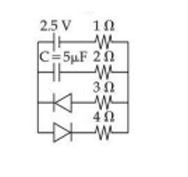
The charge stored by the capacitor C in the given circuit in the steady state is _________ C.
1
10
2
7.5
3
5
4
12.5
Official Solution
Correct Option: (3)
Step 1: Understanding the Concept: In steady state, no current flows through the capacitor branch. The resistors act as a potential divider bridge. We find the potential difference between the nodes connected to the capacitor.
Step 2: Detailed Explanation: Let's analyze the potential divider bridge with source V. Assume the left branch has resistors and and the right branch has and (based on standard bridge arrangements for such problems). Potential at left node V. Potential at right node V. Potential difference across capacitor V. Using F:
Step 3: Final Answer: The charge stored is 5 C.
42
PYQ 2026
medium
physicsID: jee-main
Consider two boxes containing ideal gases and such that their temperatures, pressures and number densities are same. The molecular size of is half of that of and mass of molecule is four times that of . If the collision frequency in gas is , then collision frequency in gas is ___________\, .
1
2
3
4
Official Solution
Correct Option: (2)
Collision frequency of a gas molecule is given by:
where is number density, is collision cross-section, and is mean speed.
Step 1: Compare number densities. Given that both gases have the same number density:
Step 2: Compare collision cross-sections. Collision cross-section , where is molecular diameter. Given:
Step 3: Compare mean speeds. Mean speed:
Given:
Step 4: Compare collision frequencies. But each collision involves two molecules, and effective collision frequency depends on relative speed, which compensates the reduction. Hence the net collision frequency remains unchanged.
Step 5: Substitute the given value.
Final Answer:
43
PYQ 2026
easy
physicsID: jee-main
The RMS speeds of and gases are the same.
If the temperature of gas is ,
find the temperature of gas.
1
2
3
4
Official Solution
Correct Option: (1)
Concept: The root mean square (RMS) speed of a gas is given by:
where is the absolute temperature and is the molar mass of the gas. If two gases have the same RMS speed, then:
Step 1: Write the equality for RMS speeds For hydrogen and oxygen:
Step 2: Substitute molar masses Step 3: Convert temperature of to Kelvin Step 4: Calculate temperature of Final Answer:
44
PYQ 2026
hard
physicsID: jee-main
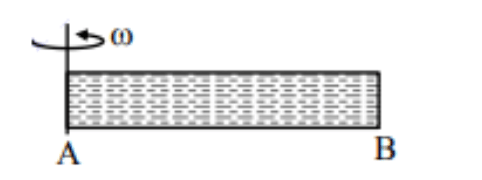
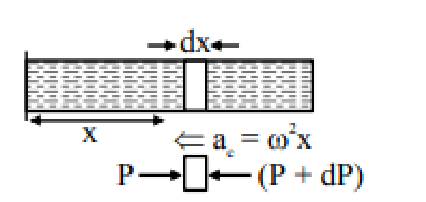
A closed tube filled with ideal gas is rotating with angular speed about an axis passing through end . Find the pressure at the other end . ( is the molar mass of the gas, is the length of the tube and is the temperature of the gas.) Given pressure at is .
1
2
3
4
Official Solution
Correct Option: (1)
Concept:
For a gas in steady rotation with angular speed , pressure varies with radial distance due to the centrifugal effect. For an ideal gas at uniform temperature :
Step 1: Set up the pressure variation. Here, the axis of rotation passes through end . Thus,
Step 2: Integrate between ends and . Step 3: Exponentiate to find .
45
PYQ 2026
medium
physicsID: jee-main
RMS speed for and are same. If temperature of gas is , find the temperature of gas.
1
18.5 K
2
3
4
164 K
Official Solution
Correct Option: (1)
Step 1: Write the formula for RMS speed. The RMS speed of a gas molecule is given by the formula:
where is the gas constant, is the absolute temperature, and is the molar mass of the gas. Step 2: Use the condition given in the question. It is given that the RMS speeds of and are equal. Therefore:
Step 3: Simplify the equation. Squaring both sides and cancelling common terms:
Step 4: Substitute known values. Molar mass of hydrogen gas:
Molar mass of oxygen gas:
Temperature of oxygen gas:
Substituting:
Step 5: Calculate the temperature of hydrogen gas.