The current gain of a common emitter amplifier is . If the emitter current is , collector current is :
1
9.6 mA
2
6.9 mA
3
0.69 mA
4
69 mA
Official Solution
Correct Option: (2)
mA
02
PYQ 2022
hard
physicsID: jee-main
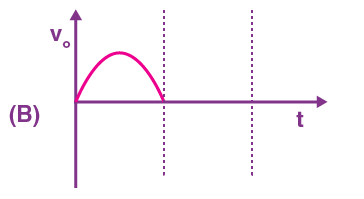
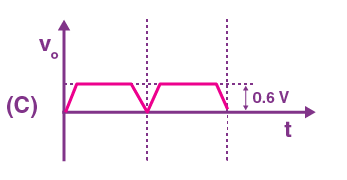
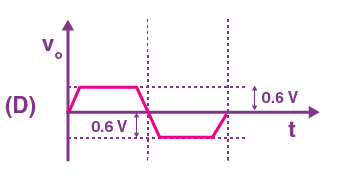
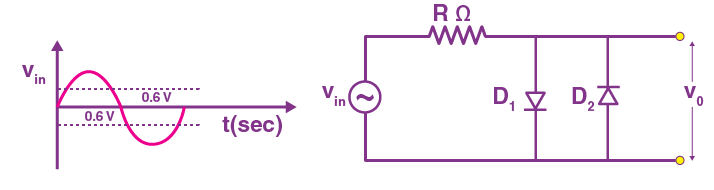
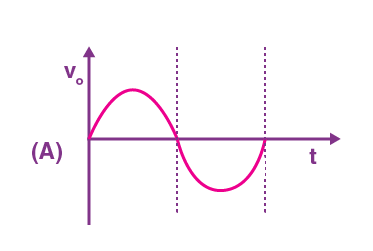
In the given circuit the input voltage Vin is shown in figure. The cut-in voltage of p–n junction diode (D1 or D2) is 0.6 V. Which of the following output voltage (V0) waveform across the diode is correct?
1
2
3
4
Official Solution
Correct Option: (1)
Till |V|\leq 0.6 V |V0|=|V| So, correct graph is D.
03
PYQ 2022
medium
physicsID: jee-main
The photodiode is used to detect the optical signals. These diodes are preferably operated in reverse biased mode because:
1
fractional change in majority carriers produce higher forward bias current.
2
fractional change in majority carriers produce higher reverse bias current.
3
fractional change in minority carriers produce higher forward bias current.
4
fractional change in minority carriers produce higher reverse bias current.
Official Solution
Correct Option: (4)
A photodiode operates under reverse bias conditions, and when illuminated, it generates charge carriers. The fractional variation in minority carriers is significant due to the initial current being extremely low.
So, the correct option is (D): fractional change in minority carriers produce higher reverse bias current.
04
PYQ 2022
easy
physicsID: jee-main
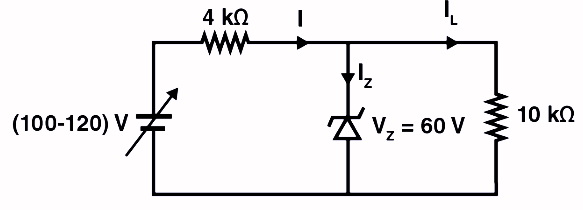
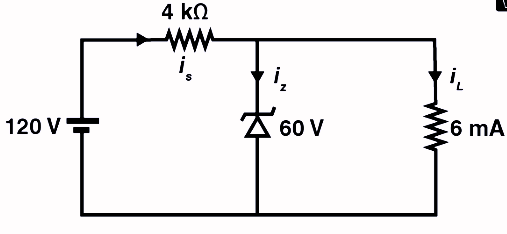
In the circuit shown below, maximum Zener diode current will be ________ mA.
Official Solution
Correct Option: (1)
The maximum Zener diode current,
So, the answer is .
05
PYQ 2023
medium
physicsID: jee-main
Given below are two statements ; one is labelled as Assertion and the other is labelled as Reason
Assertion A: Photodiodes are used in forward bias usually for measuring the light intensity
Reason R: For a p-n junction diode at applied voltage the current in the forward bias is more than the current in the reverse bias for where is the threshold voltage and is the breakdown voltage
In the light of the above statements, choose the correct answer from the options given below
1
A is true but is false
2
A is false but is true
3
Both and are true but is NOT the correct explanation
4
Both and are true and is correct explanation
Official Solution
Correct Option: (2)
1. Analyzing Assertion A: Photodiodes are not used in forward bias for light intensity measurements. Instead, they are used in reverse bias to ensure that the photocurrent is proportional to the incident light intensity. Hence, Assertion A is false. 2. Analyzing Reason R: The given statement about the current in a p-n junction diode in forward bias being greater than in reverse bias is correct. The reverse bias current is minimal (leakage current) until breakdown voltage is reached. Hence, Reason R is true. Thus, the correct answer is A is false but R is true. Photodiodes operate in reverse bias mode because the reverse current is directly proportional to light intensity, providing accurate measurement. Forward bias operation is unsuitable for this purpose.
06
PYQ 2023
medium
physicsID: jee-main
Given below are two statements: one is labelled as Assertion A and the other is labelled as Reason R. Assertion A: Diffusion current in a p-n junction is greater than the drift current in magnitude if the junction is forward biased. Reason R: Diffusion current in a p-n junction is from the n-side to the p-side if the junction is forward biased. In the light of the above statements, choose the most appropriate answer from the options given below
1
Both A and R are correct and R is the correct explanation of A
2
Both A and R are correct but R is NOT the correct explanation of A
3
A is correct but R is not correct
4
A is not correct but R is correct
Official Solution
Correct Option: (3)
The diffusion current in a forward biased p-n junction is greater than the drift current, as the charge carriers move due to the gradient in the concentration. The direction of the diffusion current is from the n-side to the p-side, which is correctly explained by Reason R.
07
PYQ 2024
hard
physicsID: jee-main
When a potential difference V is applied across a wire of resistance R, it dissipates energy at a rate W. If the wire is cut into two halves and these halves are connected mutually parallel across the same supply, the same supply, the energy dissipation rate will become:
1
2
3
4W
4
2W
Official Solution
Correct Option: (3)
To solve this problem, we need to analyze the energy dissipation rate before and after the wire is cut.
Initial Energy Dissipation Rate: The power P dissipated by a resistor is given by:
,
where: - V is the voltage across the resistor, and R is the resistance.
Initially, with resistance R, the energy dissipation rate is:
.
After Cutting the Wire: When the wire is cut into two halves, each half has a resistance of:
.
Connecting in Parallel: When these two halves are connected in parallel, the equivalent resistance Req is given by:
.
Thus, the equivalent resistance is:
.
New Energy Dissipation Rate: The new power P' dissipated in the circuit with the new resistance Req is:
.
Comparing Power Dissipation Rates: Since from the original circuit, we can relate the new power: