Nuclear Physics
61 previous year questions.
High-Yield Trend
Chapter Questions 61 MCQs
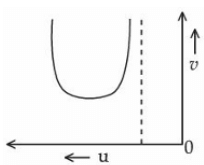
A sample of a radioactive nucleus A disintegrates to another radioactive nucleus B, which in turn disintegrates to some other stable nucleus C. Plot of a graph showing the variation of number of atoms of nucleus B versus time is : (Assume that at t=0, there are no B atoms in the sample) 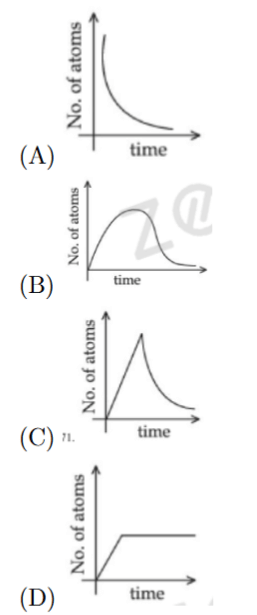
Nucleus A is having mass number 220 and its binding energy per nucleon is 5.6 MeV. It splits in two fragments ‘B’ and ‘C’ of mass numbers 105 and 115. The binding energy of nucleons in ‘B’ and ‘C’ is 6.4 MeV per nucleon. The energy Q released per fission will be :
In the following nuclear reaction,
Mass number of D is 182 and atomic number is 74. Mass number and atomic number
of D4, respectively, will be _____.
Assertion A : The binding energy per nucleon is practically independent of the atomic number for nuclei of mass number in the range 30 to 170.
Reason R : Nuclear force is short ranged.
In the light of the above statements, choose the correct answer from the options given below:
[Take, mass of He = 4.0026 u, mass of C = 12 u]
The identity of emitted particles (R) is:
In a nuclear fission process, a high mass nuclide (A ≈ 236) with binding energy 7.6 MeV/Nucleon dissociated into middle mass nuclides (A ≈ 118), having binding energy of 8.6 MeV/Nucleon. The energy released in the process would be ____ MeV.
(Given 1 u = 931 MeV/c2 , atomic mass of helium = 4.002603 u)
Given below are two statements. One is labelled as Assertion (A) and the other is labelled as Reason (R).
Assertion (A): The binding energy per nucleon is found to be practically independent of the atomic number , for nuclei with mass numbers between 30 and 170.
Reason (R): Nuclear force is long range.
In the light of the above statements, choose the correct answer from the options given below:
Match the LIST-I with LIST-II
Choose the correct answer from the options given below:
Given below are two statements: one is labelled as Assertion (A) and the other is labelled as Reason (R).
Assertion (A): The density of the copper ( ) nucleus is greater than that of the carbon ( ) nucleus.
Reason (R): The nucleus of mass number A has a radius proportional to .
In the light of the above statements, choose the most appropriate answer from the options given below:
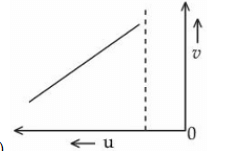
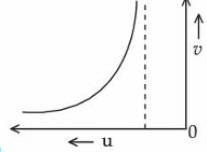
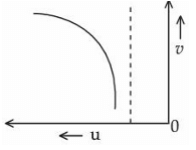
(Mass of , mass of , mass of proton and and Avogadro number )
A small bob A of mass m is attached to a massless rigid rod of length 1 m pivoted at point P and kept at an angle of 60° with vertical. At 1 m below P, bob B is kept on a smooth surface. If bob B just manages to complete the circular path of radius R after being hit elastically by A, then radius R is_______ m :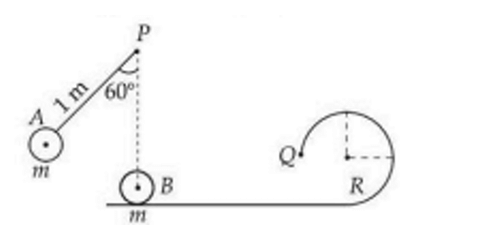
[Mass of He nucleus amu, amu kg, J s and m/s]
represents stability of , represents stability of and represents stability of . Compare the stabilities.
If denote the stability of and , respectively, then the correct order is:
Statement I: For all elements, greater the mass of the nucleus, greater is the binding energy per nucleon.
Statement II: For all elements, nuclei with less binding energy per nucleon transform to nuclei with greater binding energy per nucleon.
Choose the correct answer.
Both Statement I and Statement II are true
Statement - II : Nucleus with less (Binding energy/nucleon) breaks into nucleus with higher .
Choose the correct option :
About Nuclear Physics - JEE-MAIN
Nuclear Physics is a vital chapter for JEE-MAIN aspirants. Mastering the concepts covered in this chapter is essential for securing a top rank.
By rigorously practicing the previous year questions associated with this chapter, you can identify high-yield topics, understand the examiner's perspective, and boost your confidence during the actual exam.
Frequently Asked Questions
Why focus on Nuclear Physics PYQs?
Analyzing PYQs for this specific chapter reveals the most frequently tested concepts and the typical complexity of questions, allowing you to tailor your study plan efficiently.
How to best use this analysis?
Review the topic breakdown to see which sub-topics within Nuclear Physics carry the most weight. Then, tackle the questions iteratively to solidify your understanding.