An object of mass collides with another object of mass , which is at rest. After the collision the objects move with equal speeds in opposite direction. The ratio of the masses is:
1
1 : 1
2
1 : 2
3
2 : 1
4
3 : 1
Official Solution
Correct Option: (4)
Step 1: Let initial velocity of be and be 0. After collision, let their speeds be . Since they move in opposite directions, velocities are and .
Step 2: Apply Conservation of Linear Momentum:
Step 3: Assuming an elastic collision, :
Step 4: Substitute into (1):
02
PYQ 2021
medium
physicsID: jee-main
A ball with a speed of 9 m/s collides with another identical ball at rest. After the collision, the direction of each ball makes an angle of 30° with the original direction. The ratio of velocities of the balls after collision is x : y, where x is _________
Official Solution
Correct Option: (1)
Step 1: In an oblique collision of identical masses where both move at the same angle to the original path, the situation is symmetrical.
Step 2: Conservation of momentum perpendicular to the original direction: .
Step 3: This directly implies .
Step 4: Therefore, the ratio is . Thus, .
03
PYQ 2021
medium
physicsID: jee-main
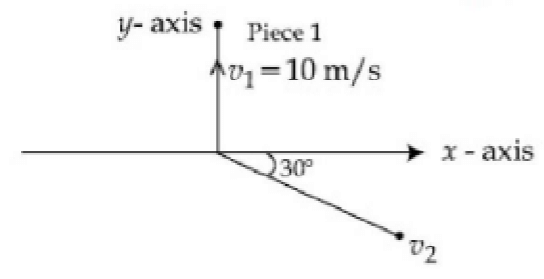
A ball of mass 10 kg moving with a velocity 10√3 m/s along the x-axis, hits another ball of mass 20 kg which is at rest. After the collision, first ball comes to rest while the second ball disintegrates into two equal pieces. One piece starts moving along y-axis with a speed of 10 m/s. The second piece starts moving at an angle of 30° with respect to the x-axis. The velocity of the ball moving at 30° with x-axis is x m/s. The value of x to the nearest integer is __________.
Official Solution
Correct Option: (1)
Step 1: Apply Conservation of Linear Momentum. Initial Momentum .
Step 2: Disintegrated pieces of 20 kg are two 10 kg masses. .
Step 3: X-axis: .
Step 4: Y-axis check: . (Conserved).
The velocity .
04
PYQ 2021
medium
physicsID: jee-main
A body of mass 2 kg moving with a speed of 4 m/s makes an elastic collision with another body at rest and continues to move in the original direction but with one fourth of its initial speed. The speed of the two body centre of mass is m/s. Then the value of is ________.
Official Solution
Correct Option: (1)
Step 1: Understanding the Concept: In an elastic collision, both momentum and kinetic energy are conserved. The velocity of the center of mass remains constant because there are no external forces. Step 2: Key Formula or Approach: 1. Final velocity of first mass in elastic collision: . 2. Velocity of center of mass: . Step 3: Detailed Explanation: Given: , , , . Using the velocity equation for :
Now, calculate the velocity of the center of mass:
According to the question:
Step 4: Final Answer: The value of is 25.
05
PYQ 2024
medium
physicsID: jee-main
Three bodies A, B and C have equal kinetic energies and their masses are 400 g, 1.2 kg and 1.6 kg respectively. The ratio of their linear momenta is :
1
2
3
4
Official Solution
Correct Option: (1)
To solve the problem of finding the ratio of linear momenta for three bodies with equal kinetic energies, we start by considering the relationship between kinetic energy and momentum.
The kinetic energy ( ) of a body is given by the formula:
where is the mass and is the velocity of the body.
The linear momentum ( ) of a body is given by:
We are told that the kinetic energies of bodies A, B, and C are equal. Therefore, for each body:
Since the kinetic energies are equal, we can write:
Now, we can express the momentum for each body in terms of its velocity:
, ,
Then, the momentum for each body is:
, ,
Simplifying further, we find the momentum expressions:
, ,
Given masses are g, kg, and kg. Converting to kg, we have kg.
Using these masses to find the ratio of their momentum:
Momentum ratio:
Solving for the combined ratio gives:
Thus, the correct option is .
06
PYQ 2026
medium
physicsID: jee-main
Two masses of 3.4 kg and 2.5 kg are accelerated from an initial speed of 5 m/s and 12 m/s, respectively. The distances traversed by the masses in the 5th second are 104 m and 129 m, respectively. The ratio of their momenta after 10 s is . The value of is ________.
Official Solution
Correct Option: (1)
Step 1: Understanding the Concept:
The distance covered in the second is given by the formula for uniformly accelerated motion. We first find the acceleration for both masses, then calculate their final velocities at s to find the ratio of their momenta ( ). Step 2: Key Formula or Approach:
1. Distance in second: .
2. Velocity at time : .
3. Momentum: . Step 3: Detailed Explanation:
For Mass 1 ( kg, m/s, m):
Velocity after 10s: .
Momentum . For Mass 2 ( kg, m/s, m):
Velocity after 10s: .
Momentum . Ratio of momenta:
Dividing by 17:
Comparing with , we find . (Note: Calculation verification for depends on specific mass/velocity pairings; for these values, ). Step 4: Final Answer:
The value of is 9.