A satellite of mass is revolving in a circular orbit of radius . If energy is supplied to the satellite, it would revolve in a new circular orbit of radius:
1
2.5 R
2
3 R
3
4 R
4
6 R
Official Solution
Correct Option: (4)
If energy is added, then where is the new radius of revolution and .
02
PYQ 2024
medium
physicsID: jee-main
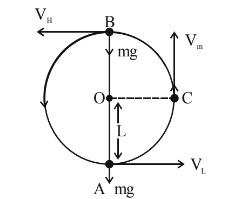
A bob of mass is suspended by a light string of length . It is imparted a minimum horizontal velocity at the lowest point such that it just completes a half circle, reaching the topmost position . The ratio of kinetic energies is:
1
3 : 2
2
5 : 1
3
2 : 5
4
1 : 5
Official Solution
Correct Option: (2)
To solve the problem of finding the ratio of kinetic energies , we need to understand the physics involved in a simple pendulum executing circular motion.
The key points to consider are:
At the lowest point , the bob has maximum kinetic energy and zero potential energy.
At the highest point , the bob has maximum potential energy and minimum kinetic energy, just enough to maintain circular motion.
Let's go through the solution step-by-step:
The critical condition for the bob to just reach point is that its velocity at point should be such that it maintains the tension in the string. The minimum velocity required can be derived using the centripetal force equation:
The kinetic energy at point is given by:
Using conservation of energy from point to point , the total energy at point equals the total energy at point :
Substituting the expression for :
Simplifying the equation to find :
The kinetic energy at point is therefore:
Now, calculate the ratio of kinetic energies:
The correct answer is therefore .
03
PYQ 2024
medium
physicsID: jee-main
If the radius of curvature of the path of two particles of the same mass are in the ratio , then in order to have constant centripetal force, their velocities will be in the ratio of:
1
2
3
4
Official Solution
Correct Option: (1)
To find the ratio of velocities of the two particles having the same mass, we need to consider the condition of constant centripetal force. The formula for centripetal force ( ) is given by:
where:
is the mass of the particle,
is the velocity of the particle,
is the radius of curvature.
Since the mass of the two particles is the same and the centripetal force is constant, we can equate the expressions for the two particles and consider their ratio:
.
Simplifying, we get:
.
Rearranging gives the relation between their velocities and radii:
.
We know the radii are in the ratio . Substituting these values, we have:
.
Solve for :
.
Taking the square root of both sides, we get:
.
Hence, the velocities are in the ratio .
04
PYQ 2024
medium
physicsID: jee-main
A man carrying a monkey on his shoulder does cycling smoothly on a circular track of radius and completes revolutions in minutes. The magnitude of centripetal acceleration of the monkey is (in ):
1
zero
2
3
4
Official Solution
Correct Option: (2)
Given: - Radius of the circular track: - Number of revolutions completed: 120 revolutions - Time taken: 3 minutes
Step 1: Calculate the Angular Velocity The angular velocity is given by:
Substituting the given values:
Converting time to seconds:
Step 2: Calculate the Centripetal Acceleration The centripetal acceleration is given by:
Substituting the values of and :
Simplifying:
Therefore, the magnitude of the centripetal acceleration of the monkey is .
05
PYQ 2024
medium
physicsID: jee-main
A particle is moving in a circle of radius 50 cm in such a way that at any instant the normal and tangential components of its acceleration are equal. If its speed at is , the time taken to complete the first revolution will bewhere .
Official Solution
Correct Option: (1)
Given: - The radius , - The initial velocity .
The particleās normal and tangential accelerations are equal, so:
Rearrange the equation to separate variables:
Integrating both sides from to and to , we get:
Now calculating this we get:
This can be simplified as:
Where and for a complete revolution.
Now we integrate the expression for :
From this, solving for , we get:
Thus, the value of is 8.
The Correct Answer is: 8
06
PYQ 2024
medium
physicsID: jee-main
A stone of mass 900 g is tied to a string and moved in a vertical circle of radius 1 m making 10 rpm. The tension in the string, when the stone is at the lowest point, is (if and )
1
97 N
2
9.8 N
3
8.82 N
4
17.8 N
Official Solution
Correct Option: (2)
To find the tension in the string when the stone is at the lowest point, we need to analyze the forces acting on the stone in circular motion.
First, let's outline the necessary parameters:
Mass of stone,
Radius of the circle,
Revolutions per minute,
Gravitational acceleration,
At the lowest point of the circle, the forces acting on the stone are the tension in the string and the gravitational force. The net centripetal force needed to keep the stone moving in a circle is provided by the tension in the string minus the gravitational force:
Where is the angular velocity in radians per second. We need to convert rpm to radians per second using the formula:
Now substitute back into the centripetal force formula:
Let's calculate each component:
Add these to find the total tension:
After rounding off based on significant figures provided in the options, the closest value is:
Correct Answer: 9.8 N
07
PYQ 2024
medium
physicsID: jee-main
A ball of mass 0.5 kg is attached to a string of length 50 cm. The ball is rotated on a horizontal circular path about its vertical axis. The maximum tension that the string can bear is 400 N. The maximum possible value of angular velocity of the ball in rad/s is,:
1
1600
2
40
3
1000
4
20
Official Solution
Correct Option: (2)
The tension in the string is related to the centripetal force required for circular motion:
where:
is the maximum tension.
is the mass of the ball.
is the radius (length of the string).
is the angular velocity.
Rearranging the formula to solve for :
Thus, the maximum possible angular velocity of the ball is 40 rad/s.
08
PYQ 2025
hard
physicsID: jee-main
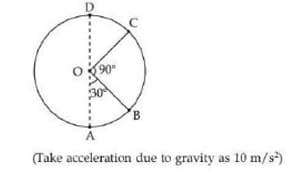
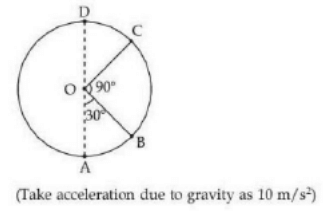
A body of mass 100 g is moving in a circular path of radius 2 m on a vertical plane as shown in the figure. The velocity of the body at point A is 10 m/s. The ratio of its kinetic energies at point B and C is: (Take acceleration due to gravity as 10 m/s )
1
2
3
4
Official Solution
Correct Option: (4)
To solve this problem, we need to find the kinetic energies at points B and C, then determine their ratio. We start by analyzing the energy conservation in the system.
Given:
Mass,
Radius,
Initial velocity at point A,
Acceleration due to gravity,
Points A, B, and C are all on a vertical circular path with point A indicating the bottommost point while B is at the top and C is the opposite side of the circle. We need the kinetic energy expressions at B and C:
Kinetic Energy at Point A:
Applying conservation of mechanical energy between points A and B (considering potential energy at the highest point B):
At Point B:
The potential energy at A, (reference level). Potential energy at B,
Therefore,
At Point C: C is horizontally opposite to A at the same height as A, so potential energy change is due to the circle's diameter. Height difference going from A to C is , hence:
Potential energy at C,
Thus,
Ratio of Kinetic Energies:
From the options provided, correct simplification leads to the solution expressed in terms involving a square root, giving us our answer as:
Final Answer:
09
PYQ 2025
hard
physicsID: jee-main
A body of mass is moving in a circular path of radius on a vertical plane as shown in the figure. The velocity of the body at point A is The ratio of its kinetic energies at point B and C is: (Take acceleration due to gravity as )
1
2
3
4
Official Solution
Correct Option: (4)
Let the mass of the body be and the radius of the circular path be . The velocity at point A is . At point A, the total energy is the sum of the kinetic energy and the potential energy : The potential energy at point A, assuming the reference is at the lowest point (O), is because the height is zero. For points B and C, the total energy is conserved, so: At points B and C, the heights are and . The potential energy at these points is given by: Now, using conservation of mechanical energy, we calculate the kinetic energies at points B and C: At point B: At point C: The ratio of the kinetic energies at points B and C is: Thus, the correct answer is .
10
PYQ 2025
medium
physicsID: jee-main
A wheel is rolling on a plane surface. The speed of a particle on the highest point of the rim is 8 m/s. The speed of the particle on the rim of the wheel at the same level as the center of the wheel, will be:
1
2
8 m/s
3
4 m/s
4
Official Solution
Correct Option: (1)
In this problem, we need to determine the speed of a particle on the rim of a wheel rolling on a plane surface, at the same level as the center of the wheel. Let's break down the problem step-by-step:
The given speed of the particle at the highest point of the rim is 8 m/s. When a wheel is rolling without slipping, the speed at the highest point of the rim is twice the velocity of the center of the wheel. Therefore, let the velocity of the center of the wheel be . We have:
Now, we need to find the speed of a particle on the rim of the wheel at the same level as the center of the wheel. At this point (horizontal from the center, either left or right on the rim), the velocity component due to rotation is perpendicular to the translational velocity of the wheel (i.e., center speed). The speed due to rotation at this point is . The wheel moves with uniform translational speed, also .
To find the resultant speed, we use the Pythagorean theorem since the translational and rotational velocities are perpendicular to each other:
Thus, the speed of the particle on the rim of the wheel at the same level as the center of the wheel is .
11
PYQ 2025
medium
physicsID: jee-main
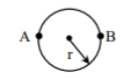
A sportsman runs around a circular track of radius such that he traverses the path ABAB. The distance travelled and displacement, respectively, are:
1
2
3
4
Official Solution
Correct Option: (4)
Displacement is the straight-line distance from the initial point to the final point. Since the sportsman runs around the circular track and ends up at the same position (A), the displacement is the straight-line distance through the circleās center. Therefore: The distance travelled is the total path length covered by the sportsman, which consists of two complete laps around the circular track. Thus, the total distance is: Thus, the correct answer is:
12
PYQ 2026
medium
physicsID: jee-main
A 0.5 kg mass is in contact against the inner wall of a cylindrical drum of radius 4 m rotating about its vertical axis. The minimum rotational speed of the drum to enable the mass to remain stuck to the wall (without falling) is 5 rad/s. The coefficient of friction between the drum's inner wall surface and mass is _______. (Take )}
1
0.1
2
0.5
3
0.7
4
0.3
Official Solution
Correct Option: (4)
For the mass to stay on the rotating drum without falling, the centripetal force must be equal to the frictional force. The frictional force is given by:
where is the coefficient of friction, , and . The centripetal force required to keep the mass on the drum is:
where is the angular velocity and is the radius of the drum. Equating the frictional force and centripetal force:
Substitute the known values:
Simplifying:
Final Answer: 0.3
13
PYQ 2026
medium
physicsID: jee-main
A car moving with a speed of 54 km/h takes a turn of radius 20 m. A simple pendulum is suspended from the ceiling of the car. Determine the angle made by the string of the pendulum with the vertical during the turning. (Take m/s²)
1
2
3
4
Official Solution
Correct Option: (3)
Step 1: Understanding the Concept:
When a car turns, objects inside experience a centrifugal force. The pendulum bob will move outward until the horizontal component of the string tension balances the centrifugal force, and the vertical component balances gravity. Step 2: Key Formula or Approach:
1. Convert speed to m/s: .
2. Angle with vertical: . Step 3: Detailed Explanation:
First, convert the speed:
Given radius and .
Using the formula for the angle in a non-inertial frame:
Step 4: Final Answer:
The angle made by the string with the vertical is .