Fluid Mechanics
66 previous year questions.
High-Yield Trend
Chapter Questions 66 MCQs
A light cylindrical vessel is kept on a horizontal surface. Area of base is A. A hole of cross-sectional area 'a' is made just at its bottom side. The minimum coefficient of friction necessary to prevent sliding the vessel due to the impact force of the emerging liquid is (a << A) : 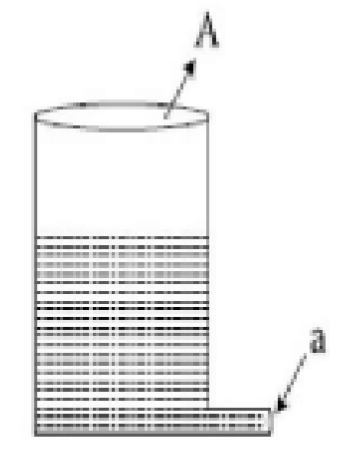
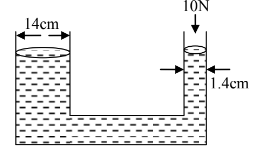
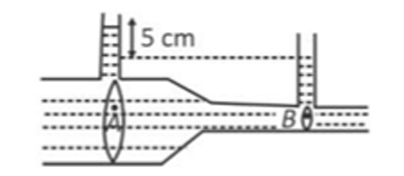
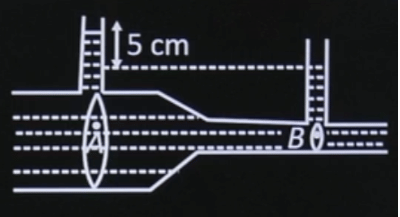
Consider a water tank as shown in the figure. It's cross-sectional area is 0.4 m². The tank has an opening B near the bottom whose cross-section area is 1 cm². A load of 24 kg is applied on the water at the top when the height of the water level is 40 cm above the bottom, the velocity of water coming out the opening B is v ms . The value of v, to the nearest integer, is ________. [Take value of g to be 10 ms ] 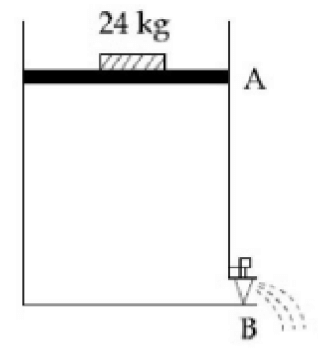
Statement-I: When a capillary tube is dipped into a liquid, the liquid neither rises nor falls in the capillary. The contact angle may be 0°.
Statement-II: The contact angle between a solid and a liquid is a property of the material of the solid and liquid as well : In the light of above statement.
Choose the correct answer from the options given below.
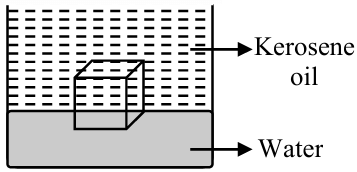
Statement I: When the speed of liquid is zero everywhere, the pressure difference at any two points depends on the equation $ $
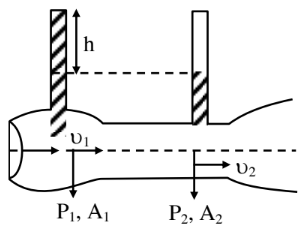
In the light of the above statements, choose the most appropriate answer from the options given below.
(Given density of air = 1.2 kg m-3)
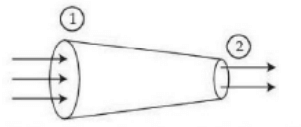
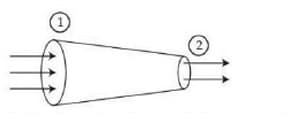
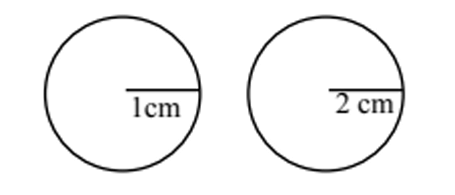
A tube of length L is shown in the figure. The radius of cross section at point (1) is 2 cm and at the point (2) is 1 cm, respectively. If the velocity of water entering at point (1) is 2 m/s, then velocity of water leaving the point (2) will be:
B. The terminal velocities of different diameter balls are constant for a given liquid.
C. Measurement of terminal velocity is dependent on the temperature.
D. This experiment can be utilized to assess the density of a given liquid.
E. If balls are dropped with some initial speed, the value of will change.
Given below are two statements: one is labelled as Assertion (A) and the other is labelled as Reason (R).
Assertion (A): Emission of electrons in photoelectric effect can be suppressed by applying a sufficiently negative electron potential to the photoemissive substance.
Reason (R): A negative electric potential, which stops the emission of electrons from the surface of a photoemissive substance, varies linearly with frequency of incident radiation.
In light of the above statements, choose the most appropriate answer from the options given below:
In photoelectric effect, the stopping potential vs frequency curve is plotted. is the Planck's constant and is the work function of metal.
(A) vs is linear.
(B) The slope of vs curve is .
(C) constant is related to the slope of vs line.
(D) The value of electric charge of electron is not required to determine using the vs curve.
(E) The work function can be estimated without knowing the value of . \text{Choose the correct answer from the options given below:}
In the experiment for measurement of viscosity of a given liquid with a ball having radius , consider following statements:
A. Graph between terminal velocity and will be a parabola.
B. The terminal velocities of different diameter balls are constant for a given liquid.
C. Measurement of terminal velocity is dependent on the temperature.
D. This experiment can be utilized to assess the density of a given liquid.
E. If balls are dropped with some initial speed, the value of will change.
Consider the following statements:
A. Surface tension arises due to extra energy of the molecules at the interior as compared to the molecules at the surface of a liquid.
B. As the temperature of liquid rises, the coefficient of viscosity increases.
C. As the temperature of gas increases, the coefficient of viscosity increases.
D. The onset of turbulence is determined by Reynolds number.
E. In a steady flow, two streamlines never intersect.
Choose the correct answer from the options given below:
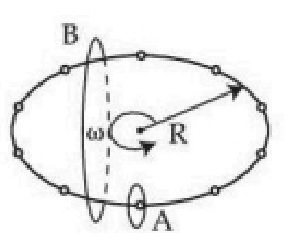
N equally spaced charges each of value are placed on a circle of radius . The circle rotates about its axis with an angular velocity as shown in the figure. A bigger Amperian loop encloses the whole circle, whereas a smaller Amperian loop encloses a small segment. The difference between enclosed currents, for the given Amperian loops is:
A cube of side 10 cm is suspended from one end of a fine string of length 27 cm, and a mass of 200 grams is connected to the other end of the string. When the cube is half immersed in water, the system remains in balance. Find the density of the cube.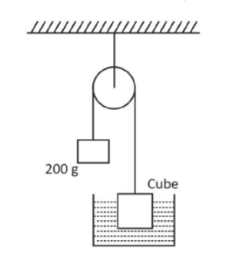
Assertion : A sound wave has higher speed in solids than in gases.
Reason : Gases have higher value of Bulk modulus than solids.
In photoelectric effect, the stopping potential vs frequency curve is plotted. is the Planck's constant and is the work function of metal.
(A) vs is linear.
(B) The slope of vs curve is .
(C) constant is related to the slope of vs line.
(D) The value of electric charge of electron is not required to determine using the vs curve.
(E) The work function can be estimated without knowing the value of .
Choose the correct answer from the options given below:
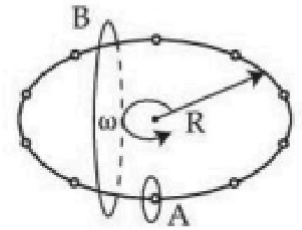
N equally spaced charges each of value are placed on a circle of radius . The circle rotates about its axis with an angular velocity as shown in the figure. A bigger Amperian loop encloses the whole circle, whereas a smaller Amperian loop encloses a small segment. The difference between enclosed currents, for the given Amperian loops is:
Statement-I: The hot water flows faster than cold water.
Statement-II: Soap water has higher surface tension as compared to fresh water.
In the light of the above statements, choose the correct answer from the options given below:
Given below are two statements: one is labelled as Assertion and the other as Reason :
Assertion : A sound wave has higher speed in solids than in gases.
Reason : Gases have higher value of Bulk modulus than solids.
A bead of mass slides without friction on the wall of a vertical circular hoop of radius as shown in figure. The bead moves under the combined action of gravity and a massless spring attached to the bottom of the hoop. The equilibrium length of the spring is . If the bead is released from the top of the hoop with (negligible) zero initial speed, the velocity of the bead, when the length of spring becomes , would be (spring constant is , is acceleration due to gravity): 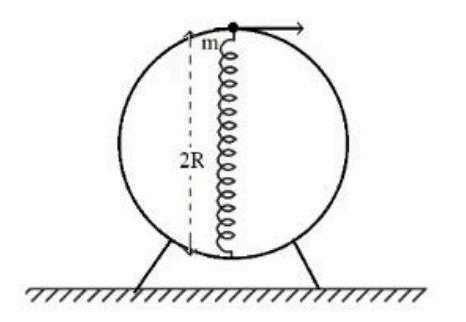
A flexible chain of mass is hanging as shown. Find tension at the lowest point. 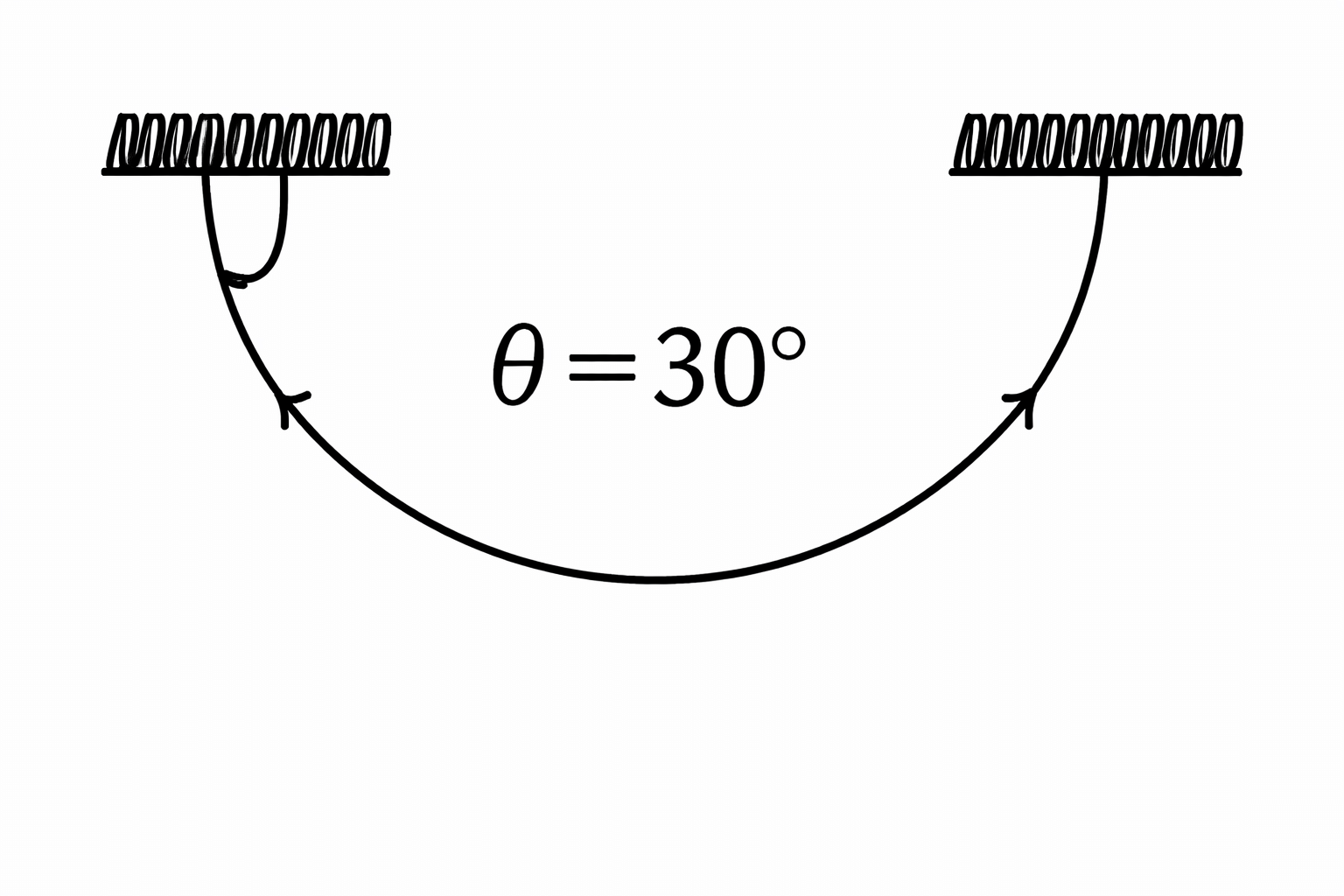
A wooden cubical block of relative density 0.4 is floating in water. Side of cubical block is . When a coin is placed on the block, it dips by , weight of coin is: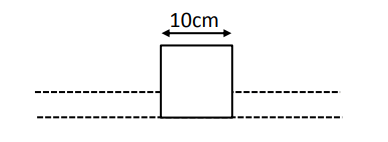
About Fluid Mechanics - JEE-MAIN
Fluid Mechanics is a vital chapter for JEE-MAIN aspirants. Mastering the concepts covered in this chapter is essential for securing a top rank.
By rigorously practicing the previous year questions associated with this chapter, you can identify high-yield topics, understand the examiner's perspective, and boost your confidence during the actual exam.
Frequently Asked Questions
Why focus on Fluid Mechanics PYQs?
Analyzing PYQs for this specific chapter reveals the most frequently tested concepts and the typical complexity of questions, allowing you to tailor your study plan efficiently.
How to best use this analysis?
Review the topic breakdown to see which sub-topics within Fluid Mechanics carry the most weight. Then, tackle the questions iteratively to solidify your understanding.