The width of one of the two slits in Young's double-slit experiment is while that of the other slit is . If the ratio of the maximum to the minimum intensity in the interference pattern on the screen is 9 : 4, then what is the value of ?(Assume that the field strength varies according to the slit width.)
1
2
2
3
3
5
4
4
Official Solution
Correct Option: (3)
To find the value of in the given Young's double-slit experiment, we start by analyzing the relationship between slit widths and intensities in the interference pattern. Assume the electric field amplitude at the screen is proportional to the slit width.
Let's denote the amplitude of the wave from the first slit as and from the second slit as , where is a constant proportionality factor.
The resulting amplitude at any point on the screen is given by:
The intensity is proportional to the square of the amplitude:
The maximum intensity occurs when the two waves are in phase:
The minimum intensity occurs when the two waves are out of phase, i.e., their amplitudes subtract:
We are given the ratio of the maximum to minimum intensity as 9:4:
Substitute the expressions for and :
This reduces to:
Taking the square root on both sides:
Cross-multiply to solve for :
Expand and simplify:
Combine like terms:
Finally, solve for :
Therefore, the value of is 5.
02
PYQ 2026
medium
physicsID: jee-main
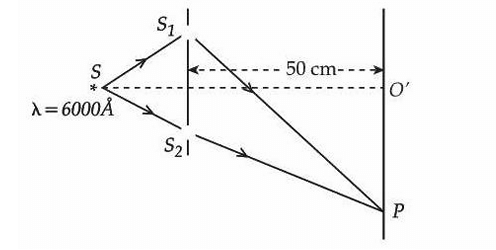
In a Young double slit experiment, the wavelength of incident light is , the separation between slits and is and the distance between slits plane and screen is , as shown in the figure. If the resultant intensity at is equal to the intensity due to individual slits, the path difference between interfering waves is _____ \AA.
1
2
3
4
Official Solution
Correct Option: (2)
Concept:
Resultant intensity in Youngβs double slit experiment: For equal intensities : Also, where is the path difference. Step 1: {Use the condition given.} Given resultant intensity equals intensity due to one slit: Substitute in formula: Step 2: {Find phase difference.} Step 3: {Find path difference.} Step 4: {Substitute wavelength.} Considering the possible phase condition and geometry shown in the diagram, the correct option corresponds to
03
PYQ 2026
medium
physicsID: jee-main
In Young's double slit experiment, the fringe width of the interference pattern produced on the screen is . If the experiment is carried out in another medium having refractive index 1.2, the fringe width will be _______ .
1
1.2
2
2
3
2.4
4
2.88
Official Solution
Correct Option: (2)
Step 1: Understanding the Question: The fringe width in YDSE depends on the wavelength of light. When the medium changes, the speed of light and therefore its wavelength changes, while frequency remains constant. Step 2: Key Formula or Approach: 1. Fringe width . 2. Wavelength in medium . Step 3: Detailed Explanation: Given and . The new fringe width is:
Step 4: Final Answer: The fringe width in the medium is 2 m.
04
PYQ 2026
medium
physicsID: jee-main
In single slit diffraction pattern, the wavelength of light used is nm and slit width is mm. The angular width of central maximum is degrees. The value of is ____.
Official Solution
Correct Option: (1)
Concept: For single slit diffraction, the angular width of the central maximum is where = wavelength of light, = slit width. Step 1:Convert units Step 2:Calculate angular width in radians Step 3:Convert to degrees} Step 4:Express in required form Thus
05
PYQ 2026
medium
physicsID: jee-main
In hydrogen type atom, shortest wavelength in Lyman series is given as 91 nm. Then the longest wavelength in Paschen series of this atom shall be
1
31.82 nm
2
113.3 nm
3
1.87 ΓΒΌm
4
2.31 ΓΒΌm
Official Solution
Correct Option: (3)
Step 1: Use the Rydberg formula. The Rydberg formula for the wavelengths of spectral lines in hydrogen atom is: where is the Rydberg constant, and are the principal quantum numbers for the two energy levels. Step 2: Shortest wavelength in Lyman series. For Lyman series, the shortest wavelength corresponds to the transition from to , which gives the given wavelength of 91 nm. Step 3: Longest wavelength in Paschen series. For the longest wavelength in the Paschen series, the transition is from to , which results in a wavelength of 1.87 ΓΒΌm. Final Answer: