Two particles and having equal charges are being accelerated through the same potential difference. Thereafter, they enter normally in a region of uniform magnetic field and describe circular paths of radii and respectively. The mass ratio of and is:
1
2
3
4
Official Solution
Correct Option: (2)
To solve the problem, we need to determine the mass ratio of two particles and that have equal charges and are accelerated through the same potential difference. They enter a uniform magnetic field, resulting in circular paths with radii (for ) and (for ).
The formula for the radius of the circular path described by a charged particle in a magnetic field is given by:
Where:
is the mass of the particle.
is the velocity of the particle.
is the charge of the particle.
is the magnetic field strength.
The kinetic energy of a particle accelerated through a potential difference is:
From the equation of kinetic energy, we find the velocity:
Substituting this velocity back into the expression for :
Simplifying, we get:
From this equation, for particles and , whose radii are and respectively, and using the fact that and are the same for both particles, we have:
Equating the expressions for and :
To find the mass ratio , we divide these two equations:
Hence, the mass ratio is given by:
Thus, the correct answer is:
02
PYQ 2024
medium
physicsID: jee-main
A charge of is moving with a velocity of along the positive y-axis under a magnetic field of strength . The force acting on the charge is . The value of is _____.
Official Solution
Correct Option: (1)
To find the force acting on the charge, we use the equation for the magnetic force on a moving charge: . Here, , , and .
The cross product can be determined using the determinant method:
Calculating the determinant, we find:
.
Substituting back, the force is:
.
Thus, the value of is 32, which confirms it fits within the given range [32,32].
03
PYQ 2024
easy
physicsID: jee-main
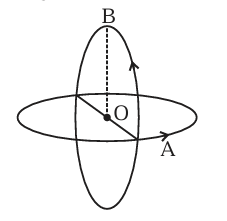
Two insulated circular loop A and B radius ‘a’ carrying a current of ‘I’ in the anti clockwise direction as shown in figure. The magnitude of the magnetic induction at the centre will be :
1
2
3
4
Official Solution
Correct Option: (3)
The problem asks for the magnitude of the net magnetic induction at the common center 'O' of two identical, perpendicular, current-carrying circular loops.
Concept Used:
The solution is based on two key principles of magnetism:
1. Magnetic Field at the Center of a Circular Loop: The magnitude of the magnetic field (magnetic induction) at the center of a circular loop of radius 'a' carrying a current 'I' is given by the Biot-Savart law as:
The direction of this magnetic field is perpendicular to the plane of the loop and is determined by the Right-Hand Thumb Rule.
2. Principle of Superposition: The net magnetic field at any point due to a system of multiple current-carrying conductors is the vector sum of the magnetic fields produced by each conductor individually at that point.
Step-by-Step Solution:
Step 1: Determine the magnetic field due to loop A.
Loop A is a horizontal circular loop. The current 'I' is in the anti-clockwise direction when viewed from above. According to the Right-Hand Thumb Rule (curling the fingers in the direction of the current), the thumb points upwards. Therefore, the magnetic field produced by loop A at the center O is directed vertically upwards. Let's consider the vertical direction to be along the z-axis.
The magnitude of this field is:
So, the vector representation is .
Step 2: Determine the magnetic field due to loop B.
Loop B is a vertical circular loop, perpendicular to loop A. The current 'I' is also anti-clockwise as shown. Let's assume loop B lies in the y-z plane. An anti-clockwise current in this plane (as seen from the positive x-axis) would produce a magnetic field along the positive x-axis, according to the Right-Hand Thumb Rule. Thus, the magnetic field produced by loop B at the center O is directed horizontally.
The magnitude of this field is the same as that for loop A since the radius and current are identical:
So, the vector representation is .
Step 3: Calculate the net magnetic field at the center O.
The net magnetic field is the vector sum of the individual fields:
Since is along the z-axis and is along the x-axis, the two magnetic field vectors are perpendicular to each other.
Final Computation & Result:
Step 4: Find the magnitude of the net magnetic field.
The magnitude of the resultant of two perpendicular vectors is found using the Pythagorean theorem:
Substituting the magnitudes:
The magnitude of the magnetic induction at the centre is or equivalently .
04
PYQ 2024
easy
physicsID: jee-main
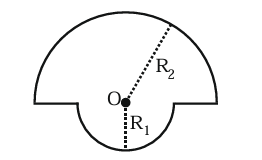
The magnetic field at the centre of a wire loop formed by two semicircular wires of radii and carrying current as per figure given below is . The value of is ______. (Centre O is common for all segments)
Official Solution
Correct Option: (1)
The magnetic field at the center of a circular loop carrying current is given by:
For a semicircular loop, the magnetic field is half of that:
Given two semicircular loops with radii and :
The magnetic field at the center due to each is:
The net magnetic field at the center is the difference due to opposite directions:
Substitute , , , and :
Thus, . Hence, the value of fits within the given range of 3,3.
05
PYQ 2024
medium
physicsID: jee-main
A proton moving with a constant velocity passes through a region of space without any change in its velocity. If and represent the electric and magnetic fields respectively, then the region of space may have: (A) (B) (C) (D) Choose the most appropriate answer from the options given below:
1
(A), (B) and (C) only
2
(A), (C) and (D) only
3
(A), (B) and (D) only
4
(B), (C) and (D) only
Official Solution
Correct Option: (3)
In this problem, we need to analyze the interactions of a proton moving through a region of space with electric and magnetic fields. We are given that the proton moves with constant velocity, indicating that the net force on it is zero.
The forces experienced by a charged particle (like a proton) moving in electric and magnetic fields are given by the Lorentz force law:
where:
is the total force on the particle,
is the charge of the particle (positive for a proton),
is the electric field,
is the velocity of the particle,
is the magnetic field.
For the proton to continue moving with constant velocity, the net force must be zero:
We will now analyze each given scenario:
Case (A):
Here, both fields are zero, so there is no force, allowing the proton to move with constant velocity. This is possible, so (A) is correct.
Case (B):
If the electric field is zero, to have no net force, the cross product term must also be zero.
This is possible if is parallel to or is zero itself.
Therefore, (B) is also correct.
Case (C):
With , the magnetic force is zero, and only the electric field contributes to the force.
The presence of an electric field will exert a force, disturbing the constant velocity condition unless .
So, (C) is not correct.
Case (D):
To achieve zero net force, the electric and magnetic forces must cancel each other, i.e., .
This is possible with specific orientations of and .
Thus, (D) can be correct.
Based on this analysis, the options where the proton can move with constant velocity are (A), (B), and (D).
06
PYQ 2024
medium
physicsID: jee-main
A 2A current-carrying straight metal wire of resistance 1 Ω, resistivity , area of cross-section , and mass 500 g is suspended horizontally in mid-air by applying a uniform magnetic field . The magnitude of is ________ (given, ).
Official Solution
Correct Option: (1)
07
PYQ 2025
medium
physicsID: jee-main
The least count of a screw gauge is 0.01 mm. If the pitch is increased by 75% and the number of divisions on the circular scale is reduced by 50%, the new least count will be:
Official Solution
Correct Option: (1)
Given:
- Original least count = - The pitch is increased by 75% (new pitch = ) - The number of divisions on the circular scale is reduced by 50% (new divisions = of the original divisions)
Step 1: Formula for Least Count
The least count of a screw gauge is given by:
Step 2: Apply the Changes
The new pitch is , and the new number of divisions is . Hence, the new least count is:
Step 3: Final Calculation
Substituting , we get:
Final Answer:
The new least count is .
08
PYQ 2025
medium
physicsID: jee-main
A plano-convex lens having radius of curvature of first surface 2 cm exhibits focal length of in air. Another plano-convex lens with first surface radius of curvature 3 cm has focal length of when it is immersed in a liquid of refractive index 1.2. If both the lenses are made of the same glass of refractive index 1.5, the ratio of and will be:
1
2
3
4
Official Solution
Correct Option: (2)
To solve this problem, we need to determine the focal lengths of two plano-convex lenses made of glass with a refractive index . We will use the lens maker's formula to find the focal lengths.
Lens Maker's Formula:
The lens maker's formula is given by:
where is the focal length, is the refractive index of the lens material, is the radius of curvature of the first surface, and is the radius of curvature of the second surface. For a plano-convex lens, , so the formula simplifies to:
Focal Length of the First Lens ( ):
The radius of curvature and the lens is in air, so . Using the simplified lens maker's formula:
Focal Length of the Second Lens ( ):
The radius of curvature and the lens is immersed in a liquid with refractive index 1.2, so the effective refractive index .
Ratio of and :
Finally, the ratio of the focal lengths is given by:
Thus, the ratio of to is .
The correct answer is therefore:
09
PYQ 2025
medium
physicsID: jee-main
A thin plano-convex lens made of glass of refractive index 1.5 is immersed in a liquid of refractive index 1.2. When the plane side of the lens is silver coated for complete reflection, the lens immersed in the liquid behaves like a concave mirror of focal length 0.2 m. The radius of curvature of the curved surface of the lens is:
1
0.15 m
2
0.10 m
3
0.20 m
4
0.25 m
Official Solution
Correct Option: (2)
This problem involves a thin plano-convex lens made of glass with a refractive index and immersed in a liquid of refractive index . We need to find the radius of curvature of the lens's curved surface. When the plane side of the lens is silver-coated, the lens acts as a concave mirror with a focal length of 0.2 m. Let's solve it step-by-step.
Step 1: Understand the Concept
When the plane side of the lens is silvered, the system becomes like a mirror-lens system, where the lens and the mirror are in combination. The light will pass through the lens, reflect off the silvered surface, and then pass through the lens again. In such a silvered lens, the effective focal length ( ) is given by:
Given that the entire system behaves like a concave mirror of focal length 0.2 m, we have:
(Negative sign because it's a concave mirror)
Step 2: Using Lens and Mirror Formulas
The focal length of a lens in a medium is given by the lens maker's formula:
For a plano-convex lens, (since the plane surface has infinite radius of curvature), and . Therefore, the formula becomes:
Since the plane surface is silvered, it behaves as a mirror with for a concave surface (since plane surface acts as planar mirror after silvering).
Step 3: Solve Using Given
For a silvered lens:
After finding using lens formula, substitute into the combined formula:
Rearrange to find that:
Equating the expanded expression and solving for , we find:
Conclusion: The radius of curvature of the curved surface of the lens is 0.10 m. This matches with option 2.
10
PYQ 2025
medium
physicsID: jee-main
A car of mass moves on a banked road having radius and banking angle . To avoid slipping from the banked road, the maximum permissible speed of the car is . The coefficient of friction between the wheels of the car and the banked road is:
1
2
3
4
Official Solution
Correct Option: (3)
To determine the coefficient of friction for a car moving on a banked road, we need to analyze the forces acting on the car and use the given conditions.
The forces involved are:
Centripetal force required to keep the car moving in a circle of radius .
The gravitational force acting downward.
The normal force perpendicular to the surface of the road.
The frictional force, which can act either up or down the slope depending on the speed of the car relative to the design speed.
Let's consider the car at the verge of slipping, where friction is maximized. The centripetal force required is given by:
Let's resolve the forces parallel and perpendicular to the inclined plane.
Balance of forces perpendicular to the incline gives:
Balance of forces parallel to the incline (where friction opposes slip):
Solving these equations will yield the expression for the coefficient of friction .
First, express from the perpendicular balance:
Substitute in the parallel balance equation:
Simplifying and solving for , you arrive at:
This matches the correct answer:
11
PYQ 2025
medium
physicsID: jee-main
Consider the following statements: A. The junction area of a solar cell is made very narrow compared to a photodiode. B. Solar cells are not connected with any external bias. C. LED is made of lightly doped p-n junction. D. Increase of forward current results in a continuous increase in LED light intensity. E. LEDs have to be connected in forward bias for emission of light.
1
B, D, E Only
2
A, C Only
3
A, C, E Only
4
B, E Only
Official Solution
Correct Option: (4)
To solve the given problem, we need to evaluate each of the statements provided and determine their validity regarding solar cells, photodiodes, and LEDs. Let's analyze each statement one by one:
Statement A: "The junction area of a solar cell is made very narrow compared to a photodiode."
This statement is incorrect. The junction area of a solar cell is usually larger to absorb more sunlight and generate more current, whereas in a photodiode, the focus is on speed and sensitivity, often involving a more optimized design for specific applications.
Statement B: "Solar cells are not connected with any external bias."
Statement C: "LED is made of lightly doped p-n junction."
This statement is incorrect. LEDs are typically made with heavily doped p-n junctions to facilitate electron-hole recombination, which is necessary for efficient light emission.
Statement D: "Increase of forward current results in a continuous increase in LED light intensity."
This statement can be seen as generally true, but there are limitations at maximum current ratings where further increases can damage the LED or cause efficiency droop (a decrease in efficiency with increased current). However, in typical operating ranges, this statement holds true.
Statement E: "LEDs have to be connected in forward bias for emission of light."
This statement is correct. LEDs need to be forward-biased to allow charge carriers to recombine and emit light.
Based on the analysis above, the correct statements are B and E. Therefore, the correct answer is: B, E Only.
12
PYQ 2025
medium
physicsID: jee-main
During the transition of an electron from state A to state C of a Bohr atom, the wavelength of emitted radiation is 2000 Å, and it becomes 6000 Å when the electron jumps from state B to state C. Then the wavelength of the radiation emitted during the transition of electrons from state A to state B is:
1
3000 Å
2
6000 Å
3
4000 Å
4
2000 Å
Official Solution
Correct Option: (1)
To solve this problem, we apply the concept of energy level transitions in the Bohr model of the atom. When an electron transitions between energy levels, it emits or absorbs radiation. The wavelength of the radiation is related to the energy difference between the initial and final states by the equation:
where:
is the energy difference between the two states.
is Planck's constant.
is the speed of light.
is the wavelength of the radiation emitted or absorbed.
Given:
Wavelength of radiation emitted from state A to state C:
Wavelength of radiation emitted from state B to state C:
We need to find the wavelength of the radiation emitted during the transition from state A to state B, denoted as .
To find this, we use the relationship between these wavelengths implied by Bohr's model:
The energy difference between states is additive, as these are quantized transitions: .
Now, substituting the known wavelengths into the energy relations gives:
Thus, the energy difference for the transition from A to B is:
Combining these terms gives us:
Finding a common denominator:
Thus, , which means the correct option is 3000 Å.
13
PYQ 2026
medium
physicsID: jee-main
A current of each flows in opposite directions in two conducting wires, placed parallel to each other at a distance of . The magnetic field at the mid point between the two wires is _____ .
1
2
3
4
Official Solution
Correct Option: (2)
Concept:
Magnetic field due to a long straight current carrying wire: If currents flow in opposite directions, magnetic fields at the midpoint add. Step 1: {Determine distance from each wire.} Distance between wires: Distance from midpoint to each wire: Step 2: {Magnetic field due to one wire.} Since Thus Step 3: {Add fields from both wires.} Since fields are in same direction: Convert to :
14
PYQ 2026
medium
physicsID: jee-main
If find and .
1
2
3
4
Official Solution
Correct Option: (1)
Concept: Using the principle of dimensional homogeneity, the dimensions on both sides of a physical equation must be equal. Dimensions used: Step 1:Write the dimensional equation. Step 2:Substitute dimensions. Step 3:Equate powers of fundamental quantities. For : For : For : For : Step 4:Solve the equations. From the equations,
15
PYQ 2026
medium
physicsID: jee-main
A particle having charge moving in - plane in fields of and experiences a force of . The velocity of the particle at that instant is _______ m/s.
1
2
3
4
Official Solution
Correct Option: (4)
Step 1: Use the Lorentz force law.
The force on a charged particle moving in an electric and magnetic field is given by the Lorentz force equation:
where is the charge, is the electric field, and is the magnetic field. Step 2: Solve for the velocity.
The force experienced by the particle is:
We can equate the two expressions for force and solve for the velocity vector :
By solving this vector equation, we find the velocity of the particle is m/s. Final Answer:
16
PYQ 2026
medium
physicsID: jee-main
A 5 mg particle carrying a charge of C is moving with velocity of m/s in a region having magnetic field Wb/m². It moves a distance of meter along when it completes 5 revolutions. The value of is ________.
Official Solution
Correct Option: (1)
Step 1: Understanding the Concept:
When a charged particle has a velocity component parallel ( ) and perpendicular ( ) to a uniform magnetic field, it follows a helical path. The time taken for one revolution is determined by the perpendicular component, but the distance moved along the field lines depends on the parallel component. Step 2: Key Formula or Approach:
1. Time period of one revolution:
2. Pitch (distance in 1 revolution):
3. Total distance: , where is the number of revolutions. Step 3: Detailed Explanation:
Given: kg, C, T.
Velocity . Here, m/s (component along ).
Calculate Time Period :
Distance for 5 revolutions:
Step 4: Final Answer:
The value of is 2.
17
PYQ 2026
medium
physicsID: jee-main
A current carrying circular loop of radius 2 cm with unit normal is placed in a magnetic field, . If T and current A, the torque experienced by the loop is ________ Wb·A.
1
2
3
4
Official Solution
Correct Option: (4)
Step 1: Understanding the Concept:
Torque ( ) on a current loop in a magnetic field is given by the cross product of its magnetic moment ( ) and the magnetic field ( ). The magnetic moment is the product of current, area, and the unit normal vector. Step 2: Key Formula or Approach:
1. .
2. . Step 3: Detailed Explanation:
Area .
Magnetic Moment:
Magnetic Field:
Torque:
Step 4: Final Answer:
The torque experienced by the loop is .
18
PYQ 2026
medium
physicsID: jee-main
The charged particle moving in a uniform magnetic field of has an acceleration . The value of is ____.
Official Solution
Correct Option: (1)
Step 1: Understanding the Question: A magnetic force is always perpendicular to both the velocity ( ) and the magnetic field ( ). Since acceleration ( ) is in the direction of the force, must also be perpendicular to . Step 2: Key Formula or Approach: If two vectors are perpendicular, their dot product is zero:
Step 3: Detailed Explanation: Given:
Perform the dot product:
Step 4: Final Answer: The value of is .
19
PYQ 2026
medium
physicsID: jee-main
A charge moving with velocity}
in the region of magnetic field}
The magnitude of force acting on it is N. The value of is ____.}
Official Solution
Correct Option: (1)
Concept: Magnetic force on a moving charge: Magnitude: Step 1:Compute cross product} Step 2:Find magnitude} Step 3:Calculate force Thus
20
PYQ 2026
medium
physicsID: jee-main
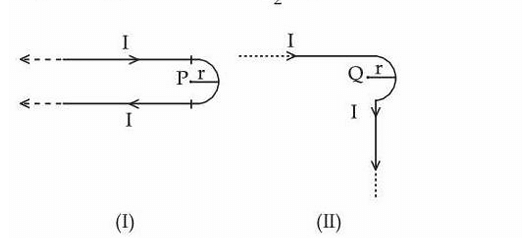
Two identical long current carrying wires are bent into the shapes shown. If the magnitude of magnetic fields at the centres and of a semicircular arc are and respectively, then the ratio is:
1
2
3
4
Official Solution
Correct Option: (1)
Concept: Magnetic field due to:
Long straight wire:
Circular arc (angle ):
For a semicircle: Thus Step 1:Field at point } Contribution from two straight sections: From semicircle: Total Step 2:Field at point } Here only one straight section contributes with semicircle. Step 3:Take ratio} Multiply numerator and denominator by :
21
PYQ 2026
medium
physicsID: jee-main
A circular coil of radius 2 cm and 125 turns carries a current of 1 A. The coil is placed in a uniform magnetic field of magnitude 0.4 T. The axis of the coil makes an angle of with the direction of the magnetic field. The torque acting on the coil is . The value of is _______. ( )
Official Solution
Correct Option: (1)
Step 1: Understanding the Concept:
A current-carrying loop in a magnetic field experiences a torque that depends on its magnetic dipole moment and the external field. The torque acts to align the magnetic moment with the field.
Step 2: Key Formula or Approach:
Torque: , where and is the angle between the axis (normal) and the magnetic field.
Step 3: Detailed Explanation:
Given: , , , , .
First, calculate the area :
Now, calculate the torque :
Comparing with , we find .
Step 4: Final Answer:
The value of is 314.
22
PYQ 2026
hard
physicsID: jee-main
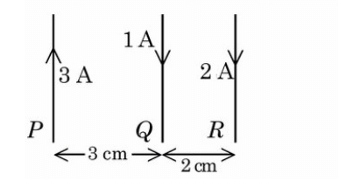
Three long straight wires carrying current are arranged mutually parallel as shown in the figure. The force experienced by cm length of wire is ________. ( )
1
towards
2
towards
3
towards
4
towards
Official Solution
Correct Option: (3)
Concept: The force per unit length between two long parallel current-carrying wires separated by distance is:
- Currents in the same direction attract.
- Currents in opposite directions repel. Step 1: Force on wire due to wire Currents in and are in opposite directions repulsion. Force on cm:
Direction: away from , i.e., towards the right. Step 2: Force on wire due to wire Currents in and are in the same direction attraction. Direction: towards (right). Step 3: Net force on wire Both forces act towards the right, hence add: Correcting for significant figures as per options:
23
PYQ 2026
easy
physicsID: jee-main
Two small balls with masses m and 2m are attached to both ends of a rigid rod of length d and negligible mass. If angular momentum of this system is L about an axis (A) passing through its centre of mass and perpendicular to the rod then angular velocity of the system about A is:
1
2L/(5md²)
2
(4/3) L/(md²)
3
(3/2) L/(md²)
4
2L/(md²)
Official Solution
Correct Option: (3)
Step 1: Understanding the Concept:
Angular momentum is defined as . To find , we must first determine the moment of inertia about the center of mass (CM). Step 2: Key Formula or Approach:
1. CM distance .
2. , where is reduced mass. Step 3: Detailed Explanation:
The position of the CM from mass :
Moment of Inertia :
Since :
Step 4: Final Answer:
The angular velocity is (3/2) L/(md²).
24
PYQ 2026
medium
physicsID: jee-main
The energy of an electron in an orbit of the Bohr's atom is where is the ground state energy. If is the angular momentum of the electron in this orbit and is the Planck's constant, then is _________} :}
1
4
2
6
3
5
4
2
Official Solution
Correct Option: (3)
Step 1: Understanding the Concept: According to the Bohr model, the energy of an electron in the orbit is inversely proportional to , and the angular momentum is quantized.
Step 2: Key Formula or Approach: 1. Energy: 2. Angular momentum:
Step 3: Detailed Explanation: We are given that the energy in the orbit is: