A capacitor of capacitance 900 μF is charged by a 100 V battery. The capacitor is disconnected from the battery and connected to another uncharged identical capacitor such that one plate of the uncharged capacitor is connected to the positive plate and another plate of the uncharged capacitor is connected to the negative plate of the charged capacitor. The loss of energy in this process is measured as J. The value of is:
Official Solution
Correct Option: (1)
The initial energy stored in the charged capacitor is given by the formula:
Substitute the values:
After connecting the uncharged capacitor, the total charge gets shared between the two capacitors. The final voltage across each capacitor becomes half of the initial voltage because the two capacitors are identical:
The final energy stored in each capacitor is:
The total final energy in both capacitors is:
The energy loss during this process is the difference between the initial and final energy, which is:
The energy loss is measured as , where
02
PYQ 2025
hard
physicsID: jee-main
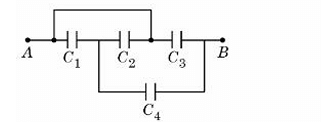
Find the equivalent capacitance between A and B, where .
1
48
2
8
3
32
4
16
Official Solution
Correct Option: (3)
In this problem, we have several capacitors in series and parallel. When capacitors are in series, their equivalent capacitance is given by:
For capacitors in parallel, their equivalent capacitance is the sum of their individual capacitances:
Given that , the capacitors are arranged in a combination of series and parallel. After applying the appropriate formulas, we find the equivalent capacitance between points A and B is .
03
PYQ 2026
medium
physicsID: jee-main
A sphere of capacitance is charged to a potential of . Another identical uncharged metal sphere is brought in contact with the charged sphere, then the change in the total energy stored on these spheres, when they touch is . The value of is _____. (combined capacitance of spheres is ).
1
2
3
4
Official Solution
Correct Option: (2)
Concept:
Energy stored in a capacitor: When identical spheres touch, charge redistributes equally and potential becomes half. Step 1: {Find initial energy.} Step 2: {Find final potential.} Initial charge: When two identical spheres touch, charge divides equally: Potential on each sphere: Step 3: {Find final energy.} Energy of each sphere: Total energy (two spheres): Step 4: {Find change in energy.} Thus
04
PYQ 2026
medium
physicsID: jee-main
A parallel plate air capacitor is connected to a battery. The plates are pulled apart at uniform speed . If is the separation between the plates at any instant, then the time rate of change of electrostatic energy of the capacitor is proportional to , where is ______.
1
-2
2
1
3
-1
4
2
Official Solution
Correct Option: (1)
Step 1: Understanding the Concept:
Since the capacitor is connected to a battery, the potential difference ( ) remains constant. As the distance changes, the capacitance changes, which in turn changes the stored electrostatic energy .
Step 2: Key Formula or Approach:
1. Capacitance .
2. Energy .
3. Rate of change of energy is .
Step 3: Detailed Explanation:
1. Express energy in terms of : .
2. Differentiate with respect to time : .
3. Using the chain rule: .
4. Given the plates are pulled at a uniform speed , (constant).
5. So, .
6. Therefore, or .
Step 4: Final Answer:
The value of is -2.
05
PYQ 2026
medium
physicsID: jee-main
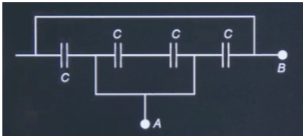
From the circuit given below, the capacitance between terminals A and B shown in the circuit is _______ .
(take and .)
1
2
2
7/2
3
7/3
4
5/2
Official Solution
Correct Option: (3)
Step 1: Understanding the Concept:
By carefully analyzing the schematic nodes, we can redraw the circuit into a standard parallel/series representation. The key is tracing the continuous wires (nodes) to see which components are effectively bridged across the same potential differences.
Step 2: Key Formula or Approach:
Series capacitors:
Parallel capacitors:
Step 3: Detailed Explanation:
Let's analyze the circuit diagram connections carefully.
The main top branch consists of three capacitors in series: , , and .
There are two vertical wires connecting a parallel bottom branch containing .
- The first vertical wire drops down from the terminal A line, strictly *before* the plate of . This means the left plate of is directly connected to Node A.
- The second vertical wire drops down from the terminal B line, strictly *after* the plate of . This means the right plate of is directly connected to Node B. Because spans the entire length from Node A to Node B, it is wired perfectly in parallel with the entire top series branch. First, calculate the equivalent capacitance of the top series branch ( ):
Since ,
.
. Now, add the parallel capacitor :
The total equivalent capacitance
.
Step 4: Final Answer:
The equivalent capacitance is .
06
PYQ 2026
medium
physicsID: jee-main
Parallel plate capacitor... separation 5 mm... mica sheet 2 mm... draws 25\% more charge. Dielectric constant is ___.
1
2.0
2
1.0
3
1.5
4
2.5
Official Solution
Correct Option: (1)
A parallel plate capacitor initially has no dielectric material between its plates. When a mica sheet of thickness 2 mm is inserted (the total separation between the plates is 5 mm), it is stated that the capacitor draws 25% more charge. We need to find the dielectric constant of mica.
The capacitance of a capacitor without a dielectric is given by:
where:
is the permittivity of free space,
is the area of the plates, and
is the separation between the plates.
With the dielectric (mica) inserted, the capacitor system now consists of two dielectric mediums: air and mica. The mica fills 2 mm of the space, while the air fills the remaining 3 mm. The effective capacitance is given by:
where
,
, and
is the permittivity of the mica, which can be expressed as , where is the dielectric constant of mica.
The new capacitance becomes:
.
We know the charge increases by 25%, meaning
.
Substituting the values, we have:
.
Simplifying, we find:
.
Solving for ,
.
.
Therefore, the dielectric constant of mica is .
Hence, the correct answer is 2.0.
07
PYQ 2026
easy
physicsID: jee-main
Two capacitors and charged to and respectively are connected in parallel with opposite polarity. The common potential is:
1
2
3
4
Official Solution
Correct Option: (1)
Step 1: Find the initial charges on the capacitors.
Step 2: Since the capacitors are connected with opposite polarity, the net charge is:
Step 3: The equivalent capacitance in parallel is:
Step 4: The common potential is: