Mechanical Properties Of Fluid
40 previous year questions.
High-Yield Trend
Chapter Questions 40 MCQs
3 \times 108 Nm–2
9 \times 108 Nm–2
6 \times 108 Nm–2
12 \times 108 Nm–2
[PA–1T0]
[PAT–1]
[PA–1T]
[PA–1T–1]
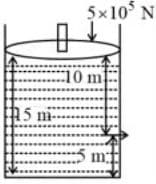
(Given g = 10 ms–2, viscosity of water = 1.0 \times 10–5 N-sm–2).
If 1000 droplets of water of surface tension 0.07 N/m, having same radius 1 mm each, combine to from a single drop In the process the released surface energy is - (Take π= )
(Given, and )
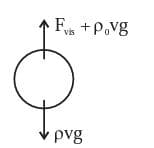
Assertion A : A spherical body of radius (5 ± 0.1) mm having a particular density is falling through a liquid of constant density. The percentage error in the calculation of its terminal velocity is 4%.
Reason R : The terminal velocity of the spherical body falling through the liquid is inversely proportional to its radius.
Assertion A: When you squeeze one end of a tube to get toothpaste out from the other end, Pascal's principle is observed.
Reason R: A change in the pressure applied to an enclosed incompressible fluid is transmitted undiminished to every portion of the fluid and to the walls of its container.
In the light of the above statements, choose the most appropriate answer from the options given below:
Water flows through a horizontal tube as shown in the figure. The difference in height between the water columns in vertical tubes is 5 cm and the area of cross-sections at A and B are 6 cm and 3 cm respectively. The rate of flow will be ______ cm /s. (take g = 10 m/s ). 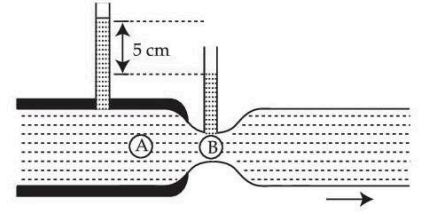
Statement I: Pressure of a fluid is exerted only on a solid surface in contact as the fluid-pressure does not exist everywhere in a still fluid.
Statement II: Excess potential energy of the molecules on the surface of a liquid, when compared to interior, results in surface tension.
In the light of the above statements, choose the correct answer from the options given below
About Mechanical Properties Of Fluid - JEE-MAIN
Mechanical Properties Of Fluid is a vital chapter for JEE-MAIN aspirants. Mastering the concepts covered in this chapter is essential for securing a top rank.
By rigorously practicing the previous year questions associated with this chapter, you can identify high-yield topics, understand the examiner's perspective, and boost your confidence during the actual exam.
Frequently Asked Questions
Why focus on Mechanical Properties Of Fluid PYQs?
Analyzing PYQs for this specific chapter reveals the most frequently tested concepts and the typical complexity of questions, allowing you to tailor your study plan efficiently.
How to best use this analysis?
Review the topic breakdown to see which sub-topics within Mechanical Properties Of Fluid carry the most weight. Then, tackle the questions iteratively to solidify your understanding.