Capacitors And Capacitance
37 previous year questions.
High-Yield Trend
Chapter Questions 37 MCQs
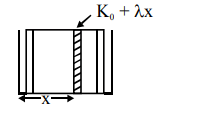
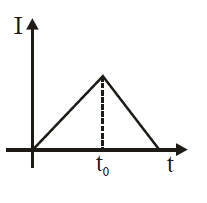
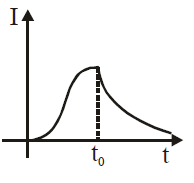
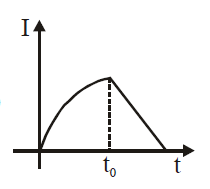
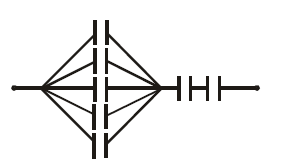
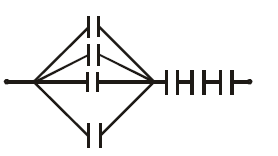
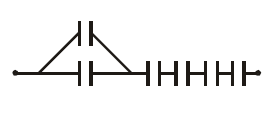
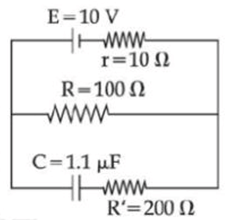
As show in the figure, in the steady state, the charge stored in the capacitor is _________ × 10–6 C.
Statement-I : The reactance of an ac circuit is zero. It is possible that the circuit contains a capacitor and an inductor.
Statement-II : In ac circuit, the average power delivered by the source never becomes zero.
In the light of the above statements, choose the correct answer from the options given below.
(Permittivity of free space, E0 = 8.85 \times 10–12 C2 N–1 m–2)
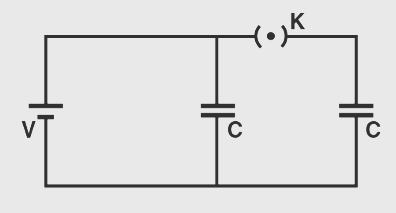
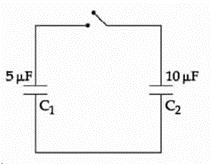
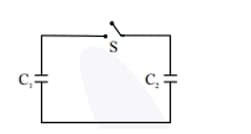
A capacitor C1 of capacitance 5 μF is charged to a potential of 30 V using a battery. The battery is then removed and the charged capacitor is connected to an uncharged capacitor C2 of capacitance 10 μF as shown in figure. When the switch is closed charge flows between the capacitors. At equilibrium, the charge on the capacitor C2 is ____ μC.
Two parallel plate capacitors and each having capacitance of are individually charged by a source Capacitor is kept connected to the source and a dielectric slab is inserted between it plates Capacitor is disconnected from the source and then a dielectric slab is inserted in it Afterwards the capacitor is also disconnected from the source and the two capacitors are finally connected in parallel combination The common potential of the combination will be ___
(Assuming Dielectric constant )
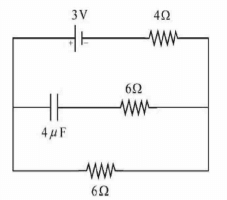
In the given circuit . The charge stored on capacitor is _____ 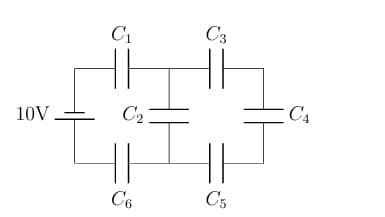
A capacitor of capacitance 100 \mu F is charged to a potential of 12 V and connected to a 6.4 mH inductor to produce oscillations. The maximum current in the circuit would be:
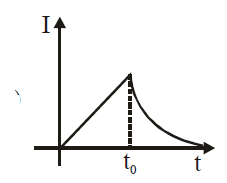
Identify the valid statements relevant to the given circuit at the instant when the key is closed.
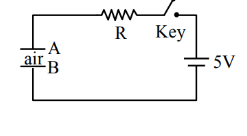
: There will be no current through resistor R.
: There will be maximum current in the connecting wires.
: Potential difference between the capacitor plates A and B is minimum.
: Charge on the capacitor plates is minimum.
Choose the correct answer from the options given below:
About Capacitors And Capacitance - JEE-MAIN
Capacitors And Capacitance is a vital chapter for JEE-MAIN aspirants. Mastering the concepts covered in this chapter is essential for securing a top rank.
By rigorously practicing the previous year questions associated with this chapter, you can identify high-yield topics, understand the examiner's perspective, and boost your confidence during the actual exam.
Frequently Asked Questions
Why focus on Capacitors And Capacitance PYQs?
Analyzing PYQs for this specific chapter reveals the most frequently tested concepts and the typical complexity of questions, allowing you to tailor your study plan efficiently.
How to best use this analysis?
Review the topic breakdown to see which sub-topics within Capacitors And Capacitance carry the most weight. Then, tackle the questions iteratively to solidify your understanding.