Consider the following statements : A. Atoms of each element emit characteristics spectrum. B. According to Bohr's Postulate, an electron in a hydrogen atom, revolves in a certain stationary orbit. C. The density of nuclear matter depends on the size of the nucleus. D. A free neutron is stable but a free proton decay is possible. E. Radioactivity is an indication of the instability of nuclei. Choose the correct answer from the options given below :
1
A, B and E only
2
A, C and E only
3
B and D only
4
A, B, C, D and E
Official Solution
Correct Option: (1)
Let's evaluate each statement's validity. Statement A: Atoms of each element emit a characteristic line spectrum when excited. This is a fundamental concept of atomic physics and spectroscopy. This statement is correct. Statement B: One of Bohr's key postulates for the hydrogen atom is that electrons can only exist in specific, stable orbits (stationary states) without radiating energy. This statement is correct. Statement C: The density of nuclear matter is found to be nearly constant for all nuclei, regardless of their size (mass number A). It is approximately . Therefore, this statement is incorrect. Statement D: A free neutron is unstable and decays with a half-life of about 10 minutes ( ). A free proton is considered stable. Therefore, this statement is incorrect. Statement E: Radioactivity is the process by which unstable atomic nuclei lose energy by emitting radiation. It is a direct consequence of nuclear instability. This statement is correct. The correct statements are A, B, and E. This corresponds to option (A).
02
PYQ 2021
medium
physicsID: jee-main
Some nuclei of a radioactive material are undergoing radioactive decay. The time gap between the instances when a quarter of the nuclei have decayed and when half of the nuclei have decayed is given as : (where is the decay constant)
1
2
3
4
Official Solution
Correct Option: (1)
Step 1: Understanding the Concept:
Radioactive decay follows the law , where is the number of nuclei remaining at time .
If a certain fraction has decayed, the remaining fraction is . Step 2: Key Formula or Approach:
Time taken to reach nuclei from is: Step 3: Detailed Explanation:
Instance 1: A quarter ( ) of the nuclei have decayed.
Remaining nuclei .
Time .
Instance 2: Half ( ) of the nuclei have decayed.
Remaining nuclei .
Time .
The time gap is:
Step 4: Final Answer:
The time gap is .
03
PYQ 2021
medium
physicsID: jee-main
An electron and proton are separated by a large distance. The electron starts approaching the proton with energy 3 eV. The proton captures the electron and forms a hydrogen atom in second excited state. The resulting photon is incident on a photosensitive metal of threshold wavelength 4000 Γ . What is the maximum kinetic energy of the emitted photoelectron?
1
3.3 eV
2
No photoelectron would be emitted
3
7.61 eV
4
1.41 eV
Official Solution
Correct Option: (4)
This problem involves three steps: finding the energy of the emitted photon, finding the work function of the metal, and finally using the photoelectric effect equation. Step 1: Find the energy of the photon emitted during electron capture.
The initial energy of the system is the kinetic energy of the electron, eV (potential energy is zero at large separation).
The electron is captured into the second excited state of the hydrogen atom. The ground state is n=1, first excited state is n=2, so the second excited state is n=3.
The energy of the n-th state is eV.
The final energy of the hydrogen atom is eV.
By conservation of energy, .
.
eV. Step 2: Find the work function ( ) of the photosensitive metal.
The work function is the minimum energy required to eject an electron, corresponding to the threshold wavelength .
Γ = 400 nm.
Using the formula :
eV. Step 3: Calculate the maximum kinetic energy ( ) of the photoelectron.
According to the photoelectric effect equation: .
eV.
04
PYQ 2021
medium
physicsID: jee-main
The K X-ray of molybdenum has wavelength 0.071 nm. If the energy of a molybdenum atom with a K electron knocked out is 27.5 keV, the energy of this atom when an L electron is knocked out will be ________ keV. (Round off to the nearest integer) [ h = eVs, c = ms ]
Official Solution
Correct Option: (1)
The energy of a K X-ray photon ( ) corresponds to the energy difference between an atom with a vacancy in the K-shell (n=1) and an atom with a vacancy in the L-shell (n=2).
. First, let's calculate the energy of the K photon from its wavelength. We can use the formula .
A useful shortcut is .
Given nm.
. We are given that the energy of the atom with a K electron knocked out is keV. This is the binding energy of the K-shell electron. The question asks for the energy of the atom when an L electron is knocked out, which is .
Rearranging the formula: . . The question asks to round off to the nearest integer.
Rounding 10.035 to the nearest integer gives 10. So, the energy of the atom with an L electron knocked out is 10 keV.
05
PYQ 2023
medium
physicsID: jee-main
A long straight wire of circular cross-section (radius ) is carrying a steady current . The current is uniformly distributed across this cross-section. The magnetic field is:
1
Zero in the region and inversely proportional to in the region
2
Inversely proportional to in the region and uniform throughout in the region
3
Directly proportional to in the region and inversely proportional to in the region
4
Uniform in the region and inversely proportional to distance from the axis, in the region
Official Solution
Correct Option: (3)
Step 1: Understanding the Magnetic Field Distribution The magnetic field around a current carrying wire is given by AmpΓ¨re's Circuital Law: where is the current enclosed by the chosen circular Amperian loop. Step 2: Magnetic Field Inside the Wire ( ) Since the current is uniformly distributed, the enclosed current at a radius (where ) is: Applying AmpΓ¨reβs law for a circular path of radius : Substituting : This shows that the magnetic field inside the wire is directly proportional to . Step 3: Magnetic Field Outside the Wire ( ) For , the entire current is enclosed within the Amperian loop: Thus, the magnetic field outside the wire is inversely proportional to . Final Answer: The magnetic field inside the wire is directly proportional to , and outside the wire, it is inversely proportional to .
06
PYQ 2024
medium
physicsID: jee-main
The energy equivalent of 1g of substance is:
1
2
3
4
Official Solution
Correct Option: (4)
To find the energy equivalent of 1 gram of a substance, we will use Einstein's mass-energy equivalence principle, given by the famous equation:
where:
is the energy equivalent.
is the mass of the substance.
is the speed of light, approximately .
For 1 gram of a substance:
(since 1 gram is kilograms)
Substituting these values into the equation:
Calculate the value inside the parentheses:
Now, multiply them together:
To convert joules to electronvolts (eV), use the conversion factor:
Therefore,
Now, convert electronvolts to mega-electronvolts (MeV):
Thus, the energy equivalent of 1 g of substance is , which matches the given correct option.
07
PYQ 2024
medium
physicsID: jee-main
From the statements given below : (A) The angular momentum of an electron in nth orbit is an integral multiple of h. (B) Nuclear forces do not obey inverse square law. (C) Nuclear forces are spin dependent. (D) Nuclear forces are central and charge independent. (E) Stability of nucleus is inversely proportional to the value of packing fraction. Choose the correct answer from the options given below :
1
(A), (B), (C), (D) only
2
(A), (C), (D), (E) only
3
(A), (B), (C), (E) only
4
(B), (C), (D), (E) only
Official Solution
Correct Option: (3)
Let's analyze each statement given in the question to determine the correct answer:
(A) The angular momentum of an electron in nth orbit is an integral multiple of h. According to Bohr's model of the atom, the angular momentum of an electron in the nth orbit is quantized and given by . This statement is correct.
(B) Nuclear forces do not obey inverse square law. Nuclear forces are short-range forces and do not decrease with distance as per the inverse square law, which is characteristic of gravitational and electrostatic forces. This statement is correct.
(C) Nuclear forces are spin dependent. Nuclear forces depend on the spin orientation of the nucleons involved, i.e., neutrons and protons, which means they are spin-dependent. This statement is correct.
(D) Nuclear forces are central and charge independent. While nuclear forces are charge independent, they are not necessarily central forces. A central force acts along the line joining the centers of two particles, which is not a valid description for nuclear forces. Thus, this statement is incorrect.
(E) Stability of the nucleus is inversely proportional to the value of packing fraction. The packing fraction is given by the formula: . A lower packing fraction generally indicates higher binding energy per nucleon, thus greater stability of the nucleus. Therefore, this statement is correct.
Analyzing the statements, we find that (A), (B), (C), and (E) are the correct statements. Thus, the correct option is:
(A), (B), (C), (E) only
This matches the answer provided, confirming its accuracy.
08
PYQ 2024
medium
physicsID: jee-main
Two sources of light emit with a power of 200 W.The ratio of number of photons of visible light emitted by each source having wavelengths 300 nm and 500 nm respectively, will be :
1
1 : 5
2
1 : 3
3
5 : 3
4
3 : 5
Official Solution
Correct Option: (4)
To determine the ratio of the number of photons emitted by each source, we need to first understand how the energy of light is related to the number of photons and their wavelength.
The energy of a single photon is given by the equation:
where:
is Planck's constant, approximately
is the speed of light, approximately
is the wavelength of the light
The power of the light source is related to the number of photons emitted per second by:
Since both sources emit light with a power of 200 W, the equation for each source is:
and
We are tasked with finding the ratio :
Solve the first equation for :
Solve the second equation for :
Calculate the ratio :
Thus, the ratio of the number of photons emitted by the two light sources is 3:5. Therefore, the correct answer is 3:5.
09
PYQ 2024
hard
physicsID: jee-main
A hydrogen atom is bombarded with electrons accelerated through a potential difference of , which causes excitation of hydrogen atoms. If the experiment is being performed at , the minimum potential difference needed to observe any Balmer series lines in the emission spectra will bewhere .
Official Solution
Correct Option: (1)
To determine the minimum potential difference (V) required to observe the first line of the Balmer series, we start with the energy levels of a hydrogen atom.
Step 1: Write the energy level formula
The energy of an electron in the orbit is given by:
Step 2: Identify the transition for the first Balmer line
The Balmer series corresponds to transitions ending at and starting from . For the first Balmer line:
Step 3: Calculate the energy difference
Substitute values:
Since the energy difference represents emitted or absorbed energy, take the magnitude:
Step 4: Relate energy to potential difference
The energy supplied by the potential difference must equal this excitation energy:
Step 5: Solve for the given potential relationship
If the potential difference is given as , then:
Step 6: Final verification
This means the potential difference required for the excitation to occur corresponds to:
Final Answer:
The minimum potential difference needed to produce visible Balmer series lines in hydrogen is therefore equivalent to an excitation energy of 1.89 eV, corresponding to .
10
PYQ 2024
medium
physicsID: jee-main
A long straight wire of circular cross-section (radius ) is carrying a steady current . The current is uniformly distributed across this cross-section. The magnetic field is:
1
Zero in the region and inversely proportional to in the region
2
Inversely proportional to in the region and uniform throughout in the region
3
Directly proportional to in the region and inversely proportional to in the region
4
Uniform in the region and inversely proportional to distance from the axis, in the region
Official Solution
Correct Option: (3)
Step 1: Understanding the Magnetic Field Distribution The magnetic field around a current carrying wire is given by AmpΓ¨re's Circuital Law: where is the current enclosed by the chosen circular Amperian loop. Step 2: Magnetic Field Inside the Wire ( ) Since the current is uniformly distributed, the enclosed current at a radius (where ) is: Applying AmpΓ¨reβs law for a circular path of radius : Substituting : This shows that the magnetic field inside the wire is directly proportional to . Step 3: Magnetic Field Outside the Wire ( ) For , the entire current is enclosed within the Amperian loop: Thus, the magnetic field outside the wire is inversely proportional to . Final Answer: The magnetic field inside the wire is directly proportional to , and outside the wire, it is inversely proportional to .
11
PYQ 2026
hard
physicsID: jee-main
A screw gauge has a pitch of 0.1 mm and 100 divisions on its circular scale. When its both jaws touch, the fifth division of its circular scale coincides with zero. When a sphere is placed between the jaws, the reading of the linear scale is 5 mm and the 50th division of the circular scale coincides with zero of the main scale. Find the diameter of the sphere.
1
5.55 mm
2
5.45 mm
3
5.056 mm
4
5.045 mm
Official Solution
Correct Option: (4)
Step 1: Understanding the measurements.
In a screw gauge, the pitch is the distance moved by the spindle per rotation, and the circular scale gives the additional precision. Here the pitch is 0.1 mm, and there are 100 divisions on the circular scale. The reading of the screw gauge consists of two parts:
1. Main Scale Reading (MSR): This is the reading of the linear scale, which in this case is 5 mm.
2. Circular Scale Reading (CSR): This is the fractional part that gives additional precision. The circular scale's 50th division coincides with the zero of the main scale. Step 2: Calculate the circular scale reading.
Each division on the circular scale represents . Thus, the CSR for the 50th division is:
Step 3: Calculate the total reading.
The total diameter of the sphere is the sum of the main scale reading and the circular scale reading:
Final Answer: 5.045 mm
12
PYQ 2026
medium
physicsID: jee-main
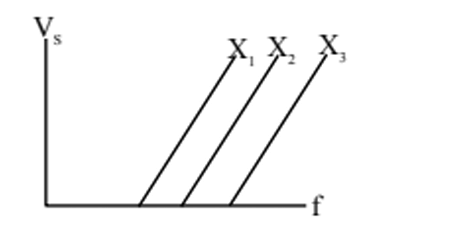
The graph shows stopping potential versus frequency of incident light for three different metals and . Choose the metal which will eject photoelectrons with maximum kinetic energy for a given frequency.
1
2
3
4
can't be predicted
Official Solution
Correct Option: (1)
Concept: According to Einsteinβs photoelectric equation, where = maximum kinetic energy of emitted electrons, = stopping potential, = Planckβs constant, = frequency of incident light, = work function of the metal. The threshold frequency is related to work function as: Thus, For a fixed incident frequency, the metal with the lowest threshold frequency (or lowest work function) will give the maximum kinetic energy. Step 1: Interpret the graph. In a stopping potential vs frequency graph: \begin{itemize} \item All metals have the same slope . \item The intercept on the frequency axis represents the threshold frequency. \end{itemize} Step 2: Identify the smallest threshold frequency. From the graph, the line corresponding to intersects the frequency axis first. Thus, Step 3: Determine which metal gives maximum kinetic energy. Since smaller gives larger . Therefore,
13
PYQ 2026
medium
physicsID: jee-main
Find the ratio of wave number ( ) of the 1st line of Balmer series and Brackett series for Hydrogen-like species.
1
2
3
4
Official Solution
Correct Option: (3)
textbf{Step 1: Formula for wave number.} For a hydrogen-like species, the wave number ( ) for the first line of the Balmer series is given by: where is the Rydberg constant. For the first line of the Brackett series: Step 2: Compute the wave numbers. The ratio of the wave numbers is: Step 3: Simplify the expression. Simplifying the numerator and denominator:
14
PYQ 2026
medium
physicsID: jee-main
A rod of length L is heated from temperature to . Let and the expansion of the rod be . The rod is further heated from to such that . Find the expansion of the rod :
1
2
3
4
Official Solution
Correct Option: (1)
Step 1: Understanding the Concept: Linear expansion depends on the initial length of the rod at the start of the heating process and the change in temperature. When the rod is heated a second time, its "initial" length is the expanded length from the first stage. Step 2: Key Formula or Approach: 1. 2. Step 3: Detailed Explanation: For the first expansion: . The new length at is . For the second expansion (from to ): Given , we rearrange: . The change in temperature is the same. . Since : . Step 4: Final Answer: The expansion is equal to .
15
PYQ 2026
medium
physicsID: jee-main
Electron and proton are accelerated with the same potential to achieve de-Broglie wavelengths of and . Given , find the ratio :
1
37
2
43
3
1/41
4
1/48
Official Solution
Correct Option: (2)
Step 1: Understanding the Concept: The de-Broglie wavelength of a particle accelerated through a potential difference depends on its mass and charge. Since both the electron and proton have the same magnitude of charge ( ), the wavelength depends inversely on the square root of their masses. Step 2: Key Formula or Approach: Since and are constant: Step 3: Detailed Explanation: Let be for the electron and be for the proton. Substitute the given mass relationship : Calculating the square root: Step 4: Final Answer: The ratio is 43.
16
PYQ 2026
medium
physicsID: jee-main
Nuclei and form a nucleus . Binding energy per nucleon for and are and respectively. Find the energy produced in the reaction:
1
2
3
4
Official Solution
Correct Option: (2)
Concept: Energy released in a nuclear reaction equals the difference between the total binding energy of the products and the total binding energy of the reactants. Binding energy of a nucleus: Step 1: Calculate total binding energy of reactants. For nucleus : Since there are two nuclei: For nucleus : Total binding energy of reactants: Step 2: Calculate total binding energy of product. For nucleus : Step 3: Calculate energy released.
17
PYQ 2026
medium
physicsID: jee-main
Find the ratio of momentum of photons of 1\textsuperscript{st and 2\textsuperscript{nd} line of Balmer series of hydrogen atom.}
1
2
3
4
Official Solution
Correct Option: (4)
Concept: Momentum of a photon is given by Hence Using Rydberg formula for hydrogen spectrum For Balmer series . Step 1: First Balmer line .} Step 2: Second Balmer line .} Step 3: Find ratio of momentum.} Final Result
18
PYQ 2026
medium
physicsID: jee-main
Shortest wavelength of Lyman series is . Find the difference of wavelengths of first Balmer and second Balmer line in terms of .
1
2
3
4
Official Solution
Correct Option: (1)
Concept: Rydberg formula for hydrogen spectrum: Shortest wavelength of Lyman series corresponds to transition Thus Step 1: First Balmer line .} Since Step 2: Second Balmer line .} Step 3: Find difference.} Final Result
19
PYQ 2026
medium
physicsID: jee-main
A cube of side is placed at centre of circular coil of radius . Current flowing in coil is . Find magnetic field energy stored in cube. ( )
1
2
3
4
Official Solution
Correct Option: (2)
Concept: Magnetic field at centre of circular loop: Magnetic energy density: Total magnetic energy stored: Step 1: Calculate magnetic field at centre.} Step 2: Find magnetic energy density.} Step 3: Find volume of cube.} Step 4: Calculate total energy stored.} Final Result
20
PYQ 2026
medium
physicsID: jee-main
An electron travelling with velocity in free space enters a medium where its velocity is reduced by . The de-Broglie wavelength of the electron in the medium is , where is the wavelength in free space. Find the value of .
1
2
3
4
Official Solution
Correct Option: (1)
Concept: The de-Broglie wavelength is given by Thus, So wavelength is inversely proportional to velocity. Step 1: Determine new velocity in the medium. Velocity decreases by : Step 2: Use inverse proportionality of wavelength and velocity. Step 3: Find wavelength in the medium. Thus,
21
PYQ 2026
easy
physicsID: jee-main
Consider the nuclear reaction:
Binding energy per nucleon of and are and respectively. Find the energy released in the nuclear reaction.
1
2
3
4
Official Solution
Correct Option: (2)
Concept: The energy released in a nuclear reaction equals the increase in total binding energy. Binding energy of a nucleus is Step 1: {\color{red}Calculate total binding energy of reactants.} Each deuterium nucleus has Number of nucleons Since there are two deuterium nuclei: Step 2: {\color{red}Calculate total binding energy of product.} For : Number of nucleons Step 3: {\color{red}Find energy released in the reaction.} Thus, the energy released in the reaction is
22
PYQ 2026
medium
physicsID: jee-main
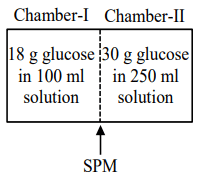
Consider given apparatus
1
Both Statement I and Statement II are correct
2
Statement I is correct but Statement II is incorrect
3
Statement I is incorrect but Statement II is correct
4
Both Statement I and Statement II are incorrect
Official Solution
Correct Option: (3)
Step 1: Understanding Statement-I. In this question, the water movement across the semipermeable membrane (SPM) is based on the principle of osmosis. Osmosis is the movement of water from a region of lower solute concentration to higher solute concentration. In Chamber-I, the concentration of glucose is higher than in Chamber-II. Thus, water will move from Chamber-I to Chamber-II to dilute the solution in Chamber-II. Step 2: Understanding Statement-II. The osmotic pressure formula is given by:
Where:
- is the number of moles of solute,
- is the gas constant,
- is the temperature,
- is the volume of the solution. Here, we have:
- Given osmotic pressure: 0.0107 bar,
- Volume: 100 ml (0.1 L),
- barΒ·L/molΒ·K,
- Temperature: 300 K,
- Mass of K SO : 2.5 mg (0.0025 g),
- Molar mass of K SO is 174.26 g/mol. Now, calculating the number of moles of K SO :
Using the osmotic pressure formula:
This matches the given osmotic pressure, confirming that Statement-II is correct. Step 3: Conclusion. - Statement-I is correct because water moves from a lower to a higher solute concentration.
- Statement-II is incorrect due to an error in the interpretation of the osmotic pressure. Final Answer: Option (C) is correct as Statement I is incorrect but Statement II is correct.
23
PYQ 2026
medium
physicsID: jee-main
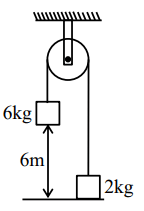
If a 6 kg block is released from rest as shown in the figure, then find the velocity of the 6 kg block just before hitting the ground.
1
6.2 m/sec
2
7.74 m/sec
3
4.7 m/sec
4
3.87 m/sec
Official Solution
Correct Option: (2)
Given the equation: Step 1: Simplifying the expression:
First, expand the terms: Step 2: Combine the terms:
Simplifying the right-hand side: Step 3: Solve for : Step 4: Solve for :
Taking the square root of both sides: Step 5: Final simplification:
Thus, the final value of is:
24
PYQ 2026
medium
physicsID: jee-main
A square loop of side 2 cm makes angle 60Β° with magnetic field . Find maximum induced EMF (in mV) in loop.
1
24
2
36
3
48
4
16
Official Solution
Correct Option: (1)
The induced EMF in a loop is given by Faraday's Law of Induction:
Where is the magnetic flux given by:
Here:
- (time-dependent magnetic field)
- (area of the square loop)
- (angle between the magnetic field and the plane of the loop) Step 1: Calculate the magnetic flux. Since , we get: Step 2: Differentiate the flux to find the induced EMF. Step 3: Find the maximum EMF. The maximum value of is 1, so the maximum EMF is:
Thus, the maximum induced EMF is 24 mV. Final Answer: 24 mV
25
PYQ 2026
medium
physicsID: jee-main
If minimum deviation for an equilateral prism is , then refractive index of the prism is:
1
2
3
2
4
4
Official Solution
Correct Option: (1)
For an equilateral prism, the angle of the prism ( ) is , and the minimum deviation ( ) is . The refractive index ( ) is given by the formula: Substitute the given values: We know that: Substitute these values into the equation: Thus, the refractive index of the prism is . Final Answer: Option (A) .
26
PYQ 2026
medium
physicsID: jee-main
Electric field in space is given by A charge is taken from to . Find magnitude of .
Official Solution
Correct Option: (1)
Concept: Change in potential energy is related to work done by electrostatic field. Work done by electric field Step 1: Compute line integral.} Step 2: Integrate each term.} Thus Step 3: Evaluate between limits.} At At Since Magnitude Final Result
27
PYQ 2026
medium
physicsID: jee-main
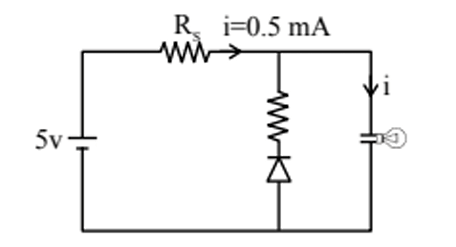
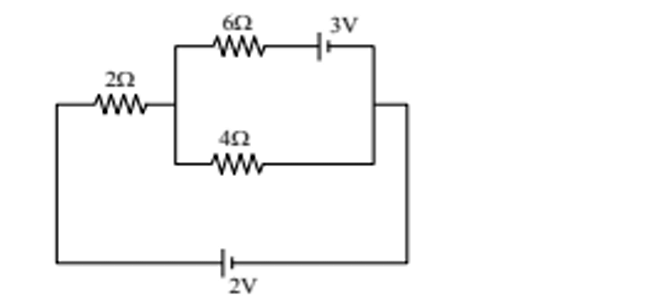
Find minimum so that LED light does not get damaged (power rating of LED is ).
1
2
3
4
Official Solution
Correct Option: (2)
Concept: Power relation: Series resistor limits current through the LED. The remaining voltage appears across the resistor. Step 1: Find voltage across LED.} Given LED power rating Current through LED Step 2: Find voltage across series resistor.} Supply voltage Step 3: Find required resistance.} Final Result
28
PYQ 2026
medium
physicsID: jee-main
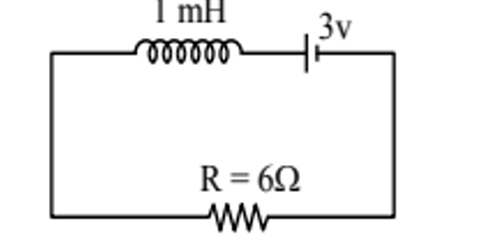
For the given circuit, find the ratio of instantaneous voltage across the inductor when current is and when current is .
1
2
3
4
Official Solution
Correct Option: (2)
Concept: In an circuit, the applied voltage is shared between the resistor and the inductor. where Thus, Step 1: When current .} Voltage across inductor: Step 2: When current .} Voltage across inductor: Step 3: Find the ratio.} Final Result
29
PYQ 2026
medium
physicsID: jee-main
Find heat dissipated in resistance in seconds in the given circuit.
1
2
3
4
Official Solution
Correct Option: (1)
Concept: Heat produced in a resistor is given by Joule's law: To find voltage across , node voltage method is used. Step 1: Apply node voltage equation.} Let node potential be . Multiply by : Step 2: Find voltage across .} Step 3: Calculate heat dissipated.} Final Result
30
PYQ 2026
medium
physicsID: jee-main
Electric field due to a half ring at the center is . Find the charge on the ring. Radius of the ring is .
1
2
3
4
Official Solution
Correct Option: (3)
Concept: For a uniformly charged semicircular ring, the electric field at the center is where
= linear charge density
= radius of the semicircle
Also, since the length of a semicircle is . Step 1: Substitute into the electric field formula.} Step 2: Substitute the given values.} Step 3: Solve for the charge .} Final Result
31
PYQ 2026
medium
physicsID: jee-main
In an AC circuit, supply voltage , , , and source frequency . Find the power factor.
1
2
3
4
Official Solution
Correct Option: (1)
Concept: In an AC circuit containing resistance and inductance (RβL circuit), the power factor is given by where
= Resistance
= Impedance of the circuit
= Inductive reactance
Step 1: Find the impedance of the circuit.} Substituting and : Step 2: Calculate the power factor.} Substituting the values: Final Result
32
PYQ 2026
medium
physicsID: jee-main
Find binding energy of . Given mass of proton and mass of neutron .
1
2
3
4
Official Solution
Correct Option: (1)
Concept: Binding energy: Energy equivalent: Step 1: Substitute values. For : Step 2: Calculate mass defect. Step 3: Calculate binding energy.
33
PYQ 2026
easy
physicsID: jee-main
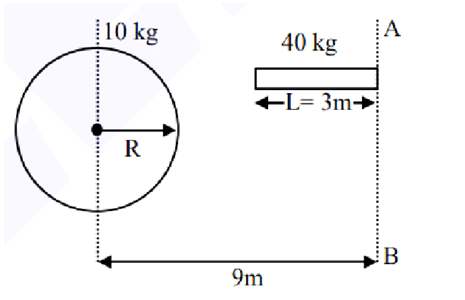
If moment of inertia of rod about axis AB is equal to moment of inertia of solid sphere about an axis parallel to AB which is at 9m from AB axis as shown in the figure. If , then find .
Official Solution
Correct Option: (1)
Step 1: Moment of inertia of the rod about AB.
The moment of inertia of a rod of mass and length about an axis at one end is given by:
For the given rod, and , so the moment of inertia becomes:
Step 2: Moment of inertia of the sphere about the axis.
The moment of inertia of a solid sphere of mass and radius about an axis passing through its center is:
However, the axis is shifted to a distance of 9m from the AB axis, so we apply the parallel axis theorem:
where is the distance between the center of the sphere and the axis. Substituting the values:
Step 3: Equating the two moments of inertia.
Since the moment of inertia of the rod is equal to the moment of inertia of the sphere:
Step 4: Solving for .
Simplifying the equation and solving for , we get:
34
PYQ 2026
medium
physicsID: jee-main
In hydrogen atom an electron jumps from state to . Radius of path of electron in state and are and respectively such that If Rydberg constant , find wavelength of emitted photon (in ). ( and are minimum possible radius.)}
Official Solution
Correct Option: (1)
Concept: For hydrogen atom, Thus Step 1: Find quantum numbers Minimum possible integers: Step 2: Use Rydberg formula Step 3: Find wavelength
35
PYQ 2026
medium
physicsID: jee-main
Work function for an object is 2.3 eV. If maximum kinetic energy of ejected electrons is 0.18 eV, find wavelength of incident photon on object.
1
200 nm
2
500 nm
3
250 nm
4
300 nm
Official Solution
Correct Option: (2)
Step 1: Understanding the photoelectric equation. The energy of a photon is given by the equation: Where:
- is Planck's constant ,
- is the speed of light ,
- is the wavelength of the incident photon. The photoelectric equation is given by: Where:
- The Work Function ,
- The maximum kinetic energy .
Step 2: Finding the total energy of the photon. Substituting the given values into the photoelectric equation:
Step 3: Converting the energy to joules. Since , we convert the photon energy to joules:
Step 4: Finding the wavelength. Now, using the energy-wavelength relation , we solve for : Substituting the known values:
Step 5: Conclusion. Therefore, the wavelength of the incident photon is . Final Answer: 500 nm
36
PYQ 2026
hard
physicsID: jee-main
Consider Bohr's model of a H-atom. If magnetic field at center due to electron in 2 orbit is , and magnetic field due to electron in 4 orbit is . Find .
Official Solution
Correct Option: (1)
Step 1: Expression for magnetic field in Bohr's model.
The magnetic field at the center due to an electron in orbit is given by the formula:
where is the permeability of free space, is the charge of the electron, is the velocity of the electron, and is the radius of the orbit. Step 2: Relationship between radius and orbit number.
The radius of the orbit in Bohr's model is given by:
Step 3: Magnetic field due to electron in orbit .
For the 2nd and 4th orbits, the magnetic field will be:
Step 4: Relationship between and .
From the formula for the radius:
Thus, we have:
Using the relation between the radii, we can find:
Step 5: Final answer.
Thus, the ratio is:
37
PYQ 2026
medium
physicsID: jee-main
Nuclei and form a nucleus . The binding energy per nucleon (BE/N) for , , and are , , and respectively. Find the energy produced in the reaction:
1
2
3
4
Official Solution
Correct Option: (2)
Concept: The energy released in a nuclear reaction equals the increase in the total binding energy of the system. Also, Step 1: Calculate total binding energy of reactants.} For nucleus : Since there are two nuclei of : For nucleus : Total initial binding energy: Step 2: Calculate total binding energy of product nucleus.} For nucleus : Step 3: Find the energy released.}
38
PYQ 2026
easy
physicsID: jee-main
For the given set of measurements, find the relative error.
1
2
3
4
Official Solution
Correct Option: (2)
Concept:
Mean value of measurements: Mean absolute error: Relative error: Step 1: Calculate the mean value. Step 2: Calculate absolute deviations.
Step 3: Mean absolute error. Step 4: Relative error.
39
PYQ 2026
medium
physicsID: jee-main
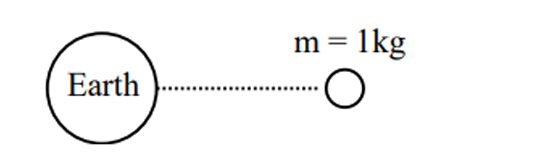
Find speed of 1 kg object when it reaches close to Earth's surface from a long distance after it is released from rest as shown in the diagram. [Given ]
1
12.5 km/s
2
11.2 km/s
3
9.8 km/s
4
2.4 km/s
Official Solution
Correct Option: (2)
Step 1: Understanding the problem. We are asked to find the speed of a 1 kg object when it reaches close to the Earth's surface from a long distance after being released from rest. We can use the concept of conservation of mechanical energy, where the potential energy lost by the object is converted into kinetic energy. Step 2: Applying the conservation of energy. The total mechanical energy at any point in the object's path is conserved. The initial potential energy of the object at a far distance is converted into kinetic energy as the object approaches the Earth's surface. The potential energy at a distance far from Earth is given by: Where:
- is the gravitational constant ( ),
- is the mass of the Earth ( ),
- is the mass of the object ( ),
- is the distance from the center of the Earth. At a large distance, the object is released from rest, so its initial kinetic energy is zero. As it falls towards Earth, its potential energy is converted into kinetic energy. Step 3: Solving for the speed at Earth's surface. When the object reaches close to the Earth's surface, the potential energy becomes: Where is the radius of the Earth ( ). The total energy at the beginning is equal to the total energy at the Earth's surface: Solving for , the speed at the Earth's surface: Substituting the known values: Step 4: Conclusion. Therefore, the speed of the object when it reaches close to Earth's surface is approximately . Final Answer: 11.2 km/s
40
PYQ 2026
medium
physicsID: jee-main
If is the Gravitational constant and is Planck's constant, then the dimension of is:
1
2
3
4
Official Solution
Correct Option: (2)
Step 1: Understand the given constants.
We are given two physical constants:
- is the gravitational constant.
- is Planck's constant. The dimensional formula for each of these constants can be derived from their respective physical equations. Step 2: Gravitational constant .
From Newton's law of gravitation, the formula for gravitational force is:
The dimensions of (force) are , and the dimensions of are (mass), and (distance) is . Rearranging the formula to solve for :
Substitute the dimensions:
Step 3: Planck's constant .
The dimension of Planck's constant is derived from the equation , where is energy and is frequency. The dimension of is , and the dimension of is . Thus, the dimension of is:
Step 4: Combine the dimensions.
Now, using the dimensions of and , we find the dimension of as:
Final Answer:
41
PYQ 2026
medium
physicsID: jee-main
Find of . Given:
1
5.8908729 MeV/A
2
3.0008729 MeV/A
3
4.2506229 MeV/A
4
7.6408729 MeV/A
Official Solution
Correct Option: (4)
Step 1: Use the binding energy per nucleon formula. The binding energy per nucleon is given by: Where:
- (atomic number),
- (mass number),
- (mass of proton),
- (mass of neutron),
- (mass of ),
- .
Step 2: Substituting the values. Substitute the known values into the formula: Simplifying the terms: Thus, the correct answer is close to the value of option (D), 7.6408729 MeV/A. Final Answer: 7.6408729 MeV/A
42
PYQ 2026
medium
physicsID: jee-main
On two metal surfaces, a monochromatic light of was incident. They have ratio of their work function and maximum KE as and . Then and values are respectively (in ).
1
2
3
4
Official Solution
Correct Option: (1)
Incident energy . Photoelectric equation: . (1). (2). Given . Given ratio of KE: . Substitute : . . . . . . .
43
PYQ 2026
medium
physicsID: jee-main
Find de-Broglie wavelength of an oxygen molecule at C. Molar mass of oxygen molecule is g/mole.
1
2
3
4
Official Solution
Correct Option: (1)
Concept: The de-Broglie wavelength of a particle is given by:
For gas molecules at temperature , the rms momentum is:
Hence,
Step 1: Convert given quantities Temperature:
Mass of one oxygen molecule:
Step 2: Substitute values Step 3: Calculate Step 4: Convert to angstrom Step 5: Hence, the de-Broglie wavelength of the oxygen molecule is:
44
PYQ 2026
medium
physicsID: jee-main
Find number of photons emitted per second by a light source of wavelength at power . If is , then find .
Official Solution
Correct Option: (1)
Concept:
Energy of a single photon is given by:
Power of the source represents energy emitted per second:
Hence, number of photons emitted per second:
Step 1: Convert Given Quantities into SI Units
Step 2: Calculate Energy of One Photon
Step 3: Calculate Number of Photons Emitted per Second
Step 4: Express in Required Form
45
PYQ 2026
medium
physicsID: jee-main
If the electric field of EM wave is given by at falls on a photo sensitive material having work function 2.8 eV. Find the maximum kinetic energy (in eV) of ejected electrons.
1
2.52 eV
2
2.16 eV
3
2.00 eV
4
2.34 eV
Official Solution
Correct Option: (2)
Step 1: Use the formula for maximum kinetic energy of photoelectrons. The maximum kinetic energy of ejected electrons is given by the equation: Where is the frequency of the incident EM wave, and is the work function. Step 2: Find the frequency of the incident EM wave. The electric field given in the problem is a combination of two waves with frequencies and . The frequency corresponding to the highest energy will determine the maximum kinetic energy. The frequency is . The energy is given by: Subtracting the work function , we get: Step 3: Conclusion. The maximum kinetic energy of the ejected electrons is , which corresponds to option (2).
46
PYQ 2026
medium
physicsID: jee-main
Which of the following material has bigger Young's modulus?
1
A
2
B
3
C
4
D
Official Solution
Correct Option: (4)
Concept:
Youngβs modulus is defined as: On a strain vs stress graph: Hence, larger Youngβs modulus corresponds to a smaller slope. Step 1: Analyze the given graph. The graph plots: Stress on the -axis Strain on the -axis Thus, the slope of each line is:
Step 2: Compare slopes of lines A, B, C, and D. From the diagram:
Step 3: Relate slope to Youngβs modulus. Since:
The material with the smallest slope has the largest Youngβs modulus.
47
PYQ 2026
medium
physicsID: jee-main
Given below are two statements: Statement (I): The dimensions of Planck's constant and angular momentum are same. Statement (II): In Bohr's model, electrons revolve around the nucleus only in those orbits for which angular momentum is an integral multiple of Planck's constant.
In the light of the above statements, choose the most appropriate answer from the options given below:
1
Both Statement I and Statement II are correct
2
Statement I is incorrect but Statement II is correct
3
Statement I is correct but Statement II is incorrect
4
Both Statement I and Statement II are incorrect
Official Solution
Correct Option: (3)
Concept:
Planckβs constant has the dimensions of action. Angular momentum also has the dimensions of action. In Bohrβs atomic model, angular momentum is quantized. Step 1: Verification of Statement (I). Dimensions of Planckβs constant:
Dimensions of angular momentum:
Since both have identical dimensions, Statement (I) is correct. Step 2: Verification of Statement (II). According to Bohrβs quantization condition:
Thus, angular momentum is an integral multiple of , not . Hence, Statement (II) is incorrect. Step 3: Final conclusion.