Laws Of Thermodynamics
6 previous year questions.
High-Yield Trend
Chapter Questions 6 MCQs
A thermodynamic system is taken from an original state D to an intermediate state E by the linear process shown in the figure. Its volume is then reduced to the original volume from E to F by an isobaric process. The total work done by the gas from D to E to F will be
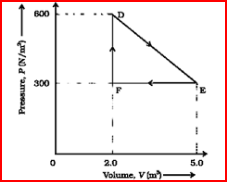
A unit scale is to be prepared whose length does not change with temperature and remains , using a bimetallic strip made of brass and iron each of different length The length of both components would change in such a way that difference between their lengths remains constant If length of brass is and length of iron will be ________
(a) Internal energy will increase
(b) Internal energy will decrease
(c) Work done by system is positive
(d) Work done by system is negative
(e) Internal energy remains constant
If there is no exchange of heat in this process , then identify the gas from the following options (assuming the gases given in the options are ideal gases):
About Laws Of Thermodynamics - JEE-MAIN
Laws Of Thermodynamics is a vital chapter for JEE-MAIN aspirants. Mastering the concepts covered in this chapter is essential for securing a top rank.
By rigorously practicing the previous year questions associated with this chapter, you can identify high-yield topics, understand the examiner's perspective, and boost your confidence during the actual exam.
Frequently Asked Questions
Why focus on Laws Of Thermodynamics PYQs?
Analyzing PYQs for this specific chapter reveals the most frequently tested concepts and the typical complexity of questions, allowing you to tailor your study plan efficiently.
How to best use this analysis?
Review the topic breakdown to see which sub-topics within Laws Of Thermodynamics carry the most weight. Then, tackle the questions iteratively to solidify your understanding.