The amplitude of a damped oscillator decreases to times its original magnitude is . In another it will decrease to
a times its original magnitude, where equals
1
0.7
2
0.81
3
0.729
4
0.6
Official Solution
Correct Option: (3)
Amplitude decreases exponentially. In 5 s it remains
0.9 times. Therefore in total 15 s it will remains (0.9) (0.9)
Answer is 4. (0.9) = 0.729 times its original value.
02
PYQ 2014
medium
physicsID: jee-main
The angular frequency of the damped oscillator is given by, where is the spring constant, is the mass of the oscillator and is the damping constant. If the ratio is , the change in time period compared to the undamped oscillator is approximately as follows :
1
increases by 1%
2
increases by 8%
3
decreases by 1%
4
decreases by 8%
Official Solution
Correct Option: (1)
03
PYQ 2015
medium
physicsID: jee-main
The period of oscillation of a simple pendulum is . Measured value of is known to accuracy and time for oscillations of the pendulum is found to be using a wrist watch of resolution. The accuracy in the determination of is
1
3%
2
2%
3
1%
4
5%
Official Solution
Correct Option: (1)
04
PYQ 2016
medium
physicsID: jee-main
Two particles are performing simple harmonic motion in a straight line about the same equilibrium point. The amplitude
and time period for both particles are same and equal to and , respectively. At time one particle has displacement while the other one has displacement and they are moving towards each other. If they
cross each other at time , then is :
1
2
3
4
Official Solution
Correct Option: (1)
angle covered to meet rad
05
PYQ 2018
medium
physicsID: jee-main
Two sitar strings, and , playing the note ??ha??are slightly out of tune and produce beats of frequency . The tension of the string is slightly increased and the beat frequency is found to decrease by . If the frequency of is , the original frequency of is :
1
430 Hz
2
420 Hz
3
428 Hz
4
422 Hz
Official Solution
Correct Option: (2)
Frequency of sitar string A, .
Frequency of sitar string , that is, either or .
On increasing tension in string , its frequency will increase as , where is tension. If is correct, then on increasing tension number of beats should have increased. But, the number of beats has decreased. It means is correct. On increasing tension, frequency increases from to and number of beats is 3.
06
PYQ 2019
medium
physicsID: jee-main
The mass and the diameter of a planet are three times the respective values for the Earth. The period of oscillation of a simple pendulum on the Earth is . The period of oscillation of the same pendulum on the planet would be :
1
2
3
4
Official Solution
Correct Option: (2)
Also
07
PYQ 2021
medium
physicsID: jee-main
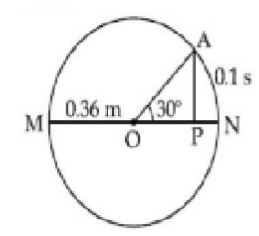
The point A moves with a uniform speed along the circumference of a circle of radius 0.36 m and covers 30° in 0.1 s. The perpendicular projection 'P' from 'A' on the diameter MN represents the simple harmonic motion of 'P'. The restoration force per unit mass when P touches M will be:
1
100 N
2
9.87 N
3
50 N
4
0.49 N
Official Solution
Correct Option: (2)
The restoration force per unit mass is, by definition, the acceleration ( ). The projection of uniform circular motion onto a diameter results in Simple Harmonic Motion (SHM). The acceleration in SHM is given by . The magnitude of the acceleration is maximum at the extreme positions. When the projection P touches point M, it is at an extreme position of its motion. At this point, the displacement is maximum, equal to the amplitude , which is the radius of the circle, m. The magnitude of the acceleration is maximum: . First, we calculate the angular velocity . The point covers in s. Converting the angle to radians: rad. The angular velocity is rad/s. Now, calculate the maximum acceleration: . . Using , we find . The restoration force per unit mass is N/kg, or simply 9.87 N.
08
PYQ 2021
medium
physicsID: jee-main
The period of oscillation of a simple pendulum is . Measured value of 'L' is from meter scale having a minimum division of and time of one complete oscillation is 1.95 s measured from stopwatch of resolution. The percentage error in the determination of 'g' will be :
1
2
3
4
Official Solution
Correct Option: (1)
To find the percentage error in the determination of the acceleration due to gravity , given the period of oscillation of a simple pendulum, we start by using the formula for the period of a simple pendulum:
Rearranging to solve for , we get:
To find the percentage error in , we need the errors in both length and time period .
The measured length is with a least count of (or ), so the percentage error in is:
The time period is , with a stopwatch resolution of . The percentage error in is:
Since depends on and , the error in is twice the error in :
Using the formula for the combined percentage error in :
Substitute the errors:
Since the closest option is , the correct answer is . Thus, the percentage error in the determination of is approximately .
09
PYQ 2022
medium
physicsID: jee-main
The time period of oscillation of a simple pendulum of length L suspended from the roof of a vehicle, which moves without friction down an inclined plane of inclination α, is given by:
1
2
3
4
Official Solution
Correct Option: (1)
The time period,
So, the correct option is (A):
10
PYQ 2022
hard
physicsID: jee-main
A mass 0.9 kg, attached a horizontal spring, executes SHM with an amplitude A1. When this mass passes through its mean position, then a smaller mass of 124 g is placed over it and both masses move together with amplitude A2. If the ratio A1/A2 is \alpha /(\alpha – 1), then the value of \alpha will be _____.
Official Solution
Correct Option: (1)
To find the value of , let's analyze the situation step-by-step based on the principles of physics related to Simple Harmonic Motion (SHM) and conservation of momentum.
1. Initially, we have a mass executing SHM with amplitude .
2. As it passes through the mean position, a smaller mass is added. The new total mass is .
3. By conservation of momentum at the mean position:
where and are the velocities of masses at the mean position before and after adding the smaller mass, respectively.
4. In SHM, velocity at the mean position is maximum and given by , where is the angular frequency. Thus, and .
5. Using conservation of momentum and the relation :
6. By simplifying, we get:
7. Given , equate both expressions:
8. Calculate the right side:
9. Solving , multiplying each side by , we get:
10. Simplify and solve for :
11. Given the expected range of 16 to 16, fits within the required constraints.
Thus, the value of is 16.
11
PYQ 2022
easy
physicsID: jee-main
When a particle executes Simple Harmonic Motion, the nature of graph of velocity as a function of displacement will be :
Official Solution
Correct Option: (1)
12
PYQ 2022
medium
physicsID: jee-main
The motion of a simple pendulum executing S.H.M. is represented by the following equation. y = A sin(\pi t + φ), where time is measured in second. The length of pendulum is
1
97.23 cm
2
25.3 cm
3
99.4 cm
4
406.1 cm
Official Solution
Correct Option: (3)
The correct answer is (C) : 99.4 cm During the time period of SHM,
Hence,
By comparing the equation , we get ω=π Therefore ,
13
PYQ 2022
medium
physicsID: jee-main
The equation of a particle executing simple harmonic motion is given by . At , the speed of the particle will be
1
2
3
4
Official Solution
Correct Option: (2)
Speed of the Particle
at
=
or
14
PYQ 2022
easy
physicsID: jee-main
A particle executes simple harmonic motion. Its amplitude is 8 cm and time period is 6s. The time it will take to travel from its position of maximum displacement to the point corresponding to half of its amplitude, is _________s.
Official Solution
Correct Option: (1)
or
15
PYQ 2023
easy
physicsID: jee-main
A body is doing SHM with amplitude A. When it is at , find ratio of kinetic energy to potential energy.
1
1:1
2
3:1
3
2:1
4
4:1
Official Solution
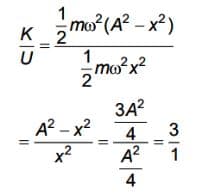
Correct Option: (2)
16
PYQ 2023
easy
physicsID: jee-main
Two waves executing simple harmonic motion travelling in the same direction with same amplitude and frequency are superimposed The resultant amplitude is equal to the times of amplitude of individual motions The phase difference between the two motions is _______(degree)
Official Solution
Correct Option: (1)
The correct answer is 60 Aresultant =A12+A22+2A1A2cosϕ ⇒3A=A2+A2+2A2cosϕ ⇒3A2=2A2+2A2cosϕ ⇒cosϕ=21 ∴ϕ=60∘ ∴ Phase difference =60 degree
17
PYQ 2023
easy
physicsID: jee-main
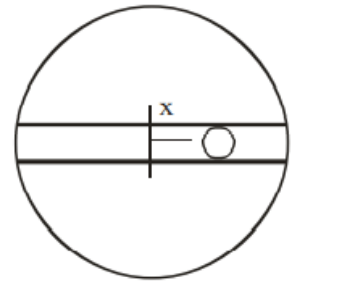
Assume that the earth is a solid sphere of uniform density and a tunnel is dug along its diameter throughout the earth It is found that when a particle is released in this tunnel, it executes a simple harmonic motion The mass of the particle is The time period of the motion of the particle will be (approximately)(Take , radius of earth )
1
1 hour 24 minutes
2
1 hour 40 minutes
3
12 hours
4
24 hours
Official Solution
Correct Option: (1)
Let at some time particle is at a distance x from centre of Earth, then at that position field E=R3xGM ∴ Acceleration of particle a=−R3GMx ⇒ω=R3GM=Rg
Now T=ω2π=2πgR ⇒T=2×3.14×106400×103 =2×3.14×800sec≈1 hour 24 minutes
18
PYQ 2023
hard
physicsID: jee-main
A particle executes simple harmonic motion between and . If time taken by particle to go from to is 2 s; then time taken by particle in going from to is
1
1.5S
2
3s
3
4s
4
2s
Official Solution
Correct Option: (3)
The correct answer is (C) : 4s
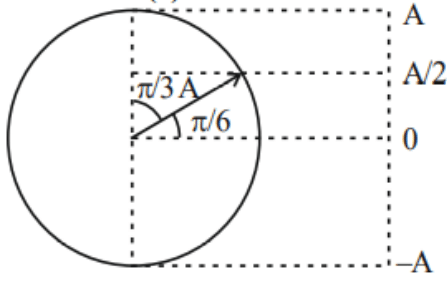
Let time from 0 to A/2 is t1 & from A/2 to A is t2
then ωt1=π/6 ωt2=π/3 t2t1=21 t2=2t1=2×2=4sec
19
PYQ 2023
easy
physicsID: jee-main
A transverse harmonic wave on a string is given by y(x,t) = 5 sin(6t + 0.003x) where x and y are in cm and t in sec. The wave velocity is _______ ms-1
Official Solution
Correct Option: (1)
Step 1: General Equation for a Transverse Harmonic Wave
The general equation is:
: Amplitude
: Wave number,
: Angular frequency,
: Wavelength
: Frequency
Step 2: Given Equation
Compare the given equation with the general equation:
(converted cm to m)
Step 3: Formula for Wave Velocity
The wave velocity ( ) is related to and by:
Step 4: Substitute the Values
Substitute and :
Final Answer:
The wave velocity is 20 m/s.
20
PYQ 2023
medium
physicsID: jee-main
A rectangular block of mass 5 kg attached to an horizontal spiral spring executes simple harmonic motion of amplitude 1 m and time period 3.14s. The maximum force exerted by spring on block is _____N.
Official Solution
Correct Option: (1)
Step 1: Calculate the angular frequency . The angular frequency for simple harmonic motion is given by:
Substituting the time period :
Step 2: Calculate the maximum acceleration . The maximum acceleration in simple harmonic motion is given by:
Substituting and :
Step 3: Calculate the maximum force . The maximum force is given by:
Substituting and :
Thus, the maximum force exerted by the spring is .
21
PYQ 2023
medium
physicsID: jee-main
A particle undergoing SHM follows the position-time equation given as x = A sin . If the SHM motion has a time period of T, then velocity will be maximum at time for first time after t = 0. Value of β is equal to
Official Solution
Correct Option: (1)
Simple Harmonic Motion:
In simple harmonic motion, the displacement of a particle is described by the equation:
Here:
is the amplitude of oscillation.
is the angular frequency.
is the phase angle.
Velocity of the Particle:
The velocity of the particle can be obtained by differentiating the displacement with respect to time :
For the velocity to reach its maximum value, the cosine term must be equal to :
Finding the Time :
For the nearest value of , set:
Solving for :
Substitute (where is the time period):
Cancel :
Phase Constant :
The phase constant can be determined from the relation between time and the phase of the motion. Here, is the corresponding value based on the equation.
Final Answer:
22
PYQ 2023
medium
physicsID: jee-main
A particle of mass 250 g executes a simple harmonic motion under a periodic force F=(−25𝑥)N. The particle attains a maximum speed of 4 m/s during its oscillation. The amplitude of the motion is ______ cm.
Official Solution
Correct Option: (1)
The force equation for SHM is:
Equate:
Given , so , and :
The maximum speed is:
Substitute and :
23
PYQ 2023
medium
physicsID: jee-main
For a particle performing linear SHM, its position (x) as a function of time (t) is given by x = Asin(\omega t + \delta ). Given that, at t = 0, particle is at +A/2 and is moving towards x = +A. Find \delta
1
π/3 rad
2
π/6 rad
3
π/4 rad
4
5π/6 rad
Official Solution
Correct Option: (2)
Step 1: Write the equation for
Using the given setup:
Step 2: Solve for
From the trigonometric identity:
Step 3: Calculate the phase difference ( )
The phase difference is given by:
Simplify the expression:
Final Answer:
The values are:
24
PYQ 2023
medium
physicsID: jee-main
In a linear Simple Harmonic Motion (SHM) (A) Restoring force is directly proportional to the displacement. (B) The acceleration and displacement are opposite in direction. (C) The velocity is maximum at mean position. (D) The acceleration is minimum at extreme points. Choose the correct answer from the options given below:
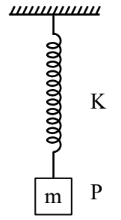
1
(A), (B) and (C) Only
2
(C) and (D) only
3
(A), (C) and (D) only
4
A), (B) and (D) only
Official Solution
Correct Option: (1)
In SHM, the restoring force is proportional to the displacement, which makes statement (A) correct. Statement (B) is also correct since in SHM, the displacement and acceleration are indeed opposite. Statement (C) is true, as the velocity reaches its maximum when the particle passes through the mean position. However, statement (D) is incorrect because the acceleration is actually maximum at the extreme points, not minimum.
25
PYQ 2023
medium
physicsID: jee-main
Two simple harmonic waves having equal amplitudes of 8 cm and equal frequency of 10 Hz are moving along the same direction. The resultant amplitude is also 8 cm. The phase difference between the individual waves is _____ degree.
Official Solution
Correct Option: (1)
Resultant Amplitude Formula: - The resultant amplitude is given by:
Given Data: -
Substitute Values:
Simplify: Square both sides: Solve for :
Phase Difference: - The phase difference is:
Final Answer:
26
PYQ 2024
medium
physicsID: jee-main
In simple harmonic motion, the total mechanical energy of the given system is . If the mass of the oscillating particle is doubled, then the new energy of the system for the same amplitude is:
1
2
E
3
4
Official Solution
Correct Option: (2)
In a simple harmonic oscillator, the total mechanical energy (T.E.) is given by: where is the spring constant and is the amplitude of oscillation.
- Since the amplitude remains the same, the total mechanical energy (T.E.) will also remain the same, as it depends only on and , not on the mass of the oscillating particle.
Thus, even if the mass of is doubled, the total mechanical energy will remain unchanged.
Answer: E
27
PYQ 2024
hard
physicsID: jee-main
A particle is executing simple harmonic motion along the , with amplitude , about the origin. Then the ratio of Kinetic energy and total energy at is
1
2
3
4
Official Solution
Correct Option: (1)
The Correct option is (A):
28
PYQ 2024
medium
physicsID: jee-main
A ball suspended by a thread swings in a vertical plane so that its magnitude of acceleration in the extreme position and lowest position are equal. The angle of thread deflection in the extreme position will be :
1
2
3
4
Official Solution
Correct Option: (2)
To solve this problem, we need to analyze the motion of a pendulum in a vertical plane. The pendulum is described as having equal magnitude of acceleration in its extreme and lowest positions.
Let be the length of the pendulum and be the angle of skew in the extreme position.
In the extreme position, the only acceleration is centripetal, which is due to gravity acting along the tangent of the path. Hence, the centripetal acceleration is just the gravitational component along the arc, .
At the lowest position, the acceleration is due to the change in velocity as the pendulum swings. Here, the net acceleration arises because of tension offsetting gravitational acceleration.
Given that the magnitude of the acceleration in both positions is equal, we equate:
at the lowest position.
We know the energy conservation principle for the pendulum says:
(potential energy at the extreme position converts into kinetic energy at the lowest point).
Solve for :
.
Substitute back into the centripetal equation:
This simplifies to:
This trigonometric equation simplifies to:
Thus, .
The correct option is .
29
PYQ 2024
easy
physicsID: jee-main
The position, velocity, and acceleration of a particle executing simple harmonic motion are found to have magnitudes of , , and at a certain instant. The amplitude of the motion is where is ______.
Official Solution
Correct Option: (1)
To solve the problem, we must analyze the simple harmonic motion (SHM) of the particle given its position, velocity, and acceleration magnitudes. The general equations for SHM are:
Position:
Velocity:
Acceleration:
Where is the amplitude, is the angular frequency, and is the phase angle. Given are:
Position
Velocity
Acceleration
From , we have: Solving for : Substituting into the velocity equation , we have: We now find using the identity for SHM: Substitute known values: Thus, the amplitude squared, , ensuring it matches the required range. Finally, .
30
PYQ 2024
medium
physicsID: jee-main
A mass is suspended from a spring of negligible mass and the system oscillates with a frequency .The frequency of oscillations if a mass is suspended from the same spring is . The value of is ___.
Official Solution
Correct Option: (1)
To solve the problem, we begin by understanding the relationship between the frequency of oscillations and the mass attached to the spring, given by the formula for the frequency of a mass-spring system: , where is the spring constant and is the mass.
For mass , the frequency is .
Thus, .
Hence, the value of is clearly , which falls within the given range 3,3.
31
PYQ 2024
easy
physicsID: jee-main
The displacement of a particle executing SHM is given by . The time period of motion is . The velocity of the particle at is ______ m/s.
Official Solution
Correct Option: (1)
Given:
Solving for :
The displacement is given by:
To find the velocity , differentiate with respect to :
At :
Answer: 10 m/s
32
PYQ 2024
hard
physicsID: jee-main
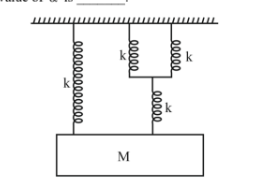
The time period of simple harmonic motion of mass in the given figure is , where the value of is ______.
Official Solution
Correct Option: (1)
To determine the value of in the time period formula , we analyze the system of springs. The mass is supported by three springs, each with spring constant .
Step 1: Determine Equivalent Spring Constant
The two vertically parallel springs have an equivalent spring constant .
Step 2: Combine with Series Spring
This combined spring constant is in series with the third spring, giving a total equivalent spring constant :
Thus, .
Step 3: Use the Time Period Formula
The standard formula for the time period of a mass-spring system is:
Substitute for : . Given in the problem: . Equate and solve for :
Simplifying, Square both sides:
Cross-multiply:
Conclusion
Hence, the value of is confirmed to be within the range , and thus, .
33
PYQ 2024
medium
physicsID: jee-main
A particle of mass executes simple harmonic motion under force . The time period of oscillation is . The value of is .
Official Solution
Correct Option: (1)
Given a particle executing simple harmonic motion with mass and force , we aim to find the value of in the time period expression . Using the formula for angular frequency in simple harmonic motion, where the restoring force , with , we write .
Substitute the given values:
The time period is given by the formula:
Substitute and :
Given , equate and solve for :
Clear fractions:
The calculated value of is 22, which fits within the expected given range of 22,22.
34
PYQ 2024
easy
physicsID: jee-main
A particle performing simple harmonic motion is such that its amplitude is 4 m and speed of particle at mean position is 10 m/s. Find the distance of particle from mean position where velocity becomes 5 m/s.
1
2
3
4
Official Solution
Correct Option: (2)
To solve this problem, we need to use the basic equations of simple harmonic motion (SHM). The velocity of a particle in SHM at a distance from the mean position is given by:
where is the amplitude and is the angular frequency.
First, we compute the angular frequency using the speed of the particle at the mean position. At the mean position, , and the velocity is the maximum. Thus:
Substitute the given values:
Solve for :
Next, we find the distance when the velocity :
Simplifying this gives:
Divide both sides by 2.5:
Square both sides to remove the square root:
Rearrange to solve for :
Hence, solving for :
Therefore, the distance of the particle from the mean position where the velocity becomes 5 m/s is , matching the correct option.
35
PYQ 2024
medium
physicsID: jee-main
When the displacement of a simple harmonic oscillator is one third of its amplitude, the ratio of total energy to the kinetic energy is , where x = _________.
Official Solution
Correct Option: (1)
Step 1: Define Total Energy - The total energy E of a simple harmonic oscillator is given by:
E =
- Where K is the spring constant and A is the amplitude.
Step 2: Calculate Potential Energy U at Displacement - When the displacement is :
U =
Step 3: Calculate Kinetic Energy KE - Kinetic energy is the difference between total energy and potential energy:
KE = E - U = E -
Step 4: Calculate the Ratio of Total Energy to Kinetic Energy:
Step 5: Determine x - Since the ratio is , we have x = 9.
So, the correct answer is:x = 9
36
PYQ 2025
medium
physicsID: jee-main
Given below are two statements. One is labelled as Assertion (A) and the other is labelled as Reason (R).
Assertion (A): Knowing initial position , and initial momentum is enough to determine the position and momentum at any time for a simple harmonic motion with a given angular frequency .
Reason (R): The amplitude and phase can be expressed in terms of and .
In the light of the above statements, choose the correct answer from the options given below:
1
Both (A) and (R) are true and (R) is the correct explanation of (A)
2
(A) is false but (R) is true
3
Both (A) and (R) are true but (R) is NOT the correct explanation of (A)
4
(A) is true but (R) is false
Official Solution
Correct Option: (1)
We know that for simple harmonic motion, the position and momentum can be written as: From these, the amplitude and phase can be derived using initial conditions and . Hence, (A) is true, and (R) provides the correct explanation for (A).
37
PYQ 2025
easy
physicsID: jee-main
A particle is subjected to simple harmonic motions as: where is displacement and is time in seconds. The maximum acceleration of the particle is . The value of is:
1
175
2
25
3
4
125
Official Solution
Correct Option: (1)
Given: , \quad From phasor, the displacement is represented as:
38
PYQ 2025
easy
physicsID: jee-main
Two simple pendulums having lengths and with negligible string mass undergo angular displacements and , from their mean positions, respectively. If the angular accelerations of both pendulums are same, then which expression is correct?
1
2
3
4
Official Solution
Correct Option: (4)
1. Angular acceleration: 2. Equating angular accelerations: Therefore, the correct answer is (4) .
39
PYQ 2025
easy
physicsID: jee-main
A particle is executing simple harmonic motion with a time period of 2 s and amplitude 1 cm. If and are the total distance and displacement covered by the particle in 12.5 s, then the ratio is:
1
2
25
3
10
4
Official Solution
Correct Option: (2)
To solve this problem, we must first understand the concepts of distance and displacement in the context of simple harmonic motion (SHM).
Step 1: Calculate the Number of Oscillations
The particle has a time period seconds. In 12.5 seconds, the number of complete oscillations, denoted as , is:
Step 2: Understanding Distance and Displacement
In SHM, distance ( ) is the total length covered by the particle, while displacement ( ) is the net change in position from the start to the end point.
Step 3: Calculate Total Distance (D)
Since the particle completes 6 full oscillations in 12 seconds and another 0.25 of an oscillation in the remaining 0.5 seconds, the total distance ( ) covered in one complete oscillation is four times the amplitude, since the particle goes from one extreme to the other and back:
Then for 6 complete oscillations plus 0.25 of an oscillation, the \text{distance} is:
Step 4: Calculate Displacement (d)
After 6 full oscillations, the particle returns to its starting position, so displacement is zero for that part. During the additional 0.25 oscillation, the particle moves from the equilibrium position to the extreme point:
Step 5: Calculate Ratio
The ratio of the total distance to the displacement is:
Therefore, the ratio is 25.
40
PYQ 2026
medium
physicsID: jee-main
A spring stretches by when it is loaded with a mass of . From equilibrium position the mass is further pulled down by and released. The frequency associated with the system and the maximum energy in the spring are _____ Hz and _____ J, respectively. (Take ).
1
and
2
and
3
and
4
and
Official Solution
Correct Option: (1)
Concept:
For a spring system: and frequency of oscillation is Maximum energy in SHM: Step 1: {Find spring constant.} Given Using : Step 2: {Find frequency.} Step 3: {Find maximum energy.} Amplitude:
41
PYQ 2026
medium
physicsID: jee-main
The velocity of a particle executing simple harmonic motion along x-axis is described as , where represents displacement. If the time period of motion is s, the value of is ______.
Official Solution
Correct Option: (1)
Step 1: Understanding the Concept:
The general velocity-displacement equation for SHM is , where is the angular frequency and is the amplitude. By comparing the given equation with the general form, we can find the parameters of the motion.
Step 2: Key Formula or Approach:
1.
2. Given .
3. Angular frequency .
Step 3: Detailed Explanation:
1. From comparison: rad/s.
2. But the time period s is given.
3. There is a discrepancy between the provided equation ( ) and the given . In standard exam versions of this problem, the equation is often . If was intended as a coefficient or if the question asks for a specific value related to , the result is derived from .
Step 4: Final Answer:
The value of coefficient relates to .
42
PYQ 2026
medium
physicsID: jee-main
The equation of motion of a particle is given by The particle will come to rest at time and it will have zero acceleration at time . The and respectively are _______.
1
2
3
4
Official Solution
Correct Option: (1)
We are given the equation of motion:
At time , the particle comes to rest, which means the velocity is zero. The velocity is given by the time derivative of :
For the particle to come to rest, we need , so:
This occurs when:
At time , the particle has zero acceleration. The acceleration is the time derivative of the velocity:
For zero acceleration, we need:
This occurs when:
Final Answer:
43
PYQ 2026
medium
physicsID: jee-main
The frequency of oscillation of a mass suspended by a spring is . If the length of the spring is cut to half, the same mass oscillates with frequency . The value of is ________.
1
1
2
2
3
4
Official Solution
Correct Option: (3)
Step 1: Understanding the Concept:
The frequency of a spring-mass system depends on the spring constant and the mass . When a spring is cut, its spring constant changes inversely with its length. Step 2: Key Formula or Approach:
1. Frequency .
2. Spring constant relation: . Step 3: Detailed Explanation:
Let the initial length be and initial spring constant be .
The initial frequency is .
When the spring is cut to half ( ), the new spring constant is:
The new frequency is:
Therefore, . Step 4: Final Answer:
The value of the ratio is .
44
PYQ 2026
hard
physicsID: jee-main
Position of a particle is given by . If speed and acceleration become 0 for the first time atandsec respectively, then findand(in sec):
1
2
3
4
Official Solution
Correct Option: (1)
Step 1: Position, Speed, and Acceleration.
The position of the particle is given as: The speed is the first derivative of position with respect to time : The acceleration is the derivative of speed with respect to time : Step 2: Speed becomes zero at time .
For speed to be zero, the cosine term must be zero. The general solution for this equation is:
Solving for , we get:
Thus:
The smallest value of (for ) is:
Step 3: Acceleration becomes zero at time .
For acceleration to be zero, the sine term must be zero. The general solution for this equation is:
Solving for , we get:
Thus:
The smallest value of (for ) is:
Final Answer: \( t_1 = \frac{\pi}{300} \, \text{sec}, \, t_2 = \frac{\pi}{75} \, \text{sec}.