Three blocks and are lying on a smooth horizontal surface, as shown in the figure. and have equal masses, while has mass . Block is given an brutal speed towards due to which it collides with perfectly inelastically. The combined mass collides with , also perfectly inelastically th of the initial kinetic energy is lost in whole process. What is value of ?
1
4
2
5
3
3
4
2
Official Solution
Correct Option: (1)
From linear momentum conservation
02
PYQ 2019
medium
physicsID: jee-main
Two particles, of masses and , moving, as shown, with speeds of and , collide elastically at the origin. After the collision, they move along the indicated directions with speeds and , respectively. The values of and are nearly :
1
3.2 m/s and 6.3 m/s
2
3.2 m/s and 12.6 m/s
3
6.5 m/s and 6.3 m/s
4
6.5 m/s and 3.2 m/s
Official Solution
Correct Option: (3)
Solving
03
PYQ 2021
medium
physicsID: jee-main
A body of mass M moving at speed collides elastically with a mass 'm' at rest. After the collision, the two masses move at angles and with respect to the initial direction of motion of the body of mass M. The largest possible value of the ratio M/m, for which the angles and will be equal, is :
1
2
2
3
3
1
4
4
Official Solution
Correct Option: (2)
Step 1: Understanding the Concept: In an elastic collision, both momentum and kinetic energy are conserved. If the scattering angles are equal ( ), we can use conservation laws to find the constraints on the mass ratio. Step 2: Key Formula or Approach: Conservation of momentum (x and y directions):
Step 3: Detailed Explanation: Substitute into the x-momentum equation:
Conservation of Energy:
Divide by :
Since the maximum value of is 1:
Step 4: Final Answer: The largest possible value of the ratio M/m is 3.
04
PYQ 2022
hard
physicsID: jee-main
A uniform heavy rod of mass kg, cross sectional area and length is hanging from a fixed support. Neglecting the lateral contraction, the elongation in the rod due to its own weight is . The value of is _____(Given Young’s modulus and g =
Official Solution
Correct Option: (1)
=
=
=
=
=
05
PYQ 2023
medium
physicsID: jee-main
Choose the option showing the correct relation between Poisson’s ratio (\sigma ), Bulk modulus (B) and modulus of rigidity (G).
1
2
3
4
Official Solution
Correct Option: (1)
Derivation of Poisson's Ratio (σ)
Given Equations:
1. ……(1) 2. ……(2)
Equating the Two Expressions for :
From (1) and (2), we equate :
Rearranging the Equation:
Expanding both sides: Collecting terms involving and constants:
Solving for :
Divide through by :
Final Answer:
The Poisson's ratio is:
Thus, the correct answer is (A).
06
PYQ 2025
hard
physicsID: jee-main
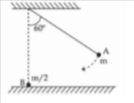
As shown below, bob A of a pendulum having a massless string of length is released from 60° to the vertical. It hits another bob B of half the mass that is at rest on a frictionless table in the center. Assuming elastic collision, the magnitude of the velocity of bob A after the collision will be (take as acceleration due to gravity):
1
2
3
4
Official Solution
Correct Option: (3)
Velocity of just before hitting:
The velocity of just before it hits is given by:
Just after collision: Let the velocities of and just after the collision be and , respectively.
By Conservation of Momentum (COM): The total momentum before and after the collision must be conserved. Thus:
Simplifying:
Using the Coefficient of Restitution ( ): The coefficient of restitution is given as . By definition:
Substituting :
Solving Equations (i) and (ii): From equation (ii):
Substitute into equation (i):
Simplify:
Substitute :
Final Answer: The velocity of just after the collision is:
07
PYQ 2025
medium
physicsID: jee-main
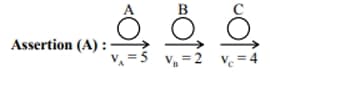
Given below are two statements, one is labelled as Assertion (A) and the other is labelled as Reason (R).
Three identical spheres of the same mass undergo one-dimensional motion as shown in the figure with initial velocities . If we wait sufficiently long for elastic collision to happen, then will be the final velocities. Reason (R): In an elastic collision between identical masses, two objects exchange their velocities. In light of the above statements, choose the correct answer from the options given below:
1
Both (A) and (R) are true but (R) is NOT the correct explanation of (A)
2
(A) is true but (R) is false
3
Both (A) and (R) are true and (R) is the correct explanation of (A)
4
(A) is false but (R) is true
Official Solution
Correct Option: (4)
Step 1: In an elastic collision for the same mass, the velocities of the objects interchange. Before the collision:
After the collision:
Step 2: The assertion states that after a sufficiently long time, the velocities will be . This holds true as per the elastic collision property, where velocities exchange.
Step 3: The reason also holds true, as in an elastic collision between identical masses, the velocities of the objects do indeed exchange. However, the assertion describes a situation where the objects have reached final velocities after sufficient time. Therefore, the reason is not the correct explanation for the assertion, which is why option (4) is correct.