Units Dimensions And Measurements
44 previous year questions.
High-Yield Trend
Chapter Questions 44 MCQs
Match List - I with List - II : 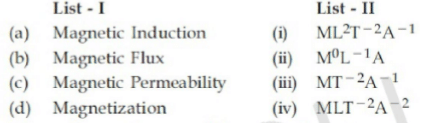
Choose the most appropriate answer from the options given below :
List - I: (a) h (Planck's constant), (b) E (kinetic energy), (c) V (electric potential), (d) P (linear momentum)
List - II: (i) [M L T ], (ii) [M L T ], (iii) [M L T ], (iv) [M L T I ]
Choose the correct answer from the options given below :
Where t = time, h = height, s = surface tension, = angle, = density, a, r = radius, g = acceleration due to gravity, v = volume, p = pressure, W = work done, = torque, = permittivity, E = electric field, J = current density, L = length.
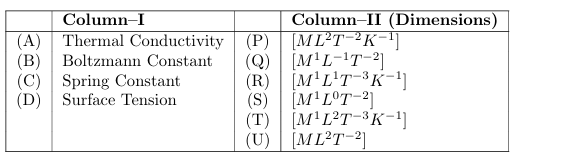
Match List - I with List - II 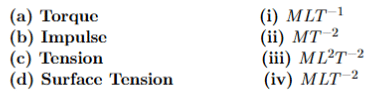
Choose the most appropriate answer from the option given below :
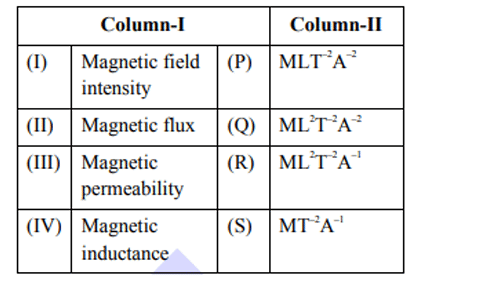
Match List - I with List - II. 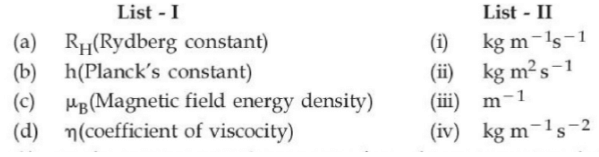
Choose the most appropriate answer from the options given below :
Student A and Student B used two screw gauges of equal pitch and 100 equal circular divisions to measure the radius of a given wire. The actual value of the radius of the wire is 0.322 cm. The absolute value of the difference between the final circular scale readings observed by the students A and B is __________.
Figure shows position of reference '0' when jaws of screw gauge are closed
Given pitch = 0.1 cm. 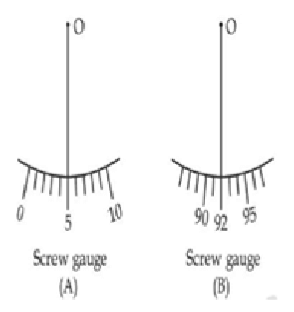
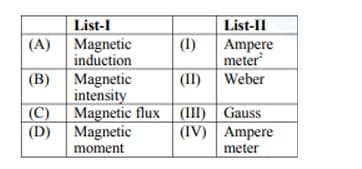
Match List I with List II. 
Choose the correct answer from the options given below:
Statements 1: Astronomical unit (AU), Parsec (pc) and Light year (ly) are units for measuring astronomical distances.
Statement 2: The light of the above distances, choose the most appropriate answer from the options given below:
[width=0.3](6).png
Calculate activation energy (E )
N/m and
N/m.
If they are connected in parallel, the percentage error in the equivalent spring constant is:
About Units Dimensions And Measurements - JEE-MAIN
Units Dimensions And Measurements is a vital chapter for JEE-MAIN aspirants. Mastering the concepts covered in this chapter is essential for securing a top rank.
By rigorously practicing the previous year questions associated with this chapter, you can identify high-yield topics, understand the examiner's perspective, and boost your confidence during the actual exam.
Frequently Asked Questions
Why focus on Units Dimensions And Measurements PYQs?
Analyzing PYQs for this specific chapter reveals the most frequently tested concepts and the typical complexity of questions, allowing you to tailor your study plan efficiently.
How to best use this analysis?
Review the topic breakdown to see which sub-topics within Units Dimensions And Measurements carry the most weight. Then, tackle the questions iteratively to solidify your understanding.